
You're standing at the kitchen window in Colorado Springs, looking toward Pikes Peak, but the view is broken by streaks, pollen, and water spots. You've tried the spray bottle and paper towels, yet the glass still looks cloudy when the high-altitude sun hits it. That's when professional window cleaning in Colorado Springs, CO becomes more than a cosmetic chore. The right crew can clean the glass, screens, sills, and tracks, reach difficult panes safely, and help you prevent buildup that becomes harder to remove later.
Whether you're searching for window cleaning near me, residential window washing, or dependable commercial service, local conditions matter. Hard-water deposits, seasonal debris, construction dust, and intense sun exposure all affect how a crew should approach the job. The most useful service is consistent, careful, and matched to the property, not just the lowest quote.
What Professional Window Washers Do in Colorado Springs
A homeowner may call for “window washing” because the outside glass looks dirty. Once the crew arrives, the full scope often becomes clear. Exterior panes may carry mineral film, interior glass may show fingerprints and cooking residue, and screens can hold pollen that blows back onto clean windows. Second-story dormers, skylights, French panes, and windows above decks create access problems a household squeegee cannot solve easily.
Professional window washers clean the glass, then inspect the parts around it. A thorough residential visit can include interior and exterior window cleaning, screen removal and washing, sill wiping, and track detailing. A technician may also identify moisture between panes, failing seals, oxidized frames, damaged weatherstripping, or mineral-etched glass. Cleaning improves appearance, but it cannot reverse every form of damage.
The first visit is often different
A neglected window needs more preparation than one maintained on a regular schedule. Dust and pollen may require a careful pre-rinse. Mineral residue may need a specialty treatment instead of repeated squeegee passes. Construction grit requires particular care because loose particles must be removed before tools move across the glass.
The first cleaning often centers on restoring a safe, workable surface. After that, recurring maintenance becomes easier because the crew removes fresh debris before it bonds to the pane.
Practical rule: A maintenance plan protects consistency. It isn't just a discount for repeating the same one-time cleaning.
Recurring service is the real maintenance advantage
Colorado Springs properties benefit from planned exterior cleaning because pollen, roof runoff, sprinkler overspray, and windblown dust return with the seasons. A recurring agreement changes the question from “How much for this visit?” to “What schedule keeps this property presentable and easier to maintain?”
That model works for homeowners, HOAs, property managers, and businesses with multiple buildings. Market coverage identifies growing interest in recurring window-cleaning agreements and bundled facility services, making reliability, accountability, and total maintenance effort more important than comparing one price alone (market outlook for window cleaning services). In practice, a dependable schedule can reduce missed service windows and simplify vendor coordination.
Colorado's high-altitude sun also makes residue and streaks stand out quickly. A crew that records access details, problem panes, and the recommended service interval gives the next visit a clear starting point. That continuity is where recurring service earns its value.
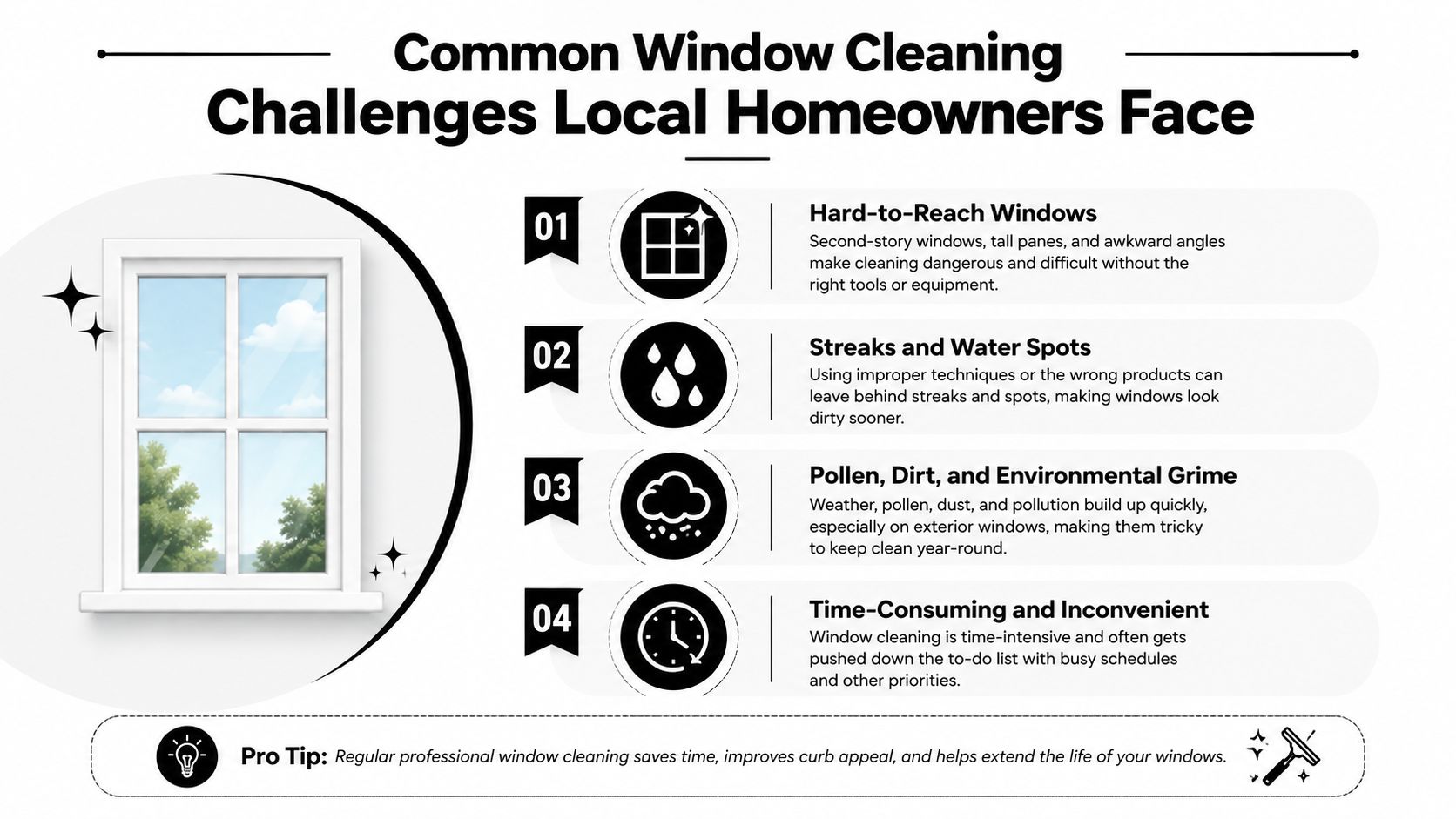
Common Window Cleaning Challenges Local Homeowners Face
After a Colorado Springs storm or a dry, windy week, clean windows can become hazy again quickly. The cause is usually specific: mineral deposits, seasonal pollen, construction grit, or access that makes safe cleaning difficult.
Hard-water spots
Sprinkler overspray and roof runoff leave minerals on exterior glass. South- and west-facing panes show the marks quickly because high-altitude sun makes each spot more visible and dries deposits firmly onto the surface. Household cleaner may remove loose dirt while leaving the mineral film behind.
Professional crews often use purified water for routine rinsing, then apply a glass-safe treatment when deposits need extra work. If the haze changes while the pane is wet, it may be surface staining. If it looks the same wet and dry, the glass may be etched and require polishing or replacement rather than ordinary cleaning, as explained in this hard-water stain removal guide.
Pollen and seasonal film
Cottonwood and elm pollen settle on screens, frames, and glass. Morning moisture turns loose dust into a sticky coating, so a dry cloth can spread it across the pane. Controlled rinsing, microfiber detailing, and suitable tools around seals remove the film more effectively.
Seasonal debris is one reason a planned maintenance interval works better than waiting for the glass to look neglected.
Construction grit and red dirt
New construction and exposed soil can put fine red dirt, stucco particles, and grit on windows. Scrubbing before rinsing may drag abrasive material across the glass. The safer sequence is to loosen and rinse the debris first, then use lubricated tools and careful edge detailing.
Difficult or unsafe access
Second-story windows above sloped landscaping, decks, and retaining walls require an access plan. A water-fed pole often reaches upper exterior glass while the operator stays on the ground. Where a pole is unsuitable, the crew should explain its method instead of improvising with an unstable ladder.
Busy service businesses also need clear scheduling and customer communication. A tool such as customer inquiry automation can organize incoming requests, but it cannot replace an on-site assessment or safe work practices.
Residential vs Commercial Window Washing Services
A home and a storefront may both need streak-free glass, but the work is organized around different priorities. Residential window cleaning is usually detail-oriented and coordinated directly with the homeowner. Commercial window cleaning is more often driven by access, operating hours, tenant needs, and a repeat service schedule.
| Factor | Residential | Commercial |
|---|---|---|
| Primary focus | Glass, screens, tracks, sills, and homeowner preferences | Glass coverage, access planning, appearance, and minimal business disruption |
| Typical equipment | Squeegees, scrubbers, extension tools, water-fed poles, ladders where appropriate | Water-fed systems, ladders, lifts, and specialized high-access equipment |
| Scheduling | Seasonal or maintenance visits arranged around the household | Recurring visits arranged around opening hours, tenants, and site operations |
| Pricing approach | Per pane, per window, or flat residential rate | Scope-based, glass-area, access, and contract pricing |
| Safety needs | Safe ladder placement and ground-level alternatives | Formal fall protection, lift procedures, and high-access planning |
A residential crew may arrive in an unmarked van, walk the property with the owner, remove screens, and discuss which interior panes need attention. The visit may include a kitchen bay window, French panes, skylights, and second-story glass. The homeowner usually wants careful edge work and a clean finish without disrupting the household.
Commercial work can look very different. A downtown storefront may need service before opening, while an office building may require a lift or a rope descent system. Post-construction work often includes sticker removal, tape stripping, mineral treatment, and careful scraping. Those tasks require more than routine maintenance cleaning.
Choosing the right commercial credentials
For commercial properties, ask whether the crew is trained for the access equipment the site requires. High-rise and commercial work should be planned around recognized safety practices, including ANSI/IWCA I-14.1, which applies to commercial window cleaning operations and high-rise work above 25 feet (industry window-cleaning safety standards).
A small shop may need simple recurring storefront service. A multi-story office, dealership, grocery store, restaurant, or retail property needs a written access and safety plan, clear scheduling, and a crew prepared to work around customers and employees.
How Professional Window Cleaning Works From Start to Finish
A good service call begins before anyone wets the glass. The crew walks the property, identifies fragile panes and difficult access points, and confirms whether the quote includes screens, tracks, sills, skylights, and interior work.

Inspection and preparation
Technicians typically remove screens before cleaning the glass. They can then vacuum or brush loose debris from tracks and sills, where grit tends to collect. This preparation keeps dirt from washing back onto the pane and gives the crew a chance to notice cracked glass, failed seals, or damaged frames.
Interior panes are commonly cleaned with a scrubber and squeegee. The operator applies a controlled cleaning solution, loosens the soil, removes the water with overlapping passes, and details the edges with a microfiber cloth. This traditional method gives the technician close control around trim, furniture, and delicate interior surfaces.
Water-fed pole cleaning
For upper-story exterior panes, crews may use a water-fed pole connected to a purification system. The brush loosens dirt while purified water carries residue away, allowing the glass to dry without the mineral spotting associated with ordinary tap water.
The key quality metric is total dissolved solids, or TDS. Professional guidance treats 0 ppm as the standard for spot-free glass, while output above approximately 5 to 10 ppm increases the chance of visible spotting, particularly in direct sun or on hydrophobic coatings (RO guidance for window cleaning). Crews should check water quality at the feed, after reverse osmosis, and after deionization, replacing resin or filtration components when readings rise.
Specialty treatments and final inspection
Hard-water treatment requires a method compatible with the glass and frame. Mild acidic solutions may help with mineral residue, but aggressive chemicals, dry scraping, and abrasive tools can damage modern coatings, frames, or seals. A technician should identify the condition before promising complete restoration.
Screens are rinsed and reinstalled after the surrounding glass and tracks are finished. Before leaving, the crew should inspect the panes in changing light and tell you about failed seals, cracks, etched areas, or weatherstripping that cleaning won't repair.
This short visual shows the practical flow from inspection through the final check:
Safety Standards and Insurance Worth Verifying Before Hiring
Window cleaning becomes a safety job as soon as access involves height, slopes, fragile surfaces, or equipment attached to a building. A water-fed pole can reduce ladder use, but it doesn't make every property risk-free. Upper-story work above patios, retaining walls, and uneven landscaping still requires planning.
Ask for documentation before the crew starts. The basic documents are general liability insurance, workers' compensation coverage, and appropriate commercial auto coverage for company vehicles used at the property. A certificate of insurance addressed to the homeowner or business gives you something concrete to verify instead of relying on a verbal promise.
Fall protection and anchor points
OSHA guidance says exterior window cleaning is allowed from the outside only when the window is constructed, equipped, and maintained so it can be cleaned safely with fall protection. Workers must receive an approved fall-protection harness, and a worker in a boatswain's chair must use both a harness and a lifeline (OSHA window-washing guidance).
Roof anchorages also deserve attention. OSHA states that anchorages used for window-washing equipment must be a permanent part of the structure, sound, rigid, and capable of supporting intended loads without displacement or deformation (OSHA anchorage interpretation). For rope descent systems, building owners must provide written information that each anchorage has been identified, tested, certified, and maintained to support 5,000 pounds in any direction for each attached worker, with annual inspection and recertification at least every 10 years (rope descent anchorage requirements).
Questions worth asking
- Coverage: Can you provide a current certificate of insurance?
- Workers: Are your employees covered by workers' compensation?
- Access: How will you reach my second-story or difficult windows?
- Equipment: Will you use a water-fed pole, ladder, lift, or another system?
- Glass: How will you handle coatings, hard-water deposits, or fragile panes?
- Scope: Are screens, tracks, sills, and interior glass included?
- Protection: How will you protect floors, landscaping, furniture, and siding?
- High access: What training applies to lift or rope work?
- Inspection: Will you report failed seals, cracks, or etching?
- Communication: Who handles scheduling, changes, and follow-up?
A service business also needs reliable customer communication when weather changes a route or a commercial tenant needs an appointment adjusted. Contractor-focused systems such as Mercateer's contractor reception system can support that administrative side, while the crew remains responsible for safe execution.
For a homeowner-focused explanation of the risk difference, see why professional window washers are safer than DIY cleaning.
Typical Pricing Models and What Drives the Cost
Window-washing quotes vary because the work varies. A home with accessible panes and light soil is not comparable to a property with second-story dormers, mineral deposits, screens, skylights, and tracks packed with grit.
Colorado Springs window washers commonly use one of four pricing structures. Per-pane pricing works when the scope is easy to count. Per-window pricing is simpler for homeowners when each window has a similar configuration. A flat rate based on home size can be convenient, while a recurring maintenance contract works better when the same property receives scheduled service.
| Pricing Model | What It Covers | Best For | Typical Local Range |
|---|---|---|---|
| Per pane | Individual panes and agreed add-ons | Homes with varied window sizes | Varies by pane count, access, and condition |
| Per window | A complete window unit, sometimes including tracks or screens | Properties with consistent window styles | Varies by configuration and included detail work |
| Flat rate | A defined whole-home or site scope | Homeowners who want a predictable project price | Varies by property size and service scope |
| Recurring contract | Scheduled maintenance with defined visit frequency | HOAs, storefronts, offices, and maintained homes | Varies by frequency, access, and included services |
What changes the quote
Pane count is only the beginning. Accessibility can raise the labor requirement, especially when windows sit over slopes or require special equipment. Screen cleaning, track detailing, skylights, French panes, hard-water treatment, and post-construction residue also change the scope.
Recurring service may cost more across a single visit when it includes extra coordination or bundled work, but it can reduce the need for intensive restoration later. The useful comparison is not just the lowest initial number. Compare what each company will clean, how often it will return, whether screens and tracks are included, and what happens when a crew finds etching instead of removable residue.
For a deeper homeowner-oriented breakdown, review this guide to window cleaning cost. Then request a written quote that separates routine cleaning from specialty treatments and optional exterior services such as gutter clearing.
How to Choose a Reliable Window Washing Company in Colorado Springs
Start with questions, not a price. A reliable crew should be able to explain its process, access plan, insurance, and scope without pressuring you into services you didn't request.

A practical hiring checklist
- Ask for a written scope: Confirm whether the quote includes interior glass, exterior glass, screens, tracks, and sills.
- Verify insurance: Request current general liability and workers' compensation documentation.
- Discuss access: Find out how the crew will reach second-story and high-risk windows.
- Ask about water quality: If the crew uses a water-fed pole, ask how it monitors TDS.
- Identify specialty glass: Mention coatings, self-cleaning glass, tinted panes, and previous repairs.
- Clarify hard-water work: Ask whether mineral residue is removable staining or possible etching.
- Confirm equipment: Make sure the method fits your property instead of defaulting to ladders.
- Check multi-story experience: Request references or examples involving similar access challenges.
- Compare maintenance options: Ask about one-time, seasonal, quarterly, or biannual scheduling.
- Set communication expectations: Confirm arrival windows, weather policies, and follow-up contact.
Recent reviews can reveal whether a company serves neighborhoods such as Briargate, Broadmoor, and Old Colorado City with dependable communication and careful work. Look for comments about punctuality, screen handling, streak-free results, and multi-story access rather than generic praise alone.
Red flags that should stop the conversation
Be cautious with door-knocker quotes that include no business address, cash-only pricing, missing insurance certificates, or high-pressure upsells for sealing and restoration. A company shouldn't promise that every stain will disappear before inspecting the glass. It should also explain when ordinary cleaning is enough and when specialty treatment may carry a different risk.
For many Colorado Springs homes, seasonal exterior service is a practical starting point, particularly after spring pollen and fall debris. Storefronts and busy commercial properties may need a more frequent maintenance schedule because customers see the glass every day. The right company will build that plan around your property, not force every customer into the same package.
If you're comparing local options, Cultivate House Detailing provides residential and commercial window cleaning, including screen cleaning, with service from ground level through fourth-story glass. Request an itemized quote that separates per-pane work, screen cleaning, track detailing, and hard-water treatment so you can compare proposals accurately.
Cultivate House Detailing serves Colorado Springs and nearby communities with residential and commercial window cleaning, screen cleaning, and exterior detailing suited to local hard-water buildup and seasonal debris. Visit Cultivate House Detailing to request a clear quote and schedule streak-free window service for your home or business.
Want it handled by a local crew? Cultivate House Detailing offers residential window cleaning in Colorado Springs. Get a free quote.