You step into the kitchen with coffee, look toward Pikes Peak or the red rock near Garden of the Gods, and the view looks milky. The glass isn't "a little dusty." Sun has baked a film on it, wind has packed fine grit into the screen, and last night's sprinklers left chalky dots that a paper towel only smears. That is the usual morning for a lot of homes in Colorado Springs, CO, and it is why window and screen cleaning is a maintenance decision, not a weekend chore you keep postponing.
Dirty panes cut daylight, make a storefront look neglected, and hide small problems in the frame until they get expensive. Ground-floor glass you can reach is one job. Upper stories, bonded minerals, and smoke film are another.
Why Colorado Springs Windows Get Dirty So Fast
A clear Front Range morning can turn hazy by lunch. High-altitude sun is stronger here than in lower cities, so whatever lands on the glass dries fast and sticks. Wind off the plains and the foothills carries fine dust, pollen, and construction grit that settles in screen mesh before it ever reaches the pane. Afternoon storms rinse some of that off, then the next dry spell bakes what remains.
Irrigation is the quieter culprit. Sprinkler overspray hits exterior glass, the water evaporates, and minerals stay behind as spots that ordinary window washing will not lift. Ordinary dust wipes away with a damp cloth. Mineral film does not. If the haze looks cloudy even after you remove loose dirt, you are looking at deposits, not housekeeping you skipped.

What the weather cycle does to glass
Sudden swings make the problem worse. Cool nights, hot glass by midmorning, and wind that dries rinse water in streaks. Homes near dusty roads pick up a fresh coat almost as soon as you finish. The same pattern shows up on patios, siding, and tracks.
Seasonal timing matters more than a single deep clean. A practical look at how Colorado's seasons challenge your windows year-round helps you plan exterior window cleaning before pollen, before you open the house for cross-breezes, and again before holiday guests or a listing photo day.
Treat the glass as part of the building, not a mirror you polish when company is coming. Clean glass keeps the view, the daylight, and the original surface. Left alone, mineral film can move from a removable spot to etching you cannot wipe off.
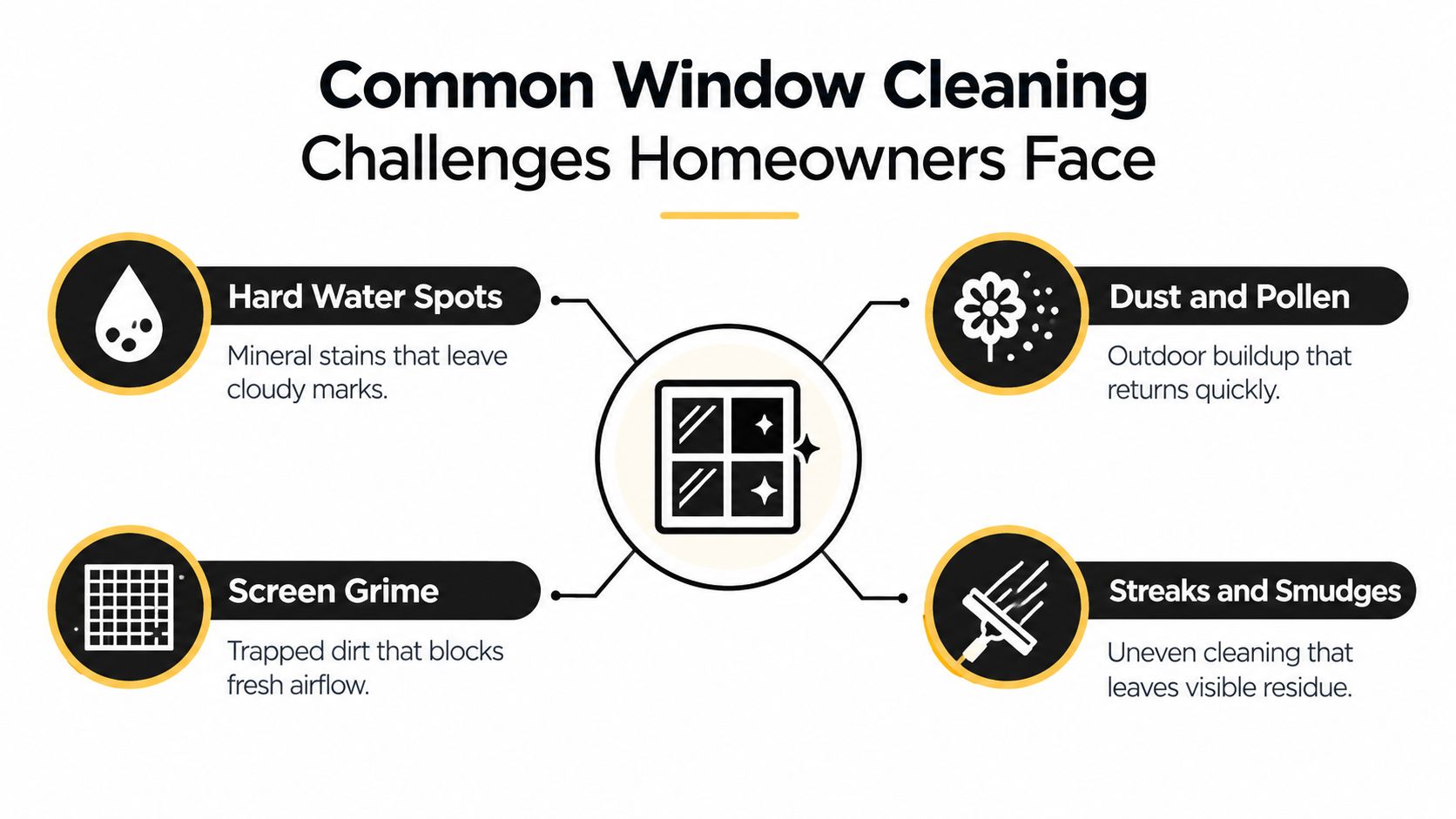
Common Window Cleaning Challenges Homeowners Face
Local weather does not create one kind of dirt. It stacks several, and each one needs a different response. If you treat them all like fingerprints, you will scrub harder and still see haze when the sun hits the pane.
Mineral film versus everyday soil
Hard-water spotting is a mineral-deposition problem. When sprinkler or tap water evaporates on glass, dissolved calcium and magnesium stay as a chalky film. The sequence is evaporation, then concentration of dissolved solids, then crystalline residue, then light scattering that reads as haze or streaking, as explained in this guide to hard-water deposits versus etching.
Oils and dirt have to come off first with a mild surfactant. An organic film blocks acid from touching the mineral layer. On compatible, uncoated glass, white vinegar or citric acid can dissolve many carbonate deposits, and a wet contact time of roughly 5–10 minutes beats aggressive scraping. If the silica surface is already etched, ordinary chemistry will not restore it. That glass needs controlled polishing or restoration, not another bottle of household cleaner.
Practical rule: If a white dot still feels raised after a gentle wash, stop scraping. You may be polishing a pit into the glass.
Streaks that appear the moment sun hits the pane are usually a water or drying problem, not a weak wrist. Tap water and even softened water can leave dissolved solids behind. What looks like a bad squeegee pass is often the rinse itself drying in place.
Screens, tracks, smoke, and height
Screens sit in the airflow path. They trap dust, pollen, and debris, then transfer that soil back onto frames and glass if you reinstall them wet. Tracks and sills collect the grit that falls while you work the pane, and they're often skipped. Grit in the track makes sashes stick long before the glass looks dirty.
After wildfire smoke, the job changes again. Research on smoke residue shows particles and semi-volatile compounds can settle on indoor surfaces, including glass, by deposition rather than by a lasting chemical reaction with the glass itself, according to environmental research on wildfire residue. Visible soot and invisible film are different. Dry-brushing a screen inside the house just moves contaminated dust. Remove the screen, clean both sides of the glass, and wipe sills, frames, and tracks before you reopen the window.
Upper-story glass adds a safety question that no better cloth will solve. Most of these headaches share one root: the wrong water, the wrong order, or the wrong access.
How to Clean Windows and Screens Step by Step
Work in an order that keeps clean surfaces clean. Screens come off before you touch the glass. Washing through a dirty screen only pushes dust around and leaves a gray cast you will blame on the soap.
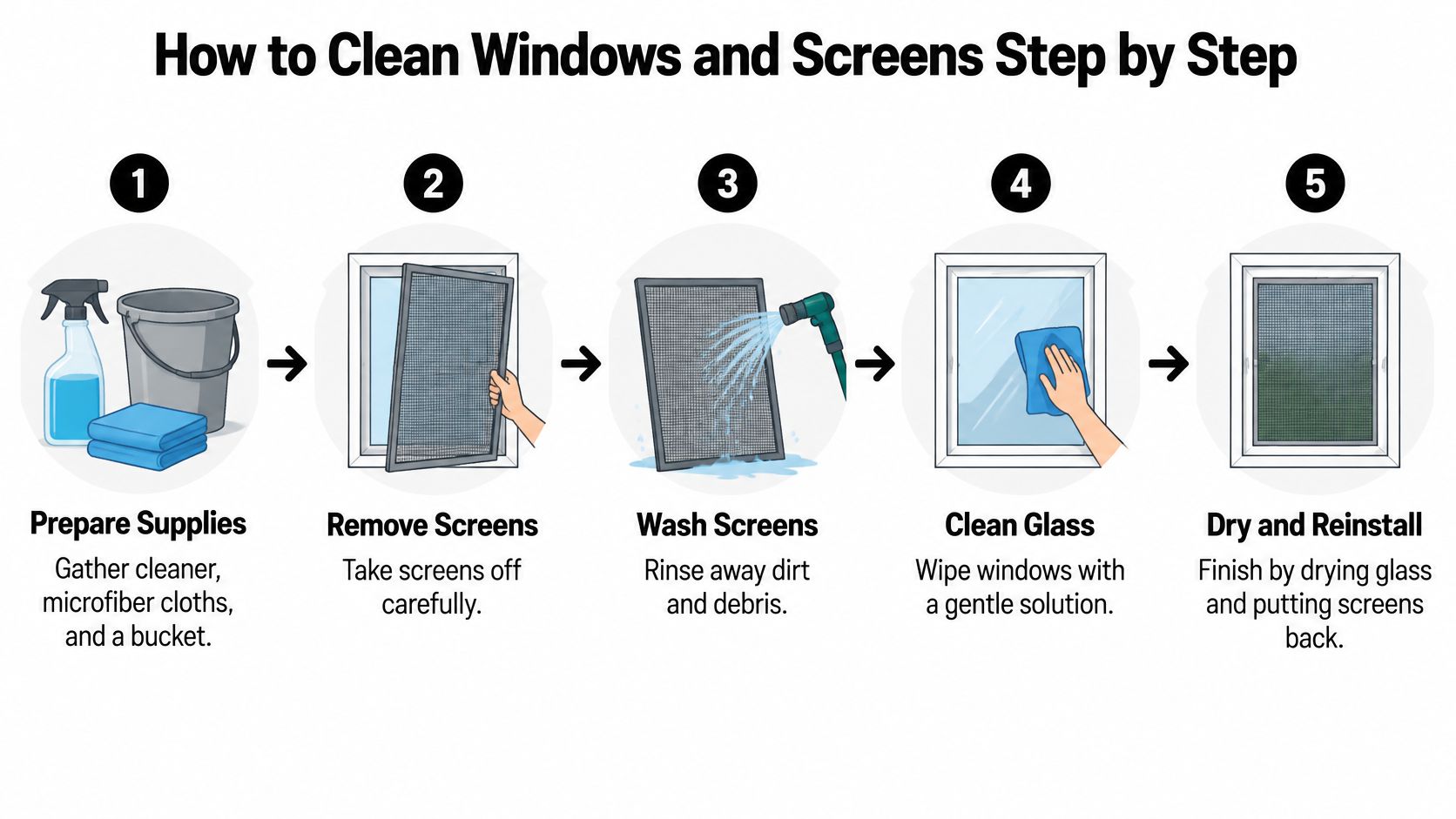
Dry soil first, then water
Brush or vacuum loose dust and pollen from the mesh before any water hits it. Wet dirt becomes mud in the weave, and mud is harder to rinse out of fiberglass than dry grit ever was. Use light pressure. A stiff brush or a pressure washer can stretch mesh and bend a frame.
On the glass, start at the top with a mild dish soap solution and a soft scrubber or microfiber. You are stripping oils and road film so later steps can reach whatever is underneath. Interior window cleaning uses the same idea at a smaller scale: edges, meeting rails, and the sill, not just the center of the pane. For mineral spots on uncoated exterior glass, the acid dwell described earlier belongs here, after the soap pass, and only after you have tested a corner on tinted, low-e, or coated glass.
A short walk-through of a basic wash helps if you want to see the motion before you start.
Why the last rinse decides the streaks
Water quality decides whether the pane stays clear. Softening swaps calcium and magnesium for sodium, but it does not remove the total dissolved-solids load, so softened water can still leave a film. Reverse-osmosis or deionized water is the better final rinse because it cuts dissolved minerals before water touches the glass, which is the point of pure-water window cleaning.
If that rinse dries on the pane, the solids left in it become the residue people mistake for poor wiping. Skip direct heat and strong wind, both of which dry the glass in patches. After it is dry, check the pane in low-angle light, not head-on, so thin streaks show up while you can still fix them.
Rinse screens gently, then let them dry fully before they go back in. Trapped moisture carries soil onto the frame and the glass you just finished. Tracks and sills come last, because debris falls downward while you work. A vacuum, then a damp cloth, keeps grit out of the weatherstripping.
- Cool glass: Early shade or an overcast hour beats a south wall at noon.
- One opening at a time: Finish the rinse before the soap flashes dry.
- Screens fully dry: Reinstall only when the mesh is no longer cool and damp.
That sequence is enough for routine seasonal window cleaning on reachable windows. It is not a substitute for bonded etching, leaded glass, or work above a safe standing height.
DIY Window Cleaning or Hiring a Professional
Ground-floor glass, a hose you can control, and a homeowner who likes the task: that is a fair DIY job between deeper visits. The trade-off shows up in safety, water, time, and what the pane looks like at 4 p.m. when the sun drops.
| Factor | DIY Approach | Professional Service |
|---|---|---|
| Safety | Fine at ground level with a stable step stool. Ladders near power lines and uneven grade raise the risk fast. | Access gear, fall planning, and a crew used to multi-story work. |
| Water | Garden hose and tap water often redeposit minerals. | Purified final rinse aimed at streak-free window cleaning. |
| Time | Setup, screen sorting, and rework eat the afternoon. | A scheduled visit covers panes, and you can add screen cleaning or track cleaning. |
| Result | Clear on easy soil. Weak on bonded minerals and tall glass. | Consistent finish on residential window cleaning and commercial window cleaning, including hard water stain removal when the glass is still restorable. |
DIY also means storing ladders, pure-water gear, and the patience to label every screen so it goes back in the right opening. If you have already washed twice and still see arcs when the light changes, more elbow grease will not fix the water.
When hiring out is the clearer call
Upper stories, deposits that have bonded, a long run of panes, and a storefront that customers see from the sidewalk are the jobs that stop paying you back in saved labor. The same is true if you are preparing photos for a listing and cannot afford a second weekend of streaks.
If you are comparing crews, use contractor vetting tips from HomeProBadge before you book: insurance, how they reach the glass, and whether the quote matches the pane count.
Cultivate House Detailing is a locally owned exterior cleaning company serving Colorado Springs and nearby communities. Founded in 2022, the team does streak-free residential and commercial window cleaning up to the fourth story, pressure washing for patios, walkways, siding, and driveways, gutter cleaning and fire-mitigation clearing, and window screen repair. You can add interior glass, exterior window washing, screens, and tracks to the same visit instead of treating them as separate projects.
Hire the height, the bonded minerals, and the buildings you cannot afford to spot-treat twice. Keep the easy ground-floor resets if you enjoy them.
Benefits of Regular Window and Screen Cleaning
Clean glass changes what people notice first. For a seller or an agent, streaked sliders show up in every photo. For a restaurant, a dealership, or a small office on a busy Colorado Springs street, the storefront is the greeting. Curb appeal here is not a slogan. It is whether the view and the business look cared for before anyone steps inside.
Clear panes also change a room. Dirt scatters light, so the same window feels dim even on a bright day. Cleaning improves visibility and daylight transmission. It does not replace insulation, better glazing, or shading. Building research has reported that user-operated windows and adaptive shading can reduce HVAC energy use by up to 30% in some buildings, with broader window-optimization strategies reporting savings from 30% to 70% depending on design and climate, as summarized in research on window behavior and energy. That is an operations and design result, not a promise that a wash will cut your bill.
Maintenance you can see while you clean
The National Park Service treats window care as more than cosmetics. Regular maintenance keeps windows operable and helps prevent deterioration that leads to replacement. Owners should look at glass, frame, sash, and nearby parts, and a cleaning day is a natural time to notice sticking sashes or worn material. The same guidance notes that reopening operable interior transoms can improve airflow and cross-ventilation, which is laid out in the National Park Service window sustainability guidance. Older Colorado Springs houses often keep original windows longer when those checks happen on a schedule.
Screen condition belongs in the same decision. Damaged, loose, or heavily soiled mesh cuts the ventilation you rely on and lets insects or debris through. Pulling screens out for the season and leaving the opening bare trades one problem for pests and a fall risk for children and pets. A deeper look at why clean window screens matter more than you think is worth reading before you toss a dusty screen in the garage.
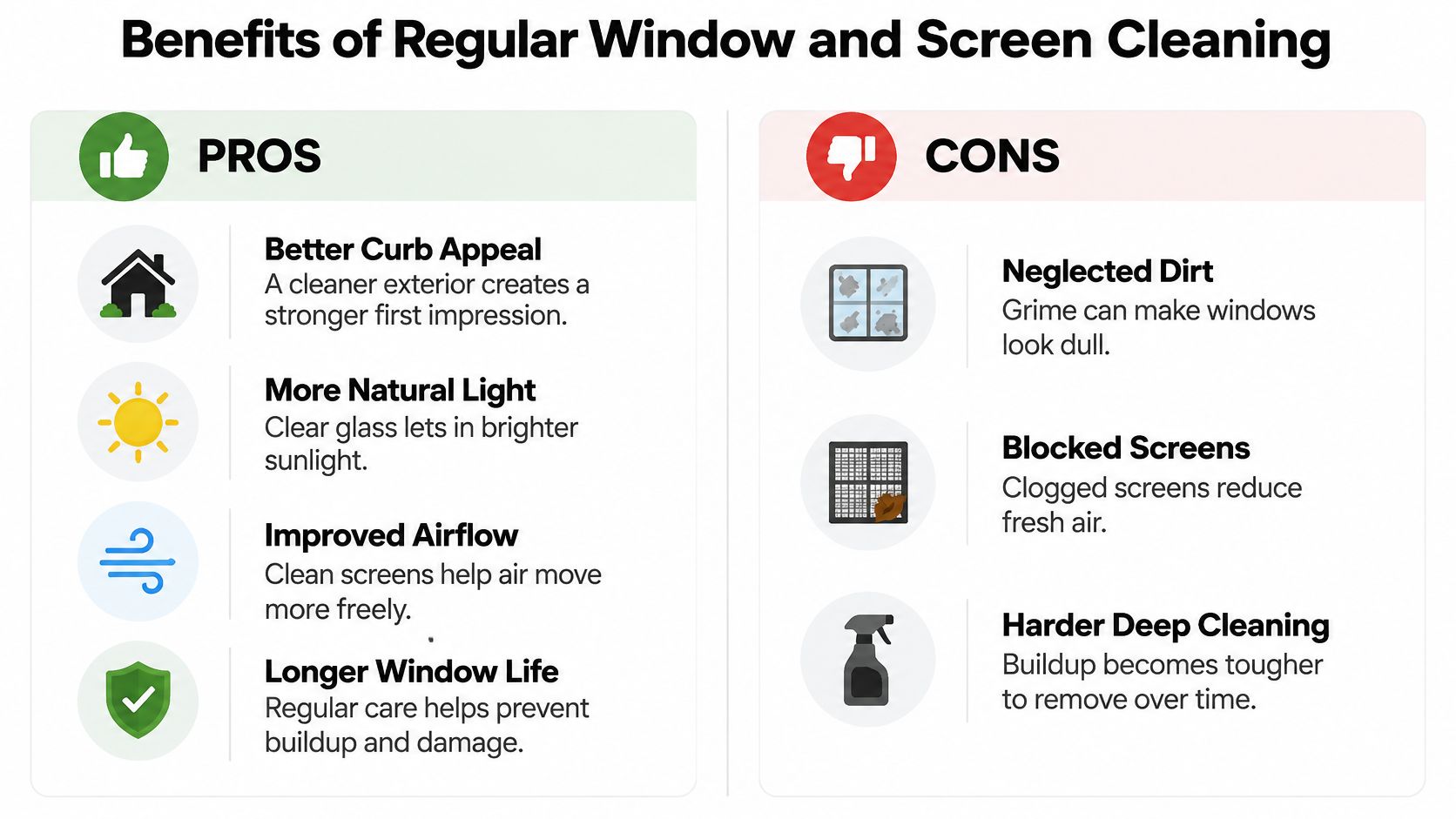
Use a simple split when you plan the year:
- Clean: Soil, pollen, and light mineral film on sound glass and mesh.
- Repair: Loose spline, small tears, bent frames, or a sash that sticks once the track is clear.
- Replace: Mesh that sags, frames that will not seat, or glass that is etched past ordinary cleaning.
- Interior only versus full exterior: Inside glass for daily living. Exterior, screens, and tracks when wind, sprinklers, or smoke have done the damage.
Maintenance on a rhythm beats a rescue clean the week before guests arrive.
Safety and Specialty Glass Considerations
Window cleaning at height is a safety-controlled job. The work involves ladders, scaffolds, raised platforms, electrical hazards, and surfaces that are fragile or uneven. An analysis of OSHA records identified 88 window-cleaning accidents over 15 years, including 62 fatalities, about 70.5% of that dataset, and the source notes the total was likely incomplete, as reported in this review of window-washer accident records. Ladder mishaps led the list, including ladders that tipped or touched overhead lines. Falls from elevated areas were prominent too. Individual OSHA examples include a worker who fell about four stories and died on April 7, 2023, an employee killed in a fall on July 6, 2022, and a fractured leg after a ladder fall on November 2, 2020.
A longer ladder is not a fall-protection plan. OSHA lists ANSI/IWCA I-14.1-2001, Window Cleaning Safety, among consensus standards for window cleaners. It describes the standard as a guide for cleaners, regulators, manufacturers, architects, consultants, designers, and building owners. Part A covers safety guidelines for access equipment. Part B covers equipment that is manufactured, distributed, designed, installed, or maintained. That split is spelled out on OSHA's fall-protection standards page. For commercial property and multi-story homes, someone should evaluate the equipment and the procedure before anyone leaves the ground.
Glass that household cleaners can harm
Stained or leaded glass needs a different sequence. The National Park Service says to start with water, preferably soft water, and to use deionized water for especially significant glass. If water is not enough, move to a non-ionic detergent. Chemical or solvent treatments stay reserved for stubborn coatings. Products should be neutral pH. Acidic, caustic, and abrasive cleaners should not be used, and many ammonia-based household glass cleaners should be avoided because they can damage glass or related materials. Work gently from top to bottom and rinse so residue is not left behind. Those limits are in the Park Service guidance on cleaning stained glass.
Hand off the job when you cannot keep both feet on a stable surface, when lines run near the work area, or when the glass is leaded, historic, or coated and you are unsure what the cleaner will do. Ground-floor clear glass with a mild soap and a pure-water rinse is the homeowner lane. Everything above that, or anything decorative, belongs with trained people and the right access plan.
What to Expect from Cultivate House Detailing
The visit starts with a clear estimate, not a surprise at the curb. For many homes, an address-based quote tool estimates pane count so the first number is grounded in the property, and you can talk through add-ons before anyone schedules the day. Pricing guidance stays transparent, and the crew is known for showing up when they said they would.
On site, the work uses professional tools and a safety-first setup, including upper-story glass up to the fourth story. You should see attention to edges and tracks, not a fast pass down the middle of each pane. Communication runs from that estimate through follow-up, so you know what was cleaned and what still needs repair.
What you can add to the same visit
Bundle only what the property needs.
- Pressure washing: Patios, walkways, siding, and driveways when the glass is only part of a dirty exterior.
- Gutters and fire-mitigation clearing: Useful before storm season and in neighborhoods where debris piles against the house.
- Window screen repair: Mesh replacement and many frame issues, so a clean opening is not put back together with a torn screen.
- Seasonal lighting: Permanent lighting and holiday light installation for homes and storefronts that need to look sharp after dark.
The company serves Colorado Springs and nearby communities from Black Forest and Monument to Manitou Springs and Woodland Park. Training newer technicians is part of how the work stays consistent, which is why homeowners, property managers, and local businesses keep coming back to a five-star reputation instead of chasing the cheapest ladder crew.
Requesting Your Window Cleaning Quote
You already know which problem you have. Routine soil, mineral film that is still removable, smoke residue on glass and screens, a torn screen, or a full exterior that includes walks and siding. The next step is a quote, not another Saturday spent redoing streaks.
Cultivate House Detailing serves Colorado Springs, CO, and surrounding communities. The first conversation covers scope, timing, and price before you commit. If you have been searching for window cleaning near me or window cleaning in Colorado Springs, CO, ask for professional window cleaning sized to the building, from a single home to a commercial front.
Enjoy the Colorado view without the haze in the way. Request a quote or schedule the visit, and start with a clear plan instead of another smeared pane.
Cultivate House Detailing handles streak-free interior and exterior window cleaning, screen and track care, screen repair, and related exterior cleaning for homes and businesses around Colorado Springs. If hard-water film, smoke residue, or hard-to-reach glass is what you see every morning, a scheduled visit is the straightforward fix. Visit Cultivate House Detailing to request a quote and put a date on the calendar.