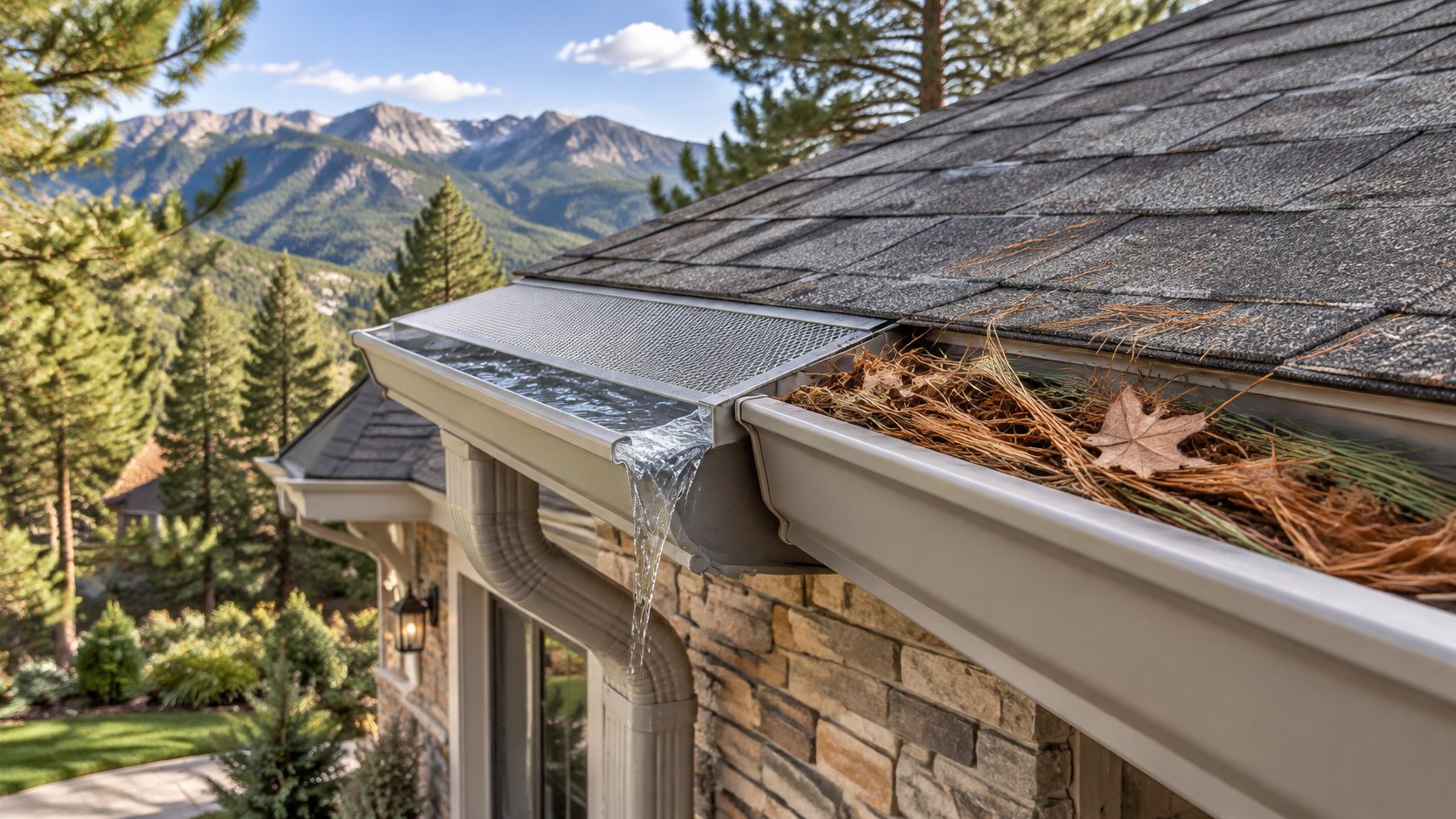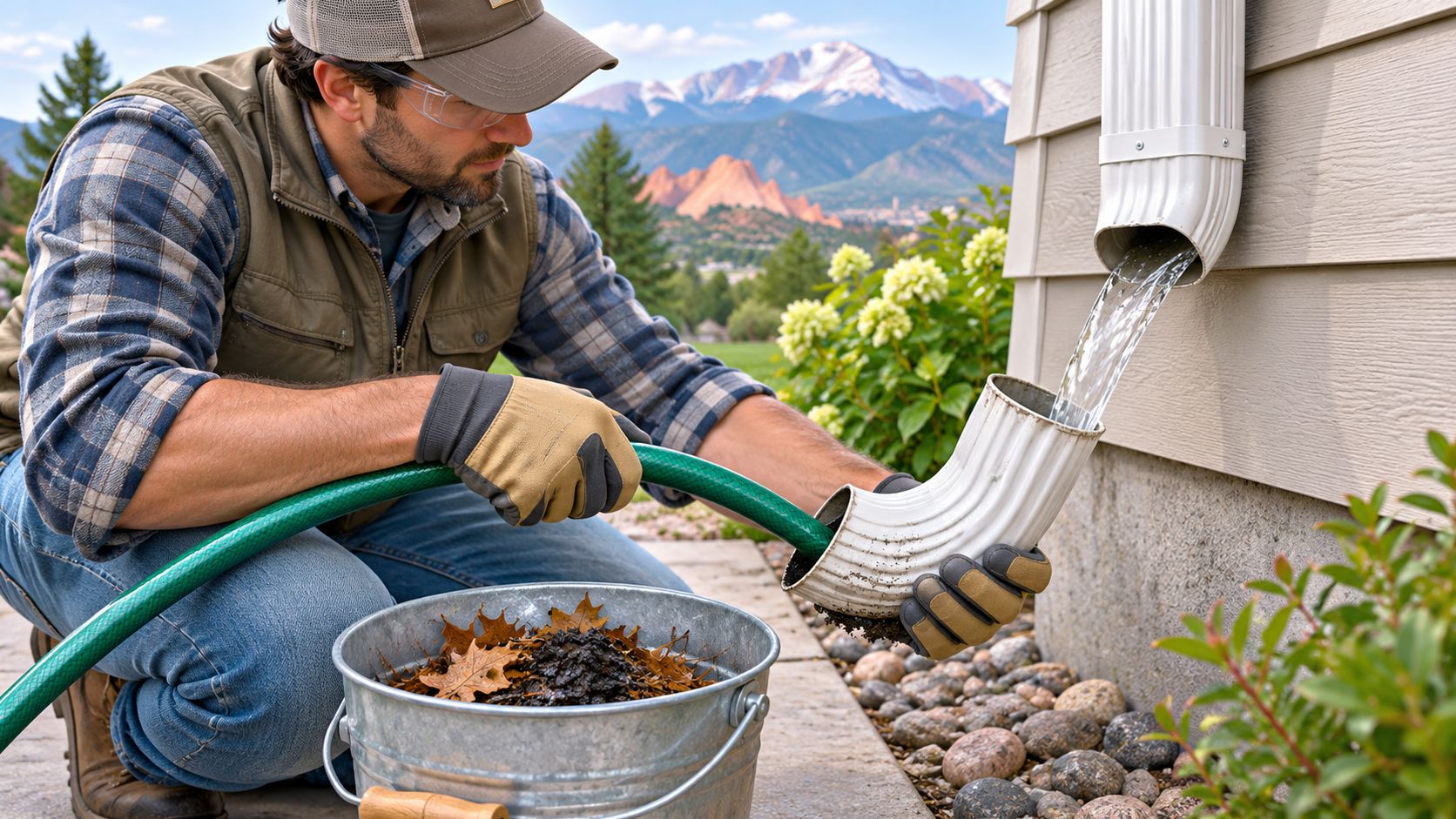
Rain is spilling over the gutter above your window, but barely anything is coming out of the downspout. The glass is streaked, the mulch is washing away, and you're wondering whether a hose will fix it or send more water toward the foundation.
For homeowners arranging window cleaning in Colorado Springs, CO, that overflow deserves attention before the glass gets washed again. Cultivate House Detailing serves Colorado Springs and surrounding communities with a safety-first approach to exterior maintenance. Learning how to unclog a gutter downspout starts with identifying where water stops, then clearing that section without forcing debris into a buried drain.
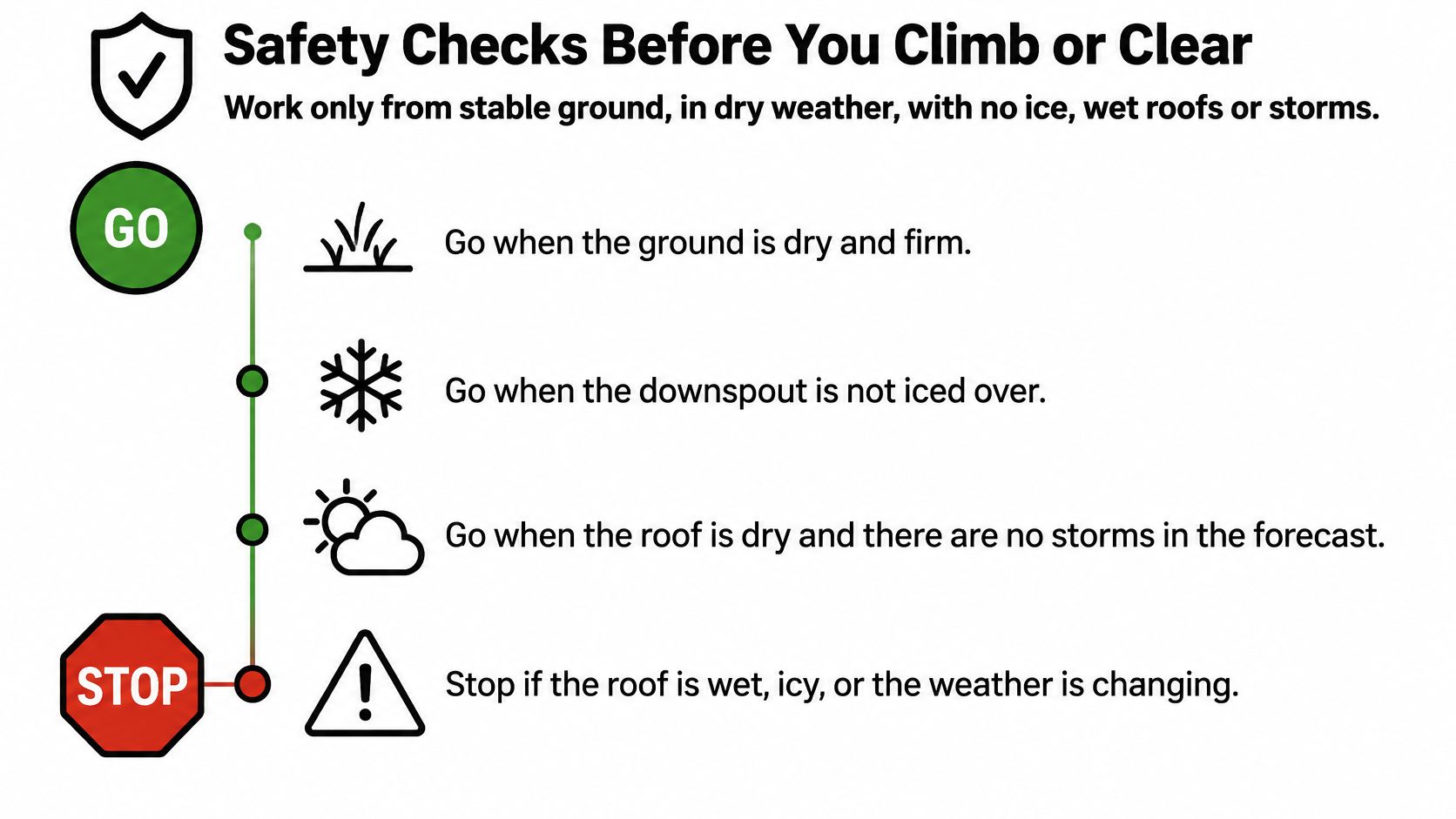
Safety Checks Before You Climb or Clear
Work only from stable ground, in dry weather, with no ice, wet roofs, or storms. A reachable lower elbow can be a reasonable homeowner task. An inaccessible gutter outlet isn't a reason to climb higher or stretch farther.
Use this go-or-stop checklist before gathering tools:
- Go when access is secure. The ground is dry and firm, and you can reach the work without leaning a ladder against the gutter.
- Go when the pipe is ice-free. Don't try to flush a frozen downspout or break ice loose with a tool.
- Stop for unsafe roof conditions. Wet, icy, or steep roofs are off-limits.
- Stop near power lines. Keep yourself, hoses, ladders, and tools away from electrical hazards.
- Stop for difficult heights. Downspouts on tall structures, particularly the fourth story or higher, need professional access.
Keep these conditions visible while you assess the job.
More pressure isn't a safer shortcut
Colorado Springs freeze-thaw cycles, pine needles, windblown debris, and sudden storms complicate an otherwise straightforward cleaning job. A damp leaf plug may move with controlled flushing, while frozen debris or a packed elbow needs a different approach.
The West Virginia University Extension gutter-safety guidance recommends heavy gloves, eye protection, and avoiding roof access and unsafe weather. Excessive water pressure can damage thin downspouts, force water through seams, or pack soft debris against an obstruction. Removing a reachable section often reveals more than increasing the nozzle pressure.
Gather heavy gloves, safety glasses, a bucket or tarp, a garden hose with a pistol-grip nozzle, and a plumber's snake. Have a helper watch the outlet so you can shut the water off as soon as drainage stalls.
Our guide to cleaning gutters safely explains access precautions in more detail. Cultivate House Detailing's gutter cleaning professionals are trained to keep the worksite safe and deliver clean gutters.
Practical rule: The fastest method is often safer access and testing one section at a time, not more pressure.
If a hazard appears mid-job, stop the water, leave the system alone, and use the professional-help criteria below.
Clear a Clogged Downspout Step by Step
Clear the debris you can see, then flush the pipe from the bottom up so water pushes the clog back toward the gutter. Keep the lower outlet disconnected from any buried drain while you diagnose the blockage.
This graphic summarizes the clearing direction, not permission to access an unsafe gutter opening.
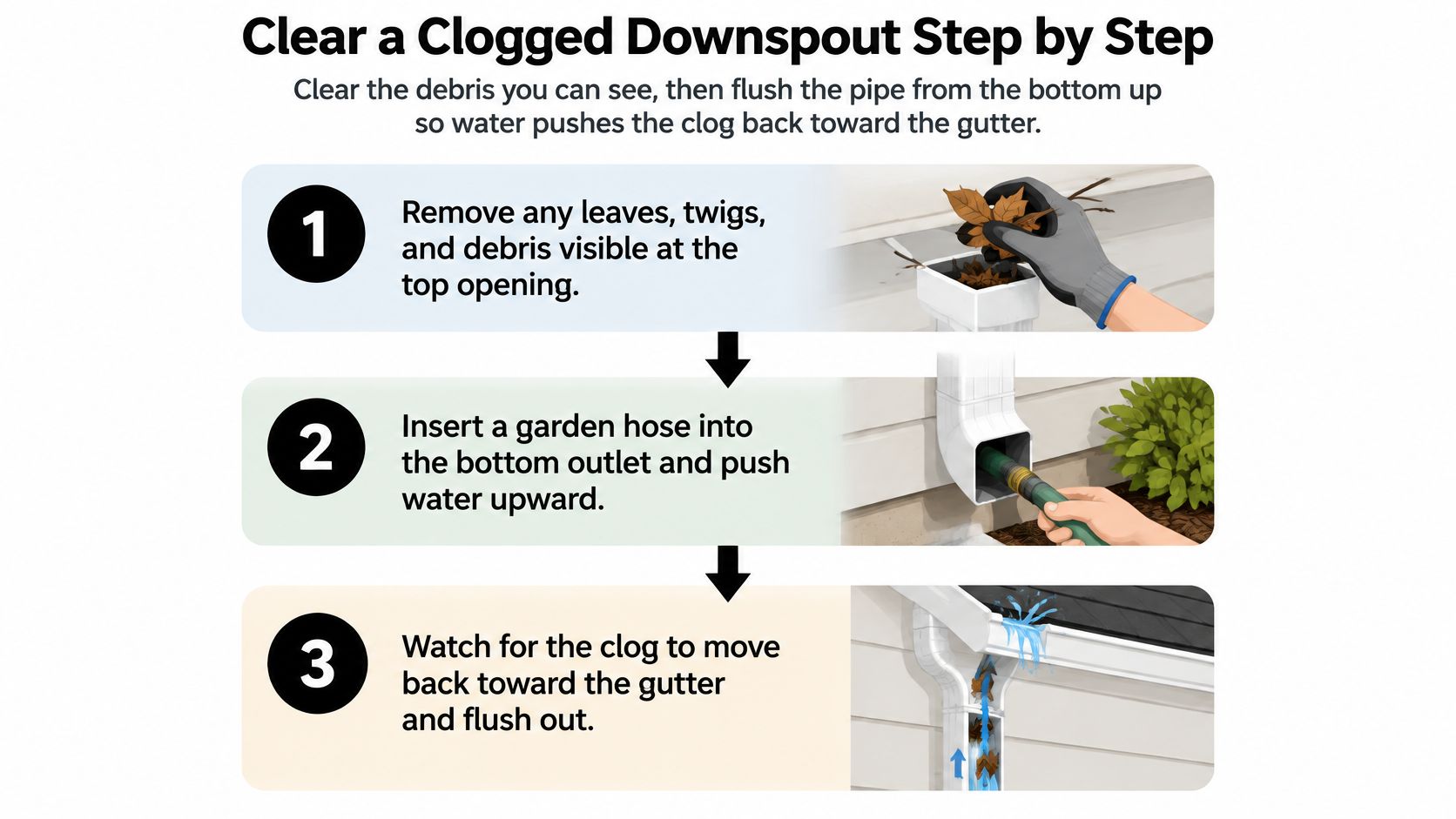
The bottom-up method appears in North Carolina State University's archived extension guidance. It directs the obstruction toward the gutter rather than packing it farther into a bend.
Open the outlet and remove the plug
Remove loose gutter debris. Wearing gloves and eye protection, scoop leaves and sediment away from the gutter outlet, working outward rather than dragging everything into the opening. Only do this where access meets the safety conditions above; otherwise, leave the upper work to a professional.
Disconnect the lower elbow or extension. Support the piece while loosening its fasteners, and place a bucket or tarp underneath to catch debris. Don't let the elbow swing or drop against another section and strain its seam.
Flush upward with controlled water. Feed the garden hose into the open bottom of the aboveground downspout, using a pistol-grip nozzle only if it fits without wedging. Keep space around the hose for water and debris to escape, and stop if water sprays through connections rather than moving the clog.
Use a plumber's snake if rinsing stalls. Shut off the hose, then gently work the cable through the isolated downspout section and withdraw loosened material. Don't force the cable through resistance or feed it into an underground connection.
Take stubborn sections apart. Remove accessible pieces and clean them on the ground, keeping track of their order and orientation. Check each elbow before reassembly; reconnecting a partly blocked bend can leave the original problem in place.
Reconnect and test. Seat the sections firmly, secure their fasteners, and introduce water into the gutter through a safely accessible position. Have your helper inspect every elbow and joint, including the gutter-to-downspout connection.
Judge the result by water flow
Don't assume the job is finished because a clump of leaves fell out. A clear downspout produces steady discharge without backing up, and its connections don't drip or spray during the test.
If the downspout drains but the gutter still overflows, consider other faults rather than repeating the same flush. HIBCO ROOF LLC's explanation of gutter overflow causes and fixes provides context for separating a blockage from other overflow problems.
For a visual demonstration, watch the clearing process while keeping your own access and drainage conditions in mind.
Tell a Downspout Clog From a Buried Drain Problem
| Symptom | Likely location | First check |
|---|---|---|
| Water pours from the top, flow stops at the gutter outlet | Downspout top or gutter outlet | Remove debris by hand and flush toward the outlet |
| Trickle from the bottom that stalls after a minute | Elbow or middle section | Disconnect the elbow and flush upward from the bottom |
| Water backs up at the gutter while the visible pipe looks clear | Buried drain line or underground connection | Disconnect the extension and stop forcing water into the system |
| Strong flow from the bottom, water pools at the outlet | Grading or soil slope, not a pipe clog | Check slope and the distance water travels |
| Water sprays from a joint or seam | Loose or split connection | Reseat the section and check the fit of the elbow |
These symptoms are diagnostic clues, not proof. A downspout can look empty from the bottom while compacted material remains in an upper elbow, and an underground line can be blocked even when the visible pipe is clear.
Overflow directly above a debris-covered gutter opening calls for removing that material first. A trickle that fades during testing suggests water is accumulating behind a restriction, so isolate the elbow instead of leaving the hose running.
Separate the aboveground pipe from the buried line
Where a Colorado Springs home routes roof water into buried drainage, disconnect the aboveground outlet before testing it. Catch or redirect the test water away from the wall without sending it into the underground opening.
If the detached downspout drains freely but the connected system backs up, the buried connection needs further investigation. Forcing a snake or more water into an unknown underground route can move debris deeper or redirect water toward the foundation.
Colorado's intense storms make this distinction important. The Colorado Climate Center's account of major rainfall and flooding illustrates how substantial rainfall can stress drainage systems; a hose test alone doesn't establish their storm capacity.
Strong flow from the downspout with pooling on the ground calls for a drainage assessment, not automatically another round of pipe cleaning.
A spraying joint needs a separate check. Reseat a loose connection, but replace or repair a split component rather than trying to tighten away physical damage.
Follow this test order: gutter outlet, downspout top, elbow, extension, then professional evaluation of the underground line. If water backs up at the gutter without a visible obstruction, stop adding water and call a professional.
Confirm Water Leaves Far Enough From Your House
| Discharge setup | Distance from the foundation | Notes |
|---|---|---|
| Surface splash block or short extension | Must carry water away without returning toward the wall | Can discharge too close, so it is not enough alone |
| Standard downspout extension | At least 2 feet | Minimum recommended in stormwater guidance |
| Basement or flood-prone wall | At least 6 feet | Recommended where a basement may flood |
| Underground piping | At least 10 feet downhill and away from the house | Standard for buried drain outlets |
The surface-extension distances of at least 2 feet, or 6 feet where basements may flood, appear in Auburn's stormwater management guidance. North Carolina State University Extension's recommendation for buried outlets, at least 10 feet downhill and away from the house, accompanies the drainage guidance summarized in FEMA's sloped-roof systems fact sheet, which also warns about ponding and water damage.
A flowing downspout isn't automatically a working drainage system. Water must reach a suitable outlet rather than soak the soil beside the foundation or follow a low spot back toward the wall.
Run a short end-to-end flow test
Allow about ten minutes for a controlled check, but stop immediately if water backs up. This is a practical inspection, not a simulation of a major storm.
- Introduce water safely. Run a hose into an accessible gutter section for several minutes without climbing onto the roof.
- Watch the connections. Have your helper look for drips, spraying seams, and water escaping around the inlet.
- Follow the discharge. Confirm that water exits continuously, then watch where it travels across the ground.
- Correct the destination. Reseat a loose joint or add an appropriate extension if water lands beside the foundation. A slope that returns water toward the building needs drainage correction.
Don't treat the shortest listed extension as sufficient for every yard. The direction of travel matters as much as the extension itself, particularly beside a vulnerable basement wall.
A guard or strainer may reduce incoming debris, but it doesn't replace inspection. The final benchmark is continuous discharge, no backing up, and no escaping water at the gutter-to-downspout connection, with runoff continuing away from the house.
How Often to Clear Downspouts Before Clogs Return
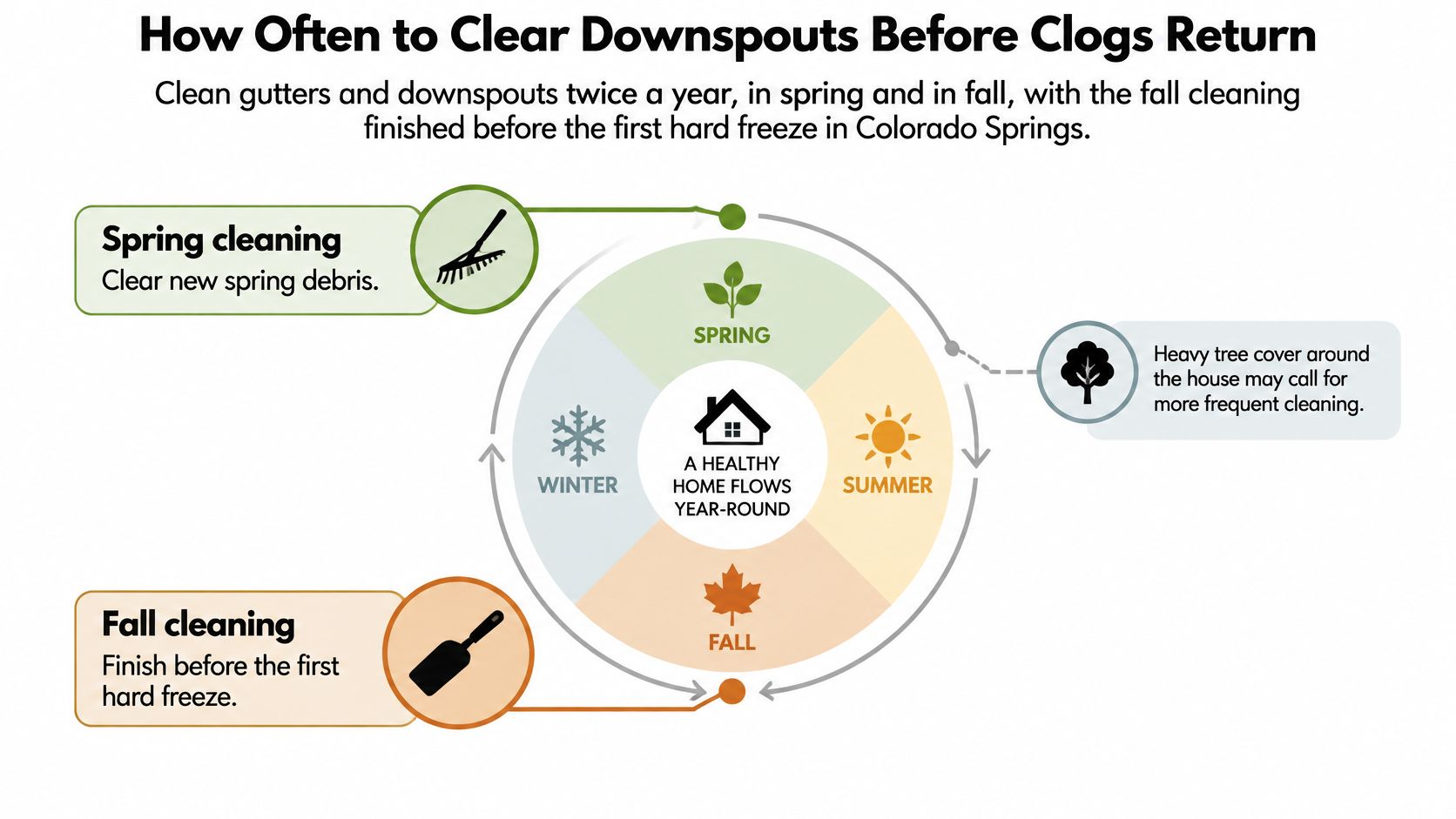
Clean gutters and downspouts twice a year, in spring and fall, with the fall cleaning finished before the first hard freeze in Colorado Springs. Cultivate House Detailing recommends that schedule, with more frequent cleaning where properties have many trees or heavy rain.
FEMA recommends thoroughly cleaning the gutter system at least twice per year, particularly around rainy seasons and autumn leaf fall. Leaves aren't the only concern: shingle granules and sediment can accumulate even when the gutter doesn't look heavily wooded from below.
Use the seasonal schedule as a baseline, then adjust it to what collects on your roof.
Let debris and weather set extra checks
| Trigger | When to clean or check | Why it matters |
|---|---|---|
| Routine schedule | Spring and fall, twice a year | Keeps leaf and sediment buildup from forming |
| Heavy tree cover or pine needles | Check after each windy period and clean as needed | Needles and seeds readily collect in elbows |
| Rainfall of 0.5 inch or more | Inspect the system after the storm | Shows whether water still exits freely |
| Major weather event | Inspect once conditions are safe, alongside yearly inspection | Storms move debris into the system |
| Before winter | Finish fall cleaning before the first hard freeze | Reduces trapped water that could freeze in clogged sections |
The rainfall trigger is a useful extra check, not a reason to clean an already clear system after every shower. Focus on what changed: fresh needles on the roof, displaced extensions, new overflow marks, or reduced discharge.
Between cleanings, walk around the house after rain once conditions are safe. Look for overflowing corners and disturbed mulch, and listen for gurgling, which can indicate restricted drainage rather than normal free flow.
Mesh guards reduce incoming debris but don't eliminate maintenance. Fine material can still collect, and debris resting on top can interfere with water entering the gutter.
Our guide to how often gutters need cleaning helps homeowners plan around tree cover and seasonal conditions. Add spring and fall calendar reminders, plus a ground-level check after any storm that leaves visible debris on the roof.
Decide Whether to Clear It Yourself or Call a Pro
- Clear it yourself when access is safe. The clog is reachable from the ground, the disconnected outlet drains after clearing, and there's no suspected buried-drain problem.
- Call for drainage diagnosis when the cause is hidden. Water backs up despite a clear visible pipe, or the blockage returns within weeks.
- Call for repair assessment when components move or fail. Sagging gutters, cracks, or sections pulling away from the fascia need more than debris removal.
- Leave hazardous access alone. Ice, electrical exposure, difficult heights, and unstable footing rule out homeowner clearing.
A first-time seasonal plug in an accessible elbow is different from a recurring failure. Repeated clogging may involve retained debris, a damaged connection, or a drainage layout that cleaning alone won't correct.
Compare the full job, not just the unclogging price
In 2026, Taskrabbit reports typical professional gutter-cleaning costs of $0.80 to $2.00 per linear foot; using that range, a hypothetical 150-foot gutter run would cost approximately $120 to $300. That's a general planning example, not a Cultivate quote or an allowance for underground drain repairs.
The useful comparison is between safely clearing an isolated plug and arranging a complete assessment. Tell the crew whether the outlet connects underground, where overflow appears, and whether the same section has blocked before.
Before requesting an estimate: Photograph the downspout from top to bottom, its lower connection, and the place where discharged water lands. Take those photos from the ground.
Cultivate House Detailing serves Colorado Springs and nearby communities. Our crews show customers the level of debris in their gutters, and our gutter cleaning professionals are trained to maintain a safe worksite.
Coordinate gutter and window maintenance
Overflow can leave dirty runoff across exterior glass, while dust, tree sap, bird droppings, and mineral deposits create separate window-cleaning challenges. Professional window cleaning addresses the glass with suitable tools rather than treating every mark as something a stronger rinse will remove.
For residential window cleaning or commercial window cleaning, distinguish exterior window cleaning, interior window cleaning, screen cleaning, and track cleaning when describing the work. Streak-free window washing improves the view and appearance of the property, while clean tracks and frames make maintenance issues easier to notice.
Clean glass also supports usable daylight, consistent with the Department of Energy's daylighting guidance. It doesn't repair failed seals or change the window's insulation.
Our exterior services can be bundled with window cleaning, and packages include screen or gutter cleaning. Complementary to our gutter guard service, we inspect the whole gutter system, identify damage, and suggest necessary repairs, so homeowners can distinguish cleaning needs from repair needs.
Cultivate House Detailing offers gutter cleaning and professional window cleaning for homes and businesses in Colorado Springs and surrounding communities. Visit Cultivate House Detailing to request an estimate, and send ground-level photos of your downspout and where the water lands so we can understand the drainage concern alongside your cleaning needs.