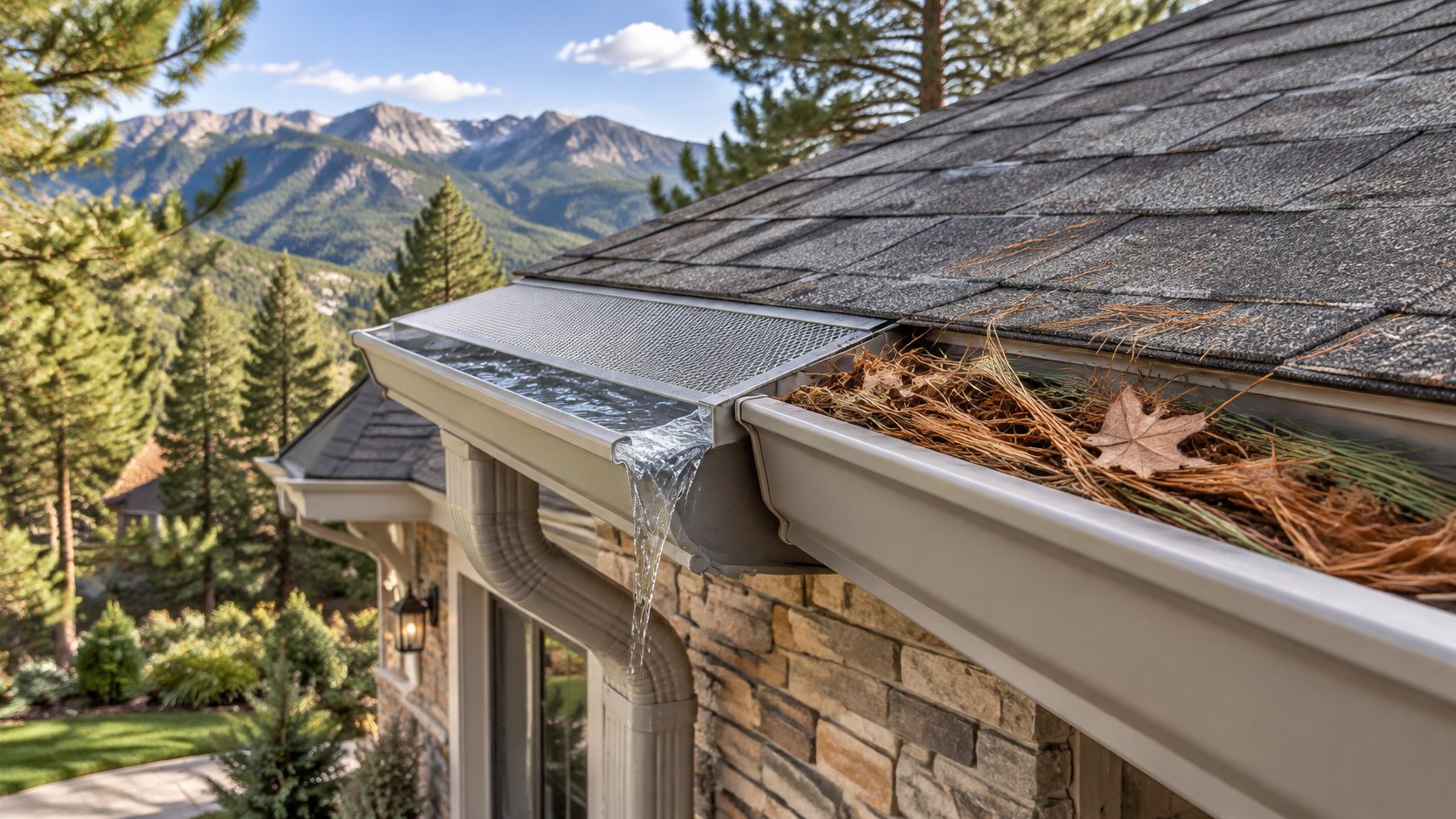
Gutter guards can pay off for homes with heavy tree cover, pine needles, or roof edges that are difficult to reach, especially when each professional cleaning visit adds up over time. They can reduce cleaning needs, but the value depends on how much debris your property collects and how often the gutters need attention.
Guards do not make gutters maintenance-free. Someone still needs to check that water drains properly and that debris has not built up on or beneath the guards. In Colorado Springs, a roof beneath conifers has different maintenance demands from an accessible roof with few nearby trees.
Choose exterior maintenance based on what your property needs, not the largest package. Cultivate House Detailing offers gutter guards and inspects the gutter system for damage before installation, recommending repairs when needed.
Who Gains Most From Gutter Guards and Who Does Not
Heavy debris and difficult access make the strongest case for gutter guards. An accessible single-story home with light debris often gets better value from routine cleaning. Neither homeowner should buy a system based on a promise of permanently clean gutters.
The distinction is between reducing maintenance and removing it. Guards intercept material before it falls into the trough, but leaves can pile up on the cover, needles can lodge in openings, and fine material can collect beneath it. You're changing the cleaning task, not retiring it.
Gutter guard verdict by home situation
| Home situation | Likely verdict | Main reason |
|---|---|---|
| Mature trees or pine needles over the roof | Usually worth it | Debris loads repeat and can overwhelm a cleaning schedule |
| Tall or steep roof that is hard to reach | Usually worth it | Ladder exposure and difficult access make each cleaning costly |
| Accessible single-story home with few trees | Often not worth it | Routine cleaning may cost less than installation |
| Undersized or damaged gutters with poor slope | Repair the gutters first | Guards don't correct drainage or structural defects |
| Short expected stay in the home | Often not worth it | Break-even may take longer than the years owned |
Homeowner responses illustrate why the verdict isn't universal. In a 2026 homeowner survey from This Old House, 58% reported cleaning at least twice annually before installation; afterward, 41% cleaned annually, nearly 17% reported no cleaning, and 43% still cleaned twice or more annually.
Those are reported experiences, not a maintenance guarantee. A homeowner whose cleaning schedule barely changes won't receive the same financial benefit as someone who avoids repeated service calls.
The advantages are less debris inside the trough, potentially fewer cleaning visits, and less ladder exposure. The drawbacks are the upfront expense, surface debris that still needs attention, and a cover that can make underlying gutter problems less obvious.
Practical rule: Buy a reduction in a recurring problem, not a promise that you'll never think about your gutters again.
Audit the property before choosing a product
Start with what happens at your roofline. Are broad leaves filling the trough after autumn storms? Are needles collecting throughout the season? Or is the recurring overflow happening at the same corner even when the gutter is clear?
That last situation deserves diagnosis before installation. A poorly pitched run, sagging gutter, or inadequate outlet needs correction rather than another layer over the opening.
Consumer coverage in the San Luis Obispo Tribune describes the economic break-even point as property-specific because residual cleaning, existing drainage defects, and ownership plans change the comparison. Use a written property audit rather than a generic payback claim:
- Current cleaning expense: Gather actual invoices, including charges for difficult access.
- Building height and roof access: Note steep areas, uneven ground, and sections that require specialized access.
- Tree and needle load: Identify what lands on the roof, not just how many trees stand nearby.
- Gutter condition: Check sagging, separated joints, outlet restrictions, and fascia condition.
- Ownership plans: Consider whether you'll remain long enough to benefit from reduced upkeep.
- Maintenance and warranty requirements: Establish how covers come off, what cleaning involves, and what neglect could invalidate.
Convenience can justify a purchase even without a quick financial return. A homeowner who shouldn't climb a ladder may reasonably prioritize fewer high-access cleaning tasks, while still arranging professional inspections.
If the gutters are sound and cleaning bills are high, guards are likely worth considering. If the gutters are sound and cleaning is easy, routine cleaning is probably cheaper.
The Real Cost Math Behind Guards and Cleaning
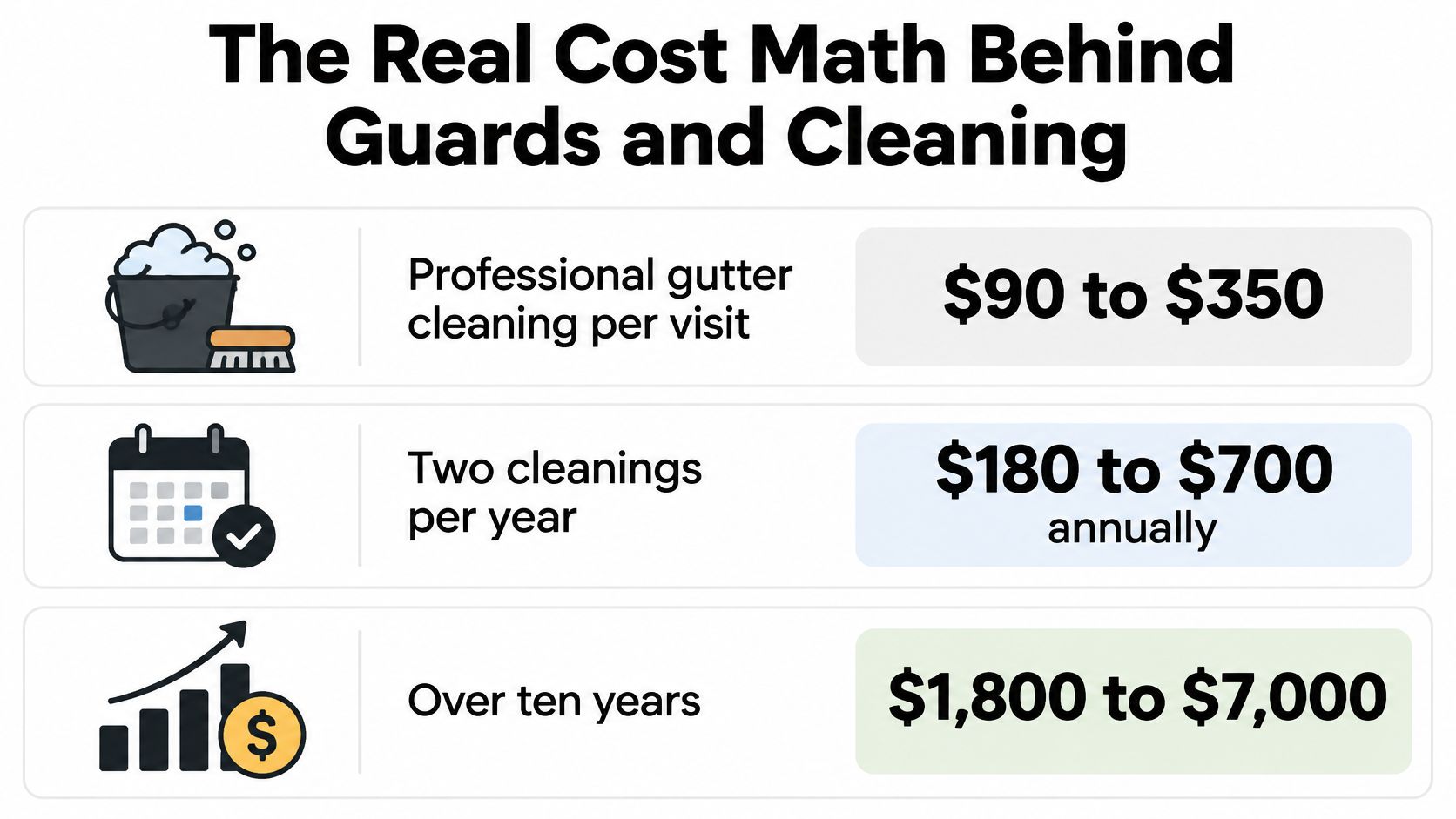
Professional gutter cleaning commonly costs $90 to $350 per visit, while installed guard systems have been reported at approximately $800 to more than $5,000, according to This Old House's gutter guard cost coverage. That coverage also reports about $40 per linear foot from a nationwide survey of 1,000 homeowners.
Using that cleaning-price range, paying for two visits annually produces $180 to $700 in yearly expense, or $1,800 to $7,000 over ten years. These are comparison figures, not a Colorado Springs quote, and they assume unchanged prices and cleaning frequency.
Annual and ten-year cleaning costs by scenario
| Cleaning scenario | Yearly cleaning cost | 10-year cleaning cost |
|---|---|---|
| One cleaning a year at $90 | $90 | $900 |
| One cleaning a year at $350 | $350 | $3,500 |
| Two cleanings a year at $90 | $180 | $1,800 |
| Two cleanings a year at $350 | $700 | $7,000 |
The chart shows how repeated visits affect the long-term comparison.
Calculate savings from visits actually avoided
For a hypothetical home with 180 linear feet, applying the national survey's installed rate produces an installation estimate of roughly $7,200. That example illustrates why a broad project-price range can't replace a measurement-based estimate.
The useful calculation is:
Simple break-even = installation cost ÷ annual cleaning expense actually avoided.
If guards reduce two paid cleanings to one, count only the avoided visit as savings. Don't subtract the entire former cleaning bill while assuming surface cleaning and inspection will somehow happen for free.
Inspection, repairs, removal for service, and eventual replacement belong in the comparison too. Keep existing gutter repairs separate from the guard price so you know what you're paying to improve drainage and what you're paying to restrict debris.
For local budgeting, use this gutter cleaning cost guide alongside your last three cleaning invoices. If you don't have invoices, obtain a realistic cleaning estimate for your property rather than assuming the most expensive scenario.
Keep insurance expectations realistic
Water damage is a reason to maintain drainage, not a guaranteed return on a guard purchase. Figures attributed to the Insurance Information Institute by Pro House Maintenance put average water-damage and freezing claim severity at $15,400 from 2019 through 2023; that category isn't limited to gutter-related losses.
Gradual neglect or deferred maintenance can fall outside standard homeowner coverage. Check your policy terms, keep dated cleaning records and photographs, and document maintenance after installation. A guard receipt alone doesn't establish that the drainage system has been maintained.
How Guard Types Compare on Lifespan and Debris Control
The main families to compare are foam inserts, plastic screens, stainless-steel micro-mesh, and heavy-gauge aluminum reverse-curve covers. Each handles roof runoff and debris differently, so the cheapest purchase isn't necessarily the least expensive system to own.
Reported estimates in the Miami Herald's gutter guard coverage place basic foam inserts and plastic screens at roughly one to seven years, compared with more than twenty years for stainless-steel micro-mesh and heavy-gauge aluminum reverse-curve systems when properly maintained.
Gutter guard types by lifespan and debris control
| Guard type | Typical lifespan | Debris handling | Best fit |
|---|---|---|---|
| Foam insert | 1–7 years | Blocks large leaves; fine grit can clog it | Light debris and short-term ownership |
| Plastic screen | 1–7 years | Keeps large debris out; needles can pass through | Low budget with few trees |
| Stainless micro-mesh | More than 20 years when maintained | Catches finer material; needles still need checking | Pine-heavy properties and long-term homes |
| Heavy-gauge aluminum reverse curve | More than 20 years when maintained | Sheds leaves over the curve; fine grit still settles | Steep roofs and long-term ownership, subject to runoff compatibility |
Foam fills the gutter opening, allowing water through its pores while keeping larger material above it. Its practical limit is embedded debris: a surface that looks mostly clear can still contain grit and decomposing organic material. Removing the insert may be necessary to clean it properly.
Plastic screens offer a simple barrier against broad leaves. Their larger openings can be a poor match for narrow needles, so a low purchase price shouldn't outweigh a mismatch with the trees above your roof.
Match the opening to the debris
Stainless micro-mesh is worth shortlisting when smaller material is the main concern. Fine openings improve screening, but pollen, grit, and needles can still form a layer on top. Use a soft brush for surface cleaning rather than a wire brush that could damage the mesh.
Reverse-curve covers guide water around a curved edge while larger debris falls away. They need careful matching to roof slope and concentrated runoff, especially below roof valleys. A strong material doesn't compensate for water overshooting the entry point.
Don't assign the nationwide installed average to every guard family. Per-type installed prices aren't established by these lifespan estimates, so compare itemized quotes instead of assuming material price equals finished project cost.
Shortlist the designs that suit your debris, then compare attachment method, slope compatibility, and cleaning access. Check whether the installer must lift roofing materials, how sections are removed, and whether fasteners remain accessible.
A long-lived cover saves money only if you can keep it clear, inspect its attachments, and service the gutter beneath it.
Colorado Debris and Fire Risk Shape the Decision
For a Colorado Springs property near conifers or dry foothill vegetation, the buying decision extends beyond clogs. Needles, windblown leaves, and roof grit can collect at the roof edge, while storms move loose material toward corners and outlets.
This is the kind of accumulation a cover must manage, not merely hide.
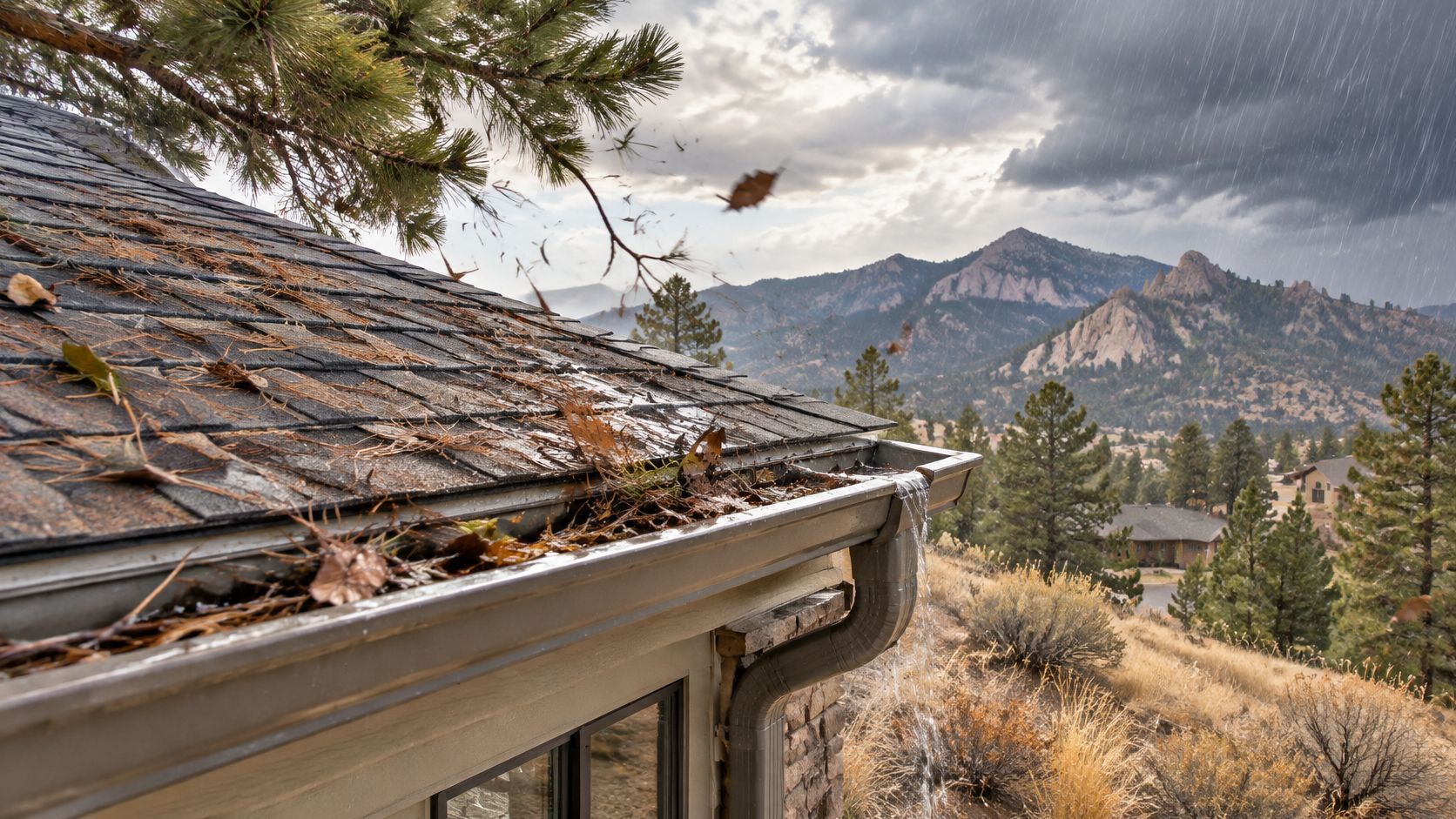
Dry leaves and needles in gutters can ignite when windblown embers land on them. Burning debris can expose the roof edge and nearby combustible materials, including fascia and siding.
Choose materials for the fire objective
CAL FIRE's official home-hardening guidance recommends noncombustible gutter covers together with regular gutter cleaning because accumulated debris is susceptible to ember ignition. That's home-hardening guidance, not a claim that installing covers makes a home fire-safe.
The Santa Barbara County Fire Safe Council's gutter guidance likewise emphasizes clearing debris and describes flat noncombustible covers, preferably following the roof slope. It also makes an important distinction: guards aren't essential, and accumulated debris still requires removal.
If reducing combustible material at the roofline is your objective, plastic and foam aren't equivalent to noncombustible metal. A product selected only for low cost can work against the reason you're installing it.
The following video provides an additional visual resource.
Keep the roofline accessible
A useful cover limits debris without making inspection impractical. Evaluate the entire assembly, including the frame and backing, rather than assuming a metal-looking surface means every component is noncombustible.
- Material: Prefer noncombustible construction when wildfire exposure is a concern.
- Roof compatibility: Avoid installations that lift shingles or interfere with the drip edge.
- Inspection access: Make sure debris underneath the cover can be found and removed.
- Nearby accumulation: Clear needles from roof valleys and roof-to-wall intersections, not just the gutter opening.
A pile of needles above a cover remains combustible material at the roofline. Don't wait for obvious overflow before addressing it during high-fire-risk periods.
Understanding why gutter cleaning is important helps put guards in their proper role. Combine them with roofline clearing, gutter cleaning, and a broader property fire-mitigation plan. They're a supporting measure, not a substitute for clearing.
How to Check Guards Are Working After Installation
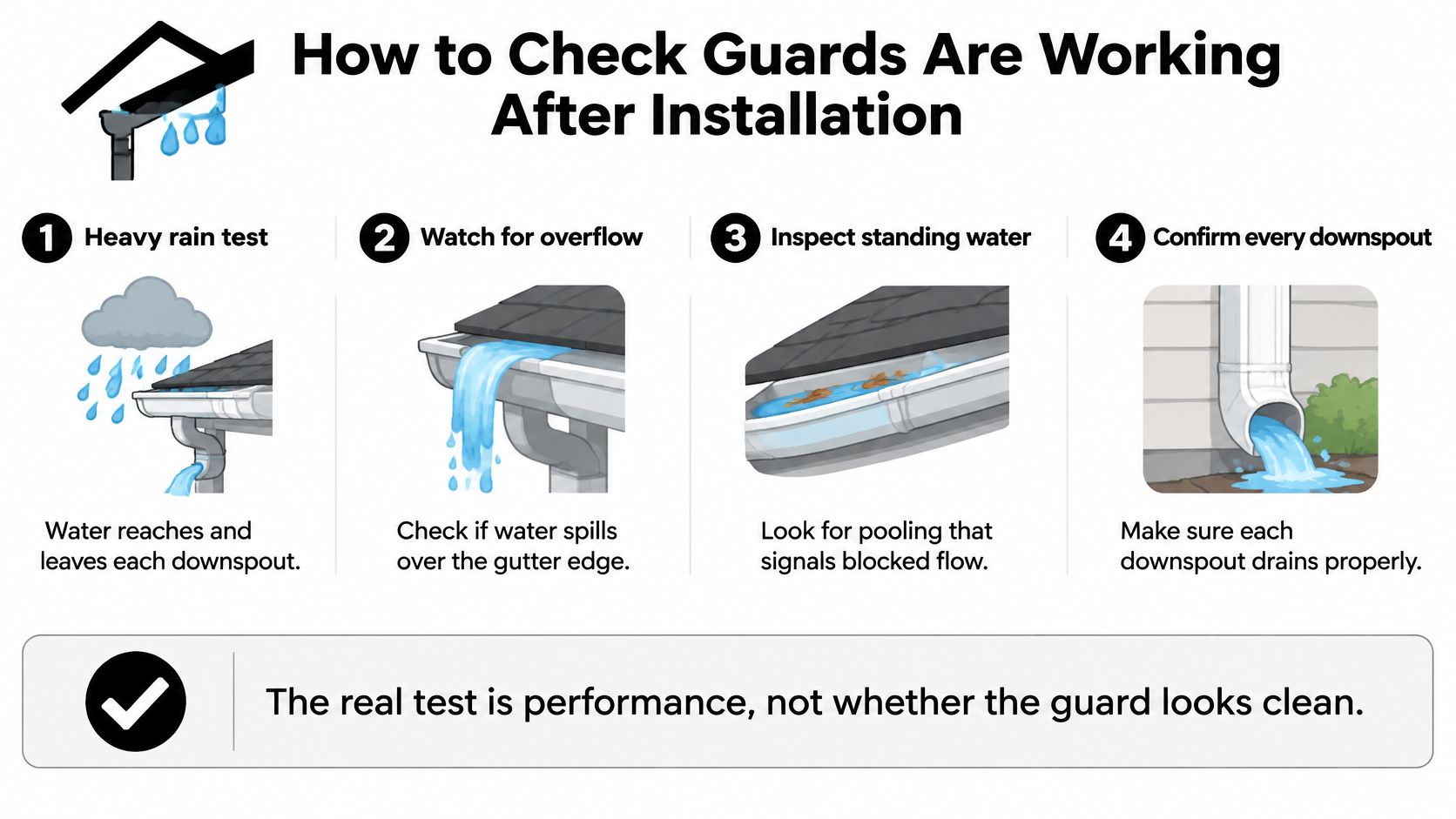
Watch the system during heavy rain from a safe position on the ground. The meaningful test is whether water enters the gutter and leaves through each downspout, not whether the cover looks tidy on a dry afternoon.
Pay particular attention below roof valleys, at inside corners, and along low-slope runs. Concentrated runoff can reveal problems that a light hose rinse won't reproduce.
Use a flow-first inspection checklist
- Watch one heavy rain. Trace runoff from the roof edge toward the outlets without standing beneath unstable branches or climbing during the storm.
- Look for overflow. Note the exact location of water spilling over the front or behind the gutter. Photograph it from the ground for the person diagnosing the problem.
- Check the guard surface. After conditions are safe, look for a sediment film, lodged needles, damaged mesh, or debris piled below a valley.
- Confirm every downspout. Check each outlet separately. Strong flow from one doesn't establish that the others are open.
- Inspect attachment points. Have loose fasteners and displaced sections reseated using the correct attachment method. Don't improvise screws through roofing.
- Brush or rinse debris. Use a soft-bristle brush and gentle water flow where safely accessible. Avoid pressure-washing mesh or forcing debris into outlets.
Use this visual checklist when checking drainage.
Set a maintenance schedule, then adjust it
USA Today's gutter guard guidance supports visual inspection at least once or twice annually, particularly after major storms. For a Colorado Springs home, spring and the period after autumn leaf drop are useful checkpoints, with additional attention around conifers.
Cultivate House Detailing recommends gutter cleaning twice per year, in spring and fall, and more often when a property has many trees or heavy rain. We don't treat a guard installation as permission to abandon that maintenance routine.
A clean cover with continuing overflow calls for diagnosis rather than more brushing. Undersized gutters, poor pitch, damaged fascia, blocked downspouts, and ice-related problems require separate corrective work.
Healthy-system check: Water moves toward the outlets, every downspout discharges, and no persistent pooling remains after drainage.
If you're also noticing dirty glass beneath the roofline, identify the runoff problem before scheduling exterior window cleaning. Window washing removes dirt and streaks, but it won't stop a gutter from repeatedly spilling water onto the same panes.
Request a Gutter Guard Estimate in Colorado Springs
A useful gutter guard estimate starts with the conditions that affect fit and installation: gutter length, building height, roof slope, nearby trees, current cleaning needs, and the look you want. Bring a few details to the consultation:
- Estimate gutter length. Use existing plans or ground-level measurements rather than climbing.
- Note difficult access. Identify upper stories, steep roof areas, and uneven ground.
- Photograph the roof edges. Include overflowing corners, damaged sections, and nearby trees.
Cultivate House Detailing serves Colorado Springs, Black Forest, Monument, Manitou Springs, and Woodland Park. The team helps customers choose guards based on gutter size and style, roof slope, and appearance, and recommends professional installation. A gutter-system inspection can also identify damage and any needed repairs.
If roof damage needs assessment, a free roofing estimate from America Roofing is a separate resource, not a substitute for evaluating gutter drainage. Have your photos and cleaning history ready when requesting a gutter guard quote.
Cultivate House Detailing offers gutter cleaning, gutter guards, pressure washing, and residential and commercial window cleaning. Visit Cultivate House Detailing to request a quote for your gutter needs, and ask about window cleaning for your home or business during the same inquiry.