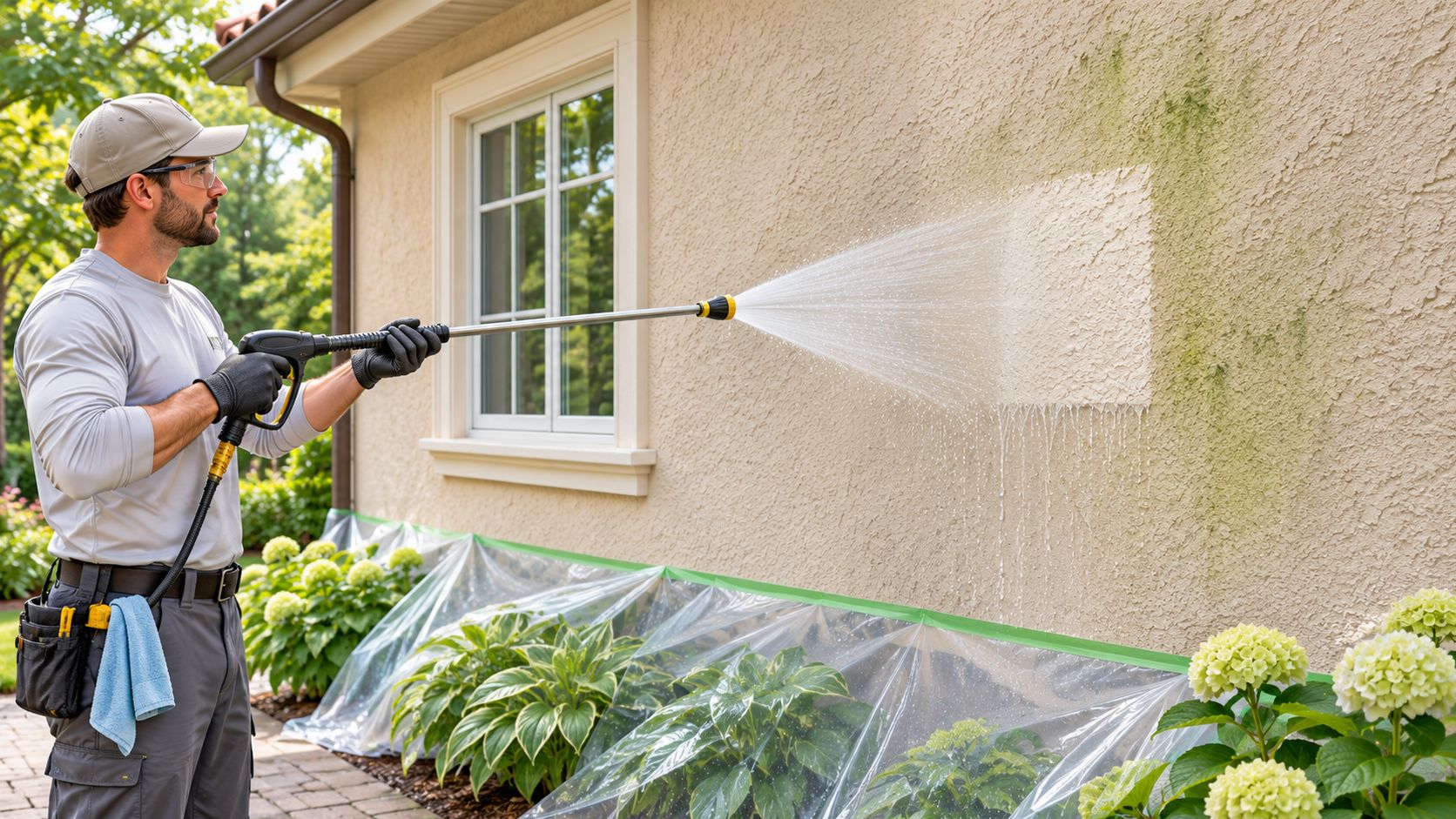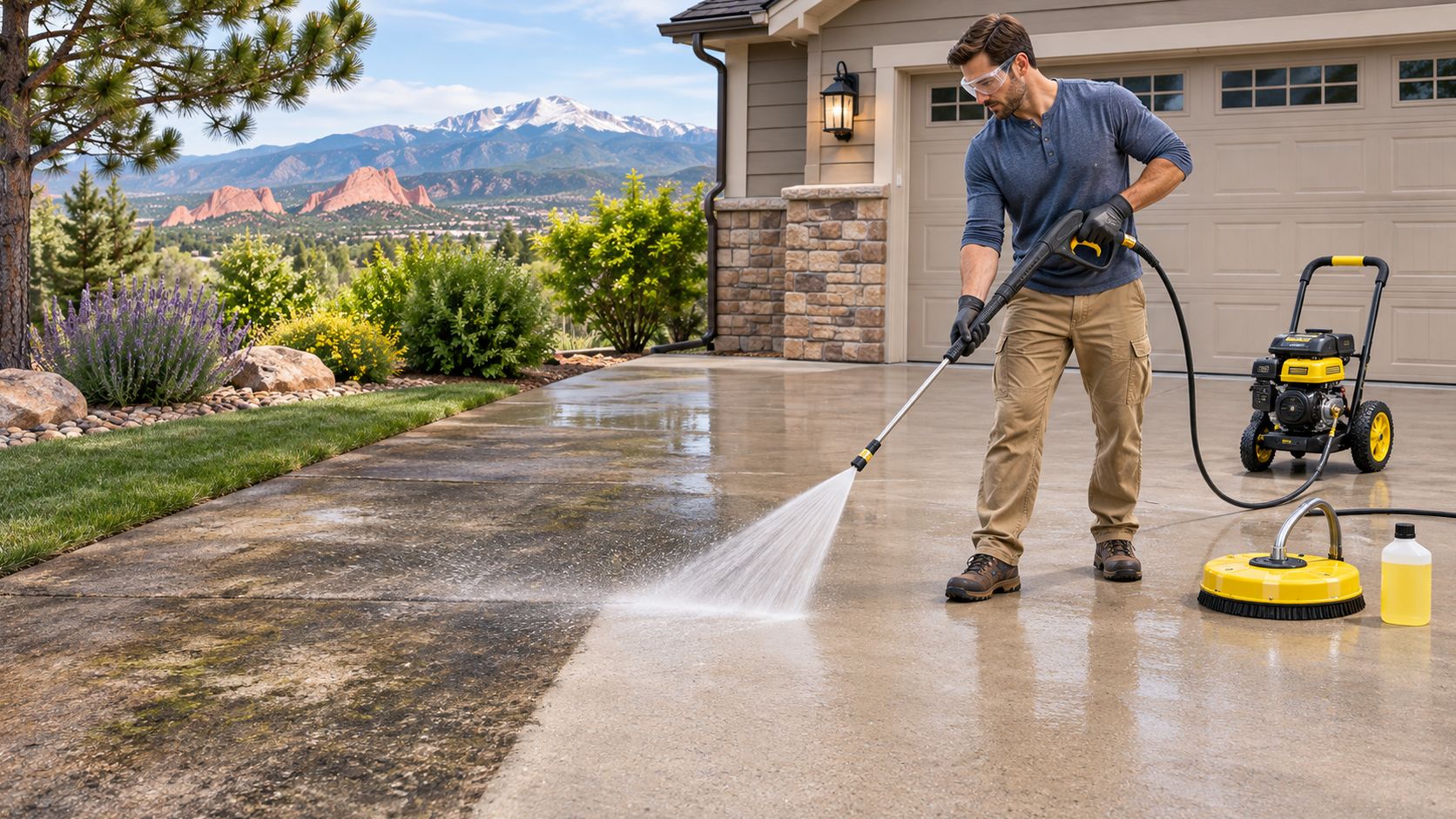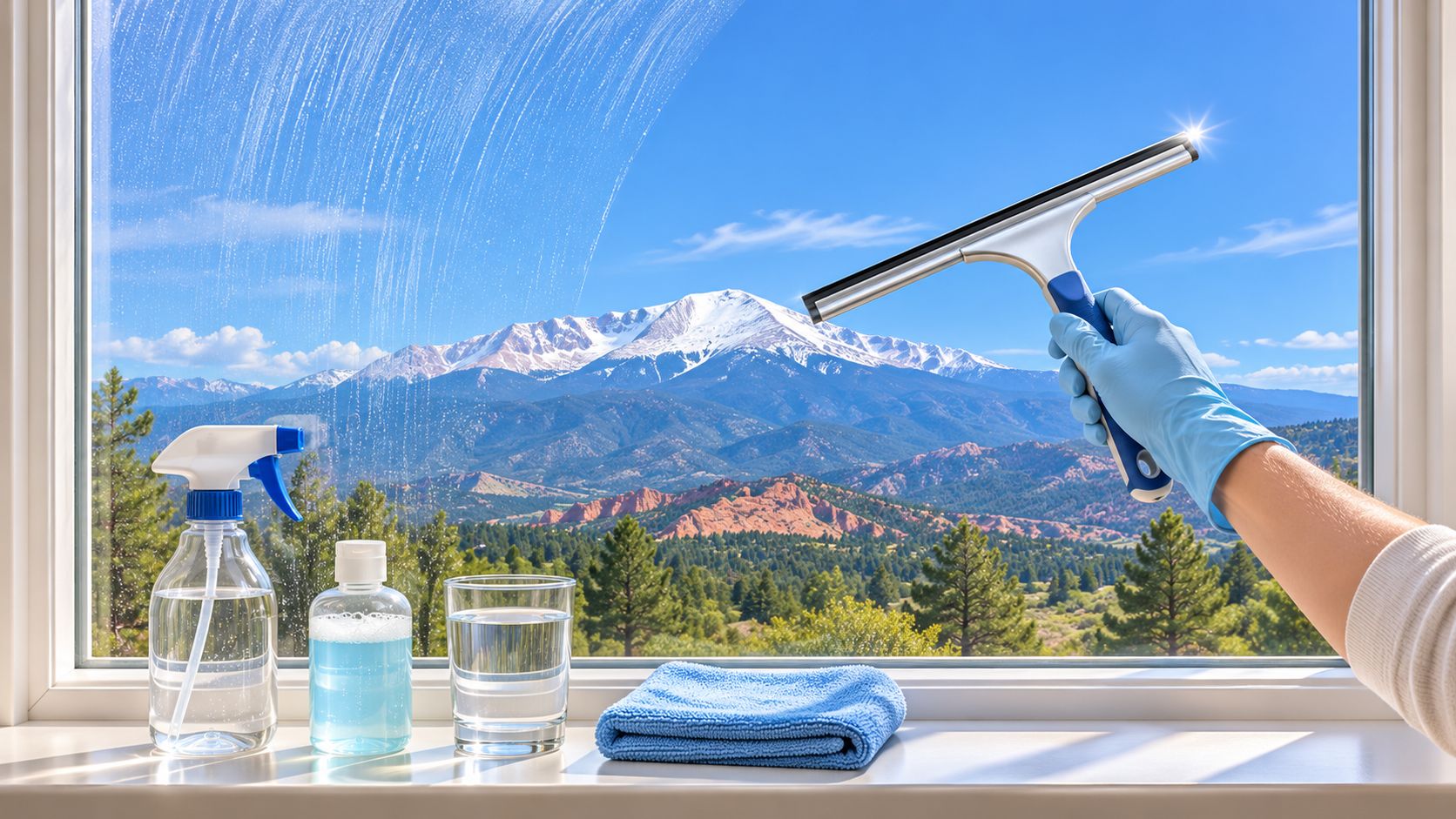
The best window cleaning solution is a measured low-residue surfactant mix of roughly 0.05% to 0.25% in water, followed by a purified-water pass, because stronger detergent causes the streaks people are trying to remove. Push past that range and the film left behind dries into the same trails you were wiping away.
Low winter sun comes through a picture window in Colorado Springs, and from across the room you can count every dried streak. You've already tried the blue spray, a vinegar mix and half a roll of paper towels. In flat light the glass looked acceptable. In direct sun it looks like a topo map of the Front Range.
The effort wasn't the problem. The chemistry was: too much surfactant, a solvent that doesn't match the soil, or hard tap water flashing dry before the squeegee reaches it. Most homes need two products, not a shelf of them, and the first step is identifying what's on the pane.
Cultivate House Detailing is a locally owned team based in Colorado Springs that handles residential window cleaning and commercial window cleaning up to four stories, with regular routes through Black Forest, Monument, Manitou Springs and Woodland Park.
Why the Right Window Cleaning Solution Matters
Three bottles sit under your sink and none of them fixed the window. The blue spray dried before the paper towel got there. The vinegar mix cut the spots on the patio door and left a rainbow haze on the slider by the kitchen. The dish soap worked fine on the grill and turned the picture window into a map.
None of that is a work-ethic problem. It's a chemistry problem, and it shows up in three flavors. Too much surfactant leaves a film that dries into trails. The wrong solvent smears grease instead of lifting it. Hard tap water flashes dry before the squeegee crosses the pane, and every mineral in it stays put.
Direct sun is an unforgiving inspector. Flat light hides residue, and a west-facing window at 4 p.m. in January shows every pass you made.
The diagnostic that matters: a pane that streaks in direct sun is usually a dilution problem before it's a technique problem.
Two products cover most Colorado Springs homes: one mild surfactant mix for everyday glass, and one purified-water option for the final pass on anything high, hot or hard to reach. Everything else on the shelf is a specialty for a specific soil, or a bottle you'll use twice a year. Before you buy another one, find out what's on the pane.
The Window Cleaning Solutions Homeowners Compare
Most homes need two products: a mild surfactant solution for everyday glass and a purified-water option for the final pass. The rest of the shelf is specialty work, bought for one specific soil.
| Solution type | Best for | Typical dilution | Residue risk | Main caution |
|---|---|---|---|---|
| Ready-to-use spray | Interior glass and quick touch-ups | Pre-mixed | Low to medium | Check ammonia or alcohol content and ventilate |
| Dish soap and water | Exterior dust and pollen | About 1/4 teaspoon per gallon (roughly 0.03%) | Medium if over-mixed | More than a few drops leaves film |
| White vinegar and water | Mineral film and hard water spots | About 1 cup per gallon (roughly 0.3% acetic acid from 5% vinegar) | Low on glass, high on metal | Acid can dull stone, sealant and some frames |
| Commercial concentrate | Whole-home or route work | Per label | Low when measured | Over-dosing causes streaks |
| Purified or deionized water | High exterior glass and final pass | None | None | Needs a water-fed pole or tank |
| Ammonia-free solvent cleaner | Cooking grease and smoke film | Pre-mixed | Medium | Solvents can haze tinted film |
| Rubbing alcohol and water | Sap, adhesive and winter quick fixes | About 1 part alcohol to 3 parts water | Low, flashes off fast | Flammable, and avoid tinted glass |
Ready-to-use sprays are the volume leader in this category. Dataintelo estimated that spray cleaners held 38.5% of the global window and glass cleaner market in 2025, according to its window and glass cleaner market report. They earn that share on convenience: no measuring, no bucket, and a bottle that fits in a caddy for interior window cleaning touch-ups. Read the label first, because ammonia and alcohol content decide how the product behaves near tinted film and how much ventilation the room needs.
Dish soap and water is the cheapest exterior window washing mix there is, and it's the most over-dosed. A quarter teaspoon per gallon lands near 0.03% surfactant, enough to lubricate a squeegee and float off pollen without laying down a film. Squeeze the bottle freely and you'll spend the afternoon rinsing a soap slick off the siding.
White vinegar at about one cup per gallon sits near 0.3% acetic acid when you start from standard 5% household vinegar. It dissolves calcium rings and hose-water haze that soap can't touch. It also etches natural stone, dulls anodized aluminum and attacks some sealants, so it belongs in a labeled sprayer, not in a bucket you carry around the property.
The rest of the shelf, and why it exists
Commercial concentrate: mixed per the label, it delivers the lowest cost per pane across a whole property. "Concentrate" is also the warning label. Twice the dose buys a second pass, not twice the cleaning.
Purified or deionized water: no minerals, so nothing dries into a spot. That's why the finish pass on high exterior glass uses it, and why it needs a water-fed pole or a tank rather than a trigger head.
Ammonia-free solvent cleaner: cooking grease, smoke film and kitchen haze come off with solvent, not with more soap. Some formulations can haze aftermarket tint and window film.
Rubbing alcohol at about 1 part to 3 parts water: sap, sticker adhesive and winter tape residue lift fast and flash off before they run. It's flammable, and it doesn't belong on tinted glass.
Group these into three families and the shopping list shortens. Water-only products, meaning purified water and alcohol mixes, leave nothing behind when used correctly. Surfactant products, meaning sprays, dish soap and concentrates, do the soil removal and carry the residue risk. Acid and solvent products, meaning vinegar and degreasers, solve specific problems and can damage the surfaces around the glass.
Two mistakes show up on do-it-yourself glass over and over. Over-dosed dish soap leaves a film that looks exactly like a bad squeegee. Vinegar used carelessly around stone and metal trim leaves a mark that outlives the water spot it removed.
The soil on the pane decides which of these you reach for, so identify it before you fill a bucket.
Safe Ingredients and the Surfaces Around the Glass
Glass cleaners aren't automatically benign, and the public-health record proves it. A CDC-linked hazard assessment tallied 1,564 reported exposures to household glass cleaners containing ammonia in 2002. Of those, 127 people (8.1%) were treated at a health care facility, 20 of the treated cases (15.7%) had moderate outcomes, and no deaths were reported. Children younger than 6 accounted for 78% of reported glass-cleaner exposures, according to the household glass cleaner hazard assessment. Secure storage matters more than most homeowners assume.
Formulation and instructions change the exposure itself. Label-directed use of a spray-on window cleaner produced an average short-term airborne ammonia concentration of about 0.7 parts per million, against roughly 10 ppm for a 0.1% floor-and-tile-cleaner solution and 11 to 30 ppm for a 0.2% solution, in the same assessment. Same chemical family, very different air.
Airborne exposure is only half of it. The U.S. Environmental Protection Agency reports that concentrations of many volatile organic compounds are consistently higher indoors, sometimes up to 10 times higher than outdoors, and that these chemicals can be released while products are used and while they're stored, as its indoor air quality guide for your home explains. Ventilate during and after interior work, use the least product that does the job, keep lids on, and never mix bleach with ammonia or vinegar.
Surfaces around the glass matter more than the glass
| Surface or material | Vinegar or citric acid | Ammonia-based cleaner | Razor or abrasive | Safer choice |
|---|---|---|---|---|
| Bare clear glass | Safe | Safe with ventilation | Safe if lubricated | Either |
| Tinted or filmed glass | Check film warranty | Avoid | Never | pH-neutral soap |
| Anodized aluminum frames | Rinse immediately | Safe | Avoid abrasives | Soap and water |
| Painted wood frames | Avoid runoff | Safe | Avoid | Damp cloth |
| Vinyl frames | Safe | Safe | Avoid | Soap and water |
| Stucco and masonry | Rinse before and after, since acid can etch | Safe | Never | Water only |
| Natural stone sills | Avoid, acid etches | Safe | Never | Stone-safe cleaner |
| Concrete walks below windows | Rinse, acid stains | Safe | Never | Water |
| Sealant and caulk | Avoid, acid degrades | Check label | Never | Soap and water |
| Fiberglass or aluminum screens | Mild mix | Safe | Gentle brush only | Soap and water |
Vinegar and citric acid are fine on bare glass and risky on nearly everything around it. That's the part most guides skip: a spotless pane with a dulled limestone sill and a chalky sealant line is a worse outcome than a pane with two water spots.
The razor blade deserves its own warning. On bare, tempered, unfilmed glass with plenty of lubrication, a fresh blade lifts paint and sticker residue cleanly. On coated, tinted or filmed panes it cuts a permanent line, and on frames it gouges anodizing that can't be refinished. For tinted or filmed glass, the film warranty decides, not the cleaner, and what to use on tinted windows is worth reading before any solvent touches the pane.
Households with toddlers or pets should keep a short list of non-toxic cleaners safe for kids so the everyday bottle isn't the same bottle that strips a sealant or stings a hand.
Natural isn't a safety rating: vinegar is food, and it will still etch a limestone sill if you let it run.
Mask the sill with a rag, pre-wet the stone before any acid goes near it, and rinse the runoff rather than wiping it down the wall. That prep costs two minutes. Repainting a sill or resealing a frame costs a weekend. Gloves, eye protection, closed containers and a locked cabinet finish the list for homes with young children.
Matching the Solution to What Is on the Glass
Streaking isn't only a wiping error. It's strongly influenced by formulation chemistry and drying behavior, and glass cleaner testing shows the two have to move together. Patent literature reports that increasing certain amphoteric surfactants improves soil removal and can also increase streaking, while selected solvents pull that back. One disclosed formulation found its balance around 3% amphoteric surfactant with 0.2% N-alkyl pyrrolidone and 0.6% of an ethylene glycol hexyl ether type solvent, per the glass cleaner formulation patent. You aren't mixing that at home. The lesson is that surfactant and solvent are tuned together, never one at a time.
| Soil or residue | How it looks | Best solution | Method | Avoid |
|---|---|---|---|---|
| Wind-blown dust and pollen | Brown or yellow film after wind | Dish soap mix | Pre-wet, scrub, squeegee | Dry wiping, which scratches grit |
| Fingerprints and cooking grease | Hazy interior panes near the kitchen | Ammonia-free solvent or alcohol mix | Dwell one minute, wipe, buff | Excess soap that films |
| Hard water and calcium spots | White rings or rainbow haze | Vinegar or citric mix, then purified water | Dwell 2 to 5 minutes, agitate, rinse | Razor blades on coated glass |
| Bird droppings and tree sap | Raised, sticky, dark spots | Warm soapy water, then alcohol | Soak until soft, lift with a plastic scraper | Scraping dry or with steel wool |
| Paint overspray and construction dust | Speckled grit and paint flecks | Soap mix plus plastic scraper | Wet the surface and keep it lubricated | Razor on tempered or filmed glass |
| Smoke and nicotine film | Yellow-brown interior haze | Degreasing solvent cleaner | Two passes, change rags often | Vinegar alone, which smears |
| Winter road film and salt | Gray haze on lower panes | Warm soapy mix | Work top down, rinse frames | Acid on aluminum or concrete |
| Screen oxidation haze | Gray streaks where screens sit | Soap mix plus screen cleaning | Clean screens separately | Cleaning glass with screens in place |
Dust and pollen need lubrication before anything touches the glass. Dry grit under a dry paper towel is sandpaper with a short career, so pre-wet and let the sleeve carry the particles off.
Grease needs solvent, not more soap. A soap-only pass on kitchen glass smears the film wider, which is why degreasers exist and why vinegar alone makes it worse.
Hard water needs an acid dwell of two to five minutes, then a purified-water rinse. Agitate with a non-abrasive pad, keep the acid off frames and sills, and never take a razor to coated glass to chase a ring.
Droppings and sap need soaking until they're soft, then a plastic scraper. A dry blade or steel wool on either one leaves a scratch that no subsequent pass will fix.
An inside pane that fogs or beads in cold weather isn't a cleaner problem at all. It's moisture, and why windows sweat inside homes covers what to check before you blame the bottle.
Skip a step and you get a two-stage reality: strong wash, then a cleaner, lower-residue finishing pass, because dissolved soil and detergent will dry back onto the glass if you let them.
If a spot doesn't soften after a two-minute dwell with the right chemistry, it isn't dirt.
That's the two-minute test, and it saves homeowners a lot of scrubbing. Etched mineral damage and coating failure are physical changes to the glass surface, so no bottle removes them, and no stronger mixture will either. Give the acid a short dwell, rinse, and if the ring stays, the fix is polishing or replacement. Put the safety steps from the section above in place before any acid goes on a pane.
How to Mix and Apply a Streak-Free Solution
The routine below is what I'd hand a new technician on day one. Eight steps carry the whole job, and each one exists because of a specific failure I've watched ruin otherwise clean glass.
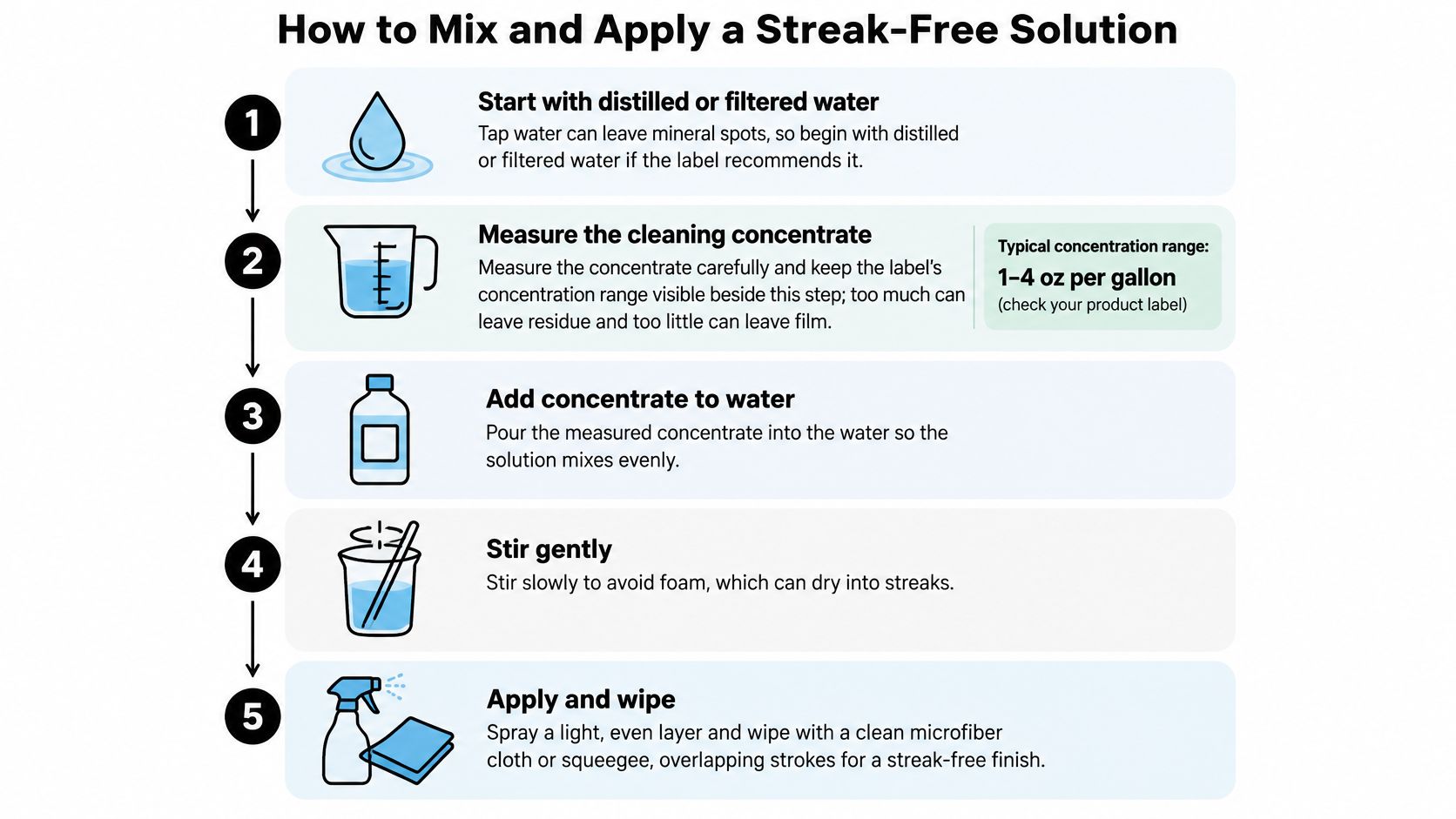
- Start with distilled or filtered water if your tap is hard. Local tap carries calcium and magnesium, which are the white rings you're trying to remove, so mixing with hard water puts the problem back in the bucket.
- Measure the surfactant instead of pouring it. A quarter teaspoon of dish soap per gallon is about 0.03%, a light and workable dose. Technical formulations put the workable range at roughly 0.02% to 1% surfactant in the ready-to-use solution, with 0.05% to 0.5% preferred and 0.05% to 0.25% for the lowest residue, per the glass cleaner formulation document. Keep those ranges taped inside the bucket lid.
- Leave alcohol out of the wash water. Reserve the 1 to 3 alcohol mix for sap and adhesive spots, applied to a cloth rather than the whole pane.
- Test one inconspicuous pane first. A small window or a corner behind a curtain tells you whether the mix is too strong before you commit a whole wall.
- Pre-wet, then scrub with a microfiber sleeve or strip washer. Work edges and corners, because grit sitting at the frame line runs down on your first squeegee pass.
- Squeegee in overlapping strokes and wipe the blade after every pass, so you're never dragging dirty water back onto clean glass.
- Detail edges and tracks with a dry microfiber. Corners hold the water that dries into white lines.
- Finish high exterior glass with purified water. Nothing left behind means nothing to dry into a spot.
Here's the squeegee pass in motion, which is faster to watch than to describe.
Why the measuring matters. Surfactants lower surface tension, spread the solution across the pane and suspend oily soil. Whatever surfactant stays on the glass after the water evaporates becomes a thin film, and that film is what you see as streaks, especially where the applicator laid it on unevenly or the pane dried before the squeegee arrived.
Higher strength helps grease and hurts clarity. Reported degreasing formulations run roughly 0.1% to 5% surfactant for difficult grease, and the same technical literature warns that heavier detergent doses increase filming and streaking. So resist the urge to add another squeeze of soap when the first pass struggles. The fix for heavy soil is a controlled wash followed by a prompt squeegee, not a hotter mix. This discipline matters most on fourth-story work, where rework means a ladder reset and direct sun shows every error you left behind.
Two habits separate a clean rinse from a wasted afternoon. Replace the solution when it turns gray, since dirty water redeposits everything you just lifted. And work in shade between 50 and 70 degrees so the squeegee finishes each pass before the edges dry.
Water quality drives most of what can go wrong in these eight steps. If your tap is hard, no amount of careful measuring fully compensates, because the minerals are in the bucket before you add a drop of soap. Purified water eliminates the minerals and impurities entirely, which is why professionals rely on it rather than stronger detergent for high exterior glass. How water quality affects streak-free window cleaning breaks down the mineral side of this pane by pane.
Why Colorado Springs Glass Gets Stubborn
Local conditions make the same glass behave differently than it would in a humid coastal city. Colorado Springs sits above 6,000 feet with intense sun, low humidity and near-constant wind, so glass collects dust, pollen and grit faster than it does in most of the country. Sun then bakes that film on before the next rain.
Sprinkler overspray and hose water leave calcium carbonate that bonds in weeks and etches in months. Monsoon runoff carries dust that dries into a gray sheet across west-facing panes. Winter brings magnesium chloride and traction sand onto lower windows, and the result is a film that soap alone pushes around rather than lifts.
Etching is the part homeowners underestimate. It's physical damage to the glass surface, not a stain sitting on top of it, so no solution removes it. Only polishing or replacement restores clarity. The same hard water that ruins glass also stains the stucco and concrete under the sills, which is why rinse water and runoff control matter as much as the mix in the bucket.
Where DIY stops
- The spot survives a dwell. If a white ring stays after two minutes of the right acid mix, the glass is etched or the coating has failed.
- There's height involved. Anything above the ground floor turns a twenty-minute job into a ladder, a stabilizer and a spotter, and window wells, skylights and steep rooflines are worse.
- The glass is tempered, tinted or filmed. Coated panes limit both acids and blades, and a mistake up there can't be undone.
- The count passes about 40 panes. Beyond that, the setup, the water and the squeegee time cost more than a crew does.
Ladders are the practical line for most homes, and the risk math is the honest reason. A fall off a ladder while chasing one stubborn pane costs far more than the cleaning.
What Professional Window Cleaning Includes
A professional visit covers more glass than homeowners expect. Exterior window cleaning reaches windows up to 4 stories above the ground, including bay, picture and dormer windows, and we use water-fed poles that pump highly purified water up to the glass so high exterior panes finish clean with no detergent residue and no ladder against the siding. Inside, interior window cleaning includes the wipe-down that removes fingerprints, pet smudges and cooking grease from the glass, plus squeegee work into corners and tracks.
- Screens and tracks on request: screen cleaning and track cleaning can be added to a project when you choose them on the quote, and screen repair is part of the service.
- Hard water and organic soil: we scrub away bird droppings, tree sap and hard water stains from exterior glass, which is the removal step that protects clarity long term.
- Equipment that explains the finish: rubber squeegees pull the water and dirt off in one pass, and purified water eliminates minerals and impurities so the glass dries spotless and streak-free.
Winter work continues on warmer days, with the mix adjusted for colder temperatures so it doesn't freeze on the glass before the squeegee reaches it.
What a crew needs from you is simple: access to the panes, pets secured, and a parking spot within hose and pole reach. The rest is our problem, including the fourth-story panes and the window wells.
What Window Cleaning Costs and How Often to Book
Price comes down to time and risk, not to a flat rate. The main drivers are the window and pane count, the number of stories and whether the job needs a water-fed pole or a ladder, how much is interior versus exterior, whether screens and tracks are included, and how long hard water, paint overspray or construction dust adds to each pane. Access changes it too: window wells, skylights and steep rooflines take longer than a straight run of double-hung glass.
That's also the honest comparison between DIY and a professional visit. A homeowner with a handful of ground-floor panes can run the routine above with a bucket, a sleeve and a squeegee and get good glass. Once the work moves up, out, or into etched mineral damage, a crew with purified-water equipment and the right tools wins on time, safety and finish.
Timing rule for Colorado homes: exterior glass wants a clean after winter and again in early fall, before the cold sets in.
A simple schedule works for most properties. Many Colorado Springs homes benefit from exterior cleaning a few times a year, with spring after the sand and salt season and early fall before the first freeze as the two dates that matter. Businesses with storefront glass often run a recurring schedule instead, because customer-facing panes collect fingerprints faster than anything the weather does.
Pricing is quoted after a look at the property rather than over the phone from a flat rate, and the walkthrough happens before the crew leaves so nothing on the glass is a surprise later.
Request a Quote for Streak-Free Windows in Colorado Springs
Have a few details ready and a quote takes minutes. I'd want the window count, the number of stories, whether you want interior and exterior, whether screens and tracks are included, and any hard water rings or paint overspray you've already noticed. Residential window washing pricing typically includes removing bug screens, cleaning them and re-installing them, so that part is already handled.
Purified water is the reason the finish comes out spotless and streak-free, and it's the same reason high exterior glass doesn't need a ladder against your siding. We schedule across Colorado Springs and nearby communities including Black Forest, Monument, Manitou Springs and Woodland Park, and we clean through the winter on warmer days with the solution adjusted for the cold.
Request a quote or book a walkthrough, and expect transparent pricing, an on-time arrival and a final pass around the property together before we pack up.
Cultivate House Detailing brings streak-free residential and commercial window cleaning to Colorado Springs and the surrounding foothills, from ground-level glass to fourth-story panes, using purified water and rubber squeegees rather than a mystery bottle from under the sink. Send over your window count, story count and the spots that have been there since last spring, and we'll quote the job after a walkthrough. Visit Cultivate House Detailing to schedule service and see what the right solution, measured and applied correctly, does for your view of Pikes Peak.