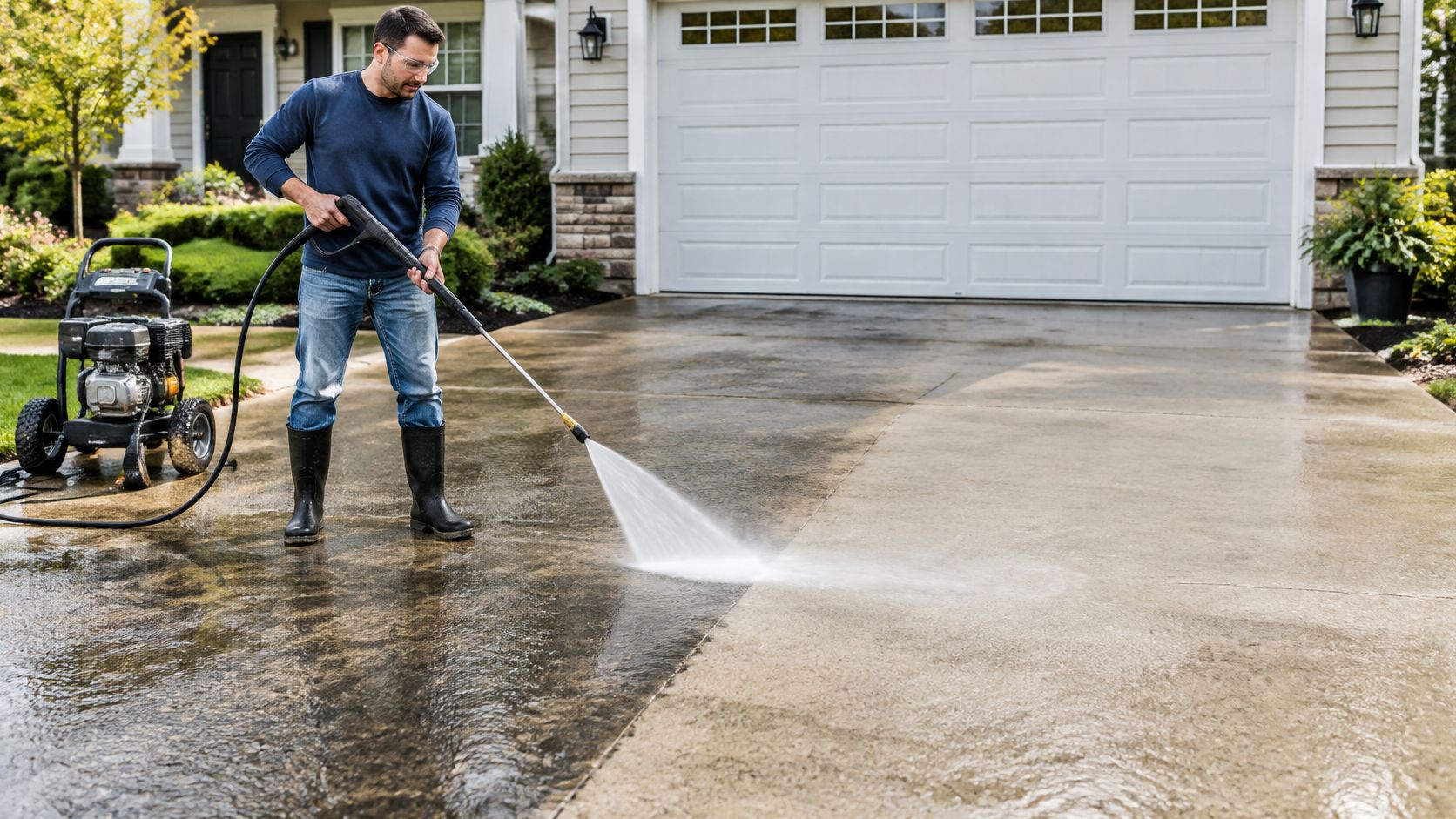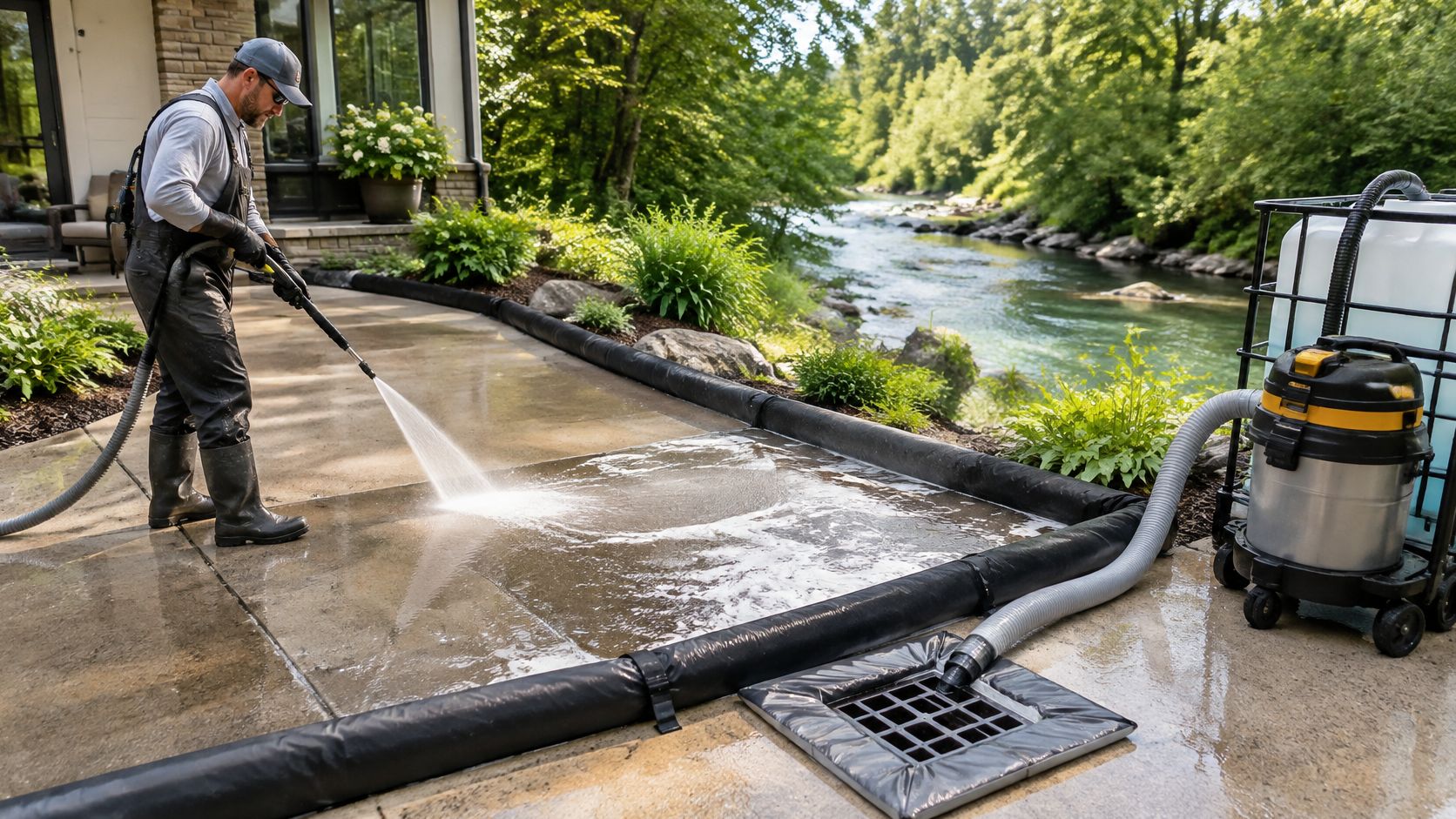
Buying biodegradable soap isn't enough to make a wash environmentally responsible. Eco friendly pressure washing starts with deciding where the dirty water will go, before anyone pulls the trigger. A clean driveway doesn't count as a good result if its oil, grit, and detergent end up in a storm drain.
For homeowners comparing window cleaning in Colorado Springs, CO, that same attention to detail matters around glass, screens, siding, and landscaping. Cultivate House Detailing is a locally owned company serving Colorado Springs and surrounding communities. Whether you're dealing with streaky windows, seasonal buildup, or a stained walkway, the right cleaning plan protects both the property and the water leaving it.
Where Wash Water Can Safely Go
The wastewater determines the disposal route, not the soap label. Identify what the wash will remove, then choose a collection and disposal method that can handle those contaminants.
Lawful wash-water routes by water type
The EPA's wash-water management guidance describes containment, recovery, oil-water separation, approved sanitary-sewer discharge, and hazardous-waste handling as controls for cleaning wastewater.
| Wastewater type | Typical source | Lawful route | Keep out of |
|---|---|---|---|
| Clean rinse water, no soap | Plain high-pressure rinse of light dust or pollen | Absorbent lawn or planting bed, only if it will not pond or run off and local rules allow | Storm drains and gutters |
| Detergent wash water | Biodegradable or low-toxicity cleaner on siding or patios | Sanitary sewer where local rules allow, or captured for disposal | Storm drains and surface water, even when labeled biodegradable |
| Oily or grease-laden water | Driveways, garages, food-service walkways | Oil-water separator, then approved disposal | Any drain or bare soil before approved treatment |
| Paint or chemical residue | Peeling paint, strong cleaners | Licensed hazardous-waste hauler when hazardous contamination is present | Any drain, lawn, or soil |
| Heavy sediment slurry | Construction dirt, gravel-heavy surfaces | Solids removed first, then sanitary sewer or approved disposal per local rule | Storm drains |
Clean rinse water means water without added cleaner or harmful contamination picked up from the surface. A planting bed is only a possible destination when it can absorb that water without erosion, pooling, or overflow toward the street. Don't assume a narrow strip of grass can absorb an entire patio rinse.
Detergent wastewater needs an approved treatment route. A sanitary sewer may be appropriate, but only after the receiving utility confirms its conditions. A nearby cleanout isn't automatic permission to discharge.
Oily water needs separation and approved handling. An oil-water separator isn't a universal filter, and it doesn't make every cleaner or dissolved contaminant acceptable for sewer discharge. Paint residue and strong chemical waste require particular caution, especially when the coating or chemical's composition is unknown.
For sediment slurry, collect grit before disposing of the remaining water. Settling or filtering solids keeps the disposal process from becoming a plumbing blockage, but it doesn't remove every dissolved pollutant.
Why even a small wash needs a route
Consider a driveway with automotive stains, a patio covered in pollen and mildew, and a restaurant entrance carrying kitchen grease. All look like ordinary cleaning jobs. Each produces different wastewater.
The municipal pressure-washing guidance explains that sediment can cloud water and clog fish gills, while soaps and nutrient-bearing residues can contribute to algal blooms and low-oxygen conditions; grease, automotive fluids, hot water, and chemicals also threaten aquatic life. It also describes the federal illicit-discharge framework for municipal storm sewers, which generally treats discharges not composed entirely of stormwater as illicit, subject to specified exceptions.
That distinction matters because storm drainage doesn't provide conventional wastewater treatment. Removing dirt from concrete relocates the pollution unless the cleaner controls the water.
Practical rule: If wash water could reach a drain, it isn't a rinse-only job. It needs a drainage-control plan.
Landscaping deserves a separate care plan rather than becoming the default wastewater destination. For homeowners also reviewing lawn treatments, Barefoot Organics' resource on pet-safe weed control options is a useful companion topic. Choosing gentler lawn care and managing cleaning wastewater are complementary decisions, not substitutes for each other.
Local Rules and Permits to Check First
A Colorado Springs address doesn't tell you everything about a property's drainage. A driveway may drain toward a public inlet, while a shopping center may have privately maintained collection structures connected to a larger system. Identify the receiving system before choosing a discharge route.
This checklist highlights the distinctions to verify before work begins.
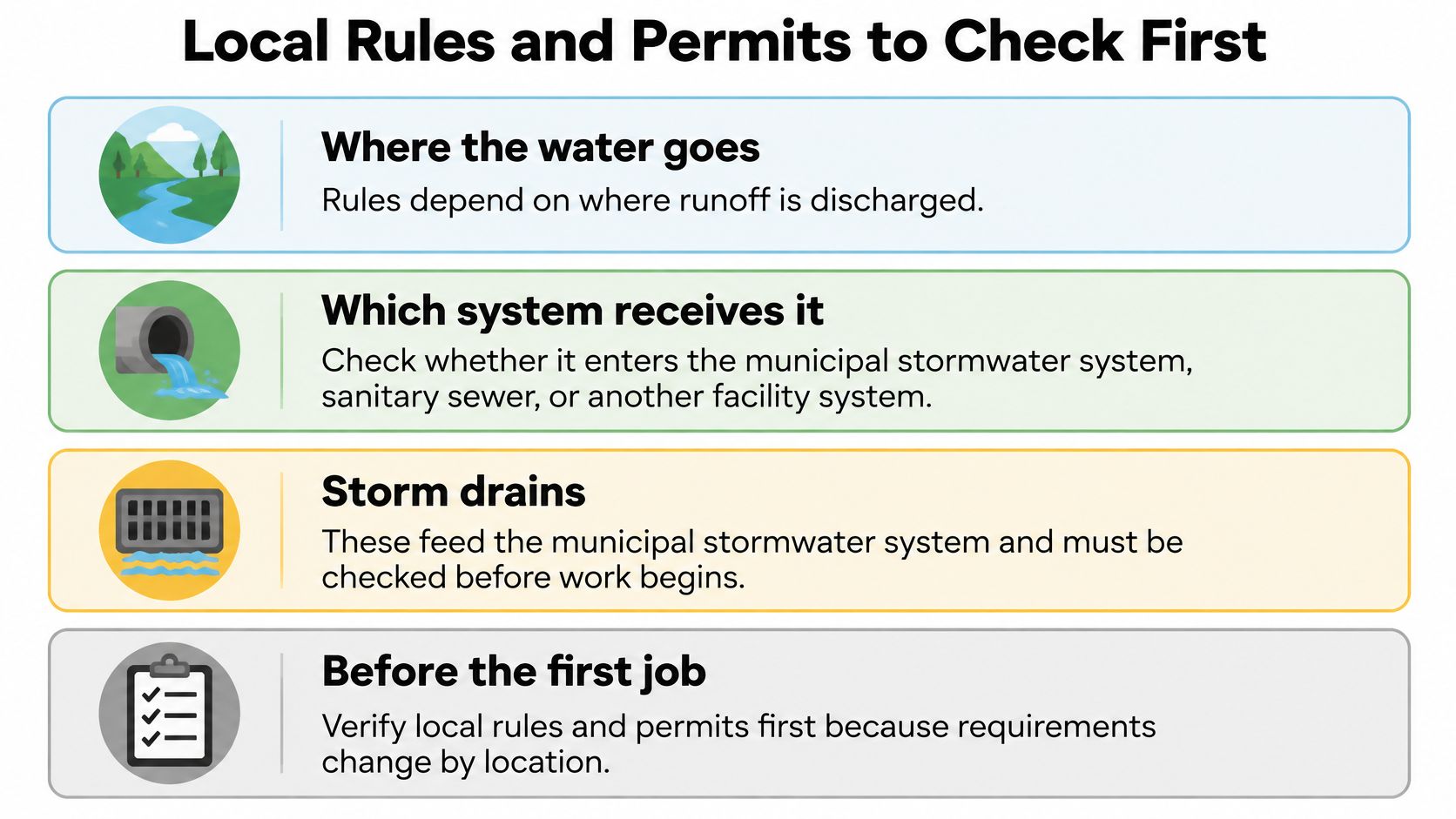
Check the receiving system and property rules
Run through these questions during the estimate or site walk:
- Drain ownership: Who owns and maintains nearby inlets, trench drains, and catch basins?
- Stormwater connection: Does the opening carry water into the municipal stormwater system, even if it's on private property?
- Sanitary-sewer acceptance: Will the receiving utility accept this wastewater, and does it require pretreatment, authorization, or a particular discharge point?
- Property approval: Does the HOA or property manager restrict exterior cleaning, common-area access, equipment placement, or work hours?
- Hazardous materials: Could old coatings, automotive fluids, or chemical residues require specialized testing or disposal?
- Site permits: Does an existing industrial, construction, or other site permit govern the activity?
- Documentation: Who will retain disposal approvals, hauling receipts, and the job's wastewater record?
Don't confuse permission to clean a property with permission to discharge wastewater. A property manager can approve access without having authority to authorize a sewer discharge.
Know when a permit question needs escalation
The federal stormwater framework includes permit requirements associated with industrial activity, construction, and designated municipal systems. That doesn't mean every residential wash needs an individual federal permit. It means larger or regulated properties need a site-specific review rather than a residential-job assumption.
Ask the site contact for applicable permit conditions before scheduling work at commercial facilities. A restaurant service area, active construction entrance, and office courtyard shouldn't automatically receive the same disposal plan.
Approval to use a sanitary sewer should come from the authority responsible for receiving the water, not from the person holding the hose.
Confirm current requirements with City of Colorado Springs stormwater staff and the appropriate sewer provider. Requirements and site conditions can change, and an online article can't authorize a discharge. Resolve uncertainty before equipment arrives, when there's still time to arrange collection or off-site disposal.
How to Cut Water Use Without Losing Cleaning Power
Gallons per minute, or GPM, describes flow. Pressure describes force. Compare both, along with how long the trigger stays open, rather than judging efficiency by pressure alone.
Water use at common flow rates
The following illustrative calculations use continuous spraying for an hour, with hourly demand calculated as GPM multiplied by minutes; the EPA's vehicle-washing guidance supports flow-restricting guns and nozzles as water-saving controls.
| Spray setup | Flow rate (GPM) | Change vs 4.0 GPM |
|---|---|---|
| Standard wand | 4.0, or 240 gallons per hour | Baseline |
| Restricted spray gun | 2.5, or 150 gallons per hour | 37.5% less |
| Low-flow setup | 2.0, or 120 gallons per hour | 50% less |
These are flow comparisons, not promises that every lower-flow machine will finish the same surface in the same time. A setup that needs repeated passes may give back some of its theoretical savings.
Correct nozzle sizing matters. Use a nozzle matched to the machine's operating specifications, not an undersized tip chosen to restrict water. Pair suitable equipment with deliberate passes and release the trigger while repositioning hoses or moving furniture.
Pre-sweeping often saves more effort than trying to wash loose debris across the entire property. Bag leaves and grit first, spot-treat stubborn contamination, and avoid repeatedly rinsing an area because dirty water keeps crossing it.
Match output to the material
Siding and painted wood call for gentler methods than sound, durable concrete. Stone also needs inspection, since a hard-looking surface may have vulnerable joints, coatings, or weathered areas. Our explanation of soft washing versus pressure washing helps homeowners understand why more pressure isn't automatically better.
For measuring actual demand, Axis Meter Solutions' garden hose meter maintenance tips provide useful background on keeping a hose-mounted meter serviceable. Record water used alongside cleaned area, recovered wastewater, and disposal documentation.
Less water isn't the same as less pollution. Reducing rinse volume can leave the removed contamination in a smaller volume of wastewater. The EPA's proposed permit fact sheet pairs water minimization with wash-water filtration, a useful distinction between conserving water and controlling pollution.
A low-flow rinse that escapes into a storm drain isn't greener than a properly captured wash.
For a hypothetical 60-minute continuous-spray job, the arithmetic behind the table is straightforward: 4.0 GPM uses 240 gallons, while 2.5 GPM uses 150 gallons, saving 90 gallons before trigger-off time. On a real job, use measured consumption and actual completion time rather than assuming the equipment rating equals total demand.
How to Set Up Containment Before You Spray
Stage the recovery equipment before connecting the spray wand. A drain cover sitting in the truck won't help once contaminated water reaches the curb.
The opening containment sequence is simple enough to check during the walk-around.

Build the collection path first
The EPA's construction-site washing guidance recommends containing, treating, reusing, or directing wash water to an approved sanitary sewer rather than allowing untreated runoff into storm drainage.
Map the drains. Walk the work area and mark storm inlets, gutter outlets, and low spots the spray could reach. Check beyond the immediate cleaning area, because the common mistake is overlooking an inlet downhill or behind a parked vehicle.
Block or divert. Install weighted drain covers, booms, berms, or suitable plugs before the first pass. Seat barriers against clean surfaces and check their edges, since grit beneath a cover can create a leak path.
Set the containment area. Use a portable wash mat, containment berm, or secured collection tarp where the layout allows. Direct water toward an accessible recovery point, not toward a doorway, basement opening, or neighboring property.
Remove dry debris first. Sweep and bag leaves, trash, and loose grit so they don't become additional slurry. Don't use the pressure washer as a broom, especially where debris can block the recovery equipment.
Recover steadily and finish cleanly
Recover water as you go. Use a wet vacuum, vacuum pump, or portable sump pump suited to the water and solids load to transfer water into a holding tank. Waiting until a pool becomes large makes it harder to contain, so keep someone watching the collection point.
Separate solids and oils. Allow sediment to settle or use appropriate filtration, and arrange oil-water separation when suitable for the contamination. Don't assume a sediment filter also removes oil, dissolved cleaner, or hazardous chemicals.
Confirm disposal before starting. Arrange the approved sewer destination or appropriate waste hauler while planning the job. The common slip is collecting a tank of wastewater without knowing where it can legally go.
A small patio with limited contamination may need a drain cover and wet vacuum. A greasy food-service walkway may require more extensive barriers, recovery capacity, pretreatment, and off-site handling. Size the setup for the contaminant and drainage pattern, not just the square footage.
For a visual companion to the equipment setup, watch the following demonstration.
Finished-job check: No pooled water crosses the curb, no collected solids remain beside a drain, and the disposal record stays with the job file.
Before removing barriers, recover the last puddles and inspect the perimeter. Lift covers carefully so trapped grit doesn't fall into the inlet during cleanup.
Drying Water Trapped Around Doors and Windows
Start the final walk-around at the openings. Check sills, frames, screen edges, door thresholds, and adjoining wall materials for standing water or damp patches. Water can collect behind a screen or at a joint even when the glass looks dry.
Aftercare checklist
- Remove bulk water: Use a squeegee, absorbent cloths, or a wet vacuum appropriate for the location. Don't push water into frame joints or block window drainage openings.
- Accelerate drying: Use fans or a dehumidifier where moisture has entered enclosed areas. The EPA's mold and moisture guidance recommends drying damp or wet materials within 24 to 48 hours to help prevent mold growth.
- Check indoor conditions: The EPA's homeowner mold guide recommends relative humidity below 60%, ideally between 30% and 50%, and identifies window condensation as a reason to dry the surface and address excess moisture.
- Investigate recurring dampness: Check bathroom ventilation, leaks, insulation, and indoor moisture sources rather than repeatedly wiping the same wet sill.
Interior window cleaning can remove residue, but it doesn't fix a leaking assembly or excessive humidity. If water appears inside during exterior cleaning, stop work at that opening and investigate before continuing.
Separate appearance from moisture repair
Screen cleaning and track cleaning help remove the dirt that makes wet areas harder to inspect. During seasonal window cleaning, look for staining, deteriorated sealant, soft trim, or repeated condensation that deserves further attention. Hard water stain removal is a separate task from ordinary window washing and should begin with an assessment of the glass and deposits.
Apply the same aftercare standard in offices, restaurants, and stores after water intrusion. A finished job has no standing water at sills, no damp drywall edges, and indoor humidity under control. Don't close blinds or replace furniture against damp materials just because the visible glass is clean.
Choose Cleaners and Methods by Surface
Start with the label checklist: concentration instructions, phosphate content, supplier disposal guidance, and compatibility with the material being cleaned. Check the finish as well as the underlying surface. A sealed decorative patio doesn't necessarily tolerate the same treatment as unfinished concrete.
The aim is to remove buildup without creating a damaged coating, unnecessary chemical load, or wastewater problem.
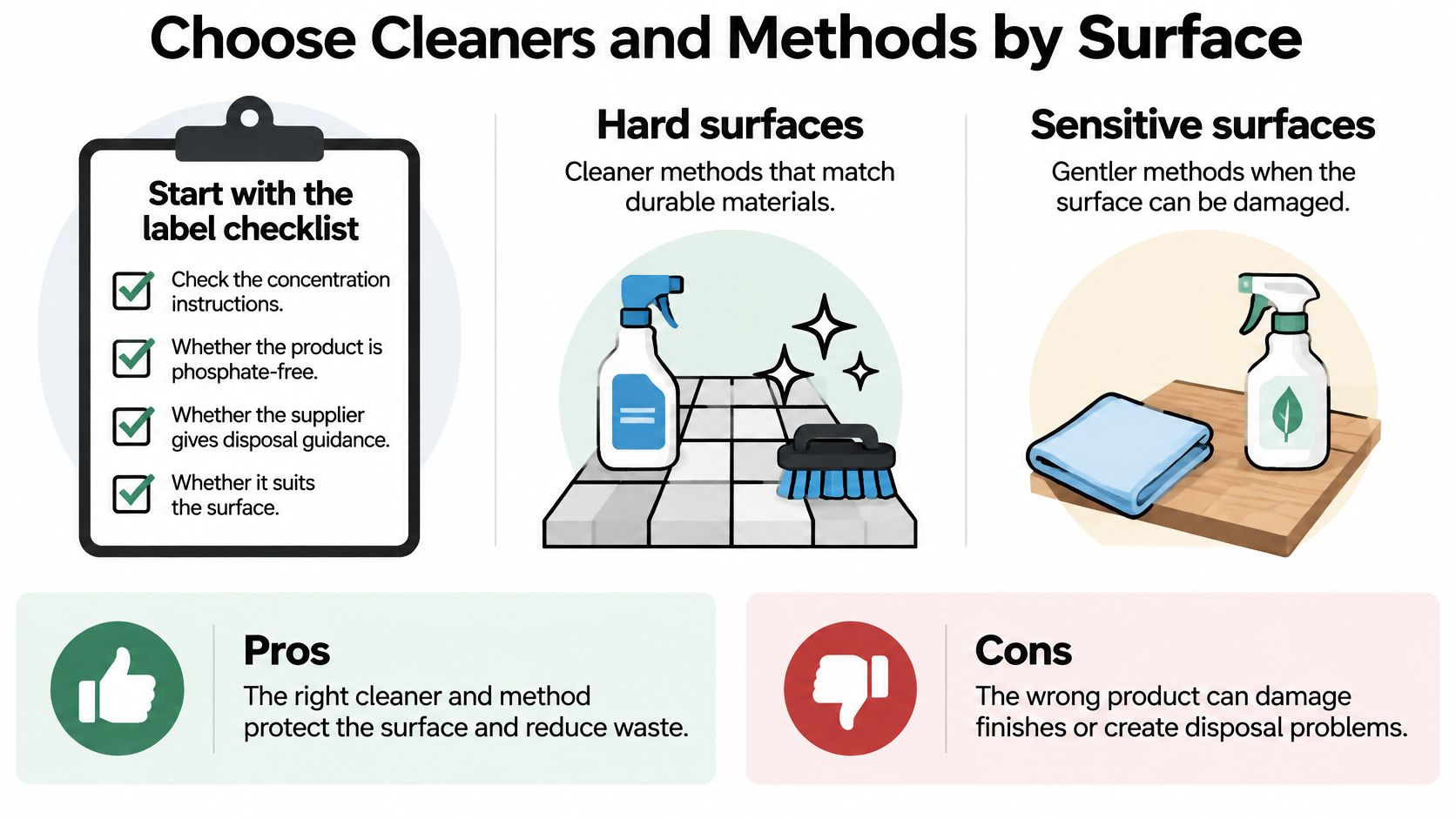
Choose the least intensive effective method
For light dust on a walkway, start with dry removal. Follow with a controlled, low-flow rinse only when needed and when the receiving area can safely accept it. There's no benefit in adding detergent to contamination that comes off without it.
For siding or a patio with attached organic buildup, select a compatible cleaner at the minimum effective concentration. Give it the specified working time without letting it dry, then rinse with pressure suited to the finish. More concentrated product isn't a substitute for correct application.
For an oily driveway, target the stain instead of coating the entire slab unnecessarily. The guide to pretreating a driveway for pressure washing explains why preparation matters before the main cleaning pass.
Decorative finishes require another check. Homeowners with patterned or sealed surfaces can consult stamped concrete care from Concrete Resurfacing Products before choosing a cleaning method. Test an inconspicuous area and stop if the finish changes, loosens, or becomes patchy.
Paint residue, unknown chemicals, and heavy contamination call for a more cautious plan. Don't blast through peeling coatings just to complete the scheduled wash. Identify the material and arrange suitable containment and specialist handling first.
Understand what a good product label can promise
Biodegradable and low-toxicity formulations can help reduce chemical impact when used correctly. They don't neutralize oil, metals, paint particles, or everything else lifted from the surface. The stormwater pollution-prevention manual explicitly warns that environmentally friendly, non-toxic, or biodegradable detergents still can't be discharged into stormwater systems or surface waters.
At Cultivate House Detailing, we use biodegradable, non-toxic cleaning products, with eco-friendly solutions safe for family, pets, and plants. Our pressure washing covers patios, walkways, siding, and driveways, and our residential and commercial window cleaning includes interior and exterior window care. The online quote form lets customers choose gutter cleaning, window washing, pressure washing, and holiday lights.
Expect a plan that covers the glass too
Dirty windows present different challenges from dirty concrete: streaks, hard-to-reach panes, mineral deposits, screens, and tracks need their own treatment. Professional window cleaning should coordinate those tasks with exterior washing so a freshly cleaned pane doesn't receive another pass of siding runoff.
The benefits are practical. Clearer glass improves the view and admits daylight without a layer of surface dirt, while clean frames and surrounding finishes improve curb appeal. Regular maintenance also makes developing defects easier to notice, although cleaning can't repair failed seals or restore a damaged window assembly.
For window cleaning near me in Colorado Springs, Monument, Black Forest, or nearby communities, request a written scope that distinguishes routine cleaning from stain treatment and repair. Include the surfaces, access needs, water-use approach, containment equipment, and disposal destination. Request a quote and ask for the containment plan in writing before the first spray.
Cultivate House Detailing offers pressure washing and professional window cleaning for homes and businesses in Colorado Springs and surrounding communities. Visit Cultivate House Detailing to request a quote for your windows, siding, patio, or driveway, and include any nearby drains, stains, or moisture concerns so the cleaning plan addresses them before work begins.