Straightforward ground-level commercial glass is commonly planned at about $4–$8 per pane, and a typical local job starts near $100 for the minimum visit. Those two numbers are where most Colorado Springs storefront and office budgets begin, and neither one is a finished bid.
You've got a building budget due Friday, a stack of invoices to justify, or a district manager asking why the north-facing glass looks hazy in listing photos. You open a commercial window cleaning cost calculator, type in a window count, and get a number you don't quite trust. That instinct is sound. The tool is doing arithmetic on the one input you happen to know, while the cost sits in how a crew reaches the glass, how often they come back, and what's already stuck to the panes when they arrive.
Use the access table below as a planning range, not a quote. Then read the rest of this page the way you'd read an estimate: line by line, with the parts that don't apply to your building crossed out.
Commercial Window Cleaning Prices by Access Method
A manager pricing a one-story retail suite with 40 exterior panes can start with a per-pane range. That estimate is useful for setting a budget, but it leaves out interior glass, doors, screens, and any access equipment. The final quote depends on what the crew must clean and how it can safely reach each area.
Published U.S. planning rates range from $4–$8 per pane for ground-level work to $7–$14 per pane for ladder access, $12–$22 per pane for aerial-lift work, and $18–$35 per pane for rope-descent work, according to the U.S. Calculators' window cleaning production rate guide. The difference reflects the time and equipment needed to reach the glass, along with setup and safety requirements. A calculator should sort panes by access method rather than apply one rate to every window.
Planning rates by how the crew reaches the glass
| Access method | Planning rate per pane | Typical use |
|---|---|---|
| Ground level | $4–$8 | Storefronts and glass reached from the ground |
| Water-fed extension pole | $5–$10 | Higher glass still reached from the ground after a site check |
| Ladder | $7–$14 | Low-rise glass a ladder can reach safely |
| Aerial lift | $12–$22 | Elevations that need delivery, setup, and repositioning |
| Rope descent | $18–$35 | Specialized high-rise work, generally limited above 300 feet |
What forty panes actually adds up to
For 40 exterior panes at ground level, the planning math is $160–$320, before adding glass doors, screens, interior windows, or the visit minimum. If those same panes require ladder access, the estimate becomes $280–$560. The glass count has not changed; the route the crew takes to reach it has.
For one- and two-story commercial buildings, Cultivate House Detailing's rule of thumb is about $5 per pane for the outsides and $4 per pane for the insides. Commercial window washing typically starts at $100. Larger or smaller commercial properties can have costs reaching tens of thousands of dollars, so a single flat rate per window cannot describe every building. The number, size, and location of the windows all affect the quote.
Where the four-foot line changes the quote
Height can change the work method, not just the rate. The linked production guide notes that OSHA's general-industry walking-working-surfaces rule requires fall protection when a worker faces an unprotected edge 4 feet or more above a lower level. That makes higher panes a reason to review access before multiplying them by a ground-level rate. A calculator can flag those panes for a different planning range, but it cannot confirm the equipment or method a crew will use at a specific property.
Rope work has its own access requirements, including rigging and a separate personal fall-arrest system. It is specialized work, so rope access window cleaning is better treated as a project estimate than as a simple pane-count calculation. The quoted range helps with early budgeting; a building-specific quote accounts for the actual access conditions.
To use the table, count panes by access method and calculate each group separately. For example, a building with 20 ground-level panes, 12 ladder panes, and 8 lift-access panes needs three calculations, then the results can be combined into a planning range. This approach is more useful than multiplying every pane by one flat price, because it separates ordinary washing from the extra work required to reach high glass. These figures are planning benchmarks, not a guaranteed Colorado Springs bid.
Storefront Office and Facade Pricing Categories
Not every commercial property should be priced the same way, because the work isn't the same shape. A row of identical retail bays and a dealership showroom are both "glass," yet one is a counting job and the other is a measuring job.
Uniform storefronts and restaurants. Repeated openings of similar size and height are the cleanest fit for per-window pricing. When every unit looks like the last one, counting is fast, production is predictable, and the estimate holds up. Bakeries, coffee shops, and strip-center retail land here.
Offices with mixed glass. A single office suite might combine wide picture windows, a glass entry door, sidelights, and an interior conference wall facing the lobby. Count those separately. One lumped "window count" forces the estimator to guess, and guessing usually inflates the line you can least afford.
Dealerships and curtain walls. Showroom glass and full facades are measured by square footage, because one opening isn't one pane. A curtain-wall panel can hold several lights of glass, and a showroom wall may run 20 feet tall behind the sales desk. Square footage describes that surface accurately; a window count doesn't.
Fourth-story and lift work. Once equipment has to be delivered, set up, repositioned, and torn down, the wash itself stops being the cost driver. That's the point to leave per-pane math behind and price by crew hour or by project.
Practical rule: If a crew can walk to the glass, count units. If equipment has to be staged to reach it, price the visit.
Two errors that swing a facade quote
The first is treating building floor area as glass area. A 6,000 square foot office might have 900 square feet of glass, or 2,400, and nobody can tell from the lease document. Count the glass, not the square footage you pay rent on.
The second is treating a divided window as one unit. Colonial-style grids, deep frames, and mullions all slow production down, so a 12-pane grid window is a different line item from a single fixed pane of the same overall size.
Our exterior work covers properties up to four stories, including bay windows, picture windows, and dormers, and the fourth floor is where the pricing logic shifts rather than just the price. Interior work is a different scope again: it includes clearing dirt and grime buildup from corners and tracks, which is slower per unit than wiping a flat pane and often gets skipped in a cheap bid.
A mixed building can use more than one unit on the same quote, and it usually should. Per window across the ground-floor retail, square footage across the broad facade above it, and crew hours wherever a lift has to be parked.
How a Commercial Window Cleaning Cost Calculator Adds Up
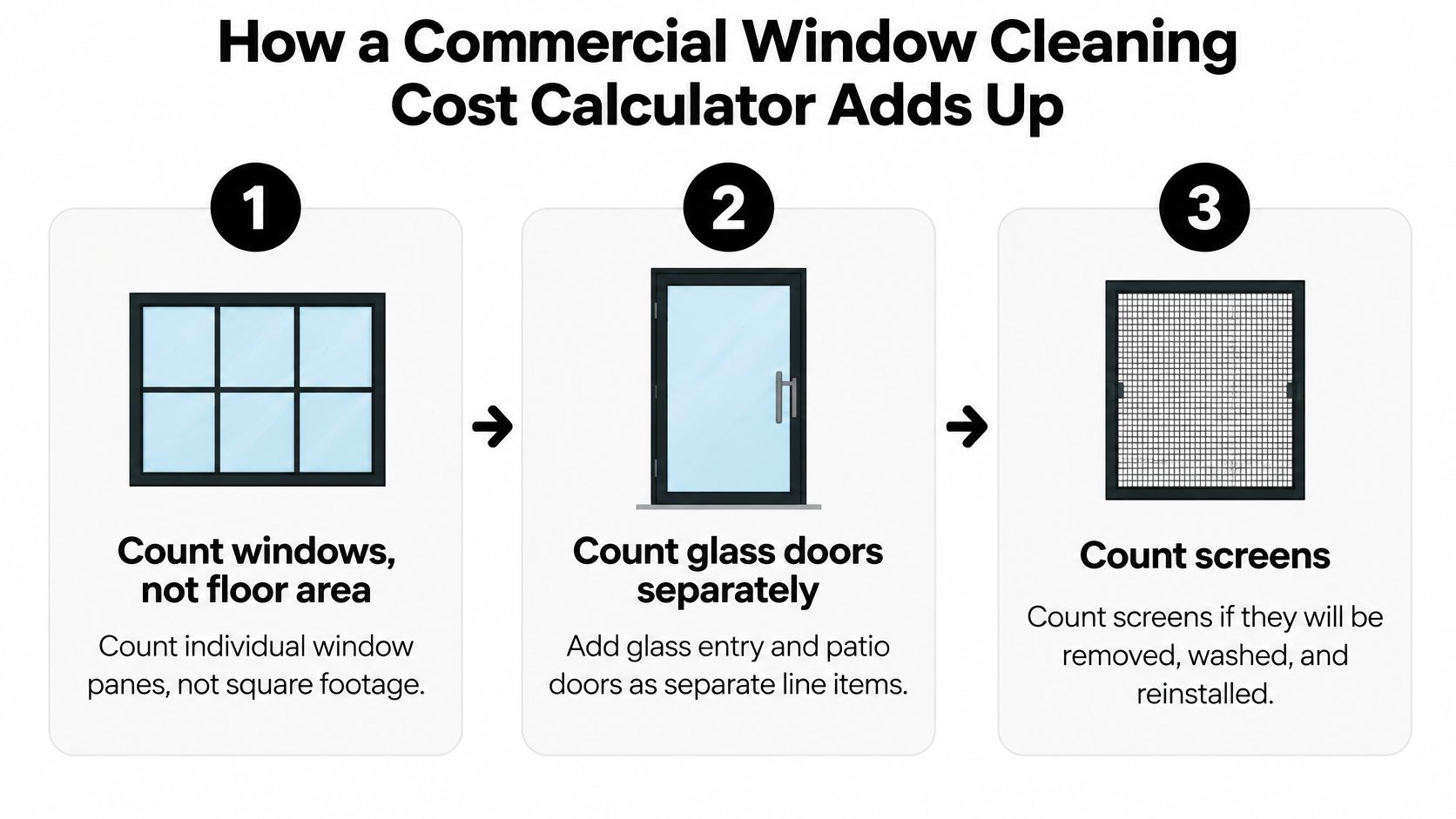
A storefront quote is easier to understand when each part of the job has its own line. A useful calculator starts with the glass, then accounts for doors, screens, access, and cleaning scope. That makes it a planning range, not a finished bid: the final quote depends on the building and the work requested. Jobber's guide to pricing window cleaning describes a formula that adds windows, doors, and screens, then applies any recurring-service discount to the base total.
Build the estimate in sequence:
- Count windows, not floor area. Tally the visible openings on each elevation.
- Count glass doors separately. Entry and other full-glass doors should not disappear into the window count.
- Count screens. Include only screens that are part of the requested cleaning.
- Choose the scope. Exterior-only and interior-and-exterior work are different estimates.
- Record access by elevation. Note whether each area can be reached from the ground or needs other access.
- Set the schedule. Enter a one-time visit or the requested recurring frequency.
- Apply any recurring discount last. Calculate the base work first, then adjust it if the program includes a discount.
A national-benchmark storefront example
Use thirty uniform windows to check the arithmetic. The example excludes doors and screens from the total because their rates are not specified. Interior tracks are also outside the scope.
Worked national-benchmark storefront example
| Component | Count | Unit rate |
|---|---|---|
| Windows | 30 | $6–$20 per window |
| Glass doors | 2 | Separate line, rate not specified |
| Screens | 10 | Separate line, rate not specified |
| Recurring discount | Applied after the base total | Only on scheduled programs |
| Window-line total | 30 windows | $180–$600, before doors and screens |
Published commercial benchmarks place straightforward work at $6–$20 per window or $0.50–$2.50 per square foot of glass, according to The Pricer's commercial window cleaning cost data. These are national figures, not a Colorado Springs bid. A per-window rate can differ from a per-pane rate because a window frame may contain several panes. Crew time, mobilization, safety requirements, and glass condition can also affect the unit price.
Keep each component visible in the estimate. Then, when a written quote arrives, you can compare the same scope line by line rather than trying to judge one unexplained total against another.
First Clean and Recurring Visit Price Ranges
The first visit and the tenth visit are not the same job, and a calculator that hides that difference will undershoot your budget every time. A building that hasn't been washed in three years carries mineral film, oxidized sealant, and construction dust that a maintenance crew never has to fight.
One published framework puts exterior glass at approximately $0.24–$0.36 per square foot for a first clean and about $0.11–$0.17 per square foot on a monthly program, per Sky Professional Services' commercial window pricing framework. Same glass, roughly half the unit rate, because the maintenance visit is removing weeks of dust rather than years of buildup.
First clean versus recurring commercial glass pricing
| Schedule | Published unit | Example visit | Example year |
|---|---|---|---|
| First exterior clean | $0.24–$0.36 per square foot | Higher than maintenance | One restoration-style visit |
| Monthly exterior program | $0.11–$0.17 per square foot | Lower per visit | Twelve maintenance visits |
| Quarterly example | $3–$6 per pane | $900–$1,800 | $3,600–$7,200 |
That same framework works a quarterly job at $3–$6 per pane, producing an estimated $900–$1,800 per visit or $3,600–$7,200 annually for the stated job size. Treat those as benchmarks that demonstrate the mechanics, not as Colorado Springs rates.
The mechanics in four moves
Measure the glass. Pick the frequency. Price the visit. Multiply by visits per year. That last step is the one property managers forget, and it's the only one that belongs in an annual maintenance budget.
Why does dirt come back fast enough to justify a schedule? Front Range sun is brutal at altitude, wind carries grit off lots and fields, and a single spring storm can leave spotting on west-facing glass within days. We recommend cleaning windows at least 2 times per year for local properties, one visit in spring after pollen and one in fall before the holidays. Read that as a planning rule for this climate, not a measured requirement. Some storefronts on heavy foot-traffic corners do better quarterly.
Where the first visit belongs
Hard-water residue and construction film belong on the first or restoration visit, when the crew can spend the time on mineral removal instead of maintenance. Later visits maintain clarity rather than restore it. If your glass has chalky white rings near sprinkler heads or a haze along the bottom six inches, that's restoration work, and it doesn't fit a monthly maintenance rate.
Quote pricing varies with the number, size, and location of the windows being cleaned, so two buildings of identical square footage can price differently because one has a shaded north face and the other takes full afternoon sun above a gravel lot. Use the table to compare schedules against each other, not to compare your building against a stranger's.
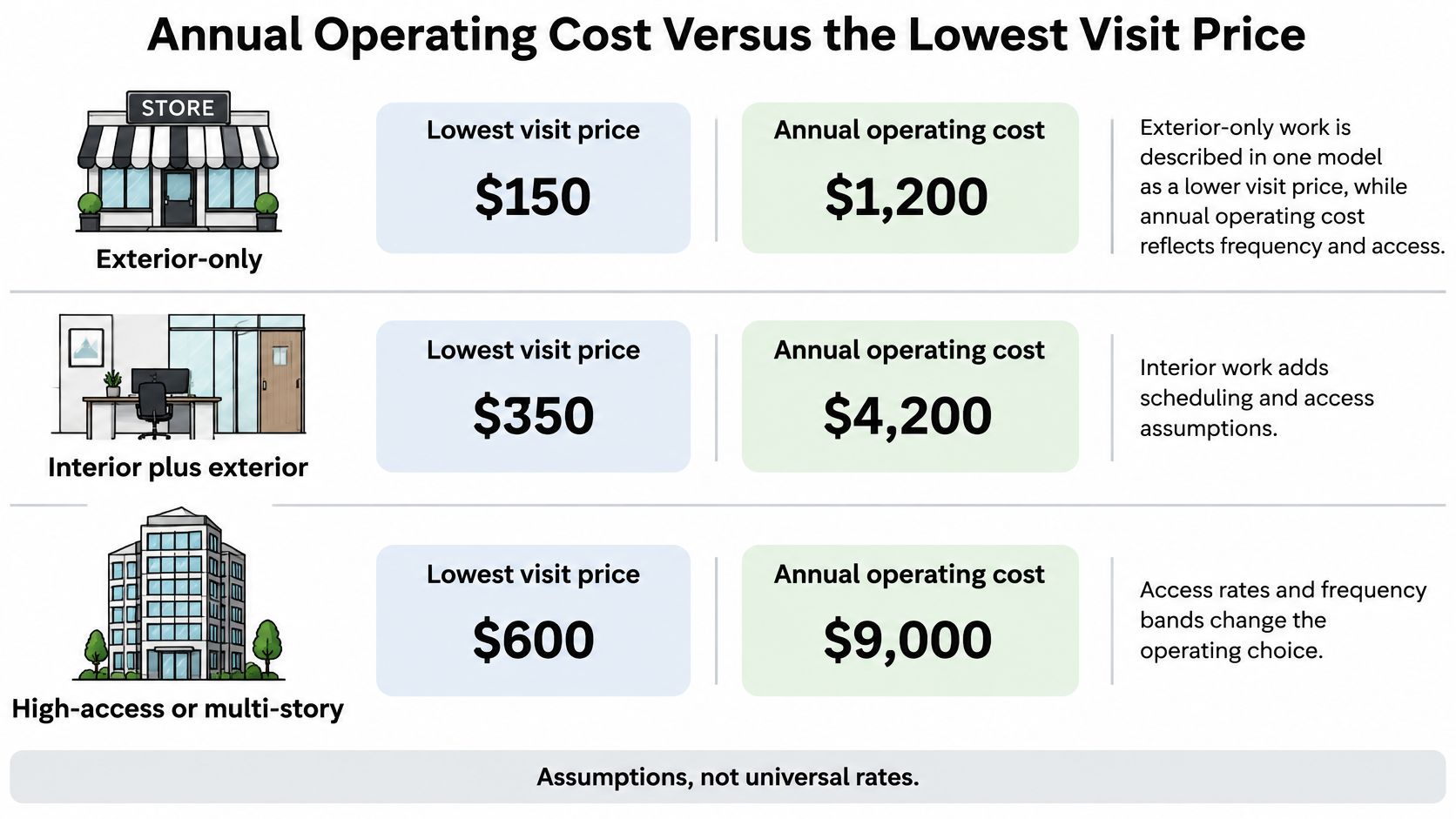
Put the annual figure into the maintenance plan, not just the invoice for one morning. A $1,200 visit reads very differently as $4,800 a year than as a surprise in March.
Inputs That Make a Calculator Range Unreliable
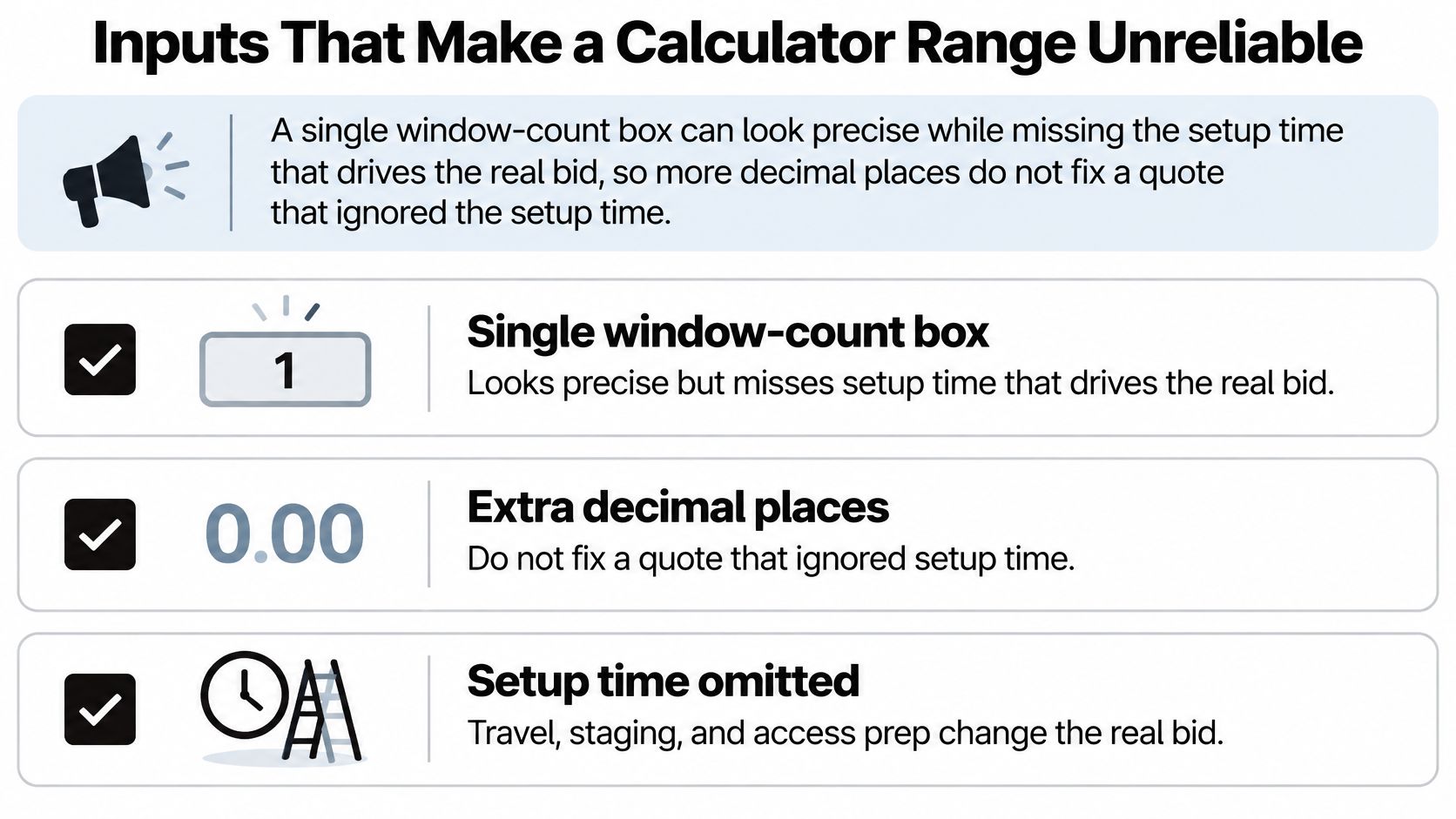
A single window-count box can look precise while missing the setup time that drives the bid. Adding decimal places doesn't fix a quote that ignored the building.
Published models already handle pane count, stories, access difficulty, interior versus exterior scope, and frequency. What they routinely skip is the list that changes labor time: divided panes, deep frames, screens, hard-water or construction residue, tenant obstacles, and after-hours scheduling, as CleaningCalcs' commercial window cleaning breakdown points out. Each missing input shifts production minutes, not just the total at the bottom.
What to send for a tighter range
- Photos of each elevation. Four phone shots beat any verbal description of "mostly normal windows."
- Building height and story count. This decides which access row applies.
- Glass configuration. Divided panes, deep frames, storm windows, and atrium glazing all slow the crew.
- Screen count, and whether they come off. Removal, washing, and reinstallation is real labor.
- Residue type. Hard-water staining, paint overspray, and construction film each need a different method.
- Operating hours and any pre-opening window. A 6 a.m. start changes the schedule, not the scope.
- Whether interior glass is in scope. Including it roughly doubles the surfaces and adds furniture to work around.
When a walkthrough stops being optional
Some properties can't be quoted from photos and a form. Mixed heights on one elevation, lift access over landscaping, heavy mineral staining, post-construction cleanup, and occupied floors where furniture and customers have to be protected all warrant eyes on the glass.
A budgetary estimate tells you what the work usually costs. A firm quote tells you what it costs on your building, with a scope you can hold someone to.
The distinction matters most on multi-story properties, where a few wrong inputs on access can swing the number by thousands rather than hundreds.
Our own intake asks for photos, building height, glass configuration, screen requirements, residue type, operating hours, and service scope, and the result gets labeled a planning range pending verification. That's deliberate. A confident-looking number on the wrong inputs is worse than an honest range.
If two or more of the items on that list are present, treat any calculator output as a starting point and nothing more.
Annual Operating Cost Versus the Lowest Visit Price
The lowest visit price does not always make the lowest annual cost. A restaurant or property manager needs to compare the cleaning scope and schedule with the time and access a visit requires. Lifts, water-fed poles, rope access, safety precautions, and after-hours scheduling can all affect a quote, while recurring work may change the rate per visit. Trade Pricing Control's commercial pricing calculator analysis discusses these variables, but a calculator is best used to plan a range, not to produce a final bid.
Scope and timing scenarios for total cost
| Choice | What usually happens to price | What the building absorbs | Better when |
|---|---|---|---|
| Exterior only | Prices lower than combined interior and exterior service | Interior film remains | The public mainly sees the facade |
| Interior and exterior | Interior glass adds cost | More access to occupied rooms | Customers and staff see both sides |
| Daytime visit | Lower scheduling premium | Customer separation and noise | The business can pause a zone |
| Before opening or after hours | Higher visit price | Less lost trade | Peak hours cannot be blocked |
| One restoration visit | Highest single invoice | Dirt returns sooner | Glass has heavy buildup |
| Recurring plan | May lower the rate per visit | More coordination across the year | The look must stay consistent |
The question worth asking
Is the lowest per-visit estimate also the lowest total operating cost?
At a restaurant on Tejon Street, a Saturday morning wash may mean moving patio furniture and roping off part of the dining room as brunch service builds. The invoice may be lower, but the disruption still takes staff time and space. A 6 a.m. Tuesday visit may cost more per visit while leaving the floor clear during service.
Recurring maintenance can lower the rate per visit, while requiring coordination for keys, alarm codes, tenant notices, furniture movement, and equipment staging. Keep those demands in the comparison instead of judging the plan by its visit price alone.
Planning rule: Choose a schedule that keeps the glass presentable without placing equipment in front of the door during your busiest hour.
Build the annual view yourself
A quarterly plan turns one visit price into four invoices a year. Multiply the visit price, then list what the building absorbs alongside the annual total: access time, staff time to move furniture, customer separation, and space for equipment. Keep those impacts visible without assigning a speculative dollar value to lost sales.
Use the access method and schedule that fit the building, then compare the scopes being priced. The calculator helps organize those choices into a budgetary range; a verified quote accounts for the actual building and agreed work.
For businesses weighing a recurring schedule, regular commercial window cleaning can help keep buildup from becoming harder to remove.
What Colorado Springs Businesses Can Expect From a Crew
Picture a Tuesday at a managed office building off Powers Boulevard, with a restaurant tenant on the ground floor and two floors of suites above. Black Forest, Monument, Manitou Springs, and Woodland Park properties follow the same rhythm, with weather and access as the variables.
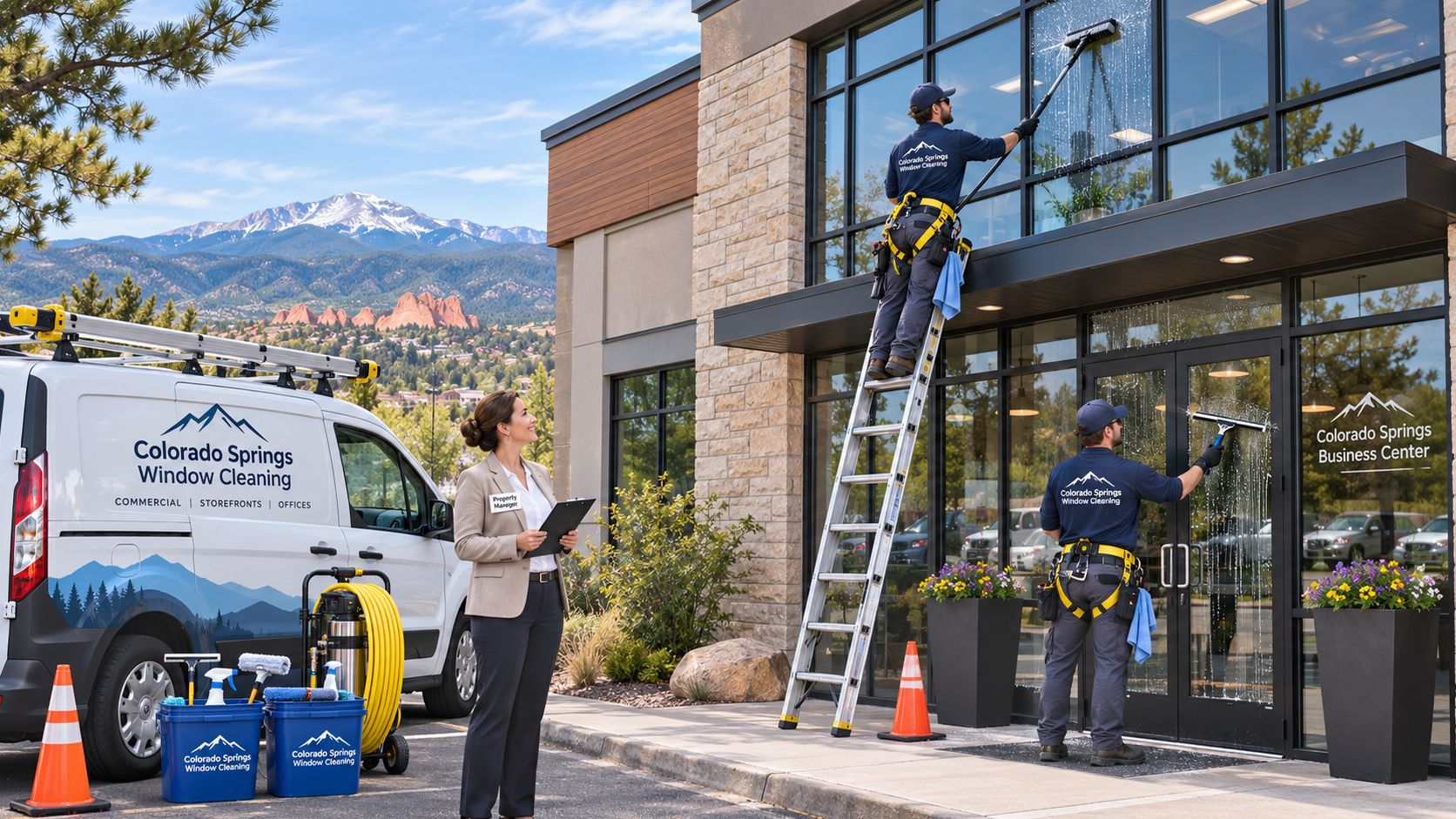
The visit runs in a practical order:
- Confirm access, hours, and tenant zones. Which lot is clear, which suite opens at 7, which side of the building is the lobby entrance.
- Protect floors, entries, and landscaping. Drop cloths inside, cleared walk paths outside, hoses routed away from doorways.
- Clean exterior glass up to four stories using the access method named on the quote. No surprise ladders on a stucco wall.
- Clean interior glass where it's in scope, working around desks, displays, and customers.
- Clear corners, frames, and tracks. Interior work includes removing dirt and grime buildup from corners and tracks, which is where a quick wash shows its limits under low winter light.
- Clean and reinstall screens where they're on the quote. Screen cleaning and track cleaning can be added to a project when you select them on the quote, and skipping them leaves a visible film line on the sill.
Hard-water stains get treated so clarity returns rather than being wiped over, and regular washing helps prevent mineral damage from setting in. Tinted glass, older wood frames, and modern vinyl all call for different methods, and the crew confirms products are safe around people, pets, and plants before starting. Our solutions are eco-friendly and safe for family, pets, and plants, which matters in a dining room or a pediatric waiting area.
Here's the difference between a wash and a plan, filmed on a real building:
What should be waiting for you afterward
Streak-free glass, inside and out, with frames and sills dry. A short note listing anything found during the visit, a cracked seal, a torn screen, a sprinkler head aimed at the same pane every morning. And a date for the next scheduled clean, so the building never drifts back to where it started.
Weather happens. When rain hit shortly after a cleaning, our owner offered to have the windows re-washed for free if necessary, which is the kind of judgment call a local crew can make and a national directory cannot.
Request a Free Quote for Your Building
Use the calculator to pick a budget band, then get a firm number before anything is scheduled. The whole path takes one phone and about ten minutes of gathering.
- Set the budget band. Match your elevations to the access rows and your tolerance for buildup to a schedule.
- Gather the inputs. Photos of each elevation, story count, glass configuration, screen count, residue type, operating hours, and whether interior glass is included. Add the property address in Colorado Springs or a nearby community.
- Submit the request through the quote form. Note whether the work must happen before opening, and choose window washing from the service list; the same form covers gutter cleaning, pressure washing, and holiday lights.
- Review a quote that shows its work. Glass scope, access method, and visit frequency stated line by line, so you can check each component against your own count.
Quotes are free and pricing is up front, which matters more than most owners expect. You shouldn't have to schedule a walkthrough to learn whether the project is even close to budget.
Price still depends on the number, size, and location of the windows rather than a single citywide rate. A shaded north wall on a quiet side street and a sun-blasted west elevation above a gravel lot don't clean the same way, and a quote that pretends otherwise will need revising later.
For offices, retailers, restaurants, dealerships, and property managers, the glass is part of the first impression customers see before anyone says a word. Request a free quote for your building and get a firm number, with the scope and access spelled out, instead of a range you have to guess your way through.
Cultivate House Detailing plans commercial window washing around the access and frequency that suit your building, not a single flat rate per pane, and quotes are free with pricing stated up front. Serving Colorado Springs, Black Forest, Monument, Manitou Springs, Woodland Park, and the surrounding communities, the team cleans commercial glass up to four stories, handles interior tracks and screens on request, and treats hard-water staining so the glass regains its clarity. Visit Cultivate House Detailing to request your quote and put a firm, line-by-line number behind the planning range you worked out here.