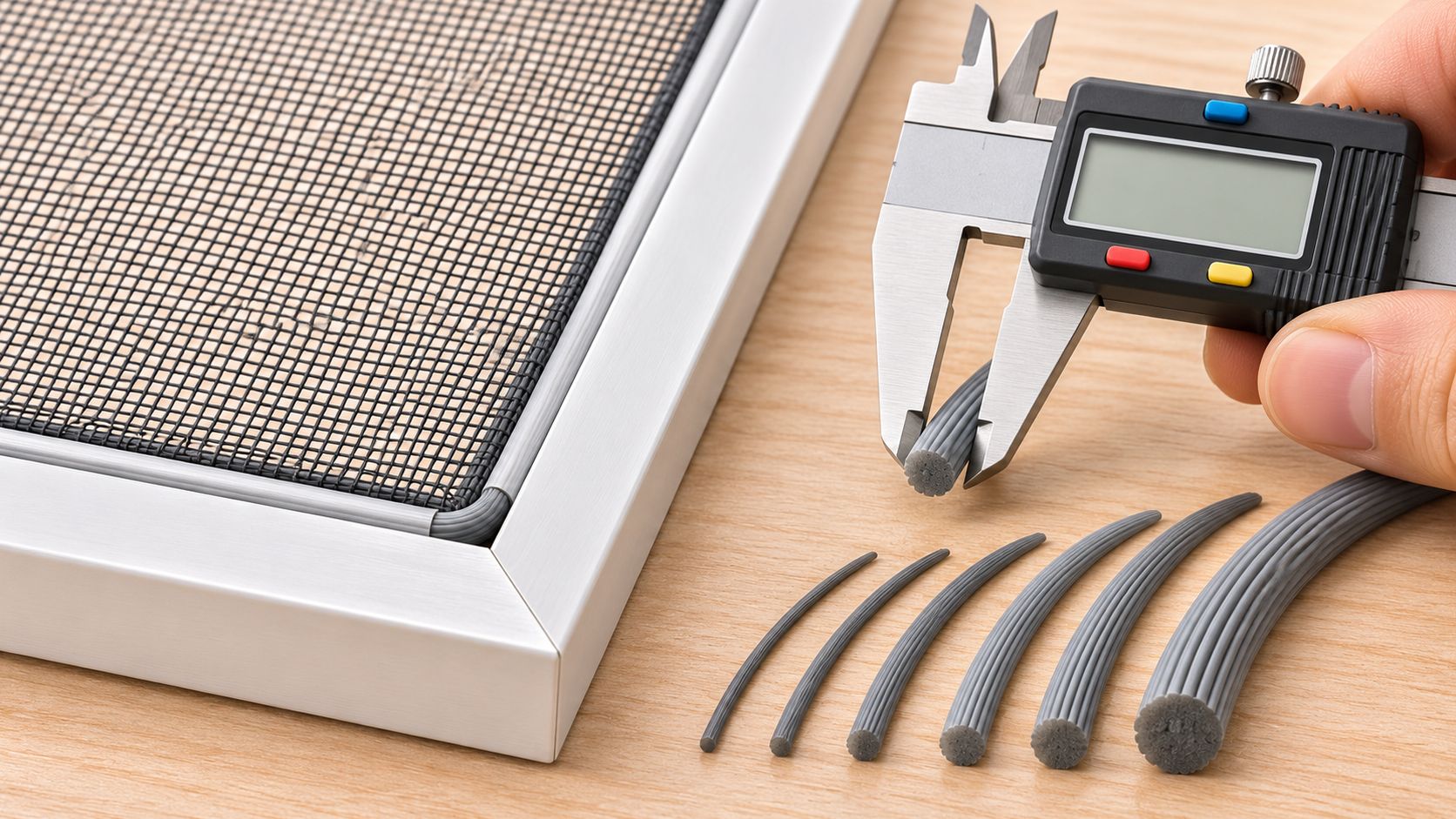
Round window screen spline runs from 0.125 to 0.250 inch in diameter, which converts to about 3.2 to 6.4 millimeters. For ordinary residential fiberglass and aluminum screens, 0.140 inch and 0.160 inch are the two most common sizes you'll need.
You pull a torn screen off a bedroom window, lay it across the kitchen table, and yank out a stiff strip of sun-baked rubber cord. Ten minutes later you're standing in a hardware aisle staring at six spools of black spline that all look identical to the naked eye. Pick one step too thin and the new mesh sags on the first warm afternoon. Pick one step too thick and you'll bow the aluminum frame or slice right through the screening while rolling it in.
Getting window screen spline sizes right isn't guesswork. Once you match the rubber cord to the exact frame groove and mesh thickness, rescreening takes minutes and holds drum-tight for years.
Round Spline Diameters at a Glance
Start with the channel measurement, then use the chart to narrow your choices. The Installix window screen spline sizing chart lists eight principal round diameters within the 0.125 to 0.250 inch (3.2 to 6.4 mm) range used for residential frames. The ScreenOps spline sizing and selection guide identifies 0.140 in and 0.160 in as the two most frequently used sizes for standard fiberglass and aluminum screening.
Those common sizes are starting points, not automatic matches. Manufacturer charts differ, and the frame channel and mesh thickness determine which cord will seat properly.
Use the table to look up a measured diameter, check its metric equivalent, and narrow the likely application. The larger 0.285 in and 0.315 in entries cover enclosure frames rather than ordinary window-screen channels.
| Diameter (in) | Metric (mm) | Fraction | Typical use |
|---|---|---|---|
| 0.125 in | 3.175 mm | 1/8 in | Thin channels, small window screens, aluminum insect mesh |
| 0.140 in | 3.556 mm | about 9/64 in | Standard fiberglass window screens |
| 0.160 in | 4.064 mm | about 5/32 in | Common window and door screens |
| 0.175 in | 4.445 mm | about 11/64 in | Window and door frames, some patio doors |
| 0.190 in | 4.826 mm | about 3/16 in | Sliding patio-door screens and porch frames |
| 0.210 in | 5.334 mm | about 13/64 in | Heavier frames; check worn channels individually |
| 0.220 in | 5.588 mm | about 7/32 in | Wider 7/16 x 1 in fiberglass screen channels |
| 0.250 in | 6.350 mm | 1/4 in | Porch, patio, and pool screen systems |
| 0.285 in | 7.24 mm | about 9/32 in | Large enclosure frames |
| 0.315 in | 8.00 mm | about 5/16 in | Large enclosure frames |
Why Close Numbers Still Matter
Use the decimal diameter when buying cord. The fractions help you read a tape measure, but most are approximate: 0.125 in and 0.250 in match their listed fractions exactly, while 0.140 in and 0.160 in fall near the ruler marks shown.
Small differences matter at the groove. A cord that suits lightweight fiberglass may fit too tightly when thicker solar or pet-resistant mesh occupies more of the same channel. A worn channel also needs a fit check rather than an automatic move to thicker spline.
Cord construction changes how the listed diameter behaves:
- Serrated hollow vinyl: Exterior ridges grip the mesh and groove walls. The hollow core compresses slightly as you roll it into place.
- Foam-core spline: A soft center inside a vinyl skin accommodates slightly uneven channels, though the foam can eventually take a set.
- Solid round cord: Dense rubber or vinyl provides firm holding pressure in clean, consistent grooves, with little room for an oversized choice.
Match the channel, mesh, and cord together. A typical-use label cannot account for all three, and choosing by “window” or “patio door” alone leaves too much to guesswork.
Practical rule: Use the diameter chart to narrow the options, then let the actual frame groove and screen material decide the fit.
Round and Flat Spline Formats Compared
Before pulling a single diameter from that chart, check the shape of the cord sitting inside your frame. Screen spline comes in two distinct formats, round and flat, and only round spline is sized by diameter.
Pry up a short tail of the existing retainer with a flathead screwdriver or scratch awl and inspect the cut end. Round spline looks like a uniform circular cord with the same thickness all the way around, so you measure straight across its widest point. Flat spline is a thin, rectangular ribbon whose width is obviously greater than its thickness, designed specifically for shallow, flat-bottomed frame grooves.
Manufacturer specifications treat flat spline as a completely separate hardware system rather than a substitute for round cord. Older aluminum windows, storm doors, and certain aftermarket replacement kits occasionally mix flat and round extrusions on the same house, so never assume every window on your property uses the same format based on what's printed on a generic repair kit.
One Decision Rule Before You Shop
Apply one straightforward check with a tape measure or caliper before ordering parts. If the cross-section is circular and measures between 0.125 and 0.250 inch, stay with the round diameter chart and frame lookup. If the strip is flat and wide rather than circular, step away from round cord entirely and match the strip's exact width against the manufacturer's flat-spline listing.
Jot down three details on a scrap of paper before heading to the store:
- Spline format: Write down "round" or "flat" based on the actual piece pulled from the groove, not a guess from outside the window.
- Measured dimension: Record the diameter for round cord or the strip width for flat spline in decimal inches.
- Frame profile: Measure the frame bar's thickness and face width in inches, such as 5/16 x 3/4 or 7/16 x 1, because those two dimensions narrow down the groove geometry immediately.
How to Measure Your Spline and Frame Channel
Guessing a size by eye sends more homeowners back to the hardware store than any other part of rescreening. This quick visual sums up the first two habits that keep your measurement honest before you buy a single foot of cord.
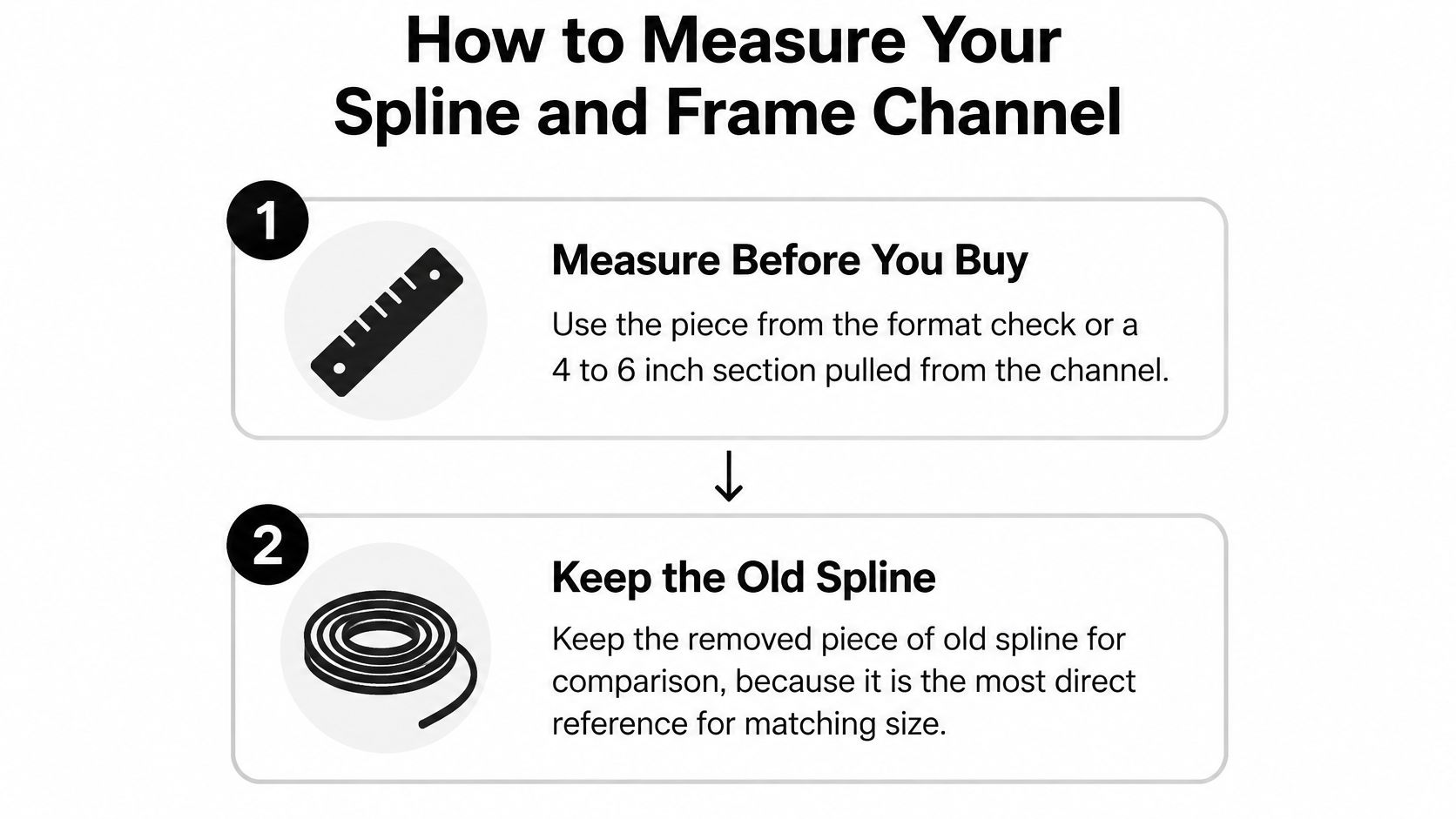
According to the Phifer DIY spline sizing guide, spline selection is governed by the frame's groove rather than any universal window standard. For standard fiberglass insect mesh in common U.S. frames, Phifer lists practical starting ranges of 0.125 to 0.140 in (3.18 to 3.56 mm) for 5/16 x 3/4-in frames, 0.140 to 0.160 in (3.56 to 4.06 mm) for 7/16 x 3/4-in frames, and 0.220 to 0.235 in (5.59 to 5.97 mm) for 7/16 x 1-in frames. Treat metric equivalents as rounded conversions, not interchangeable tolerances.
Follow these five steps to pull an accurate reading before you shop for DIY window screen projects:
- Pull and keep a 4 to 6 inch piece of the old spline. That original strip gives you the closest physical match to the channel, even if sun exposure has made it slightly stiff. Many people toss the whole tangled length in the trash before checking it, losing their best benchmark.
- Scrub out the empty channel. Run a thin screwdriver tip or stiff nylon brush along the U-shaped groove to clear out dust, broken vinyl crumbs, and frayed fiberglass threads. Measuring over packed grit makes the slot read narrower than it really is.
- Measure the spline with digital calipers. Pinch the jaws gently across the widest point of a straight, uncrushed section and record both inches and millimeters. A household ruler can't reliably separate steps that sit only a few thousandths of an inch apart, and rounding up by eye creates binding issues later. Keep in mind that old vinyl shrinks slightly after years of Colorado sun, so if your reading falls directly between two nominal sizes, note both.
- Measure the groove and frame profile if the spline is missing. Use the inside jaws of your calipers to check the empty groove width and depth, then measure the frame's outer cross-section (for example, 5/16 x 3/4 in or 7/16 x 1 in). Never measure the overall height and width of the whole screen panel expecting that to tell you the spline size; two identical-looking 30 x 40-inch panels can carry completely different channel grooves.
- Confirm the mesh material going back into the frame. Feel the old fabric and check any packaging label on your replacement roll. Fiberglass feels soft and pliable, aluminum holds a crisp crease when folded, and pet-resistant or solar fabrics feel noticeably thicker and heavier, which directly changes how much room remains in the groove.
Watch this short walkthrough to see how a tradesperson compares an old cord sample against the frame channel before rolling in new mesh.
Spline Size by Frame and Mesh Type
You have your frame profile measured and your replacement mesh in hand. The table below turns those two pieces of information into a starting spline diameter. Find your frame profile in the first column, read across to your exact screen material, and note the recommended diameter in the right-hand column.
| Frame profile (in) | Screen material | Spline diameter (in) |
|---|---|---|
| 5/16 x 3/4 | Standard fiberglass | 0.125 to 0.140 |
| 7/16 x 3/4 | Standard fiberglass | 0.140 to 0.160 |
| 7/16 x 1 | Standard fiberglass | 0.220 to 0.235 |
| 5/16 x 3/4 | Aluminum insect screen | 0.125 |
| 5/16 x 3/4 | SunTex 80/90, Super Solar, PetScreen, TuffScreen | 0.125 |
| 7/16 x 1 | SunTex, Super Solar, PetScreen, TuffScreen | 0.210 |
| 5/16 to 3/8 | Pet-resistant and SunTex solar | about 0.115 to 0.125 |
| 7/16 x 1 | Pet-resistant and SunTex solar | 0.170 to 0.190 |
How to Read the Frame and Mesh Chart
The frame profile establishes the rough groove capacity, while the mesh material narrows the exact cord that will seat cleanly inside it. Two identical frames don't automatically share one spline diameter. As shown in the Phifer Spline Selection Chart, representative 5/16 x 3/4-in and 7/16 x 3/4-in frames use 0.140-in spline for standard fiberglass insect screening, yet drop down to 0.125-in spline for aluminum insect mesh, SunTex 80 and 90 solar screening, Super Solar, PetScreen, and TuffScreen. On a wider 7/16 x 1-in frame, Phifer lists 0.210-in spline for those heavier fabrics.
That drop catches almost every first-time DIYer off guard. Heavier or stiffer woven fabrics fold into the groove like thick canvas instead of thin tissue, consuming space the rubber cord normally occupies. Force the standard fiberglass diameter on top of dense solar or claw-resistant fabric and the roller jams, the cord rides up, and you risk splitting the frame corners at the joint.
Manufacturer sizing charts don't always agree to the thousandth of an inch because aluminum extruders machine slightly different groove depths. Treat every chart entry as your starting point, not an absolute guarantee.
Whenever a table row gives you a range, test the smaller diameter first and step up only if the cord lifts under a light tug. If the original spline is still intact and you're installing the same type of replacement screening material, match the original diameter first since it already proved itself in that extrusion.
For routine home repairs, short sample lengths of 0.125, 0.140, and 0.160 in cord cover the great majority of residential window frames. Keep a few feet of each in your kit so you can compare feel on the spot instead of ordering full spools in three sizes. If your window uses an unusual or older extrusion that doesn't match any row above, don't guess from the closest profile. Measure the empty groove directly with calipers and jump straight to a physical test fit.
When Standard Sizes Stop Working
Plenty of homeowners assume that once they know a frame's outside dimensions, that same frame will always take the same spline size. In real screen work, that assumption breaks down quickly. Even when a spline roller looks like it's seating the cord neatly along the rail, subtle differences in fabric thickness, channel wear, or enclosure design can turn a "standard" choice into a failed repair.
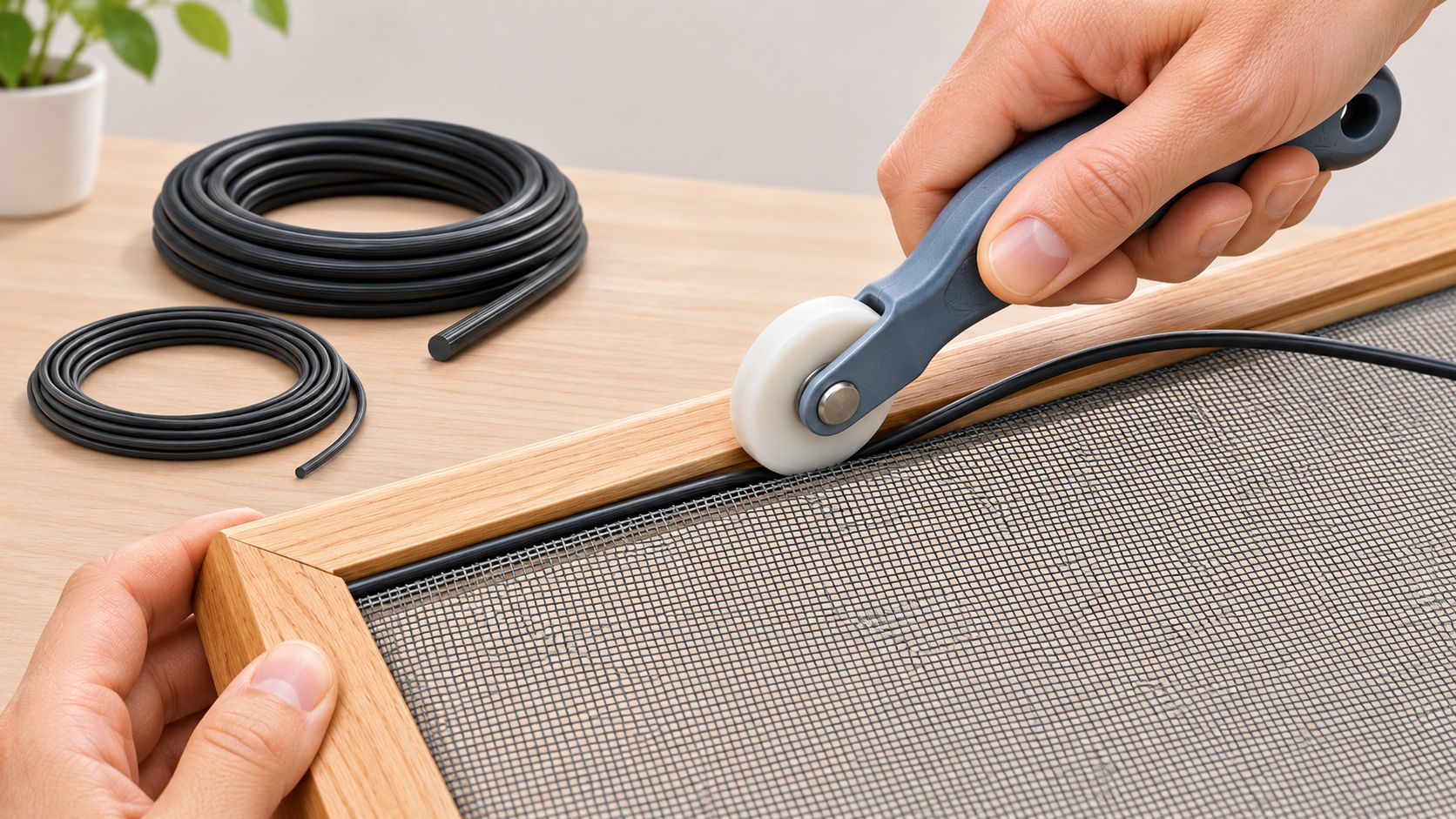
Four Cases That Break Standard Charts
Look closely at these four real-world scenarios before you grab a generic roll of 0.160 in cord off the shelf:
- Specialty mesh flips the expected size: Switching from everyday fiberglass to heavy solar screen or claw-resistant pet mesh changes the free space inside the channel. In narrow residential profiles, the thicker fabric forces you down a diameter so the cord still seats flush. In deeper, wider extrusions, the extra tension from heavy mesh may call for a stiffer, thicker cord than you'd expect. Always pair the exact fabric and frame together instead of reusing leftover spline from a standard bedroom window.
- Large enclosures outgrow window cord completely: Porch frames, sliding patio doors, and pool enclosures don't play by window-screen rules. The RetractWise spline size guide distinguishes small-channel window diameters (0.125 in for thin channels and 0.140 to 0.160 in for everyday windows) from 0.175 in and 0.190 in used in patio doors and porch frames, 0.225 to 0.250 in for porch, patio, and pool screen systems, and heavy 0.285 in and 0.315 in sizes built for large enclosure frames. Rolling small window spline into a wide patio extrusion leaves almost zero friction, so the first strong wind gust peels the whole panel loose.
- Worn or stretched channels lose their bite: Aluminum grooves aren't indestructible. After two or three previous rescreenings, or years of thermal expansion and screwdriver prying, the channel lips spread slightly. A diameter that held tightly twenty years ago may now slip out under fingertip pressure. Stepping up one nominal size, such as moving to 0.210 in on heavier frames or worn channels, restores firm compression without replacing the whole frame.
- Corners and long spans expose marginal fits: A cord that feels snug along a short vertical rail can pop free at the mitered corner where two folds of mesh overlap, or bow inward across a wide six-foot patio span. Always verify corner retention under light finger tension before trimming away the excess mesh and cutting your final spline length.
Because one house often holds two or three generations of window extrusions, avoid substituting 0.160 in automatically across every frame. Keeping two or three adjacent diameters on your workbench lets you adapt on the fly when one stubborn sash refuses to match the rest of the room.
Test Fitting and Fixing Common Spline Problems
A dry test fit catches sizing mistakes before you waste a full sheet of mesh or bend an aluminum rail. Lay a scrap of your chosen mesh over one corner of the frame, roll in a 3-inch piece of spline with a screen roller, and watch for the four fit symptoms below.
| Symptom | Likely cause | Fix |
|---|---|---|
| Spline pulls out when lightly tugged | Spline too small for the groove | Step up one diameter and retest |
| Frame bows or channel deforms | Spline forced in too large | Step down one size and seat evenly from the center |
| Mesh cut or pinched during seating | Spline too large for the channel | Step down one size and retest |
| Loose at corners after seating | Insufficient retention around corners | Test each corner before trimming and try the next size up |
Diagnosing Fit One Variable at a Time
Every symptom in that table traces back to how much groove volume remains once the fabric folds into the slot. As the Affordable Window Screens spline size guide notes, mesh construction shifts required cord size dramatically even inside the same extrusion: pet-resistant and SunTex solar screens use around 0.115 in spline in several 5/16 and 3/8-in frame profiles, yet jump to 0.170 to 0.190 in in wider 7/16 x 1-in profiles where ordinary fiberglass takes roughly 0.220 in. That pattern happens because thick mesh crowds narrow slots while wide channels demand larger cord to lock heavy fabric under tension.
When a test piece lifts right out with a gentle tug, friction is too low to hold the mesh flat. Step up one diameter and try another 3-inch sample.
If the aluminum rail bows inward like an hourglass or the metal groove flares open as you push the roller, you're forcing an oversized cord into too tight a space. Drop down one size and start rolling from the middle of each long rail toward the corners so tension distributes evenly instead of pulling the sides inward.
Sliced or shredded mesh along the channel edge means the roller wheel and oversized spline are acting like a pizza cutter against the sharp aluminum lip. Step down one diameter immediately, use the convex wheel first to pre-crease the mesh gently into the groove, and follow with the concave wheel to seat the cord.
Loose corners usually happen because the spline pops slightly shallow as you pivot 90 degrees over doubled-up fabric. Tuck the cord firmly into the corner pocket with a flat screwdriver tip, tug the mesh diagonally, and test the next diameter up if the corner still creeps.
Shop floor habit: Change only one variable per test. Swap the spline diameter while keeping the same mesh and roller technique, test a fresh 3-inch strip, and write the winning size on masking tape stuck to the frame rail.
Know when to pause a DIY repair. If the aluminum channel is kinked, a plastic corner key has snapped, or the mesh still pulls loose after testing two consecutive diameters, forcing another roll of spline won't save the frame. At that point, having a screen specialist rebuild or re-channel the frame saves both time and wasted screening.
Checklist Before You Buy Spline
Walking into a supply counter or clicking "add to cart" with a single untested number is how half-finished screens end up leaning in the garage for months. Before placing your order, build a quick buffer into your shopping list like the step shown below.
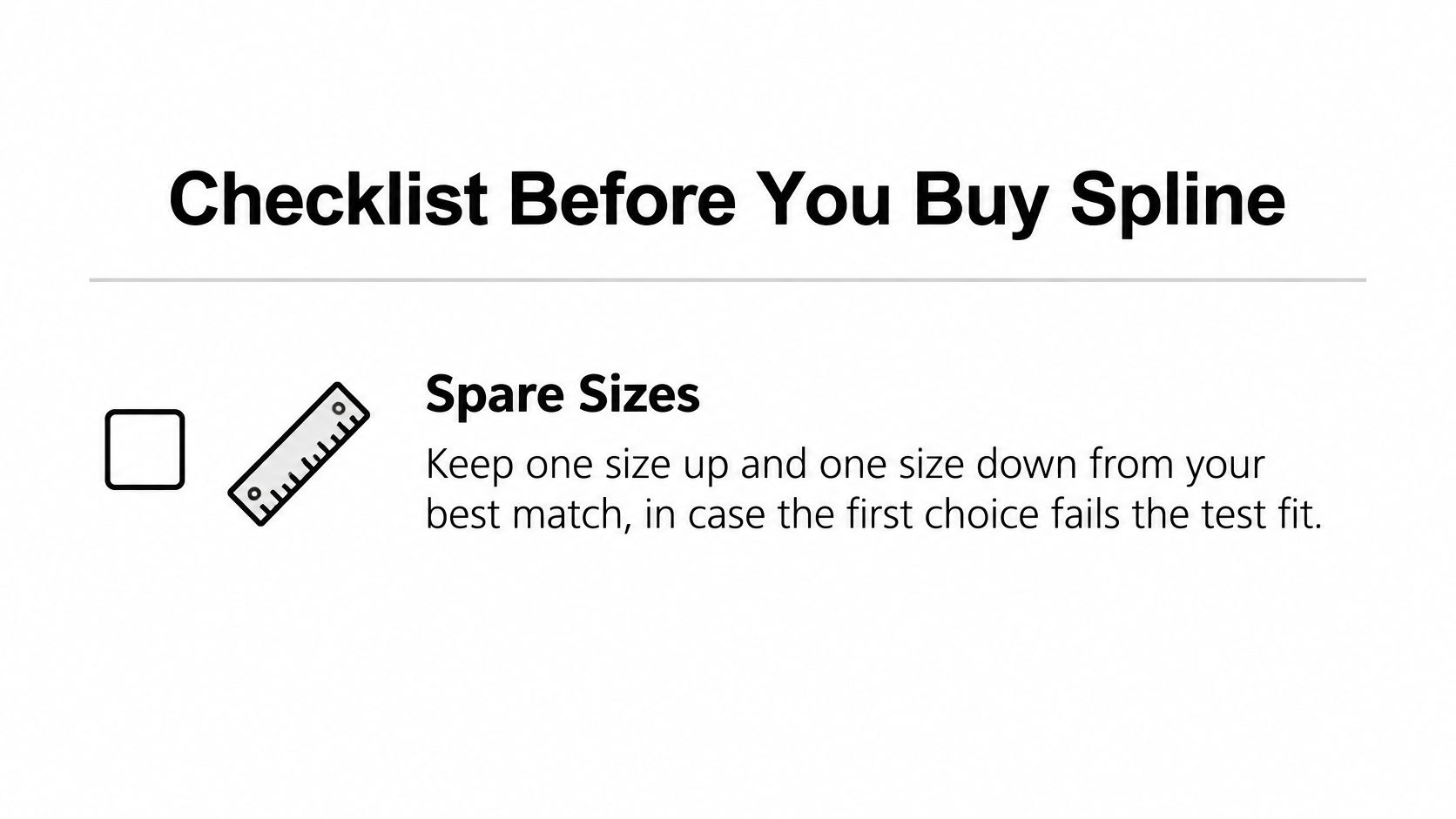
Run through four quick pre-order checks that earlier measurements don't cover on their own:
- Grab spare adjacent sizes: Pick up one diameter up and one diameter down alongside your primary match. Spline rolls are inexpensive, and having both neighbors on your table saves a second trip across town if one worn frame refuses to grip your first pick.
- Calculate continuous roll length with margin: Add up the full perimeter of every frame you plan to rescreen, then add extra buffer for corner turns and trimming waste. Hardware stores stock short homeowner packs for one or two windows, mid-size rolls for several screens, and bulk contractor spools for whole-house jobs. Buying one roll big enough for the whole project avoids splicing short scraps mid-rail, which creates weak points where mesh slips loose.
- Put every spec on one written card: Write the format (round or flat), your caliper reading in both inches and millimeters, the frame profile, and your exact screen material on a single note card or phone memo. Counter staff and screen suppliers can only confirm a match when they see those four details together.
- Log your passed test fit: Before cutting a single full-length run, verify that your 3-inch test strip seats completely below the frame edge, compresses the mesh without tearing fibers, holds firm under a light pull, and stays locked around every corner. A passed physical test is the only reliable proof your size is right.
If any item on this list is blank, pause and re-measure the frame before unrolling and cutting your main supply.
Order the Right Spline or Get Help
Every tight, long-lasting window screen comes down to three practical decisions: match the rubber cord to the frame channel's exact groove, adjust for the thickness of your screen material, and confirm the diameter with a short test fit before committing to the full perimeter. Follow that sequence and your repaired screens will stay flat, bug-tight, and clean-looking season after season.
Of course, not every homeowner or property manager wants to spend a Saturday hunting down calipers, fighting bowed aluminum channels, or balancing on ladders to pull second- and third-story screens. If you live or manage a building in Colorado Springs, CO or nearby communities, Cultivate House Detailing can take the whole job off your plate. Alongside our window screen repair services, where we fix, repair, or replace torn, loose, broken, or worn-out screens (including replacing damaged screen mesh and resolving other screen issues), we provide professional window cleaning for both residential window cleaning and commercial window cleaning clients.
Many homeowners pair screen repair with exterior window cleaning, interior window cleaning, screen cleaning, and track cleaning on a single visit, which can be added right on your quote. Getting dusty tracks scrubbed out and glass wiped streak-free at the same time your screens are tightened brings more natural light inside and keeps fresh debris from scratching your frames when the screens go back in.
If you'd like to talk through a tricky screen repair or schedule seasonal maintenance, jot down four quick details before reaching out:
- Frame profile in inches (such as 5/16 x 3/4 or 7/16 x 1)
- Measured spline diameter if you've already checked an old sample
- Screen material (standard fiberglass, aluminum, solar, or pet-resistant)
- Clear photos of any bent channels, loose mesh, or cracked frame corners
Quote pricing varies based on the number, size, and location of your windows and is provided on request. Sharing those quick measurements up front helps our crew understand your setup right away so we can give you an accurate estimate and get your views clear again.
Ready to skip the hardware-aisle guesswork and get crisp, tight screens alongside spotless glass in Colorado Springs and surrounding areas? Our team handles residential and commercial window cleaning, screen cleaning, track cleaning, and full window screen repair so every frame fits securely and every pane shines. Request your personalized quote today at Cultivate House Detailing.