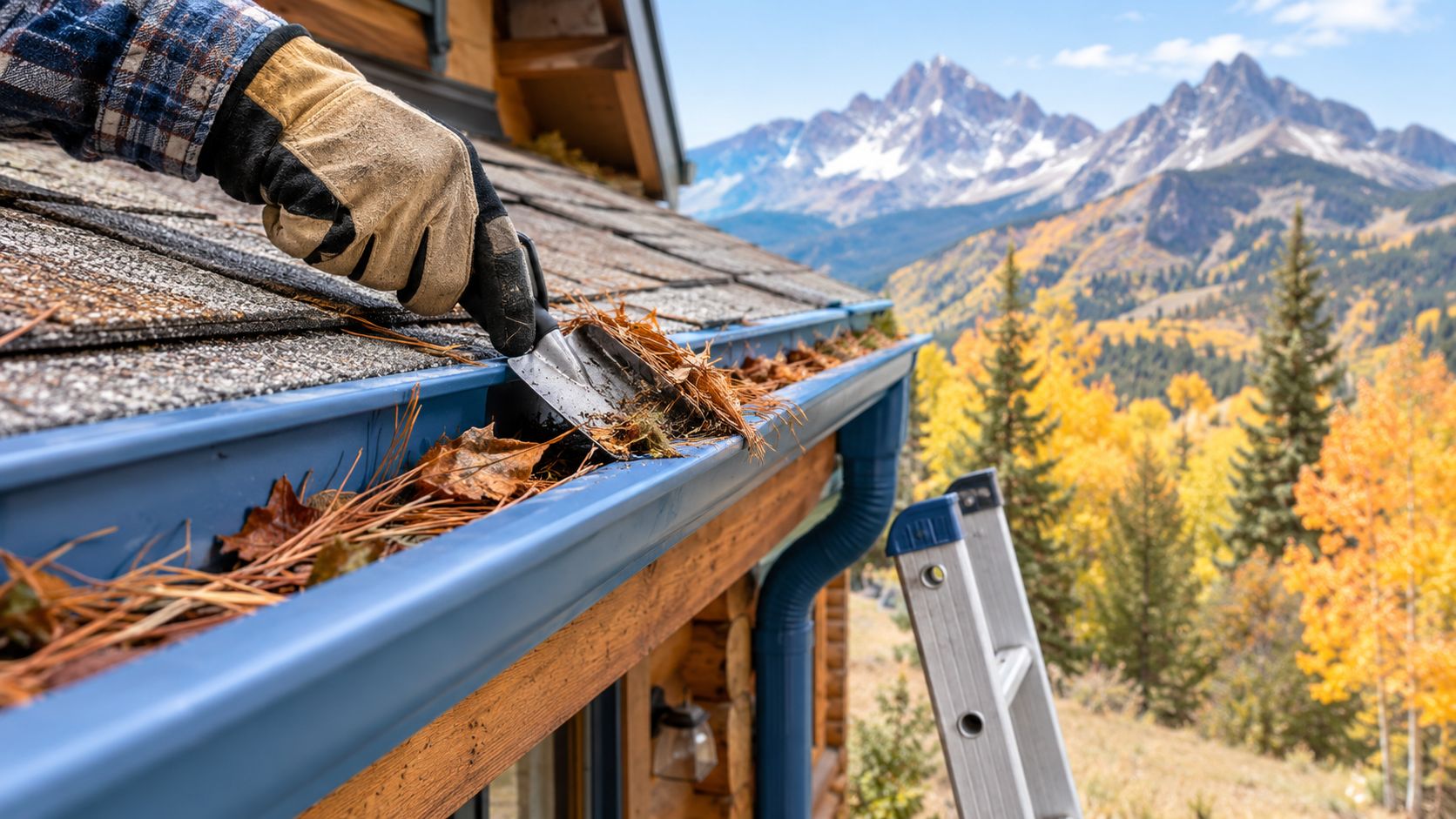
On a windy Colorado Springs morning, it's common to look up at a roofline packed with pine needles, last week's storm debris, and maybe a little hail grit sitting in the troughs. The gutters look fine from the ground until the next melt or downpour sends water where it doesn't belong. That's where a gutter guard installation service starts making real sense for a local home, especially when the goal is less ladder work, fewer clogs, and better protection for the property.
Why Colorado Springs Homeowners Need Gutter Protection
Colorado Springs gives you beautiful tree cover and a mix of weather that can turn gutters into a weekly chore. Pine needles from local evergreens, leaves, spring storms, and snowmelt all funnel into the same narrow channel, then settle there until water backs up. Once that happens, the risk isn't just an overflow at the curb, it's water reaching fascia, siding, and the areas around the foundation.

Why prevention matters more here
A lot of homeowners think of gutter guards as a convenience upgrade. In practice, they're part of a larger protection plan, especially in a market where the global gutter guards category has grown into a measurable business, valued at USD 910 million in 2024 and projected to reach USD 1.42 billion by 2030 in one independent analysis (Strategic Market Research). That kind of growth lines up with what many homeowners already know, prevention is easier than cleanup.
Practical rule: If your gutters regularly fill with needles or storm debris, a guard system only works when it's matched to the roof, not just bolted on.
That's why local service matters. Cultivate House Detailing works with Colorado Springs homes where weather, slope, and tree coverage change the job from one house to the next. A guard can help, but only if the right product and installation method fit the roofline, the debris pattern, and the way water moves off the shingles.
The value shows up after the next storm. Instead of climbing a ladder every time a branch sheds or snow starts to melt, the system gives water a path to move away from the home. For a lot of homeowners, that's the difference between seasonal frustration and a roofline that stays manageable.
Choosing the Right Type of Gutter Guard
Not every gutter guard handles Colorado conditions the same way. Some are better at stopping fine pine needles, some are easier on the budget, and some fit certain rooflines better than others. The trick is not picking the most popular style, it's picking the one that matches the debris, slope, and weather your house sees.
What works best in local conditions
Micro-mesh is often the strongest option when fine debris is the issue. High-quality micro-mesh systems use openings from 50 to 400 microns, which is small enough to block shingle granules and pine needles while still letting rain through (National Gutter Authority). That matters in heavily treed neighborhoods, where fine debris can slip through coarser products.
Screen guards can be a practical middle ground for homes with bigger leaves and a tighter budget. Brush-style guards are simple, but they're less suited to fine pine needles because debris can settle into the bristles. Reverse-curve or helmet-style systems can shed larger debris well, but they need the right pitch and placement to work properly on every roof.
| Gutter Guard Type Comparison for Colorado Homes | Best For | Pine Needle Performance | Hail Resistance | Avg. Cost |
|---|---|---|---|---|
| Micro-mesh | Heavy tree cover, fine debris | Strong | Varies by material | Higher |
| Screen | General residential use | Moderate | Varies by material | Moderate |
| Brush | Temporary or low-debris roofs | Limited | Moderate | Lower |
| Reverse-curve | Steeper roofs with good runoff | Moderate | Varies by material | Higher |
For homeowners comparing options, it helps to look at a practical overview like preventing blocked gutters with guards, especially if you're trying to understand how different guard styles still need maintenance in practice.
Matching the product to the roof
A guard doesn't perform in a vacuum. Roof pitch, gutter placement, and the way water sheets off the edge all affect how well the system catches runoff. If a home has persistent pine needles and a tricky roofline, a professional may recommend one style over another, or even a different mounting method altogether.
Cultivate House Detailing's gutter guard installation guide is useful because it connects product choice to the house itself, not just the catalog description. That's the difference between buying a product and solving a drainage problem.
The right guard is the one that fits the roof, handles the debris, and still lets water move the way it should.
Professional Installation vs A Weekend DIY Project
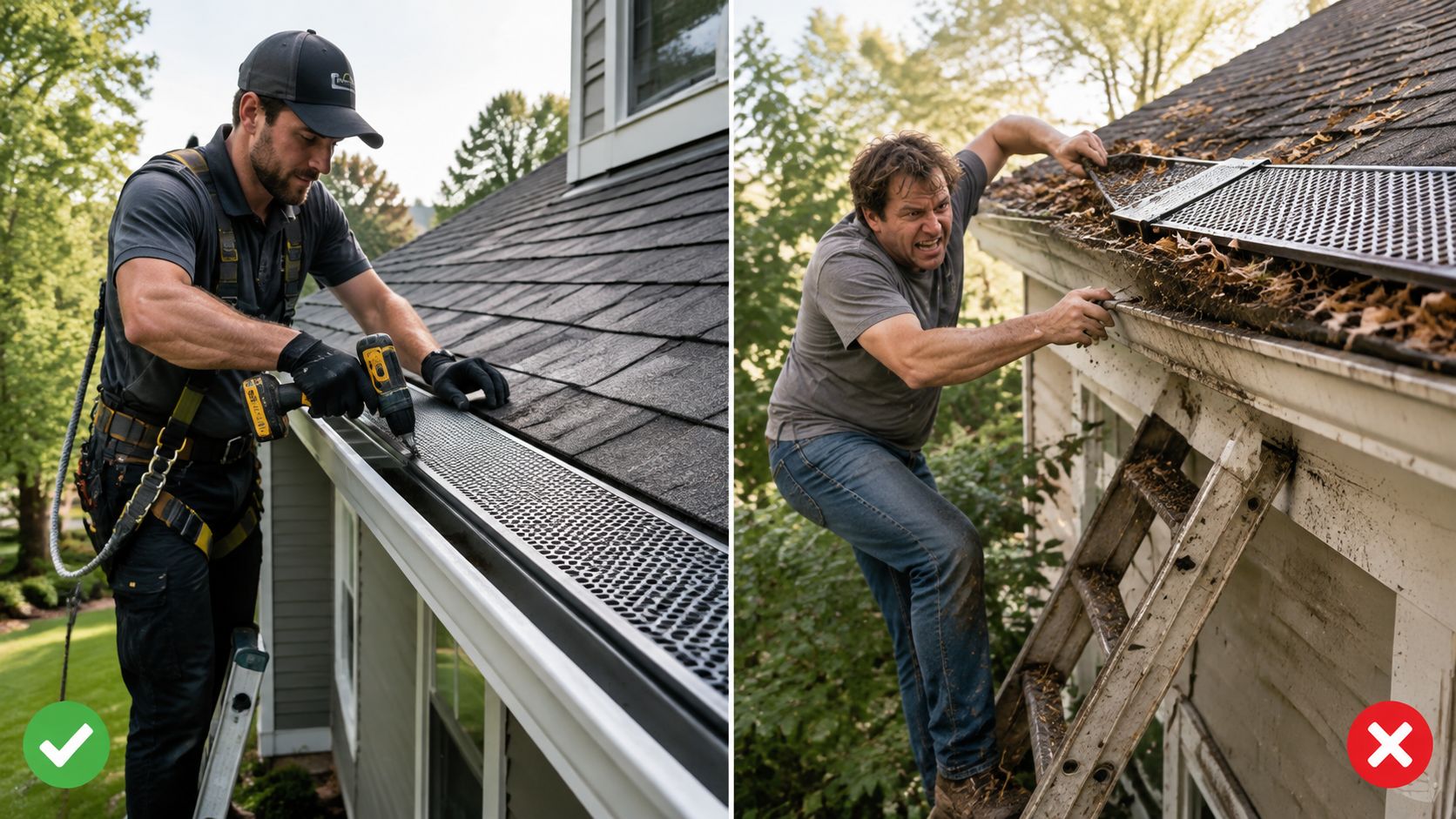
A gutter guard job can look simple from the driveway. A ladder, a few fasteners, and a Saturday afternoon sound manageable until the roofline, fascia, and weather start working against you. That's where professional installation usually earns its keep, not by making the job look fancy, but by making it hold up.
Safety and fit are the first issues
DIY work puts you on a ladder near roof edges, often while carrying tools and balancing awkward sections of material. On multi-story homes, that risk climbs fast. Even when the install goes smoothly, the bigger problem is that a guard can look secure while still sitting at the wrong slope or leaving a gap that lets debris in.
Professional installation involves critical details like setting guards at a slope of 5° to 25°, reduced to 5° to 10° on steep roofs or low-hung gutters, and using 3 self-tapping screws per 4-foot section or an approved adhesive system with the proper cure time and temperature window (Gutterglove install guide). Those aren't small details. They're the difference between a guard that stays put and one that shifts, leaks, or starts catching debris in the wrong spot.
Why the details change performance
A proper install keeps the front lip flat with no gap and sets the mesh trough at least 1/8 inch below the gutter front lip so water enters the gutter instead of bridging over the guard. That geometry matters when snow load, wind, and thermal cycling all hit the system in the same year. If the fit is off, the guard can turn into a collection point instead of a channel.
A guard that's installed wrong can create more frustration than no guard at all.
A contractor also knows when a roof edge needs a different approach, especially if the house has shingles, drip edge quirks, or a tighter fascia line. That kind of judgment is hard to match in a one-off weekend project.
Our Gutter Guard Installation Process
Homeowners usually want two things from a contractor, clear communication and a clean jobsite. The process should feel organized from the first call, not like a surprise every time someone shows up. That's how we approach gutter guard installation at Cultivate House Detailing, with a straightforward sequence that keeps the work predictable.
First comes the walkaround and measurement. We look at roofline conditions, existing gutter condition, and debris patterns so the recommendation fits the home instead of forcing one product everywhere. If the gutters need cleaning first, that gets handled before the new guards go on, because a good install starts with a clean base.
Next is the installation itself. The guards are fit to the roof geometry, fastened securely, and checked for consistent slope and contact at the front edge. That step matters on Colorado Springs homes where a small mismatch can create runoff problems later.
Then comes cleanup and walkthrough. We remove loosened debris, inspect the finished system, and make sure the homeowner understands what was installed and how it should be maintained. That last part builds trust because the work should be visible in the result, not hidden behind jargon.
Clear expectations matter. A homeowner should know what's being installed, why that product was chosen, and what the finished system should do when it rains or snows.
The goal is a smooth handoff, not a mystery invoice. When the process is organized, homeowners feel more comfortable hiring out the job and less worried about whether the guard will do what it's supposed to do.
Understanding Gutter Guard Installation Costs
Most homeowners start with one question, what's this going to cost? The honest answer is that pricing depends on the house, the material, and how hard the installation is going to be. A simple ranch with easy ladder access won't price the same as a taller home with tight roof edges and repairs needed before the guards can go on.
Nationally, professional gutter guard installation averages $1,517, with a typical range of $652 to $2,463 (This Old House). Another cost guide says the service usually falls around $6 to $13 per linear foot including materials and labor, which is why a quote should always be based on the actual footage and roof conditions. Homeowners looking for a deeper breakdown can also review how to find the best gutter guard installation near you without overpaying.
What changes the price
The biggest cost drivers are easy to understand.
- Linear footage: More gutter length means more material and more labor.
- Guard type: Micro-mesh, screens, and reverse-curve systems don't price the same.
- Roof access: Taller roofs and steep angles take more time and care.
- Current gutter condition: Repairs or cleaning before installation can change the total.
A common reason homeowners still move forward is the maintenance relief. In a 2025 survey, about 42% of homeowners said they saved 4 to 8 hours per year on maintenance after installation (This Old House survey). That doesn't make the upfront cost disappear, but it explains why many people see the service as a tradeoff between paying now and climbing fewer ladders later.
For Colorado Springs homes, the best quote is usually the one that reflects actual conditions instead of a generic square-foot guess. If the home has heavy tree cover, a complex roofline, or signs of prior overflow, the work becomes more detailed and the price should reflect that.
How We Account for Colorado's Unique Climate
Colorado weather doesn't just test the roof, it tests the whole drainage system. Heavy snow, freeze-thaw cycles, hail, wind, and pine needles all push a gutter guard to its limits. A system that works in a mild climate can fail here if the material, slope, or fastening method isn't chosen with local conditions in mind.
Snow, ice, and hail all change the job
A roof that carries heavy snow needs a guard that won't buckle or shift when the load changes. That's one reason installation quality matters just as much as product type. If water freezes near the edge, the system has to stay aligned so the melt can still move into the gutter instead of riding over the top.
A critical but often overlooked factor is how the guard fits the roof itself. High-pitch roofs can cause water to overshoot the gutter, which is why the guard's slope and position relative to the roofline need to be adjusted carefully (Lowe's installation guide). That issue shows up fast in places with steep roofs and sudden weather shifts.
Hail is another reason to be picky about materials. A guard can look solid at installation and still be vulnerable to impact later if the material choice is too thin or the attachment points are weak. That's where a local installer reads the house differently than a generic product page does.
Why local debris matters too
Pine and fir needles are a special problem because they're narrow, persistent, and good at working into gaps. Micro-mesh systems are often the strongest fit for that environment because their smaller openings are designed to stop fine debris before it reaches the gutter channel. In dense tree cover, that can make the difference between a clean trough and a system that needs constant attention.
The right Colorado Springs setup isn't just about keeping leaves out. It's about preserving flow through snow, ice, needles, and wind.
That local fit is where Cultivate House Detailing's gutter guard work becomes more than a product install. It's a house-specific decision based on roofline, exposure, and the weather that hits the property.
Questions to Ask Your Gutter Guard Contractor
A good contractor should welcome direct questions. If the answers feel vague, that's a sign to keep looking. You're not just buying hardware, you're paying for the judgment that puts it on the roof correctly.

What to ask before you sign
- What warranty is included? Ask about both product and labor coverage so you know what's protected after the install.
- Can I see local references? A contractor with work in your area should be able to point to homes with similar rooflines or debris issues.
- Describe your installation process. You want to know how they handle cleaning, fitting, fastening, and final inspection.
- Are you licensed and insured? That matters for safety, liability, and peace of mind.
A useful way to think about this is the same way homeowners verify other contractor credentials. If you've ever looked at a resource like verifying contractor credentials in Arizona, the point is the same, ask before you hire, and don't assume paperwork is in place just because the quote sounds good.
If a contractor can't explain slope, fastening, or roof-fit in plain language, they probably shouldn't be working on your gutters.
A strong answer should sound specific, not scripted. The contractor should talk about your roof, your trees, and your exposure to weather. If the explanation is generic, the install probably will be too.
If you're in Colorado Springs and want a gutter guard installation service that treats the roof as a system, not a sales pitch, reach out to Cultivate House Detailing. We install guards with local weather, roof geometry, and long-term performance in mind, and you can visit Cultivate House Detailing to request a quote and schedule service.
Looking for a professional to take care of it? Cultivate House Detailing offers gutter guard installation in Colorado Springs. Get a free quote.