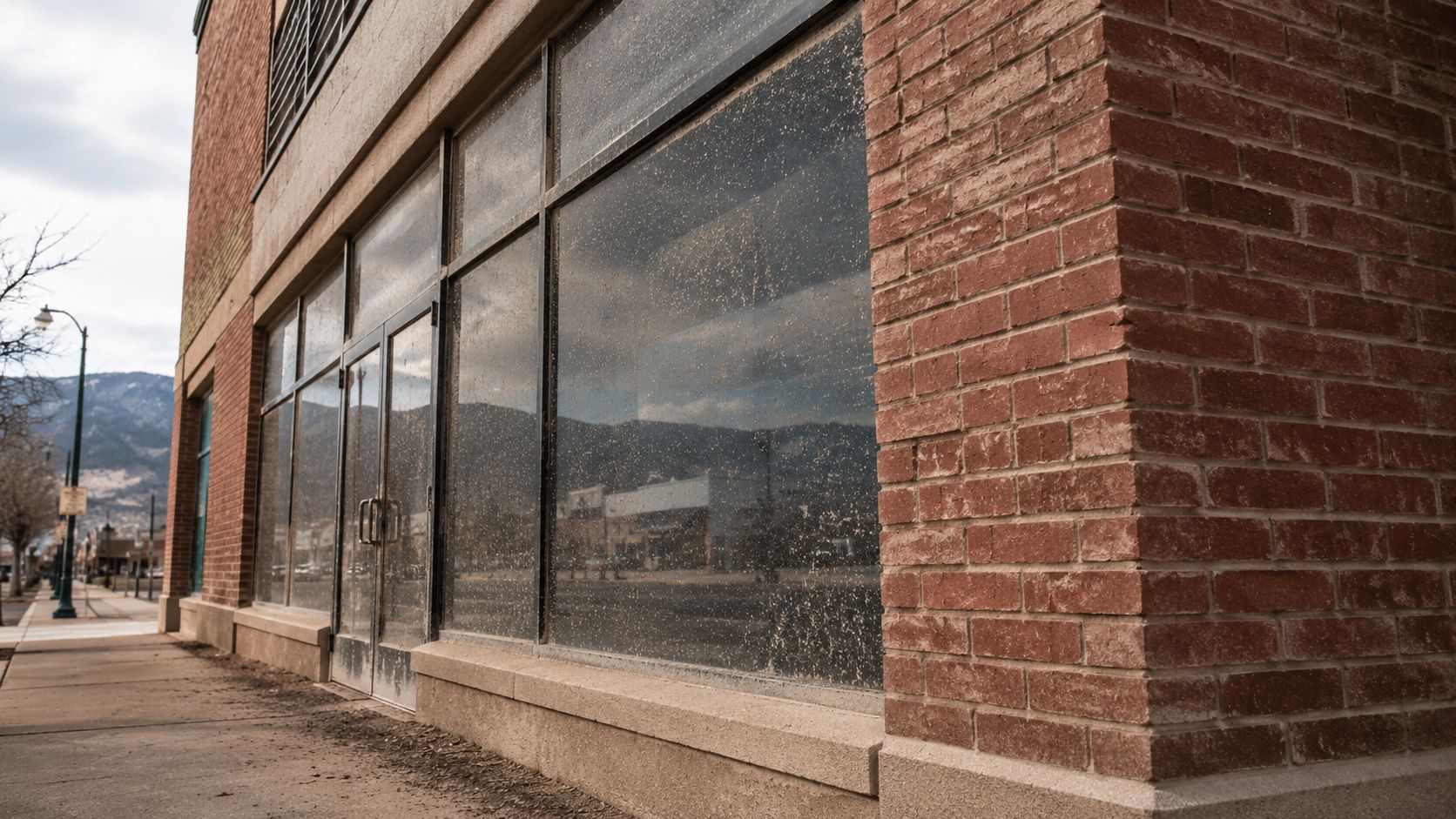
You notice it first on the parts customers see every day, the sidewalk at the entrance, the lower glass by the doors, the loading area where tires leave dark marks, the corners where wind pushes dust into a stubborn film. In Colorado Springs, that buildup doesn't sit still for long. Dry air, dust, foot traffic, and seasonal grime keep exterior surfaces looking tired fast, especially when a property has to look clean before opening hours.
A professional commercial pressure washing service gives property managers and business owners a way to stay ahead of that wear instead of reacting to it after complaints, slip concerns, or a curb-appeal problem. For a locally owned team like Cultivate House Detailing, the job is about more than blasting water at concrete. It's about matching the right pressure, flow, temperature, and chemistry to the surface so the property looks cared for without creating damage.
Why Colorado Springs Businesses Need Commercial Pressure Washing
A storefront can look fine from the parking lot and still feel neglected up close. One windy week in Colorado Springs, and dust settles on glass, stucco, concrete, and entry pads. Add tire marks, gum, spills, and the normal grime that comes with customer traffic, and a property starts to send the wrong message before anyone walks through the door.
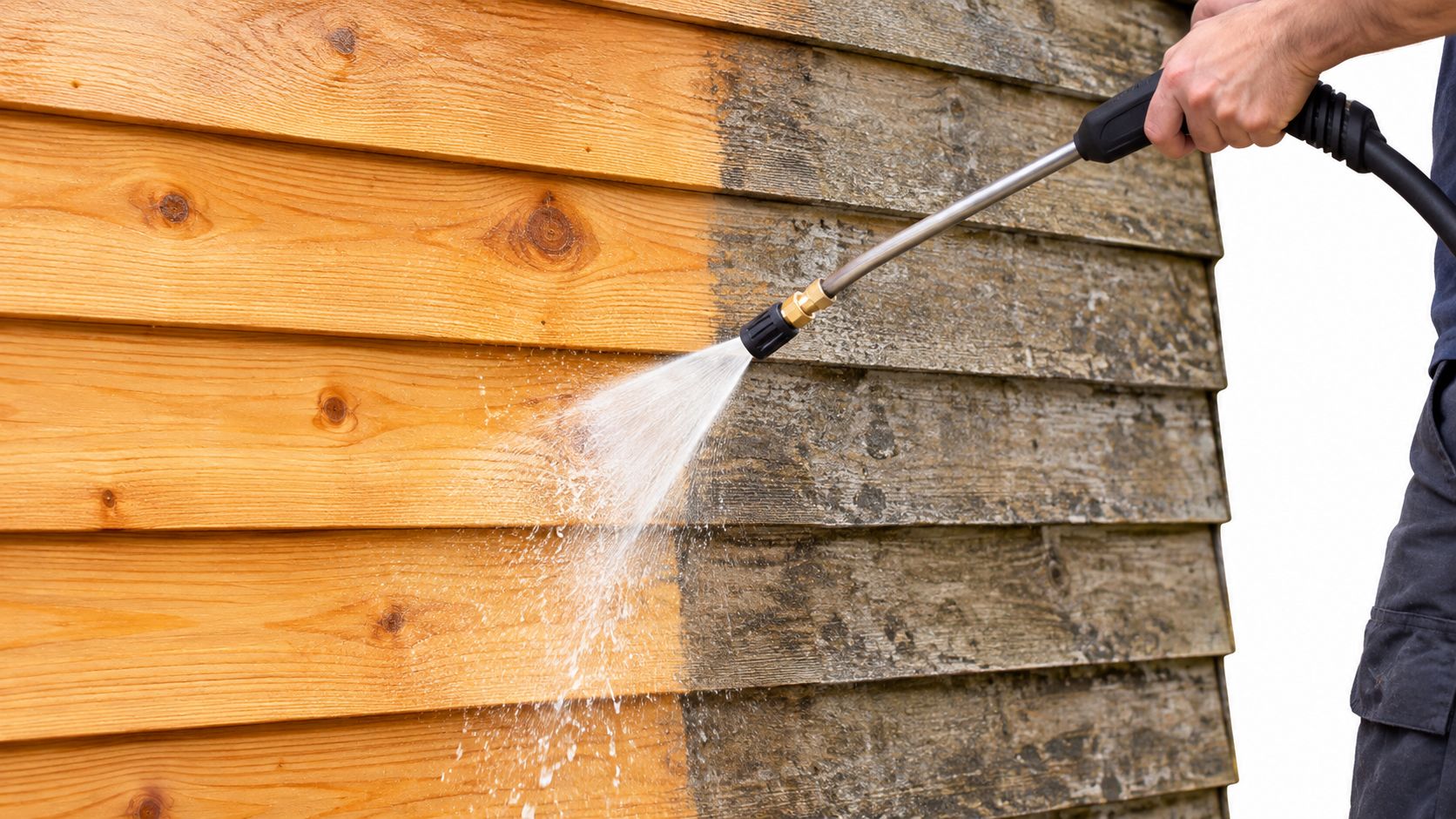
A commercial pressure washing service matters because this is maintenance, not just appearance work. Pressure washing is commonly used to remove dirt, grime, mold, mildew, dust, mud, stains, salt, and chewing gum from exterior surfaces, which makes it useful for sidewalks, storefronts, parking areas, and building faces that take constant abuse. Commercial power washing applications cover exactly the kinds of buildup business owners see every week.
What property managers usually notice first
The complaints rarely start with the whole building. They start with the entryway that looks dingy, the sidewalk that tracks dirt inside, or the dumpster pad that smells bad and looks worse. Those are small details, but they shape how tenants, customers, and inspectors read the property.
A clean exterior doesn't make a building newer, but it does make it look maintained.
That matters in a city where commercial spaces compete for attention and tenant confidence. A regular cleaning schedule also helps reduce the kind of buildup that becomes harder to remove later, which is why many owners use pressure washing as part of their routine upkeep rather than waiting for a visible problem.
Why recurring service beats one-off rescue jobs
Recurring commercial work is easier on the property and usually easier on the budget. That's especially true for high-traffic sites like office buildings, restaurants, and retail centers, where surfaces collect grime faster than a low-traffic property would. The market supports that pattern, too, because commercial contracts make up a meaningful slice of the pressure washing economy, not an occasional side job. IBISWorld's U.S. pressure washing market data show a mature, established service market rather than a speculative niche.
For businesses in Colorado Springs, the practical takeaway is simple. If the front walk, loading area, or entry glass is taking a beating, waiting usually makes the job harder. Scheduling pressure washing before buildup becomes embedded is the easier path, and it sends a better message to customers from the moment they arrive.
How Commercial Pressure Washing Actually Works
Commercial pressure washing isn't just a stronger version of the machine someone might use at home. The result depends on how several variables work together, and the crew that knows how to adjust them will usually clean faster, safer, and more evenly. Independent guidance on commercial cleaning says effective results depend on nine variables, PSI, GPM, tip size, stand-off distance, spray angle, nozzle type, chemical use, water temperature, abrasive media, and travel speed. Commercial cleaning guidance makes the main point clear, the machine setting alone doesn't decide the outcome.
Why flow matters as much as pressure
A lot of people focus on PSI because it sounds like the power number. In practice, GPM, the amount of water moving through the system, matters just as much or more on large commercial surfaces because it helps lift and carry away soil. A municipal spec for a stationary hot-water system lists 2,000 PSI at 3.9 GPM, while production-grade rigs for commercial work commonly move into the 4,000 PSI / 6.5 GPM+ range for faster removal on big exterior surfaces. Municipal equipment specification
Higher flow rinses better. Higher pressure only helps if the surface can handle it.
That's the practical difference property managers should care about. A high-PSI, low-flow setup can cut lines into a surface without moving soil efficiently. A higher-flow rig spreads cleaning energy across the surface more effectively, which is why large parking areas, loading docks, and wide walkways often respond better to professional equipment than to consumer machines.
Heat and chemistry change the job
Hot water matters when the contamination is greasy or petroleum-based. Commercial guidance cites 80 to 100°C water for penetrating oils and hydrocarbons, and other specs note hot-water machines can reach 200 to 300°F for heavy grease and oil removal. Commercial surface cleaning guidance shows why heat is not just a comfort feature, it's a cleaning tool.
Chemistry also matters. Detergent helps loosen bonded dirt, and stand-off distance, nozzle choice, and spray angle keep the stream effective without beating up the substrate. A crew that understands those adjustments can clean a loading area, a sidewalk, and a storefront entry very differently on the same property, which is exactly what commercial work demands.
The equipment question owners should ask
Not every machine is built for the same job. Consumer units may be fine for light residential cleanup, but commercial surfaces need a system that can balance force, water volume, and heat without causing collateral damage. That's why the right provider talks about the surface first and the equipment second.
In practice, professional judgment shows up. The crew should know when to reduce pressure, when to increase flow, and when to switch from brute force to a cleaning solution. If a provider treats every surface the same, the property usually pays for it later.
Common Commercial Surfaces and Cleaning Applications
Different commercial surfaces ask for different settings, and that's where the work becomes technical in a practical way. Concrete can take much more force than painted siding, but even concrete can be damaged if the operator gets careless with distance, angle, or chemical dwell time. Independent pressure-cleaning guidance recommends roughly 3,000 to 4,000 PSI for concrete driveways, but only 800 to 1,200 PSI for painted surfaces and 1,000 to 1,500 PSI for timber decks, with higher settings risking etching, paint stripping, splintering, or mortar erosion. Surface-specific cleaning guidance
Recommended PSI by Commercial Surface Type
| Surface Type | Recommended PSI Range | Special Considerations |
|---|---|---|
| Concrete walkways and entry slabs | 3,000 to 4,000 PSI | Good for embedded soil, but watch joint lines and decorative finishes |
| Painted exterior surfaces | 800 to 1,200 PSI | Too much pressure can strip coating or open up weak spots |
| Timber decks or wood features | 1,000 to 1,500 PSI | Excess force can splinter fibers and leave lap marks |
| Dumpster pads and grease-prone zones | Varies by soil load and coating | Often need hot water and chemistry more than raw pressure |
| Storefront entries and transition areas | Moderate settings matched to the surface | Focus on safety, appearance, and avoiding overspray into doors or glass |
Sidewalks and walkways
Sidewalks usually respond well to a stronger clean because they're built to tolerate it, but that doesn't mean a wand should be waved around without care. Surface cleaners help here because they distribute water more evenly than a narrow fan tip, which reduces streaking and gives a more uniform finish. On high-traffic routes, the goal is not just looks, it's removing slick buildup that can make the entry feel neglected.
Parking lots, garages, and loading areas
These surfaces are about soil type as much as surface type. Tire marks, oils, and tracked-in grime often need hot water and a detergent pass before any real rinsing starts. If the spill is greasy, a cold rinse can move surface dust without really improving the stain.
Building exteriors and siding
Painted surfaces and delicate cladding need lower pressure because the wrong setting can do real damage. It's also where nozzle choice and stand-off distance matter more than most owners realize. A competent crew will clean around trim, signage, seams, and caulking instead of forcing water into places it doesn't belong.
Loading docks, dumpster pads, and storefront entrances
These are the zones where commercial work feels most different from residential work. Grease, odor, gum, and heavy foot traffic all pile up here, and hot water often becomes the better tool. Storefront entrances also need clean transitions, because customers notice the first few steps more than the back lot.
For owners who want the broader business view, Cultivate House Detailing's commercial curb appeal resource is a useful companion when planning exterior maintenance around customer-facing areas.
Understanding Commercial Pressure Washing Pricing
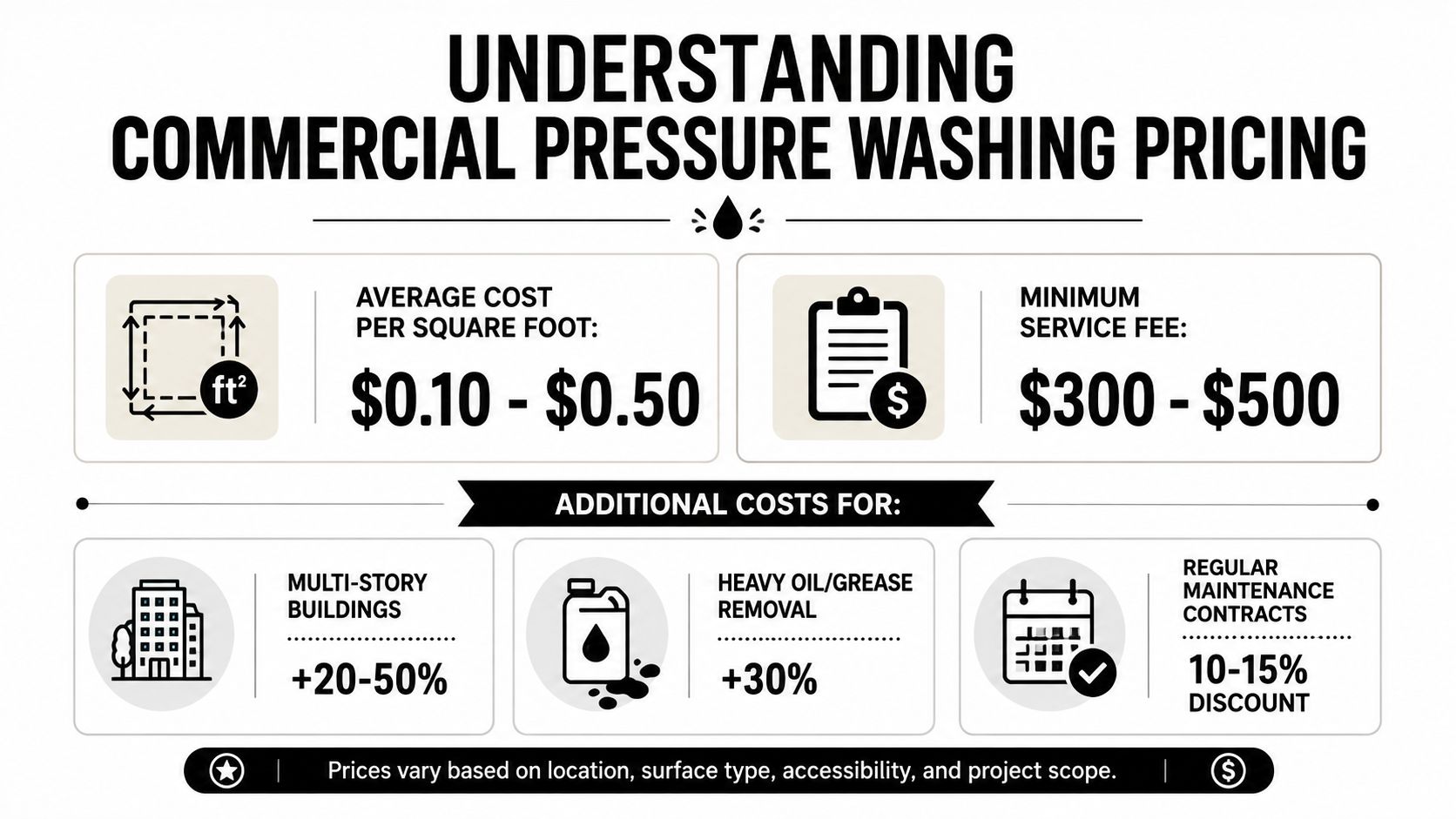
A commercial pressure washing quote makes more sense when it reflects square footage, soil load, access, and the equipment needed to do the job properly. Broad pricing often falls in the range of $0.08 to $1.00 per square foot, depending on the surface and how badly it is stained. Typical examples include $0.10 to $0.30 per square foot for sidewalks and walkways, $0.15 to $0.90 per square foot for building exteriors, and $0.75 to $1.00 per square foot for dumpster pads. Commercial pressure washing cost guide
Why the per-square-foot price changes
A sidewalk is usually cheaper than a dumpster pad because the work is different. Walkways often need routine soil removal, while dumpster pads usually carry grease, odor, and heavier contamination that call for more chemistry, more rinsing, and closer attention to runoff. Building exteriors land in the middle because access, surface type, and staining severity all affect the scope of the work.
Heat, water flow, and detergent choice also change the price. A contractor running higher GPM can move soil faster on large flat areas, but that does not mean every surface should see the same pressure. Painted siding, EIFS, seals, and decorative finishes often need soft washing, lower PSI, or a different chemical blend, while concrete may tolerate more force if the stain allows it. Colorado Springs adds its own variables, since dust, pollen, road film, winter residue, and freeze-thaw wear can leave surfaces looking dirty in ways that a quick rinse will not fix.
The cheapest estimate is not always the lowest-cost result if it skips heat, chemistry, or proper wastewater handling.
That is why a low bid should raise questions instead of excitement. A provider may be underpricing the job, skipping the right equipment, or failing to account for the time needed to clean a badly stained area correctly.
What pushes a quote higher
Surface complexity matters, and so does access. Multi-story work, awkward corners, after-hours scheduling, heavy oil removal, and large properties with multiple cleanup zones all make a commercial job more involved. A building with limited water access or tight staging space can also add labor time because crews spend longer moving hose, managing equipment, and protecting nearby finishes.
Temperature and chemistry can change the scope as well. Hot water helps on grease and gum, but it costs more to run and is not needed on every surface. Detergents, degreasers, and specialty treatments add material cost, yet they often reduce dwell time and improve the result on stained concrete, loading areas, and entry pads. That does not automatically mean a price is inflated, it often means the estimate is reflecting the actual conditions on site.
How to compare quotes fairly
A useful estimate should tell you what is being cleaned, what kind of soil is expected, and whether the crew plans to use hot water, detergents, or specialty treatment. It should also explain whether the pricing covers a one-time cleanup or an ongoing maintenance schedule. For property managers who want a local starting point, Cultivate House Detailing's commercial pressure washing rates are a practical reference for comparing scope and service levels.
Choosing a Reliable Commercial Pressure Washing Provider
A good provider protects the property before the first hose is laid out, keeps the work controlled while the crew is on site, and leaves the space ready for normal use afterward. Insurance, surface knowledge, wastewater handling, and scheduling discipline matter as much as the final appearance. Commercial pressure washing has become a mature service category, and the field includes contractors with very different levels of training and equipment. Market data from IBISWorld market size data shows that the industry is established, so property managers have real choices, and quality is one of the main ways reliable providers stand out.
Questions worth asking before you book
- Insurance coverage: Ask for proof of liability coverage and confirm that it applies to commercial property work.
- Equipment: Ask what machines they bring, especially whether they can handle commercial cleaning with the flow needed for larger surfaces.
- Cleaning method: Ask how they choose between pressure, soft washing, heat, and detergents based on the material and the soil.
- Runoff handling: Ask how they manage wastewater near drains, landscaping, and any area where runoff could create a problem.
- Estimate details: Ask for a written scope that names the surfaces, access limits, protection steps, and cleanup expectations.
These questions matter because the right answer says more than a sales pitch. A contractor who can explain why a greasy loading zone may need hot water and detergent, while a painted facade may need lower pressure and more chemistry, is showing real job-site judgment.
What a strong estimate looks like
A solid estimate does more than give a total. It identifies the surface being cleaned, points out problem areas, and notes any special precautions for signage, glass, painted areas, or landscaping. It should also tell you whether the provider is quoting a one-time cleanup or a maintenance schedule, because those jobs are priced and planned differently.
For a property manager, the best quote is easy to compare because it explains the method, not just the number. That matters on commercial sites where the actual cost is not only the wash itself, but also the risk of damage, the time needed to control access, and the crew's ability to choose the right combination of GPM, PSI, temperature, and chemistry for the surface.
Cultivate House Detailing is one local option that handles exterior cleaning with pressure washing, window cleaning, gutter cleaning, and related maintenance work, which can be useful when a property needs more than one service visit. The practical value is coordination, one crew, one schedule, and less back-and-forth to keep the exterior in shape.
Colorado Springs considerations that affect the hire
Colorado Springs properties deal with weather swings, dust, and seasonal scheduling pressure. That affects both the cleaning method and the job timing. Dry, windy conditions can leave more grit on surfaces before the wash starts, and temperature changes can affect how well detergents dwell on concrete, siding, and entry areas. A provider who works here regularly should be able to explain how those conditions change the plan from one property to the next.
Local experience also matters because commercial buildings in the area do not all clean up the same way. Stucco, brick, metal panels, painted trim, and concrete each respond differently to pressure, heat, and chemistry. A crew that understands those trade-offs will make better surface choices on the first pass, protect the property more reliably, and reduce the chance of a call-back.
If a provider cannot explain how they will protect the property, they are not ready for commercial work. A good contractor should make the process feel controlled, with clear steps, clear timing, and no guessing on site.
Your Pre-Service Checklist and Scheduling Tips
A smooth pressure washing appointment starts before the truck pulls up. Owners and property managers can save time, reduce risk, and avoid confusion by preparing the site in a simple, repeatable way. That prep doesn't need to be complicated, but it does need to be intentional.
Before the crew arrives
- Clear the work zone: Move patio furniture, displays, stored inventory, and anything else that could get in the way.
- Mark sensitive areas: Point out landscaping, electrical components, delicate trim, or surfaces that need lower pressure.
- Secure access: Let tenants, staff, or vendors know which doors, sidewalks, or loading areas may be temporarily limited.
- Plan for pets and foot traffic: Keep pets away and make sure employees know where to avoid walking until the surface is dry.
These small steps reduce delays and keep the crew focused on cleaning instead of navigating obstacles.
Scheduling that works better for business
Off-peak hours usually create less disruption, especially for restaurants, offices, and retail properties with steady daytime traffic. Weather matters too, because outdoor cleaning in Colorado Springs can shift quickly with temperature, wind, or precipitation. The safest plan is to leave some flexibility in the schedule so the crew can choose the best working window.
Good scheduling protects the property, but it also protects the day's business flow.
How often to plan service
Frequency depends on foot traffic, surface type, and how quickly the property collects visible buildup. High-traffic entries and grease-prone zones usually need attention more often than low-traffic walls or decorative areas. Property managers who already know their hot spots can schedule cleanup before complaints start, which is usually the less expensive way to handle it.
The best results come when the service is treated like maintenance, not a rescue mission. That mindset keeps the property looking presentable and makes the next appointment easier to plan.
Frequently Asked Questions About Commercial Pressure Washing
How long does a commercial job take?
It depends on square footage, soil load, site access, and the setup the job needs. A small storefront wash, a concrete pad with gum and grease, and a loading area with hot water and chemistry each take a different approach. In Colorado Springs, wind, temperature swings, and drying time can also affect the schedule. The equipment matters too, since higher GPM moves dirty water and rinses faster, while the right PSI keeps the surface safe.
Can pressure washing damage a building surface?
Yes. The wrong pressure, spray angle, nozzle choice, or temperature can scar soft materials and drive water where it should not go. Painted siding, wood, mortar joints, caulking, and decorative trim need more control than raw force. A trained crew adjusts the machine to the surface instead of treating every area the same.
What's the difference between pressure washing and soft washing?
Pressure washing uses stronger water force to remove buildup from hard surfaces like concrete, block, and some metal fixtures. Soft washing relies more on cleaning solutions and low pressure, which is better for siding, roof-related surfaces, and other materials that do not tolerate heavy impact. On a commercial site, the right method depends on the stain, the substrate, and whether heat or specific chemistry will do the work more effectively than pressure alone.
How often should commercial properties be cleaned?
That depends on traffic, weather exposure, and the kind of business using the property. A busy storefront, restaurant, or multi-tenant property usually needs attention more often than a low-traffic building because grease, dust, salt, and tracked-in soil build up faster. Property managers who watch the problem areas closely can time service before the buildup turns into a bigger cleanup.
What happens with wastewater runoff?
A professional crew should plan for runoff control and follow environmental best practices for the site. That means thinking about where water, detergent, and loosened debris go before the wash starts, especially near drains, landscaping, or sloped pavement. In commercial work, wastewater management is part of the job, not an extra step.
If your property in Colorado Springs needs cleaner walkways, better-looking storefront surfaces, or a more reliable maintenance schedule, Cultivate House Detailing can help with commercial pressure washing and related exterior cleaning needs. Visit Cultivate House Detailing to request a quote and schedule service for your property.
Rather not do it yourself? Cultivate House Detailing offers pressure washing in Colorado Springs. Get a free quote.