A customer pulls into your lot in Colorado Springs, steps out, and looks down before they ever look up. They see the gum ghosts on the sidewalk, the oil marks near the parking stalls, the dusty walkway by the entrance, and the dark buildup where people queue every day. That first glance shapes trust fast.
Business owners already know appearance matters. The tricky part is budgeting for it without feeling like you're guessing. Commercial pressure washing rates can look simple on the surface, but two properties with similar square footage can price very differently once you factor in access, buildup, water availability, and the actual cleaning method needed.
That confusion is why transparent pricing matters. If you're comparing quotes for a retail storefront in Manitou Springs, an office property in Briargate, or a mixed-use building near Monument, you need more than a vague number. You need to know what drives the price, where the common pricing ranges come from, and how to tell whether a quote is realistic or just low on paper.
Your Business's First Impression Starts at the Curb
A lot of commercial exterior cleaning decisions get delayed for the same reason. The property still functions, tenants are busy, and the dirt builds slowly enough that nobody notices it all at once. Then one day the contrast is obvious. The concrete by the front door is darker than it should be, the dumpster pad is stained, and the entrance no longer matches the level of professionalism happening inside the building.
That matters in Colorado Springs. Customers, tenants, staff, and vendors all read a property before they read your signage. A clean exterior tells people the building is maintained. A neglected one can raise questions you don't want to answer.
What business owners are usually weighing
Most owners and property managers aren't asking whether exterior cleaning helps. They're asking practical questions:
- What should this cost? They want a realistic budget range, not a mystery invoice.
- How often is enough? They need a maintenance cadence that protects appearance without overspending.
- Will this disrupt business? They want the work done cleanly, safely, and with minimal interruption.
- Are quotes comparable? They need to know whether one contractor is including the same scope as another.
Those are fair questions. Pressure washing isn't a commodity service when the surfaces, traffic patterns, and staining are different from one site to the next.
A cheap quote can be expensive if it skips pretreatment, underestimates setup time, or uses the wrong process for the surface.
Why rates feel confusing
Part of the confusion comes from how commercial work is sold. Some contractors quote by square foot. Others use hourly pricing. Others package the whole job into a flat project number. None of those approaches is automatically wrong. The problem starts when the pricing method isn't explained.
If you're trying to compare bids for a storefront apron, a restaurant patio, or a multi-tenant sidewalk run, the number only helps when you understand what work is attached to it. That's where clear guidance makes the difference. Businesses in Colorado Springs, Black Forest, and Monument usually don't need a national average. They need a quote that matches the actual conditions on their property.
How Commercial Pressure Washing Prices Are Calculated
Commercial pressure washing quotes usually come from three pricing models: per square foot, hourly, or a flat project rate. The right model depends on how predictable the work is before the crew arrives on site.
Per square foot pricing
Per square foot pricing is common for large, open areas with a clear scope. Sidewalk runs, loading zones, parking areas, and other flatwork are easier to measure, so contractors can price them with more confidence. One industry benchmark for commercial properties puts that range at $0.05 to $0.15 per square foot, with broader commercial flatwork guidance reaching $0.08 to $0.40 per square foot depending on soil level, access, and production speed, according to commercial pressure washing pricing benchmarks.
In practice, this model works best when the surface is straightforward and the cleaning method is consistent across the job. If a property manager in Colorado Springs wants pricing for a long stretch of cleanable concrete with no major staining issues, square foot pricing is often the clearest way to budget.
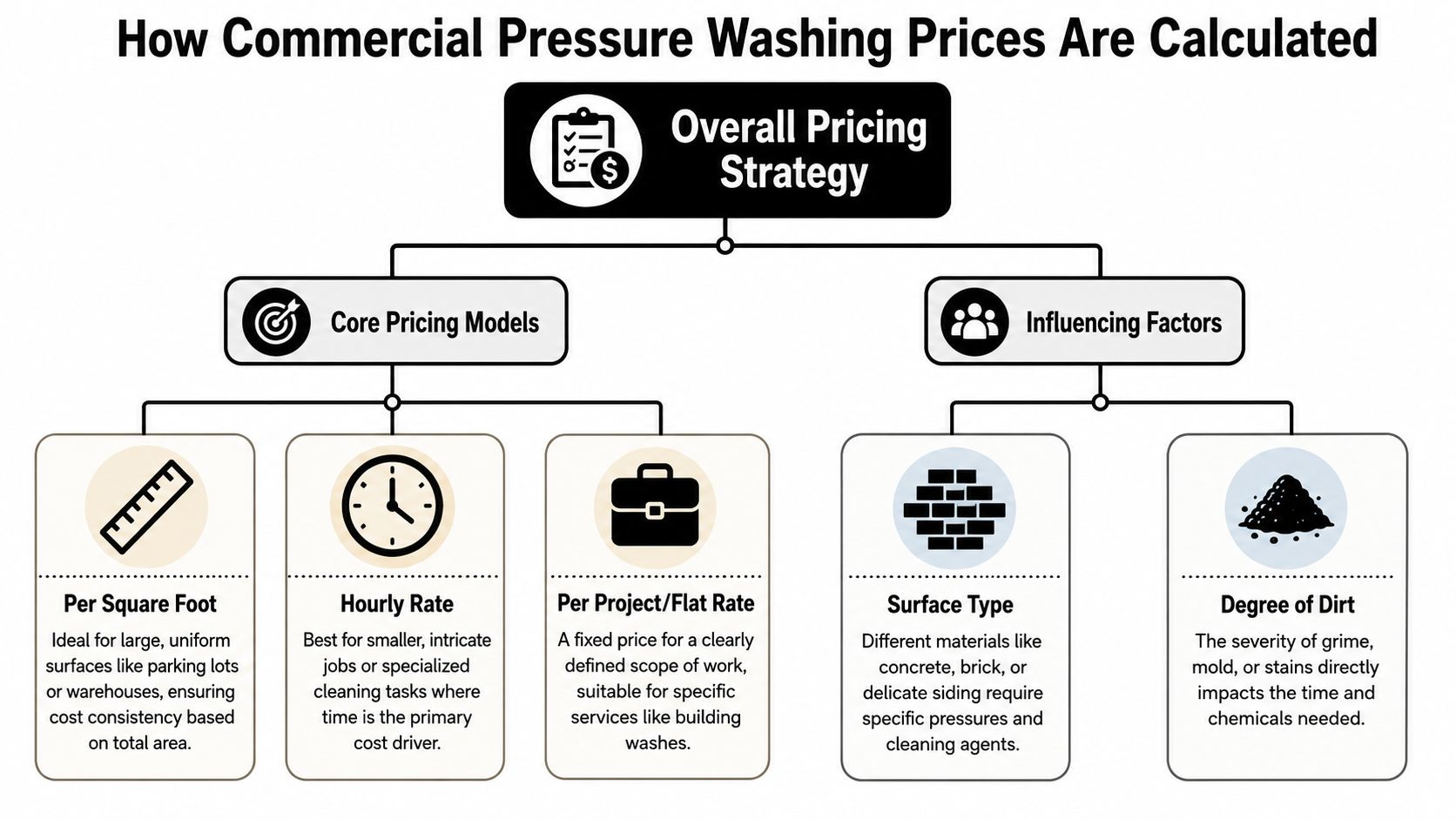
Hourly pricing
Hourly pricing makes more sense when the job has variables that are hard to measure from a map or a quick walkthrough. Mixed surfaces, tight access, heavy buildup, furniture moving, tenant foot traffic, and staged cleaning around business hours all push a contractor toward time-based pricing.
That is common on restaurant patios, storefront entries, service corridors, and smaller commercial sites where setup and detail work take as much effort as the washing itself.
Flat rate project pricing
Flat-rate pricing bundles the full scope into one number. A contractor may price a building wash, front walk, rear pad, and dumpster area together because the customer wants one total and the site has several work zones.
That flat number still comes from the same underlying math. Labor hours, chemical use, equipment wear, water access, setup time, and expected production rate all have to be accounted for. The difference is that the customer sees one project price instead of separate line items by time or square footage.
Which model usually fits best
No single method is the "correct" one for every property. A simple shopping center sidewalk may be easiest to quote by square foot. A grease-stained restaurant back pad may be safer to quote by the hour. A multi-part HOA or retail site often fits a flat project rate better because the scope includes several different tasks.
That is why quotes can look different from one contractor to another, even when they are pricing the same address.
If you want to find your optimal service pricing before requesting bids, that kind of tool can help you frame a maintenance budget and compare assumptions. It will not replace a site visit, but it can help you ask better questions and spot a quote that is missing part of the work.
Key Factors That Drive Your Final Cost
A quote doesn't move up or down randomly. Commercial pressure washing rates change because real conditions on site change the labor, equipment, chemistry, and risk involved.
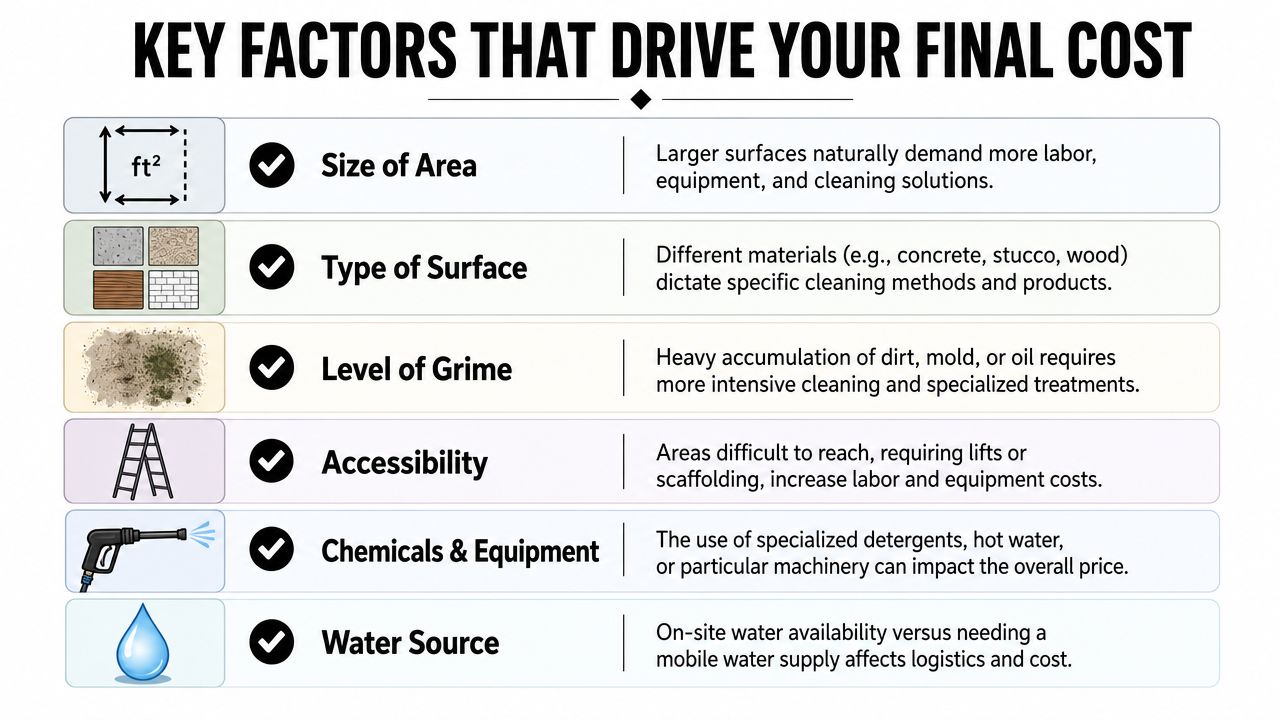
The variables contractors actually price around
A practical pricing rule used by contractors is to estimate true break-even cost from labor, chemicals, overhead, and equipment, then add a target margin. One industry guide recommends 20% to 40% profit margins, notes that commercial flatwork is often priced at $0.08 to $0.40 per square foot, and says hourly pricing commonly falls around $50 to $160 per hour in this pressure washing pricing guide.
That matters because the cleaned area alone doesn't tell the whole story. Two jobs can have the same square footage and completely different production times.
- Surface condition: Light dust and routine grime are one thing. Grease, gum shadows, food spills, algae, or heavy organic staining usually require more dwell time, more passes, or specialty cleaners.
- Material type: Concrete, painted surfaces, decorative stone, stucco, and coated materials don't all tolerate the same pressure or chemistry.
- Access and obstacles: Curbs, bollards, outdoor seating, planters, delivery areas, and tight pedestrian paths slow down production.
- Water logistics: Easy on-site water access keeps things simple. Limited access creates more setup and coordination.
- Equipment choice: Some jobs clean effectively with a standard setup. Others need hot water, stronger pretreatment, surface cleaners, or specialty nozzles.
Practical rule: If the contractor can't explain what is increasing the labor or chemical load, the quote probably isn't fully built out.
Why low numbers sometimes miss the real work
A contractor who prices too low often leaves out the slow parts. Setup. Pretreating. Rinsing carefully near doors. Managing runoff. Working around business hours. Those are the parts owners notice when they go wrong.
This short video gives a useful look at how site conditions change production in the field:
If you're comparing hourly labor assumptions across property maintenance work, a tool for landlord contractor pay can help frame what labor-based pricing may need to cover. It won't price a wash job by itself, but it helps make hourly quotes easier to interpret.
What experienced estimators pay attention to
The best estimates come from details, not shortcuts. A careful estimator will ask about stains, access times, water availability, traffic flow, and whether the cleaning has to happen before open, after close, or around active customers. That doesn't make the quote inflated. It makes it usable.
Sample Estimates for Colorado Springs Properties
The easiest way to make commercial pressure washing rates feel real is to look at common property types. These aren't fixed prices. They're budgeting examples based on common commercial surface benchmarks and the kinds of conditions local businesses deal with.
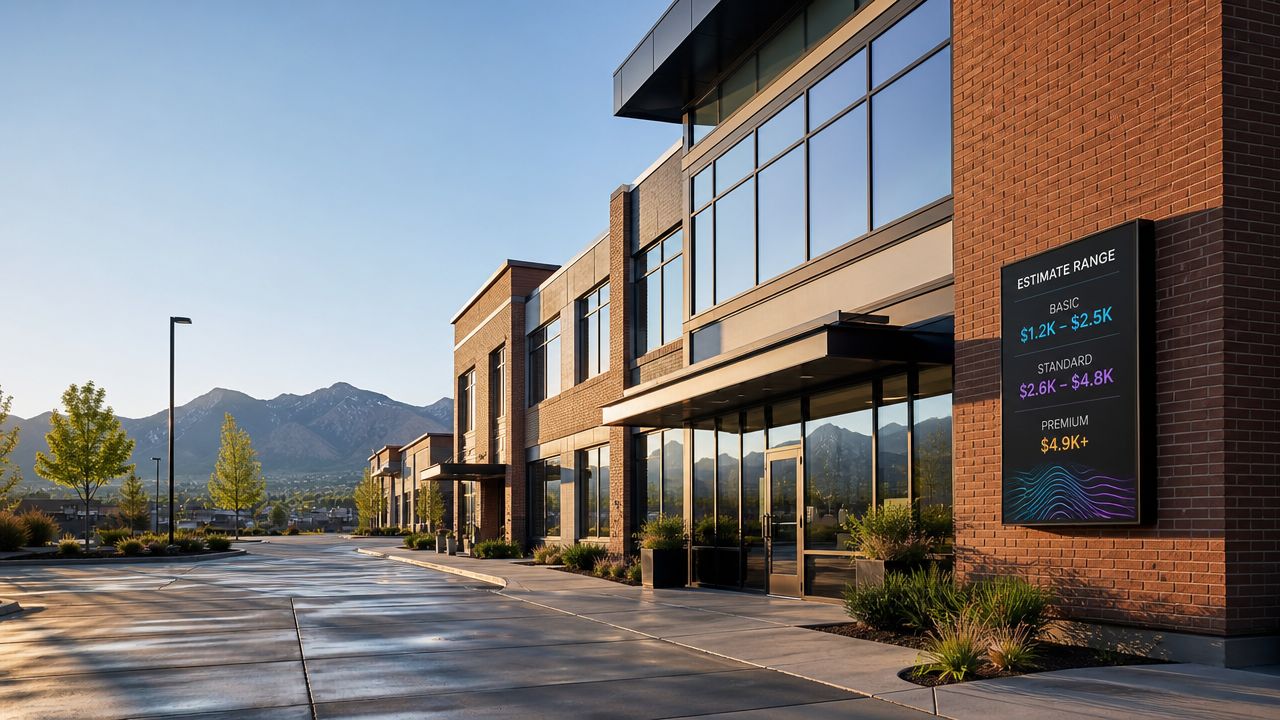
Commercial pressure washing is often benchmarked by surface type at around $0.05 to $0.15 per square foot for parking lots, $0.10 to $0.25 for warehouses, $0.15 to $0.35 for office buildings, and $0.25 to $0.45 for retail storefronts, according to commercial pressure washing surface pricing benchmarks.
A few local-style budgeting examples
| Property example | Likely pricing lens | What usually affects the quote |
|---|---|---|
| Retail storefront entrance in Manitou Springs | Retail storefront benchmark | High foot traffic, tighter access, visible entrance areas, stain detail |
| Office sidewalks and parking area in Briargate | Parking lot and office benchmark | Broad flatwork, oil spotting, curb lines, volume |
| Restaurant patio and service walk | Retail or project-based quote | Food residue, beverage staining, grease transfer, furniture movement |
Storefront entrance and walkway
A small storefront entry often looks simple from the street, but it can be slower than a bigger open slab. Retail storefronts sit in the higher benchmark range because the work is more visible and access is often tighter. Crews may need to work around signs, planters, benches, or active pedestrian traffic.
For a downtown-style storefront, owners should expect the final number to depend less on raw size and more on stain severity and the amount of detail work around the entrance.
Mid-size office property
An office property in a corridor like Briargate usually has the opposite pattern. There may be a larger sidewalk run and a more open parking area, which can make production smoother. That can support lower per-foot pricing on the broad flatwork portion, with the office-facing entry areas carrying a different rate logic.
If you're budgeting this type of job, the quote often improves when the contractor can clean a larger contiguous area in one setup.
Clean, open flatwork tends to price more efficiently than small broken-up sections, even when the total area is similar.
Restaurant patio and rear access paths
Restaurant work often needs more care than owners expect. Drink stains, food drips, grease transfer near service routes, and heavier foot traffic all slow the cleaning process. A patio may not be huge, but it can still command a stronger project price because it needs more than a quick rinse.
If you're looking for a local service page that matches this type of work, commercial pressure washing in Colorado Springs is the most relevant place to request a site-specific quote.
Tips for Getting an Accurate and Fair Quote
The fastest way to get a bad quote is to give a contractor almost no information and hope the number still lands right. The fastest way to get a fair one is to make the site easy to understand before anyone even steps on it.
What to send before the estimate
Photos help. A lot. Wide shots of the property, close-ups of the worst staining, and a note about where customers enter can save time and reduce surprises.
Give the basics up front:
- Property type: Retail, office, restaurant, mixed-use, warehouse.
- Target areas: Sidewalks, patios, dumpster pad, drive lanes, entry concrete.
- Known issues: Oil, gum, rust-colored staining, food residue, algae, or heavy dirt.
- Scheduling limits: Before open, after close, weekends, or tenant coordination.
- Water access: Whether an on-site water source is available.
What to ask when comparing quotes
A useful quote should answer more than "how much." It should tell you what work is included and what assumptions the contractor made.
Ask questions like these:
- What surfaces are included? Make sure the quote names the actual areas to be cleaned.
- Is pretreatment included? Some stains need chemistry and dwell time, not just pressure.
- How are access issues handled? Tight walkways and active business hours change labor.
- Will the crew need your water supply? It's better to know this before service day.
- What could change the final price? A professional should be able to answer this clearly.
A transparent quote usually feels a little more detailed on the front end. That's a good sign. It means the contractor is trying to prevent billing surprises instead of explaining them later.
Why the cheapest quote isn't always the fair quote
Fair pricing isn't just low pricing. It's pricing that matches the work required. If one bid is dramatically lower, look for what got removed. Was pretreatment dropped? Did they ignore stain severity? Are they assuming wide-open access when your site is anything but open?
For business owners comparing local providers, this page on pressure washing for businesses in Colorado Springs is a helpful example of the kind of commercial scope to ask about when requesting a quote.
Hiring Checklist Spotting a Pro vs an Amateur
Hiring the right contractor shows up in the details before the cleaning starts. A solid commercial washer asks better questions, sets expectations clearly, and treats your property like an operating business instead of an empty lot.
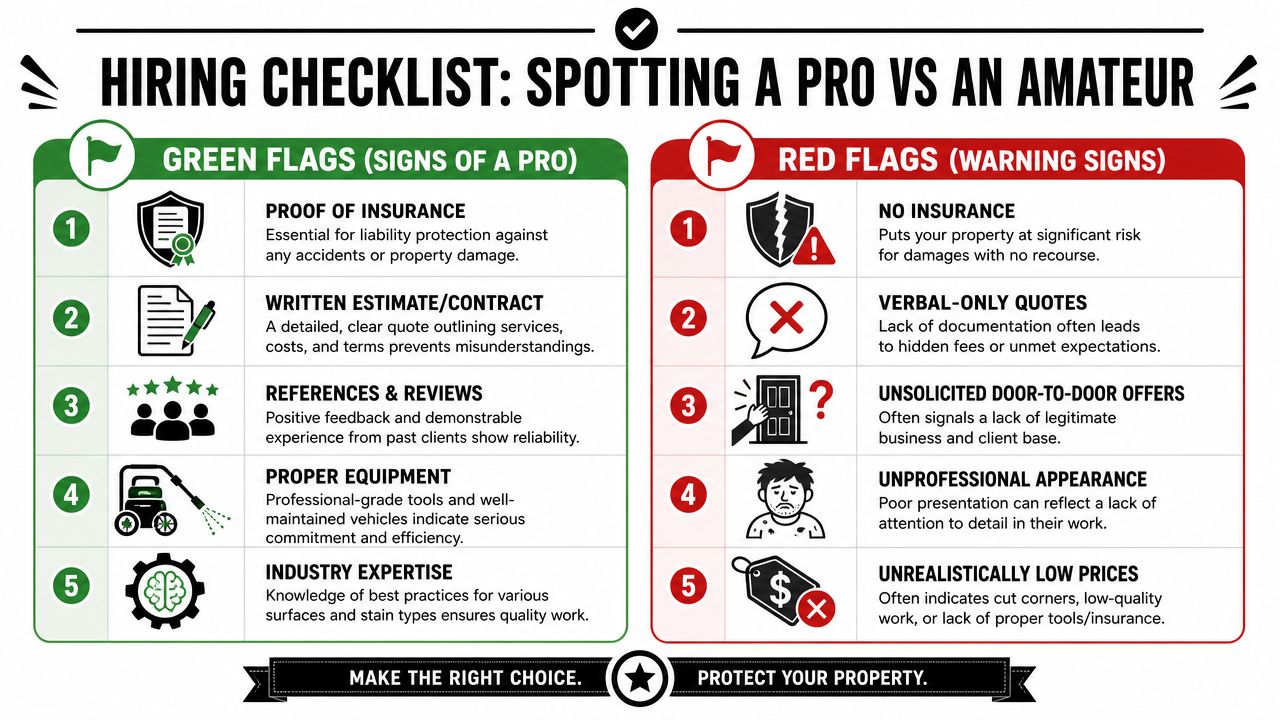
A polished estimate can still hide sloppy work. In my experience, the difference usually shows up in how a company talks through risk, access, surface type, and cleanup. A pro has a process. An amateur has a price.
Green flags worth noticing
- Written scope: The estimate clearly names the areas being cleaned, the method being used, and anything excluded from the job.
- Proof of insurance: They can send documentation without stalling or getting vague.
- Surface-specific knowledge: They can explain why concrete, stucco, painted siding, dumpster pads, and storefront walkways may need different treatment.
- Jobsite awareness: They ask about business hours, foot traffic, hose routing, water access, and runoff control before service day.
- Professional operation: Their communication is organized, they show up prepared, and they follow through on scheduling.
- References or reviews: You can verify that they finish work as promised and handle issues professionally if something changes.
Cultivate House Detailing is one example of a local Colorado Springs company that offers commercial exterior cleaning. The useful takeaway is not the brand name. It is what a serious local contractor should bring to the table: clear scope, familiarity with local property types, and straightforward communication before the job starts.
Red flags that should slow you down
| Green flag | Red flag |
|---|---|
| Clear written estimate | Verbal-only number |
| Explains cleaning method by surface | Uses one method for everything |
| Carries insurance documentation | Dodges insurance questions |
| Plans around your business hours and access | Acts like your site is simple before seeing it |
| Prices based on actual scope | Throws out a low number on the spot |
| Arrives organized and prepared | Shows up disorganized |
One sentence can tell you a lot: ask how they would clean your property without damaging it. If the answer is vague, rushed, or sounds the same for every building, keep looking.
Low bids deserve extra scrutiny. Sometimes the price is low because the contractor is efficient. More often, something is missing: insurance, pretreatment, enough labor, proper equipment, or enough time on site to do the work right. For a Colorado Springs business, that trade-off can turn a routine cleaning into etched concrete, damaged surfaces, tenant complaints, or a crew that disappears halfway through the job.
Frequently Asked Questions About Commercial Washing
How often should a commercial property be pressure washed
That depends on traffic, exposure, and how visible the area is to customers. Entryways, restaurant patios, and customer-facing sidewalks usually need attention sooner than low-traffic service areas. The best schedule is the one that keeps buildup from becoming a restoration job.
Is pressure washing safe for all building surfaces
Not every surface should be cleaned the same way. Some materials tolerate higher pressure well, while others need a softer approach, different nozzles, or specific cleaning products. A good contractor matches the method to the surface instead of treating the whole property like raw concrete.
Do contractors need to use the business's water
Sometimes yes, sometimes no. It depends on the setup and the job logistics. The important part is that this gets discussed before the appointment so there are no surprises about access, hose routing, or operating hours.
Should I choose square foot pricing or flat-rate pricing
Neither is automatically better. Square foot pricing works well for open, predictable flatwork. Flat-rate pricing can be cleaner for multi-part jobs with mixed surfaces and more variables. The better quote is the one that clearly matches the actual scope of the property.
Commercial pressure washing rates make more sense when the contractor explains the work behind the number. That's what protects your budget. Not just a low bid, but a realistic one.
If you'd like a clear, local quote for your storefront, office, restaurant, or commercial property, Cultivate House Detailing can help you review the scope, understand the trade-offs, and schedule exterior cleaning for your Colorado Springs area business without guesswork.
Rather not do it yourself? Cultivate House Detailing offers pressure washing in Colorado Springs. Get a free quote.