The first cold weekend hits Colorado Springs, and suddenly the idea sounds simple. Pull the bins from the garage. Untangle last year's strands. Drag out the ladder. Try to make the roofline look clean before your hands go numb.
Then reality shows up.
A bulb string fails halfway across the front gable. The ladder never feels quite stable on uneven ground. The second-story peaks look a lot farther away once you're standing below them. What should feel festive starts feeling like a rushed exterior project at the busiest time of year.
That's why more homeowners treat holiday lighting as a service, not a weekend chore. It has grown from a small add-on into a specialized category, with the global holiday light and decoration market valued at $7.2 billion in 2021 and projected to reach $10.73 billion by 2030, according to LightNOW's industry overview. The shift matters because people aren't just buying lights. They're buying design, installation, maintenance, takedown, and the relief of having it handled properly.
In a place like Colorado Springs, that makes sense. Homes here often have varied rooflines, exposed elevations, and weather that can change quickly. Homeowners want a display that looks sharp from the street and holds up through the season without turning December into a ladder project.
Bring Holiday Magic to Your Colorado Springs Home Without the Hassle
A well-lit home changes the whole feel of the season. Warm white rooflines, wrapped columns, and clean outlines along peaks can make a house feel finished in a way a few store-bought strands rarely do. In neighborhoods across Colorado Springs, holiday lighting becomes part of how homeowners celebrate the season and show pride in where they live.
The problem is that most DIY displays fall apart in the same places. The design is improvised. The clips don't match the surface. The extension path gets decided on the fly. By the time everything is plugged in, the result often looks uneven, and the work behind it took far longer than expected.
What homeowners usually run into
Some challenges are obvious, and some aren't.
- Tangling and fit issues happen before installation even starts. Standard retail strands rarely match roof dimensions cleanly.
- Cold-weather setup slows everything down. Clips are harder to handle, cords stiffen up, and simple adjustments take longer.
- Second-story access changes the risk level fast. A job that looks easy from the driveway doesn't feel easy from a ladder.
- Design uncertainty leaves many homes under-lit in one area and too busy in another.
Most people don't mind decorating. They mind spending a full day outside only to end up with a result that still looks temporary.
A professional holiday light installation service removes the friction points that frustrate homeowners most. The work starts with a plan that fits the home, not a pile of leftover materials from last year. It also accounts for the practical side of installation, including attachment methods, serviceability, and how the display will look from the street at night.
For homeowners who want the holidays to feel enjoyable instead of time-consuming, handing the project to a crew is often the smartest move. You keep the festive curb appeal. You skip the ladders, the troubleshooting, and the garage-floor mess.
Why Professional Holiday Lighting is a Bright Idea
A professional display isn't just about getting lights on the house. It's about getting the right look, with fewer headaches, and with a setup that holds together through the season.
Better design, better fit
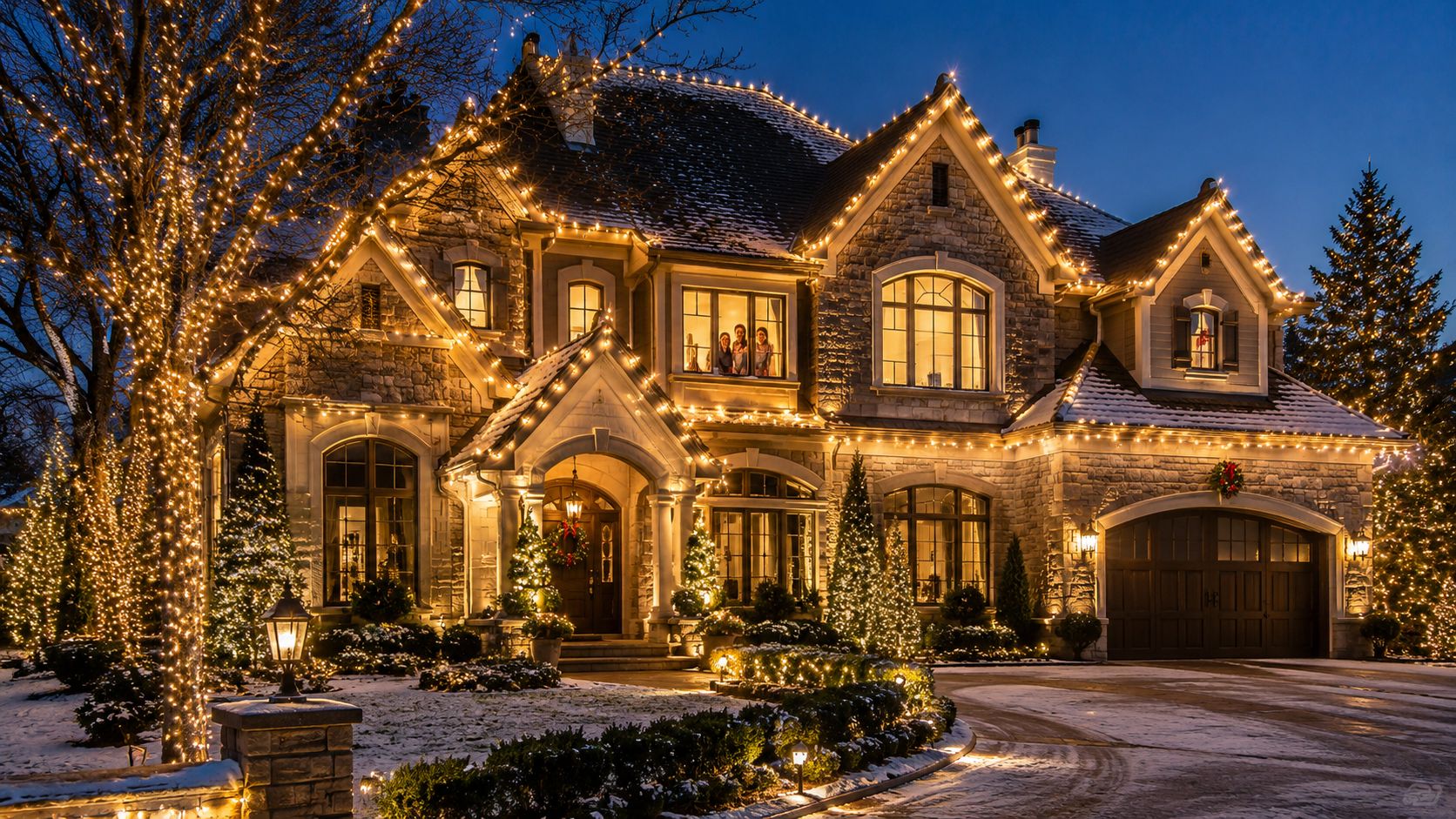
The biggest difference between a DIY setup and a pro installation is usually design discipline. Good installers don't just cover every edge they can reach. They choose focal lines, balance bright areas with quiet ones, and fit the display to the architecture.
A ranch home, a steep-gabled property, and a stucco two-story don't need the same layout. Clean roof tracing, selective tree wrapping, and measured spacing usually look stronger than trying to light every surface at once.
Quality matters more outside
Homeowners also notice the difference in materials. Commercial-grade products and custom-fit sections generally create a cleaner finish than mixing retail strands of different lengths and color temperatures.
That doesn't mean every home needs an elaborate setup. It means the materials should suit the conditions and the design. If you're comparing light types, this overview of the benefits of LED lighting for Brisbane is useful because the practical points about efficiency, durability, and consistent illumination carry over to residential holiday lighting decisions.
Why hiring out often makes more sense
- You get your weekends back. December fills up quickly with travel, school events, shopping, and hosting.
- The house looks intentional. Straight lines, matched bulbs, and symmetrical placement create a polished result.
- Service is easier. If something goes out, the display is usually easier to diagnose and repair when it was installed methodically.
- You avoid the worst part. Takedown after the holidays is often the task people put off longest.
Practical rule: If a display involves steep roof sections, upper-story peaks, or long runs across the front elevation, it stops being a casual DIY project.
For many homeowners in Colorado Springs, the value isn't only the final look. It's the convenience of knowing the display will go up cleanly, stay presentable, and come down without eating up another winter weekend.
Our Holiday Light Installation Process from Start to Finish
A good holiday light installation service should feel organized from the first conversation to the final takedown. Homeowners shouldn't have to guess what happens next, who handles repairs, or whether the wiring plan was thought through.
Here's what a well-run process looks like.
Consultation and design
The job starts with the home itself. Rooflines, entryways, trees, columns, and focal points all affect the design. The goal isn't to add lights everywhere. It's to decide where lighting will create the strongest visual impact without making the house look cluttered.
Some homeowners want a classic warm outline. Others want a fuller setup with outdoor feature accents. Looking at examples from other markets can help clarify style preferences, and this page on custom holiday lighting in Wisconsin is a good reference for how customized designs can be built around the architecture rather than forced onto it.
Installation day
Once the design is set, installation should be precise and methodical. That means correct clips for the surface, neat routing, and a power plan that doesn't rely on hope. For larger or more complex projects, electrical load planning matters. Industry guidance notes that installers should verify circuit capacity, divide work into 100-foot testable sections, and map those sections for easier troubleshooting. That approach can reduce troubleshooting time from over 30 minutes to 5 minutes if a section fails, according to PAC Lights' installation guidance.
That level of planning isn't just for commercial buildings. The same mindset improves residential jobs too. If a section goes dark in December, nobody wants someone tracing every strand by hand across the whole property.
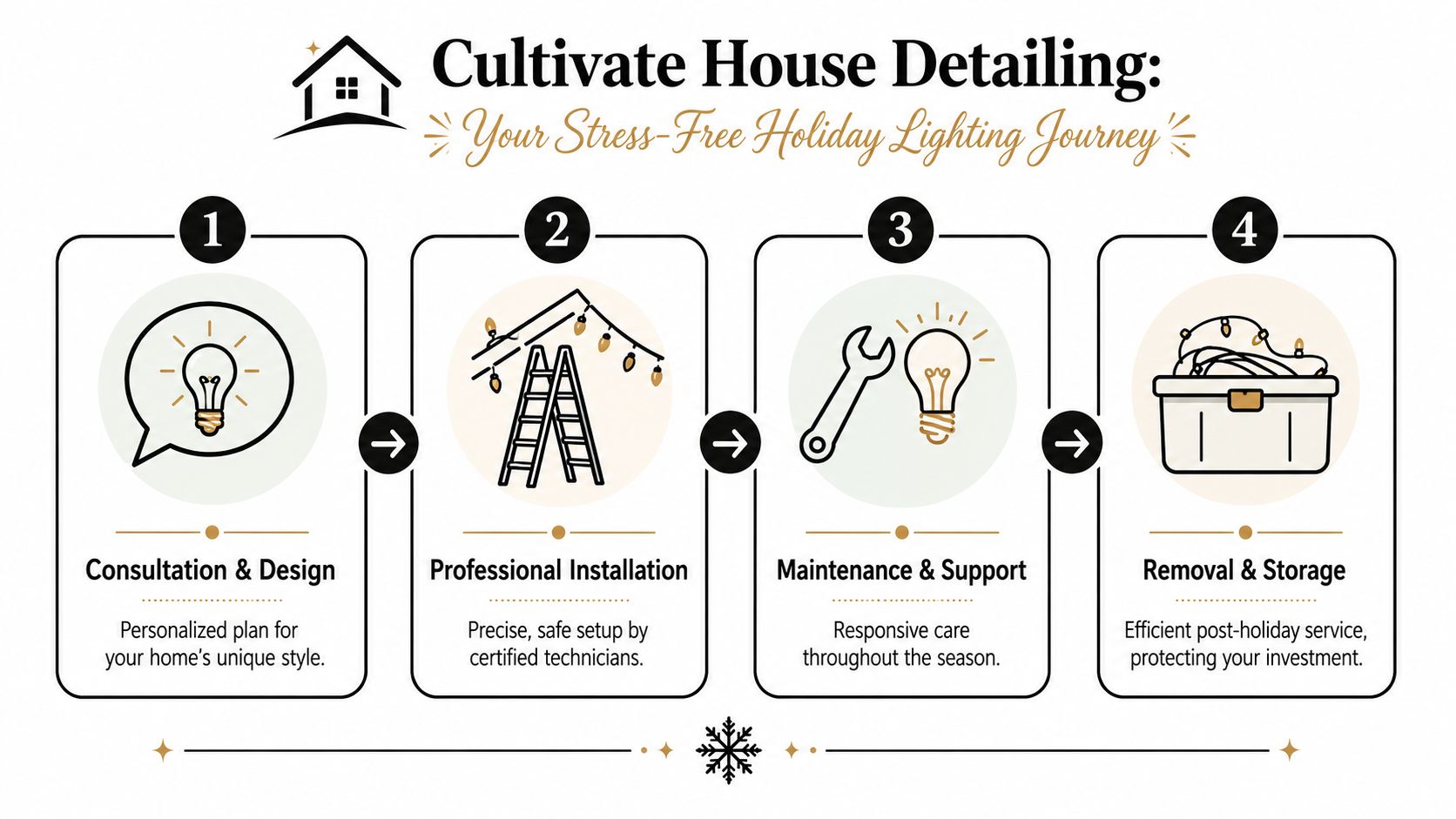
A provider like Cultivate House Detailing can handle measured installation, seasonal support, takedown, and related exterior services for homeowners in the Colorado Springs area. The important point is the service model itself. Design, install, maintain, remove.
Here's a quick look at the flow:
| Stage | What happens | Why it matters |
|---|---|---|
| Design | Home-specific layout is planned | Avoids a random, overbuilt look |
| Install | Lights are mounted and tested in sections | Makes the display cleaner and easier to service |
| In-season support | Failed sections or bulbs can be addressed | Keeps the home looking finished through the season |
| Removal and storage | Lights come down in an orderly way | Saves time and protects materials |
A short visual can make the process easier to picture:
Maintenance, removal, and storage
The season doesn't end on installation day. Wind, moisture, and connection issues can show up later, especially on larger displays. Homeowners should know in advance what happens if a section goes out and how service requests are handled.
Removal also matters more than one might anticipate. Fast takedown without organization usually creates next year's mess. A careful approach protects clips, keeps strands grouped logically, and makes future installation easier.
Understanding Holiday Lighting Costs in Colorado Springs
This is the question most homeowners ask first, and it's the one many service pages answer poorly. “Custom quote” is technically true, but it doesn't tell you what determines the number.
The most useful answer is this. Price follows scope, complexity, and service level.
The ranges most homeowners should expect
A typical residential holiday lighting job commonly falls in the $400 to $2,500 range, while larger or more complex designs can reach $1,500 to $3,500 or more, based on This Old House survey data and pricing guidance. The same source notes that professional installation often runs $8 to $35 per linear foot, depending on region and complexity.
Those ranges are helpful, but they only become meaningful once you know what's driving them.
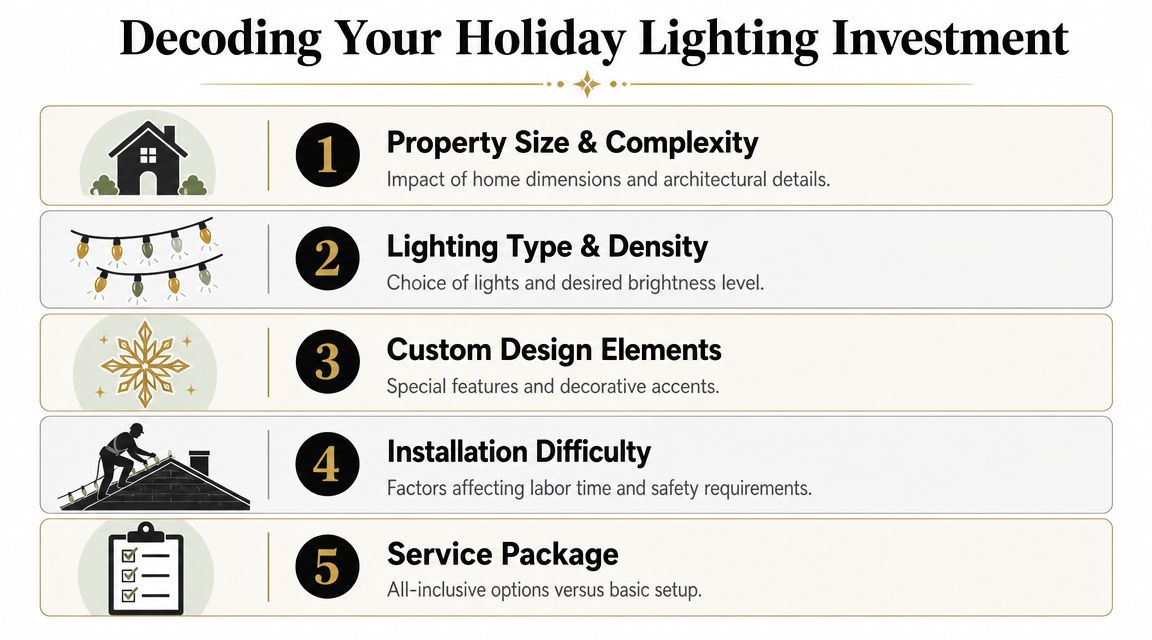
What actually changes the quote
- Linear footage is the backbone of most pricing. More roofline, more windows, more trees, and more edges mean more material and more labor.
- Height and roof shape change labor difficulty fast. A simple single-story front elevation is different from a home with dormers, steep pitches, and second-story peaks.
- Lighting type affects both look and budget. Bulb size, density, and style all influence material use and installation time.
- Package scope matters. Installation only is different from a full-service package that includes maintenance, takedown, and storage.
A “cheap” quote can become expensive if it leaves out the things homeowners usually assume are included, especially service calls, removal, or storage.
A straightforward way to think about pricing is to separate the home into cost drivers rather than chase a single average. If the front roofline is long but low and easy to access, labor may stay reasonable. If the home has multiple elevations, narrow side access, or decorative features that require detailed fitting, labor rises because setup slows down.
A practical way to budget
This quick comparison helps:
| Home situation | Cost pressure | Why |
|---|---|---|
| Simple roofline | Lower | Fewer cuts, faster setup, easier access |
| Multi-story or steep sections | Higher | More time, more safety equipment, slower installation |
| Dense design with accents | Higher | More materials and more precise layout work |
| Full-service seasonal package | Higher upfront, less hassle later | Includes more than hanging lights |
For a deeper breakdown of what homeowners compare when evaluating proposals, this guide on professional Christmas light installation cost is a useful companion because it focuses on the line items people tend to overlook.
The best quotes are transparent. They explain what's included, what isn't, and which parts of the house are driving the price.
Your Safety and Property Are Our Top Priority
“Safe and insured” gets used so often in home services that it can stop meaning much. Homeowners should ask what those words involve when someone is climbing on a roof, working around outlets, and attaching materials to exterior surfaces.
The answer has three parts. Fall protection, electrical judgment, and a clear plan if something fails mid-season.
What safety should look like on your property
Many homeowners worry most about multi-story homes, steep roofs, and hard-to-reach sections. That concern is valid. Practical guidance in the market around holiday lighting points to the same issues. A professional approach should include fall-protection practices, attention to electrical load limits, and a defined repair response process rather than vague claims of being safe, as discussed in this overview of professional Christmas and holiday lighting safety concerns.
That matters in Colorado Springs, where surfaces can be cold, slick, or unpredictable during the season. A homeowner shouldn't have to wonder whether a crew is improvising on the roof.
What insured should mean to a homeowner
Insurance isn't a marketing extra. It's part of basic risk management. If workers are on ladders, around roof edges, and operating on your property, you want a company that treats exposure seriously and communicates clearly about responsibility.
A good standard is simple:
- Work at height should be deliberate. Ladder placement, roof access, and attachment methods need to be chosen, not improvised.
- Power planning should be conservative. Good installers don't assume any exterior outlet can carry a display.
- Repair expectations should be clear. If a section goes out, homeowners should know what happens next.
If you're evaluating DIY against professional help, this article on how to hang festive outdoor lights is a useful reality check because it shows how quickly a simple decorating task turns into a roofing and safety issue.
Safety isn't just about avoiding a fall on installation day. It's also about preventing overloaded circuits, loose attachments, and mid-season failures.
Temporary Holiday Displays vs Permanent Year-Round Lighting
Some homeowners want a classic seasonal display that goes up for the holidays and comes down afterward. Others are done with the yearly cycle and want a system they can use well beyond December.
Both options make sense. The right choice depends on how you use your home and how much annual setup you want to repeat.
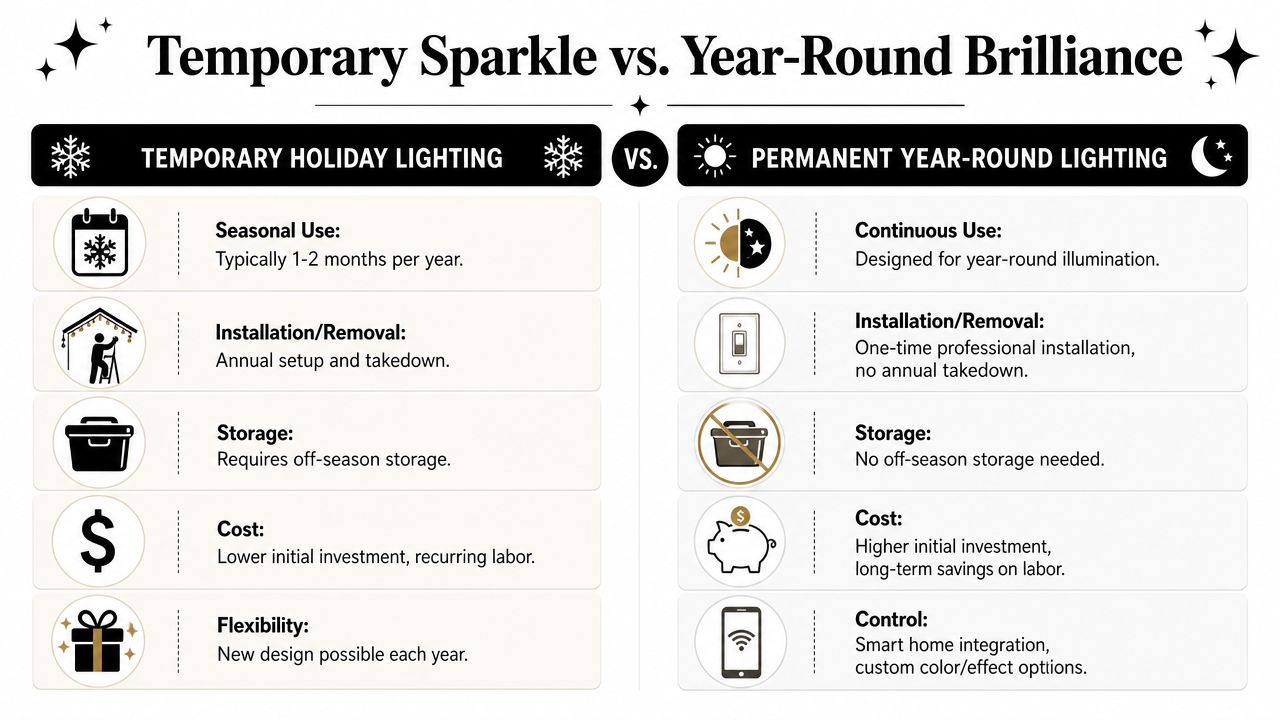
When temporary lighting makes more sense
Temporary displays are a strong fit for homeowners who enjoy changing the look from year to year. You can keep things classic one season, add more color the next, or shift focus from rooflines to trees and entry features.
They also work well if you mainly want the home lit for a defined holiday window and don't need exterior accent lighting the rest of the year.
When permanent lighting is worth considering
Permanent lighting appeals to homeowners who want convenience and flexibility. Instead of scheduling annual installation and removal, the system stays in place with a more unobtrusive daytime appearance. You can use it for holidays, game days, gatherings, or subtle architectural lighting throughout the year.
A practical comparison looks like this:
| Option | Best for | Main trade-off |
|---|---|---|
| Temporary holiday lighting | Seasonal decorating and design flexibility | Requires yearly setup, removal, and storage |
| Permanent year-round lighting | Convenience and ongoing exterior lighting use | Higher upfront commitment |
For homeowners comparing those options, the page on permanent lighting solutions is a helpful next step because it shows how year-round systems fit into residential exterior design.
Some families still prefer the tradition of a fresh seasonal install every year. Others want to stop thinking about ladders and storage altogether. Neither choice is wrong. It depends on whether you value annual variety or year-round simplicity more.
Proudly Lighting Up Homes in Colorado Springs and Beyond
Holiday lighting feels different in the Pikes Peak region. Homes in Colorado Springs, Black Forest, Monument, Manitou Springs, and Woodland Park each sit in a different setting, and the right display should respect that setting instead of overpowering it.
A home in Black Forest may call for a quieter, elegant outline that works with tall trees and darker surroundings. A property in Monument might benefit from sharper roofline definition that stands out cleanly on a wide front elevation. In Manitou Springs, character and architecture often matter as much as brightness. In Woodland Park, the mountain setting changes how a display reads from the road and against winter skies.
That local context matters. A holiday light installation service shouldn't treat every house the same. The goal is to make the home look like the best version of itself for the season, while keeping the process easy for the homeowner.
If you live in Colorado Springs or a nearby community and want your home ready for the holidays without sacrificing your weekends, it's worth getting a quote before calendars fill up.
Frequently Asked Questions About Holiday Lighting
When should I book my installation
Earlier is better. Holiday lighting schedules tighten as the season approaches, especially for homeowners who want a specific installation window. Booking ahead also gives more time to plan the design rather than rushing decisions.
Can you work with HOA rules
Yes, and that's an important part of the planning stage. HOAs often care about timing, color choices, brightness, and where decorations can be placed. It helps when homeowners share any guidelines before design and scheduling are finalized.
What if a bulb or section goes out during the season
That should be addressed before you book. Ask how service calls are handled, what support is included, and whether the display was installed in a way that makes troubleshooting easier. A methodical installation is much easier to service than one built from mixed strands and guesswork.
Do I need to provide the lights
That depends on the service model. Some homeowners prefer a full-service package, while others want to use existing materials. The key is making sure the products fit the design and are suitable for outdoor use.
Is professional installation worth it for a smaller home
Often, yes. Even a modest home benefits from clean lines, proper attachment, and a setup that doesn't take over your weekend. The value isn't only scale. It's convenience, safety, and a result that looks finished.
If you want a cleaner, safer, and more polished holiday display this season, Cultivate House Detailing offers homeowners in Colorado Springs and nearby communities a practical way to get there. Request a quote, talk through your home's layout, and get a holiday lighting plan that fits your property and your schedule.
Looking for a professional to take care of it? Cultivate House Detailing offers holiday lighting installation in Colorado Springs. Get a free quote.