The Role of Water Quality in Streak-Free Window Cleaning
After spending a Saturday afternoon scrubbing your windows, you step back to admire your work, only to see a haze of white spots and stubborn streaks emerge as the glass dries.
It’s a common frustration. You might blame your technique or your cleaner, but the real culprit is often invisible: the water from your garden hose. It may look pure, but it’s actually a cocktail of minerals and sediments. These impurities are what’s left behind on the glass, causing those frustrating spots and ruining your view.
At Cultivate House Detailing, we understand that achieving a truly streak-free window cleaning requires more than just elbow grease—it requires a scientific approach to water quality.
The Invisible Enemy: Understanding Total Dissolved Solids (TDS)
To understand why your windows look dirty even after you wash them, we have to talk about Total Dissolved Solids, or TDS.
When rain falls from the sky, it is relatively pure. But as it flows through the ground to reach aquifers or reservoirs, it acts as a universal solvent. It dissolves and absorbs minerals from the rocks and soil it passes through. By the time that water reaches your tap, it is loaded with calcium, magnesium, potassium, sodium, and bicarbonates.
These minerals are great for your health; our bodies need calcium and magnesium. They also make water taste “fresh.” But for glass, they are a nightmare.
The Mechanism of Spotting
When you spray tap water on a window and let it dry, the water molecules (H2O) evaporate into the air. The minerals, however, cannot evaporate. They are left behind on the surface of the glass. Those white spots you see are literally tiny piles of rock—calcium and magnesium deposits that have hardened onto the pane.
This is often referred to as “hard water.” The harder your water—meaning the higher the concentration of dissolved minerals—the more severe the spotting will be. Even if you squeegee the window, a microscopic film of mineral-heavy water often remains, leading to streaks that catch the light and ruin the view.
The Water Spectrum: Tap vs. Filtered vs. Pure
Not all water is created equal. In the professional window cleaning industry, distinguishing between water types is critical for determining the cleaning method and the quality of the result.
Tap Water
As mentioned, this is chemically “hard.” Depending on your region, the TDS reading of tap water can range anywhere from 50 parts per million (ppm) to over 400 ppm. For reference, professional window cleaners generally consider anything over 10 ppm effectively “dirty” for final rinsing. Using tap water for exterior cleaning almost guarantees residue.
Filtered Water (Carbon Filters)
Many homeowners try to solve the problem using filtered water, like what you might get from a fridge dispenser or a pitcher filter. While these carbon filters are excellent at removing chlorine and improving taste, they do not significantly lower the TDS count. They leave the heavy minerals behind, meaning filtered water will still cause spotting on glass.
Deionized (Pure) Water
This is the gold standard. Pure water has been mechanically and chemically processed to remove 99.9% of impurities. It has a TDS reading of 0 ppm.
Pure water has a unique chemical characteristic: it is unstable. Because it has been stripped of its minerals, it desperately wants to return to a balanced state. It becomes like a magnet for dirt. When pure water flows over a window, it aggressively bonds with grime, dust, and bird droppings to “fill” its emptiness. When it is rinsed away, it takes the dirt with it. Most importantly, because there are no solids dissolved in the water, it evaporates completely cleanly. It leaves absolutely nothing behind—no spots, no streaks, no residue.
Cultivate House Detailing’s Approach to Purity
At Cultivate House Detailing, we don’t rely on standard tap water for our exterior window cleaning services. We understand that to provide a superior service, we must control the chemical environment of the clean.
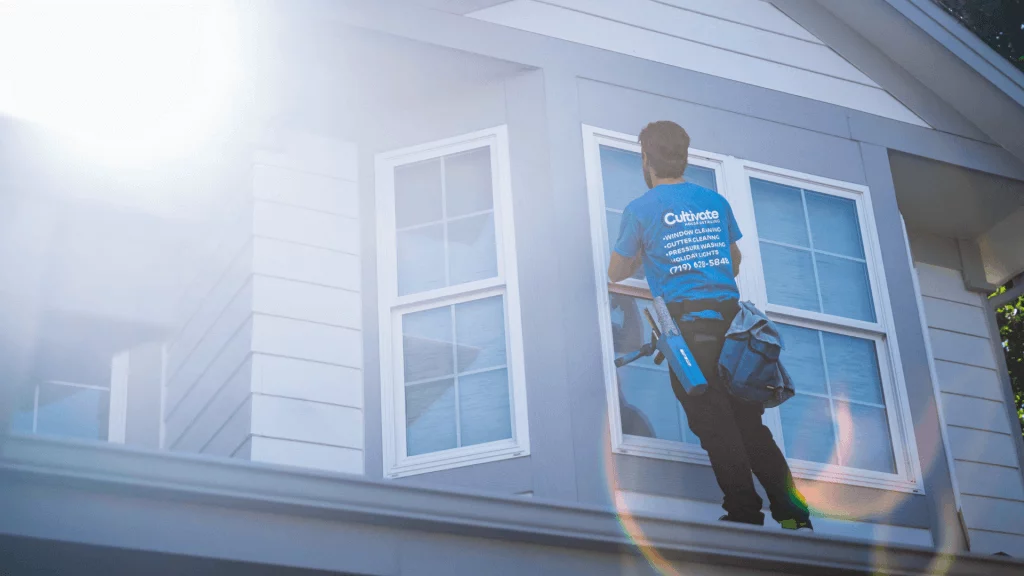
We utilize advanced, multi-stage water purification systems mounted directly in our service vehicles. This isn’t just a fancy filter; it is a mobile water treatment plant.
The Purification Process
Our process typically involves Deionization (DI). This stage uses a resin bed to exchange positive and negative ions. It swaps mineral ions in the water for hydrogen and hydroxyl ions, which combine to form pure water molecules.
By the time the water reaches the brush head at the end of our extendable poles, it is completely free of minerals. This allows us to scrub the frames and glass, agitating the dirt, and then rinse with a continuous stream of pure water. Because we aren’t using soapy detergents that leave a sticky film, and because the water has zero mineral content, the windows dry naturally to a spot-free finish.
This technology allows us to clean windows that are difficult to reach without the need for ladders, making the process safer and more efficient while delivering a result that traditional squeegees often struggle to match.
Structural Integrity and Environmental Impact
The benefits of using pure water extend beyond aesthetics. There are significant structural and environmental advantages to this method of cleaning.
Protecting Your Investment
Glass is porous. It may look smooth, but under a microscope, it has peaks and valleys. When hard water evaporates and leaves mineral deposits behind, those minerals can eventually etch into the glass. Over time, this chemical bonding causes permanent damage known as “stage two corrosion.” Once this happens, standard cleaning cannot remove the haze; the glass essentially needs restoration or replacement.
Furthermore, traditional window cleaning often relies on chemical soaps. While effective at cutting grease, soap residue can build up in the tracks and on the frames. This buildup attracts more dirt and can degrade rubber seals and vinyl frames over time.
By using pure water, Cultivate House Detailing avoids these issues. We flush the dirt out of the tracks and frames without leaving chemical residues that degrade materials. This extends the lifespan of your windows and seals, protecting your home’s envelope.
A Greener Clean
In an era where environmental consciousness is paramount, pure water cleaning is the eco-friendly cleaning choice. Traditional methods often involve ammonia-based cleaners or detergents that run off the glass and into the soil below. This can harm your flower beds, alter the pH of your soil, and contribute to groundwater pollution.
Our system uses nothing but water. It is safe for your landscaping, safe for your pets, and safe for the local ecosystem. We can clean windows directly above sensitive plants without worrying about chemical burn or toxicity.
Expert Maintenance Tips for Homeowners
While professional cleaning by Cultivate House Detailing is the best way to maintain your home’s exterior, we know you may want to touch up spots in between our visits. Here is how you can maintain clarity without undoing the benefits of a professional window clean.
Avoid the Hose
The most important rule: never spray your windows with the garden hose to “rinse them off.” You are simply covering them in minerals that will bake onto the glass in the sun. If you need to remove loose dust, use a blower or a dry brush.
Use Distilled Water for Spot Cleaning
If you have a bird dropping or a specific smudge to deal with, don’t use tap water. Buy a gallon of distilled water from the grocery store. Distilled water is similar to our deionized water; the minerals have been removed through boiling and condensation. Put it in a spray bottle for touch-ups.
The Right Tools Matter
Paper towels are the enemy of clean glass. They leave lint behind and often contain adhesives that streak. Invest in a high-quality, waffle-weave microfiber towel. These are designed to absorb water and grab dirt without shedding.
Watch the Weather
Never clean windows in direct sunlight. The heat causes water and cleaning solutions to evaporate instantly, locking streaks onto the glass before you have a chance to wipe them off. Overcast days are the best days for window maintenance.
Clean the Frames First
A common mistake is cleaning the glass while ignoring the frames. When it rains next, dirt from the dirty frames will drip down onto your sparkling clean glass. Always wipe down the frames and sills before tackling the pane.
Clearer Views Ahead
Windows are your connection to the outside world. They let light in and allow you to enjoy your surroundings. But keeping them clean is about more than just effort; it is about chemistry. The quality of the water used in the cleaning process is the single biggest factor in achieving that invisible, crystal-clear finish.
By understanding the science of Total Dissolved Solids and the power of pure water, you can see why professional tools yield professional results. It protects the structural integrity of the glass, saves the surrounding environment from chemicals, and provides a level of clarity that tap water simply cannot achieve.
At Cultivate House Detailing, we are committed to using the best technology available to care for your home. We don’t just wash windows; we treat them. If you are tired of seeing spots despite your best efforts, it is time to let pure water do the heavy lifting.
https://www.google.com/maps?cid=10139285130722580475