You're standing at the kitchen sink on a bright Colorado Springs morning, looking toward Pikes Peak through glass that should be crystal clear. Instead, streaks, dust, and pale water spots turn the view hazy. You wipe one pane, but the marks return after the next rinse.
That's a familiar problem for homeowners and businesses searching for window cleaning near me or window cleaning in Colorado Springs, CO. Local glass deals with mineral-heavy water, Front Range dust, pollen, road film, and intense sun. Pure water window cleaning tackles the problem at its source by removing dissolved minerals before the water reaches the glass.
For residential window cleaning, commercial window cleaning, and exterior window washing, the method can provide a clean finish without soap or a traditional squeegee on many reachable exterior surfaces. Cultivate House Detailing serves Colorado Springs and nearby El Paso County communities with professional window cleaning designed around the conditions local properties face.
Why Colorado Springs Windows Struggle to Stay Clean
A homeowner in Broadmoor may clean the windows before a family gathering, only to notice cloudy marks again after the sprinklers run. Someone in Rockrimmon may wash a second-story pane on a warm afternoon and find faint rings where the rinse dried. The problem isn't always poor technique. Often, the water itself is carrying minerals onto the glass.
Colorado Springs tap water can be mineral-rich. Plan notes commonly place local readings around 100 to 250+ TDS, but those specific local figures aren't verified in the available sources, so the practical point is simpler: untreated water can leave calcium, magnesium, and silica deposits as it evaporates. Industry guidance explains that dissolved minerals create visible spotting when rinse water dries on glass, which is why the chemistry behind purified-water window cleaning matters for local exterior work.

Local buildup arrives in layers
Spring cottonwood and juniper pollen can cling to oily residue on the pane. Summer dust from the Front Range settles on sills and screens, while strong gusts can push fine grit into window tracks and corners. Winter adds road film from de-icing materials, especially on lower glass near driveways and streets.
Sun exposure changes how quickly residue becomes noticeable. North-facing windows may stay damp longer and show water marks, while south- and west-facing glass can bake deposits into a faint film. Older neighborhoods with original single-pane windows and mature landscaping also see sprinkler overspray, which repeatedly places hard-water droplets on the same areas.
Local rule of thumb: If a sprinkler reaches the glass, regular exterior window cleaning becomes maintenance, not a one-time cosmetic fix.
These conditions explain why soap-and-squeegee cleaning can look excellent at first but still leave mineral traces after the glass dries. A method built around water purity, rather than detergent alone, gives professional window cleaners a better way to manage Colorado Springs conditions.
How Pure Water Window Cleaning Actually Works
Think about two sponges. One is soaked in soapy tap water, and the other is rinsed with clean water that contains almost no dissolved minerals. The first sponge can remove dirt, but it may also spread residue. The second gives the surface a cleaner final rinse.
Pure water cleaning uses that second idea on a larger scale. TDS, or total dissolved solids, measures the mineral and other dissolved content in water in parts per million. A TDS meter gives the technician a reading at the system outlet, helping determine whether the water is pure enough for spot-free exterior glass.
The purification stages
A professional system typically removes contaminants in stages:
- Sediment filtration catches rust, grit, and larger particles.
- Carbon filtration reduces chlorine and certain organic compounds.
- Reverse osmosis, or RO, removes most dissolved solids. One industry equipment reference says RO can remove up to 98% of TDS in the right system and conditions, as described in this multi-stage purification overview.
- Deionization, or DI, polishes the remaining charged particles from the water.
The DI stage uses resin to exchange remaining positive and negative ions. Hydrogen and hydroxide then recombine into water, leaving a very low-mineral rinse. For window work, professional guidance commonly targets 0 to 10 ppm TDS, with 0 ppm treated as the ideal benchmark in this pure-water cleaning guide.
On the glass, a soft brush agitates dirt, pollen, and grime while jets continuously supply purified water. The final rinse carries loosened soil away. Because the water contains very few dissolved minerals, it can evaporate without leaving the mineral film that creates spots.
The difference between RO-only and RO-plus-DI matters in a hard-water market. A final DI rinse gives the technician a measurable control point instead of relying on appearance while the window is still wet. For a deeper explanation of the process, see deionized water window cleaning.
The glass may look wet or slightly uneven during the rinse. That isn't the finished result. The technician needs to rinse thoroughly, allow the pane to dry, and inspect it under changing light.
This short demonstration shows how purified water and a water-fed pole work together:
The Tools That Make Pure Water Cleaning Possible
The visible part of pure water window cleaning is a brush moving across glass. The important work starts in the van or trailer, where the technician prepares water that won't leave a mineral coating behind.
A typical system includes sediment and carbon filters, an RO membrane, DI resin tanks, a TDS meter, a pump, and a storage tank. The technician checks the water reading before and during a job because source-water conditions, system performance, and resin condition can change the result.
The pole and brush do more than reach high glass
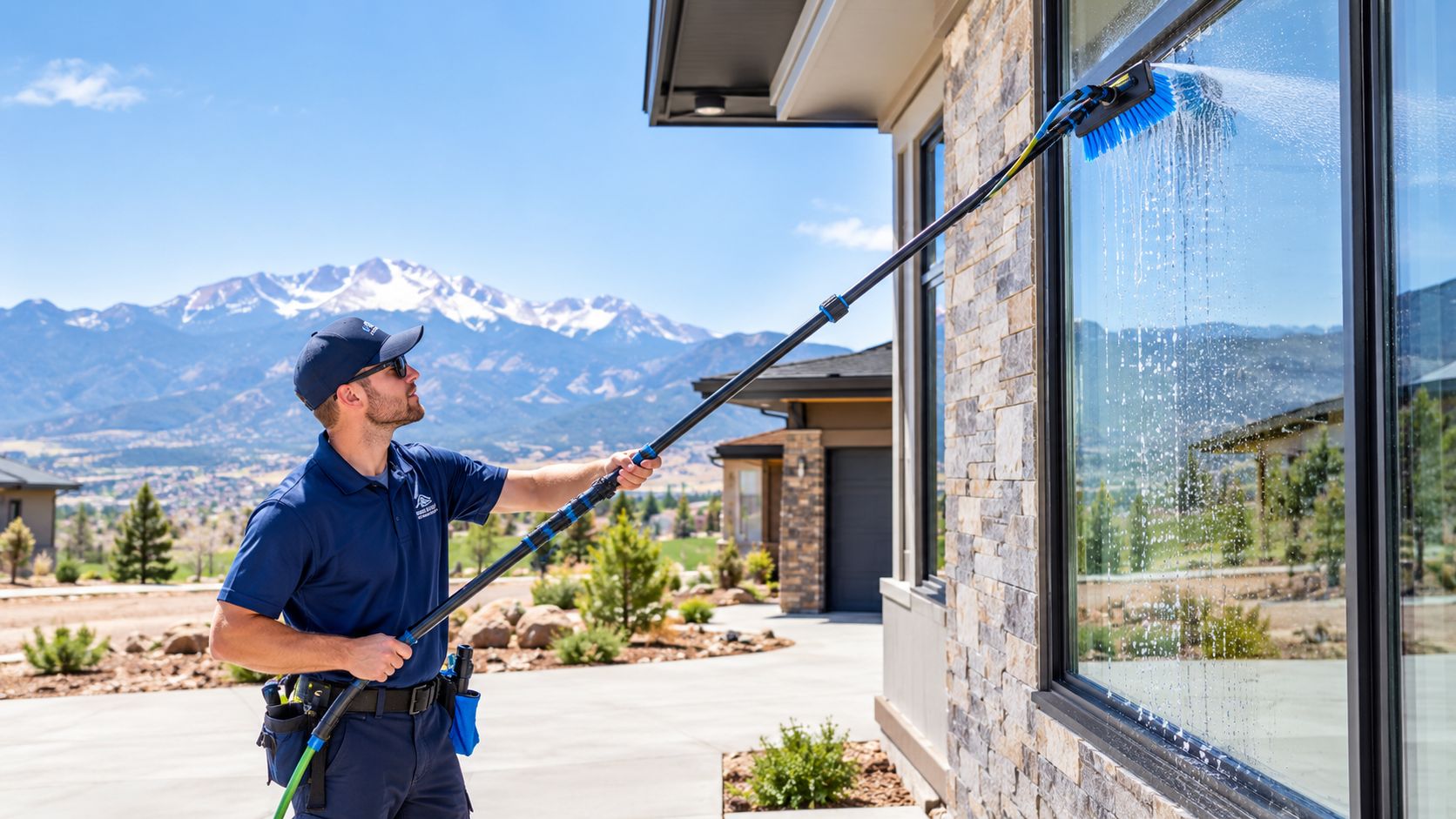
A water-fed pole carries a hose to a brush head fitted with soft nylon or flagged bristles. The brush loosens soil while the jets rinse it away. Carbon-fiber and hybrid poles keep weight manageable as the technician works across upper windows, angled panes, French grids, and sliders.
Some systems can reach about 50 feet, while poles of 45 feet and higher may reach the fourth, fifth, and even sixth story of many structures, according to this water-fed pole explanation. Actual reach depends on the property, window position, obstacles, pole setup, and safe working clearance.
Angle adapters help the brush sit flat against upstairs glass. Flow-control valves let the operator adjust delivery, which can help on hot, dry afternoons when water evaporates quickly. The goal isn't to flood the property. It's to provide enough flow for agitation and a complete rinse.

Ground access changes the safety equation
Working from a driveway, deck, or garden path removes much of the ladder movement associated with exterior window washing. That matters on sloped Front Range lots, uneven walkways, icy winter surfaces, and properties with landscaping close to the wall.
The method doesn't make every window accessible. Deep recesses, fragile surfaces, unusual rooflines, and some interior panes may need another approach. For exterior work, though, the water-fed pole can reduce disruption and keep the technician on stable ground. Learn more about water-fed pole window cleaning and how the equipment supports multi-story service.
Pure Water Cleaning vs Traditional Window Washing
Both methods have a place in professional window cleaning. The better choice depends on where the glass is located, how dirty it is, and how safely the technician can reach it.
Traditional work uses a bucket, mild detergent, scrubber, and rubber-edged squeegee. It remains useful for interior window cleaning, first-floor panes, heavily soiled glass, and detailed work around frames. Pure water cleaning uses a brush and purified rinse for many exterior surfaces, especially windows above the first floor.
| Factor | Pure Water Cleaning | Traditional Squeegee & Soap |
|---|---|---|
| Finish | Dries without mineral residue when the water is sufficiently pure and the pane is properly rinsed | Can produce excellent clarity, but untreated rinse water may leave mineral traces |
| Chemicals | Usually works without soap or detergent on suitable exterior glass | Uses a cleaning solution, generally mild detergent |
| Access | Designed for ground-based work on high or awkward exterior windows | Often relies more on ladders or reachable hand access |
| Speed | Can be efficient across multiple exterior panes once the system is set up | Allows precise detail work but may take longer on extensive upper-level glass |
| Interior glass | Less practical where water control and indoor drying are concerns | Often the stronger choice for interior panes and heavy interior soil |
| High windows | Well suited to multi-story exterior glass within safe pole reach | Useful when a pane needs close hand work or pole access is limited |
| Cost factors | Equipment, purification, access, pane count, and condition shape the quote | Labor, access, pane count, condition, and detail work shape the quote |
Pure water isn't a shortcut that removes the need for skill. The brush must agitate the surface, the rinse must be thorough, and the operator must check the pane after drying. Professional guidance on traditional and pure-water methods also highlights the importance of treating hydrophobic coatings, heavily soiled glass, and direct sunlight conditions carefully.
For a Colorado Springs home, a blended service often makes the most sense. Use pure water for exterior windows and upper elevations, then use squeegee work for interior glass, stubborn buildup, or areas that require close detailing.
Benefits Homeowners Notice Right Away
The first difference is visual. Once the glass dries, a properly purified rinse leaves no soap film and far fewer minerals behind, so the pane looks clearer instead of carrying the pale haze that develops after repeated untreated-water washing.
That clarity changes how a room feels. More daylight reaches kitchens, living rooms, offices, and entryways. On a clear morning, mountain views look like views again rather than shapes behind residue.

Practical advantages around the home
- Spot-free drying: Low-TDS rinse water reduces the mineral deposits that create visible marks as water evaporates. Industry guidance commonly treats 0 to 10 ppm as acceptable for most windows, as explained in this TDS-focused window cleaning manual.
- Less chemical contact: Exterior glass can often be cleaned without soap, which helps keep detergent away from plants, pets, children's play areas, and edible gardens.
- Safer high-window access: Water-fed poles can reach upper exterior glass from the ground, reducing ladder use on sloped or uneven Colorado Springs properties.
- Cleaner frames and sills: The brush can agitate surrounding frames, seals, and sills instead of focusing only on the central pane.
- Quieter service: The process doesn't require long stretches of pressure-washer noise, and the crew can move steadily from window to window.
- Better whole-home flow: Once the purification system is ready, a technician can work through a series of exterior panes without repeatedly climbing, repositioning, and carrying a bucket.
Pure water doesn't prevent every future mark. Sprinkler overspray, construction dust, pollen, and wildfire ash can still settle on glass. It does remove one major source of recurring residue, which makes regular exterior window cleaning more effective and helps the windows stay presentable between visits.
What Drives the Cost of Pure Water Window Cleaning
A useful quote starts with the glass, not an arbitrary hourly figure. Pane count sets the baseline, then access, height, condition, and requested detail work determine how much labor and equipment the property needs.
A small single-story home with clear access is straightforward. A larger two- or three-story property may require longer poles, more setup, careful work around landscaping, and additional time for screens, tracks, grids, or skylights. Commercial window cleaning follows the same logic, with storefront layout, foot traffic, access hours, and maintenance frequency added to the conversation.
The details that change an estimate
- Pane count: More individual panes mean more brushing, rinsing, inspection, and handling.
- Story height: Upper windows may require specialized poles, angle adapters, or another safe access plan.
- Property layout: Decks, slopes, tight side yards, mature landscaping, and fragile surfaces can slow access. Older homes around Cheyenne Creek or Patty Jewett may need more careful positioning.
- Glass condition: Mineral buildup, construction residue, paint, and neglected frames can require restoration or hard-water stain removal rather than routine washing.
- Screens and tracks: Screen cleaning, track cleaning, removal, and reinstallation add detail work.
- Window design: French pane grids, skylights, and unusual shapes take more time than broad, unobstructed panes.
- Specialty cleaning: Move-out, post-construction, gutter-face brightening, and heavy hard-water spot removal are separate scopes.
Pure-water jobs are often priced per pane or by the defined service scope rather than by the hour. That approach gives homeowners a clearer estimate and makes routine maintenance more predictable. A property that stays on a regular schedule may need less corrective work than one left until buildup becomes difficult to remove.
Because homes vary so much across Colorado Springs, an accurate quote should account for photos, pane count, story height, access, and the services you want. Ask whether interior window cleaning, exterior window cleaning, screens, tracks, and hard-water treatment are included or quoted separately.
How Often to Schedule Service in Colorado Springs
Colorado Springs windows collect different materials at different times. Spring pollen can coat screens and frames. Summer dust, wildfire ash, and nearby construction can settle on exterior glass. Winter road film can build along lower panes after de-icing slush dries near streets and driveways.
A practical maintenance rhythm starts with exposure rather than a rigid calendar. Sheltered single-story homes may remain presentable with quarterly service, while exposed west-facing multi-story glass facing the Front Range urban corridor can need attention more often.
Seasonal points worth planning around
After the pollen season, a June visit can remove the film that accumulated during spring growth. This is especially useful when screens and tracks also hold debris.
After late-summer monsoon dust, a single exterior cleaning can clear the fine layer left by wind and storms before it bonds with additional residue.
After winter road treatment, a January or early-season visit can target lower glass, frames, and sills affected by road film.
Pure water cleaning can support longer intervals because it doesn't leave the same detergent residue that attracts fresh soil. The exact interval still depends on landscaping, road proximity, window direction, construction nearby, and how much visibility matters to you.
Maintenance insight: The right schedule is the one that removes buildup before it becomes restoration work.
HOAs can coordinate seasonal exterior window cleaning across homes, while small businesses along Academy Boulevard and downtown storefronts often need a routine plan because customer-facing glass collects steady foot-traffic film. Property managers may prefer a recurring commercial window cleaning arrangement that separates regular glass care from occasional screens, tracks, skylights, and hard-water correction.
For a home listing, move-out, or pre-event refresh, a single service may be enough. For a busy storefront or exposed home, scheduled maintenance keeps the work lighter and the exterior consistently presentable.
Booking Your Service with Cultivate House Detailing
The booking process should be simple and specific. When you contact Cultivate House Detailing, expect questions about pane count, story count, the last cleaning date, access conditions, and any problem glass with hard-water spots, construction residue, or damaged screens.
Photos can help the team prepare a written estimate. The estimate should identify the agreed scope, including interior window cleaning, exterior window washing, screen cleaning, track cleaning, or specialty stain treatment, so you know what you're booking before the crew arrives.
What happens on service day
A professional visit should begin with a property walk-through. The crew checks access, landscaping, fragile surfaces, and window conditions before setting up poles or other equipment.
You can also expect practical protections such as:
- Clear communication: The team confirms the scope and points out conditions that may need separate treatment.
- Careful setup: Drop cloths or protective measures are used where indoor work requires them.
- Safe access decisions: Water-fed poles are used where appropriate, while unusual windows receive a property-specific plan.
- Final inspection: The crew checks the glass, frames, sills, screens, and tracks included in the estimate.
- Follow-up support: If an included pane shows a service-related streak, the company's satisfaction policy should give you a clear way to request attention.
Cultivate House Detailing serves Colorado Springs and surrounding El Paso County communities, including areas near Briargate, Rockrimmon, Broadmoor, Black Forest, Monument, Manitou Springs, and Woodland Park. The company provides residential and commercial window cleaning, along with related exterior maintenance, and offers online or phone scheduling for quote requests.
Cultivate House Detailing provides professional pure water exterior window cleaning, interior window cleaning, screen cleaning, and maintenance services for homes and businesses in Colorado Springs and nearby communities. Visit Cultivate House Detailing to request a quote and schedule a service that leaves your glass clearer, safer to access, and better suited to Colorado's hard-water conditions.