A clean, lightly damp microfiber followed by a separate dry microfiber beats paper towels for a streak-free finish, and that two-cloth method only removes a thin film, not bonded hard-water scale. If you've just wiped a sunny window in Colorado Springs, CO and watched arcs appear as it dried, you're not wiping too gently. You're probably leaving something behind, and the right streak free window cleaning cloth only helps when you know what that something is.
Why a Careful Wipe Still Streaks the Glass
Say you've cleaned the big picture window facing Pikes Peak or Garden of the Gods on a Saturday morning. It looks clear while it's damp. By mid-afternoon, the sun hits it at an angle and every swipe shows up as a pale arc.
Those arcs aren't usually a weak wipe. They're leftover water, cleaner, or dirt pushed across the pane and left to dry in place. A true streak free window cleaning cloth is a low-lint cloth that lifts that thin film into its fibers instead of smearing it thinner.
The two-cloth method that actually works
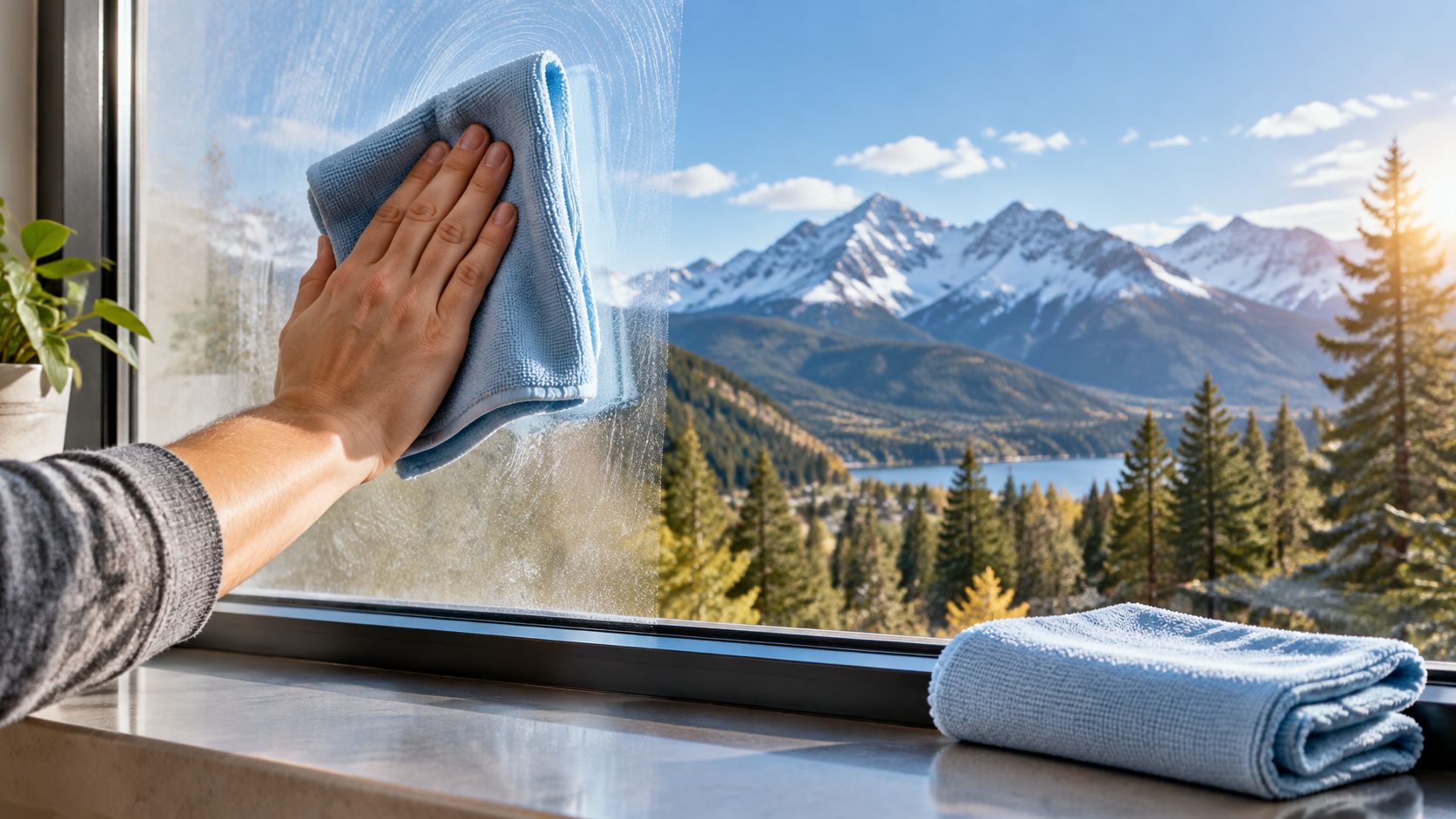
Use one lightly damp cloth to loosen and pick up soil. Then use a second clean, dry cloth to pull off the remaining moisture and polish the glass. Don't ask one soggy cloth to do both jobs.
That split is why damp microfiber performed better than paper towels and newspapers for a streak-free finish in comparative window-cleaning tests described by Wirecutter's guide to cleaning windows, glass and mirrors, with a second clean and dry microfiber then used to remove remaining moisture and residue. The same guide notes the fibers are typically polyester and polyamide, and friction can create an electrostatic charge that attracts dust while the split-fiber structure holds liquid and particles.
If the glass only looks clean while it's wet, the cloth spread the film. It didn't remove it.
A good glass cloth also carries a fair amount of solution without dripping back onto a pane you've already finished. That matters here. Wind-blown dust, dry air, and fast evaporation in Colorado Springs, Black Forest, Monument, Manitou Springs, and Woodland Park dry a film before you've finished the next pane, on both interior window cleaning and exterior window cleaning jobs.
What follows keeps that in order. You'll compare cloth types, learn how fiber size and weight change the result, wash and retire cloths correctly, spot hard-water scale that no towel can fix, and decide when DIY work stops and residential window cleaning or commercial window cleaning in Colorado Springs, CO makes more sense.
Microfiber Chamois and Cotton Compared for Glass
For the final pass, pick a tight, low-lint microfiber first. Chamois moves a big sheet of water. Cotton and paper belong off the viewing area.
That ranking surprises people who shop by softness. A plush towel feels premium in your hand, but glass rewards fiber structure, not fluff.
| Cloth | Fiber or build | Best job | Streak risk | Fails when |
|---|---|---|---|---|
| Glass microfiber | Polyester and polyamide, split fibers under 1 denier | Final damp wipe and dry polish | Low if clean and lightly damp | Grit, softener, or a soaked cloth |
| Waffle microfiber | Same synthetics in a channeled weave | Edges, corners, and light detail | Low to medium | Used first on heavy soil |
| Plush terry microfiber | Looped synthetic pile, higher absorbency | Sills and leftover droplets | Medium if saturated | Too much water left on the pane |
| Chamois, leather or synthetic | Natural skin or PVA-style sheet | Large water film on broad glass | Medium | Dry, oily, or overloaded |
| Cotton terry or flour sack | Cellulose yarns | Frames, tracks, and sills only | High lint and haze | Used as the last glass pass |
| Paper towel or newspaper | Wood pulp, sometimes ink | One-time emergency wipe | High smears and lint | Sun hits dyes or loose fibers |
Reading the table as a decision
Glass microfiber grabs dust and a thin film because its split fibers have many edges. A waffle or glass weave is your polish cloth, the one that should touch clean glass last. Keep it lightly damp for pass one, then switch to a dry one.
Plush terry microfiber drinks more water. That's useful on sills and for stray droplets, but a soaked plush towel used as the last swipe often leaves more moisture than it removes. You'll see it as a soft haze once the sun moves.
Chamois, real or synthetic, can drag a broad film off large panes. It streaks quickly when it's bone-dry, overloaded, or carrying oil. If you use one, wring it often and still finish with dry microfiber.
Cotton terry and flour-sack towels lint and haze in direct sun. Save them for frames, tracks, and sills, where a few loose fibers don't ruin the view. Paper towels and newspaper shed fibers or ink, so treat them as emergency tools only.
Three failure modes to watch for
- Grit in the fold: A speck of sand draws a line on every pass until you flip to a clean quarter.
- Fabric softener: The coating makes fibers slick, so they skate over film instead of lifting it.
- Wrong first job: Using your polish cloth on a greasy sill first loads it with oil you'll spread on the glass.
For a simple interior kit, keep one damp soil cloth, one dry polish cloth, and a separate cotton towel for the frame. That's enough for fingerprints and light dust.
Exterior glass is different. Bird droppings, sap, and irrigation mist are past what a single cloth should fight, because you'll grind grit across the pane before you collect it. Match the cloth to the soil, not to the thickest towel on the shelf.
Fiber Size Weave and GSM That Keep Glass Clear
The word microfiber on a label tells you very little. A cloth can use fine fiber and still smear if the weave is wrong, the towel is overloaded, or the minerals on the glass are bonded rather than loose.
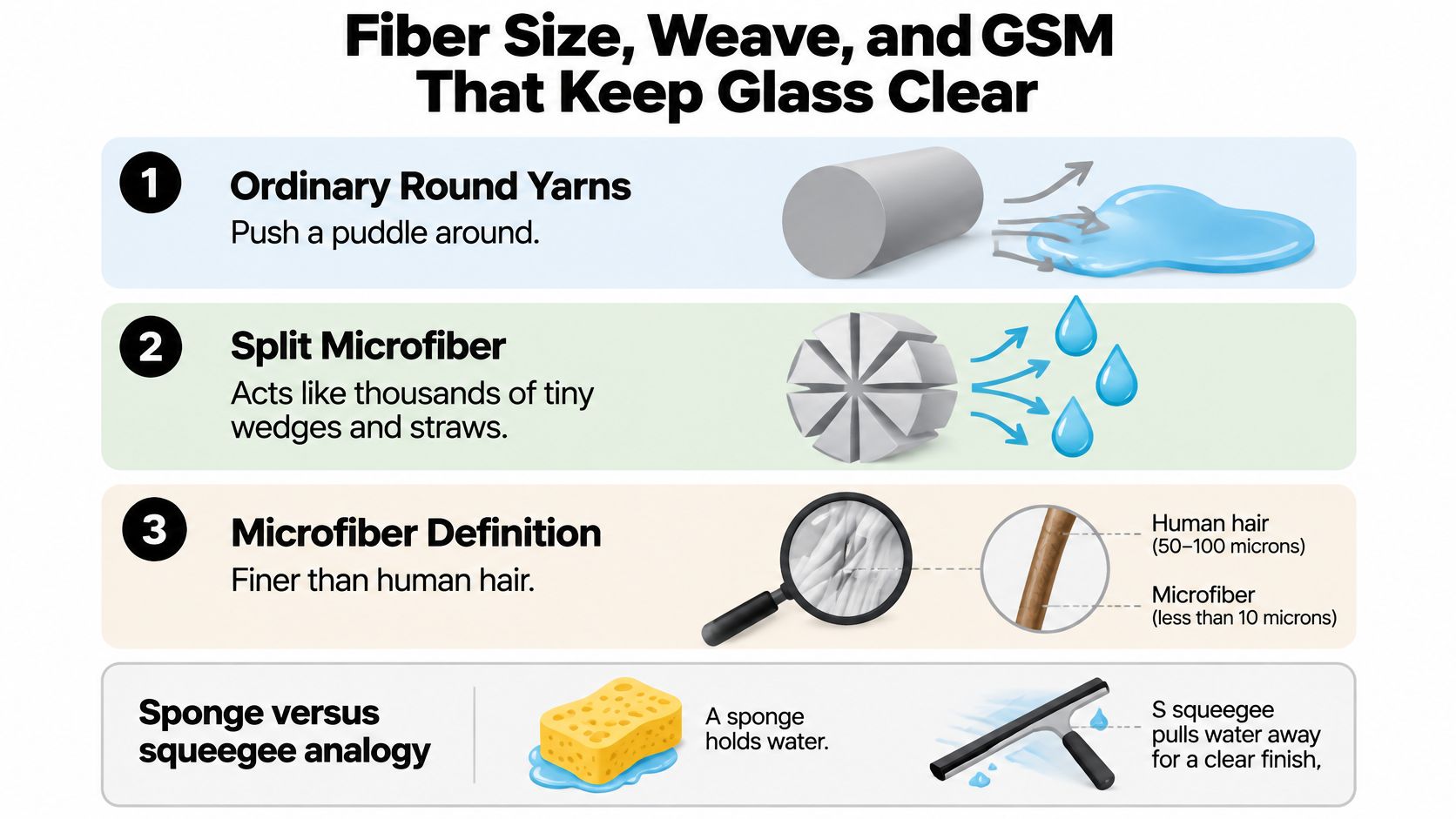
Microfiber is generally defined as a fiber finer than one denier, commonly under 10 micrometers in diameter, and its densely packed, wedge-shaped filaments create more contact points and tiny water-wicking channels than ordinary round fibers. Those channels draw in the thin water film, while the angled surfaces capture dust, oils, and loosened mineral residue.
Three conditions that make the physics work
The cloth has to be clean. A loaded cloth has nowhere to put new soil, so it redeposits what it is already holding.
It has to be lightly damp rather than wet. Too much water overflows those tiny channels, and the excess dries as a film. Wring until the fabric feels cool to the touch.
It cannot carry grit from a dirtier job. One sandy particle can draw the same faint line across pane after pane until you flip the cloth.
Practical rule: Turn to a fresh quarter often, so each stroke meets clean fiber instead of yesterday's dust.
Using GSM as a shopping guide
GSM means grams per square meter. Treat it as a weight clue, since higher GSM mainly means more fiber packed into the same area.
| Construction | Typical GSM | Moisture behavior | Use on windows |
|---|---|---|---|
| Tight woven glass cloth | 200-300 | Holds a light film, low lint | Final polish |
| Waffle weave | 250-350 | Channels water toward edges | Corners and detail |
| Terry loop microfiber | 350-500 | High absorbency, can over-wet | Sills after the polish |
| Plush drying towel | 500-800 | Soaks a heavy load | Frames and cars, not the last glass pass |
| Chamois sheet | No direct GSM match | Wrings a broad sheet of water | Large panes, then a dry cloth |
| Cotton towel | 300-600 | Slow dry and lint | Frames and tracks only |
A tight glass weave around 200 to 300 GSM holds a light film and sheds little lint. That is your finisher. Waffle weaves near 250 to 350 GSM move water toward the edges, which helps where panes meet frames.
Terry around 350 to 500 GSM is thirstier and works better after the polish for sills and drips. Plush towels at 500 to 800 GSM soak up a heavy load, though they can leave too much moisture behind for a streak-free finish.
In Colorado Springs, dry airborne dust and hard-water mist raise the risk of redepositing particles during polishing, so reserve that tight, low-lint weave for the last pass only. If a label says only microfiber and gives no weave or weight, treat it as a general towel rather than a glass cloth.
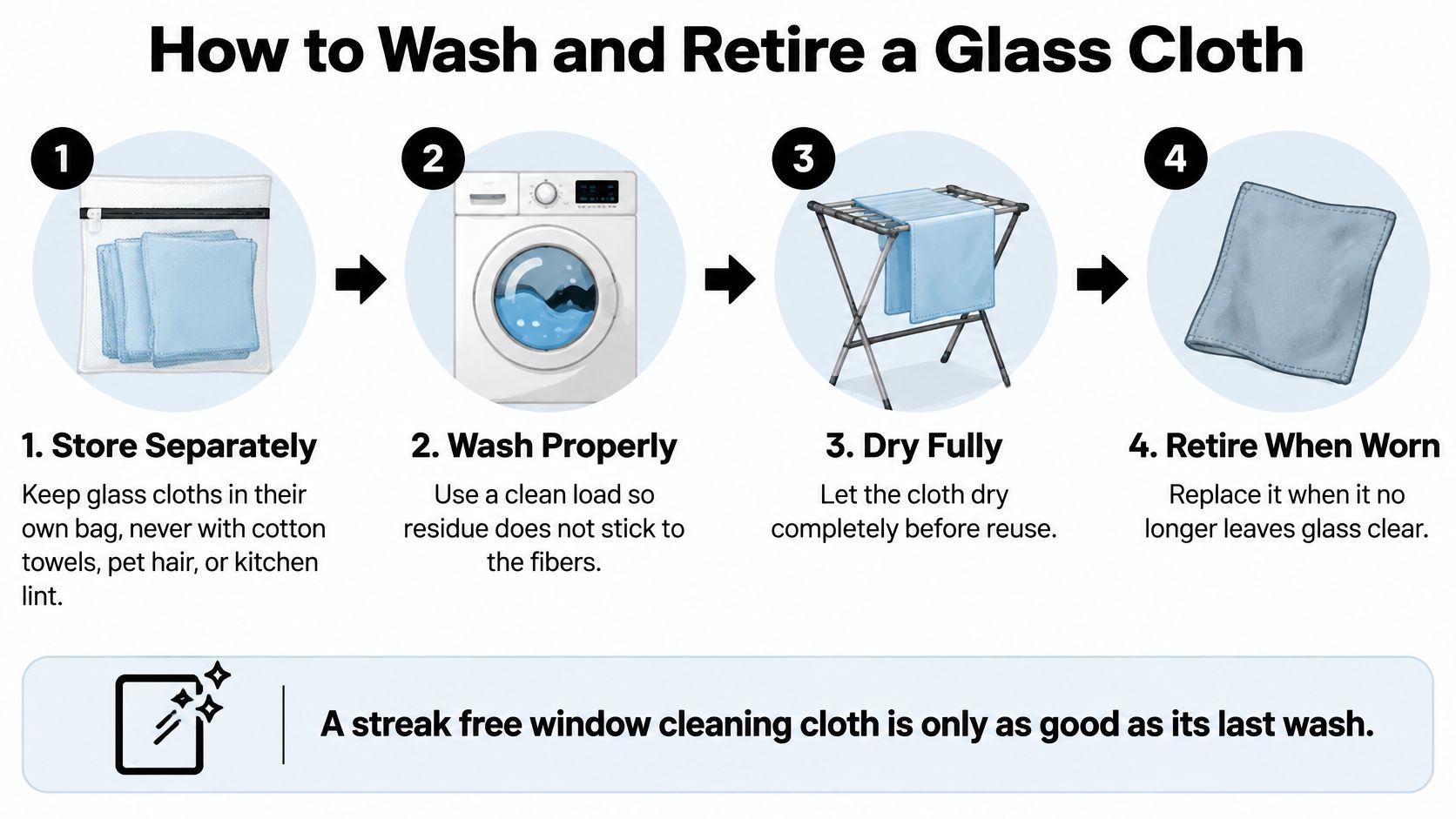
How to Wash and Retire a Glass Cloth
A streak free window cleaning cloth is only as good as its last wash. Laundry residue creates streaks that look exactly like dirty glass, so people blame the cleaner and wipe harder.
A boring wash routine that protects the fibers
- Store glass cloths separately: Keep them in their own bag, never with cotton towels, pet hair, or kitchen rags.
- Wash them alone: Use a complete but not stuffed load so water and detergent can rinse through the fibers.
- Use low-residue detergent: Skip fabric softener, dryer sheets, and bleach, because coatings clog the filaments and kill absorbency.
- Choose colder and shorter for light soil: A gentler cycle protects the fibers and sheds fewer of them.
- Dry thoroughly without softener: Store cloths fully dry so they don't go sour in a drawer.
- Separate by job: Color-code or set aside the final-buff cloth so it never touches frames, screens, greasy sills, or exterior dirt first.
That last step matters more than you might expect. A cloth loaded with sill grease will lay a faint rainbow film on clean glass, and no rinsing at the sink fully fixes it.
Why a cloth wears out before it looks worn out
Performance can improve after approximately 75 washes but decline after 150 washes, according to a laboratory assessment of microfibre efficacy over repeated laundering. Age and soil history matter more than whether the cloth still looks blue.
There's also an environmental reason to wash fewer, better cloths carefully. Machine washing released an average of 23,723 microplastic fibers per textile piece, compared with 1,853 from hand washing, in research published in ACS ES&T Water on fiber release during washing. Compact woven structures also shed less than loose knits, which is another reason weave matters.
A cloth can look clean and still be finished as a polish cloth. Trust how it grabs water, not how it looks folded.
Retire a cloth when it feels slick, stiff, or oily, sheds lint, or leaves a haze even when it's clean. Downgrade tired cloths to floors or wheels, not to glass.
Before your next window, run one check. If the dry cloth doesn't grab a drop of water evenly, it's done as a polish cloth.
Hard Water Spots a Cloth Cannot Wipe Away
A better towel doesn't fix every haze. That's the myth that sends homeowners buying a third pack of cloths when the glass itself is holding mineral scale.
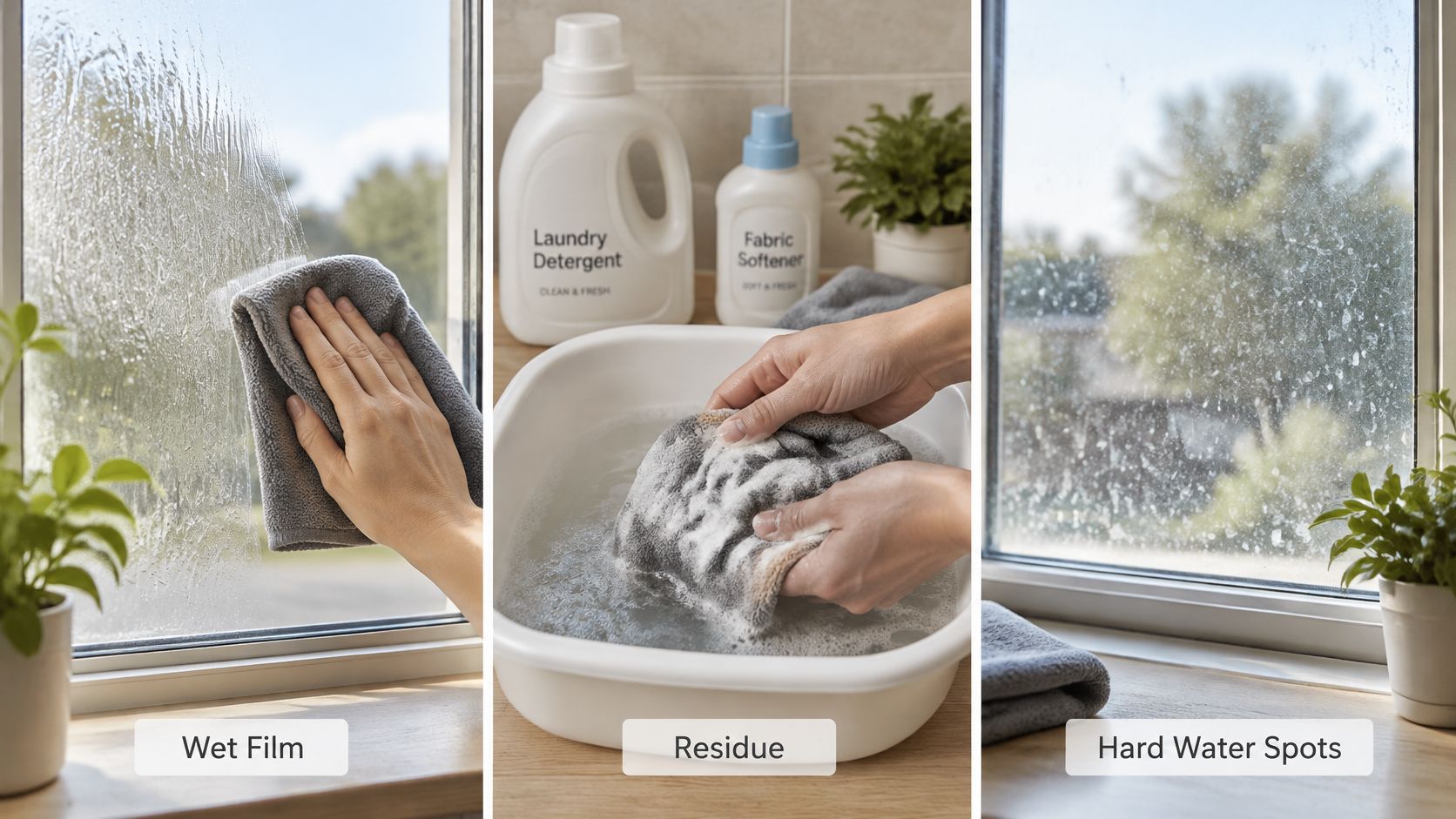
Three problems look alike in flat light. A wet film lifts with a dry microfiber. Detergent or softener residue clears once you wash the cloth correctly. Bonded calcium or magnesium scale only gets polished by wiping, and the spot stays put.
Hard-water spots are often mineral deposits that wiping alone cannot dissolve, a distinction drawn in guidance on cleaning window panes and mineral buildup, where repeated wiping can leave glass hazy while the underlying deposit remains. In Colorado's dry climate, irrigation overspray and fast evaporation concentrate those minerals, and a streak free window cleaning cloth can smear light scale into a wider cloud.
The stop-rule and the safe next step
More pressure is the wrong next step. Grit trapped in the weave can scratch, and pressing harder drives it across the surface.
Use this stop-rule instead. If two clean cloths and a fresh quarter-fold still show the same spots in raking light, stop buying towels. The problem is on the glass, not in your hand.
For light mineral film, use a cleaner made for mineral scale, keep dwell time short, spot-test a corner, rinse with clean water, and dry with a soft cloth. Don't assume vinegar is safe on every coating, tint, or stone sill. Our detailed walkthrough on what takes hard water spots off glass covers that sequence before you commit to a whole pane.
Etched glass is different again. When minerals have eaten into the surface, neither cloth nor acid brings it fully clear, and it needs a professional assessment before anyone promises a result.
Heavy buildup is professional work, and high-pressure washing belongs on siding, patios, and driveways, not window glass, because force can drive water into frames. In Colorado Springs, book exterior window cleaning and hard water stain removal when spots return after every sprinkler cycle, and handle interior haze from fingerprints, pet marks, or cooking film with cloth care.
DIY Cloth Work Versus a Professional Clean
Keep both feet on the floor. That's the simplest line between DIY cloth work and professional window cleaning.
DIY with a streak free window cleaning cloth fits interior panes you can reach easily. Fingerprints, pet smudges, light dust, and a final dry polish after a gentle wash all belong there.

What you can handle, and what you shouldn't
Work top to bottom, rinse cleaner off, and dry the edges so water doesn't creep back from the frame. A monthly dry dust and a deeper clean about twice a year suits glass that isn't heavily soiled.
Call a professional when the job involves exterior glass above easy reach, tall commercial panes, bay windows, picture windows, dormers, hard-water restoration, screens, or tracks packed with grit. Ladder work and leaning out of upper windows are the cutoff, not a challenge.
If you're weighing that choice for a full house, our comparison of cleaning your own windows versus hiring professionals lays out the time and safety trade-offs. The same logic applies indoors, too. When the rest of the house needs a reset rather than a wipe-down, it can help to book a thorough home clean and let the glass be one part of a bigger refresh.
Let the season set the schedule
January normals in Colorado Springs list a high of 45.0°F, a low of 18.5°F, 0.29 inches of precipitation, and 4.9 inches of average snowfall, according to the National Weather Service 1991 to 2020 climate normals for Colorado Springs. Winter washes need a mild day and a thorough dry so frames don't hold freeze moisture.
Spring dust and summer irrigation are the usual exterior triggers. Fall is a good reset before holiday gatherings, when low sun shows every mark.
A full visit adds what no cloth can. Crews cover interior and exterior glass, screens and tracks when requested, and frame edges, up to four stories. Storefronts, offices, and property managers searching for window cleaning near me need that same streak-free standard on a route, not a Saturday experiment.
If you can reach it, see through it, and the spots wipe off, use the cloth. If you need a ladder or the haze returns, book the service.
Book Window Cleaning in Colorado Springs
The decision comes down to three points. The right streak free window cleaning cloth is a clean, tight microfiber used damp then dry. Laundry residue and the wrong weave create new streaks. Mineral scale and high glass aren't a towel problem.
Cultivate House Detailing serves homeowners, property managers, and businesses in Colorado Springs, CO and nearby Black Forest, Monument, Manitou Springs, and Woodland Park. When you search for window cleaning in Colorado Springs, CO, you should know exactly what finish you're paying for.
How we finish a pane
We use a squeegee technique and a streak-free cleaning solution to clear the glass first. Purified water eliminates minerals and impurities, leaving windows spotless and streak-free as they dry.
Then we use microfiber towels to absorb remaining droplets along the sill and frame corners after rinsing. That's the same finishing role you've been reading about, done after the heavy soil is already gone.
One visit can cover residential window cleaning and commercial window cleaning, interior and exterior glass, and hard-to-reach exterior panes up to four stories. Screen cleaning and track cleaning can be added when you want them on the quote.
What to expect when you book
- A clear quote: You tell us if the need is interior spots, exterior haze, hard water, or a full seasonal clean.
- A method matched to your glass: We tailor the approach for tinted glass, historic wooden frames, and modern vinyl fixtures.
- A final check with you: We double-check the work and ask for your feedback to confirm the panes look right.
Clean glass brings in more natural light, lifts curb appeal before a showing or client visit, and ends the cycle of repeat DIY weekends. Regular service also helps prevent hard-water damage from building up between visits.
Request a quote or schedule your window washing service today, and tell us whether you're dealing with interior smudges, exterior haze, hard-water spots, or a full seasonal window cleaning reset.
If your glass still hazes after a clean damp pass and a dry polish, Cultivate House Detailing can reset it with squeegee work, purified water, hard-water treatment, and microfiber detailing on sills and frames for homes and businesses across Colorado Springs and nearby communities. Tell us whether you need interior touch-ups, exterior panes up to four stories, or a full seasonal clean, and visit Cultivate House Detailing to request your quote.