
You're squinting through streaky glass, wiping dust from the siding after a windy Colorado Springs day, and wondering why the gutters are already packed with debris. Pikes Peak is still there, but the view is buried under mineral spots, pollen, and Front Range grime. That's the point when residential property maintenance stops feeling like a weekend chore and starts looking like a budget decision.
Colorado Springs homes take a hard beating from high-altitude sun, wind, hail, and rapid temperature swings. A written seasonal plan helps you spend first on the exterior tasks that prevent water damage, preserve finishes, and keep your property looking cared for. If you're searching for window cleaning near me, window cleaning in Colorado Springs, CO, or a broader maintenance service, the right sequence matters more than a random checklist.
Why Colorado Springs Homes Need a Real Maintenance Plan
At more than 6,000 feet, Colorado Springs receives intense sun exposure that works on glass, paint, roofing materials, caulk, and exterior seals. Wind adds another problem. It carries fine dust and abrasive particles onto siding, screens, windowsills, and painted trim, where they collect until the next storm turns them into stubborn buildup.
A typical homeowner notices the problem in stages. First, the windows look dull. Then wind-driven debris clogs the gutters. After a hailstorm, a loose piece of trim or a small roof defect goes unnoticed because nobody is checking the exterior closely. By the time water reaches the fascia or foundation, the original issue is no longer small.
Weather creates a maintenance chain reaction
Freeze-thaw cycles are especially hard on exposed surfaces. Water enters a small crack, freezes, expands, and then leaves the opening slightly worse. Repeated cycles can loosen caulk, split deck boards, open gaps around windows, and push water toward areas that were previously protected.
Hail and sustained wind accelerate the process. Roof edges, siding, screens, gutters, and painted surfaces all deserve inspection after severe weather. Cleaning doesn't replace an inspection, but it makes defects easier to see and gives you a regular opportunity to identify trouble before it becomes an emergency.
Practical rule: Schedule exterior care by season, not by memory. If a task matters, put it on the calendar before the weather creates a problem.
Spend first where the work protects the most
A strong plan starts with the few tasks that do several jobs at once. Window cleaning improves the appearance of the property while removing deposits that can damage glass. Gutter maintenance keeps roof runoff away from fascia, siding, and foundations. Pressure washing removes grime before it breaks down paint and finishes.
That sequence also supports resale presentation. Clean glass, clear gutters, and washed exterior surfaces make a home look maintained instead of merely repaired. For Colorado Springs homeowners, seasonal residential property maintenance is a practical way to protect curb appeal and reduce the chance that routine wear turns into a recurring repair bill.
What Residential Property Maintenance Actually Costs
Maintenance is no longer a minor, occasional expense. Federal Reserve consumer expenditure data recorded $4,481 in annual household spending for maintenance, repairs, insurance, and other housing expenses in 2024, compared with $3,974 in 2023 and $3,267 in 2020. Those figures include more than exterior cleaning, but they show how upkeep fits into the broader cost of owning a home. See the Federal Reserve housing expense data for the underlying series.
A separate 2024 housing-cost study estimated that owning and maintaining a typical single-family home cost about $18,118 annually, excluding mortgage payments, which places cleaning, inspections, repairs, insurance, utilities, and related expenses in one larger ownership picture. National maintenance summaries also reported average homeowner spending of $2,041 on maintenance and $1,143 on emergency repairs, while another industry index placed annual single-family maintenance at $6,663. These figures come from the 2025 home maintenance cost summary.
For a Colorado Springs planning model, I recommend treating routine upkeep as roughly 1% to 4% of home value, with a separate emergency reserve of 1% to 3%. That is a budgeting framework, not a universal bill. On a $475,000 home, the working ranges look like this:
| Category | Low Estimate | High Estimate | Frequency |
|---|---|---|---|
| Exterior cleaning | $400 | $900 | Annual |
| Gutter service | $200 | $500 | Twice yearly |
| Window cleaning | $250 | $600 | Annual or twice yearly |
| Pressure washing | $300 | $700 | Annual |
| HVAC service | $200 | $400 | Seasonal |
| Roof and siding inspection | $200 | $500 | Annual and after severe weather |
| Routine maintenance range | $4,750 | $19,000 | Annual planning range |
| Emergency reserve | $4,750 | $14,250 | Separate reserve |
Those line items don't mean every home needs every service at the high end. They show why a homeowner needs a reserve instead of waiting for a repair to appear. The same source reported that 59% of homeowners were postponing repairs because they couldn't afford them, and 29% reported preventable repairs connected to delayed maintenance. Delaying a small exterior cleaning job can leave you paying for a much larger repair later.
For roof planning, use a dedicated resource such as this guide on when to replace your roof to understand the inspection and replacement questions that cleaning alone can't answer. My practical Colorado Springs floor is 2% to 4% of home value for combined routine and emergency planning, adjusted for the home's age, exterior materials, and exposure.
The Exterior Tasks That Protect Everything Else
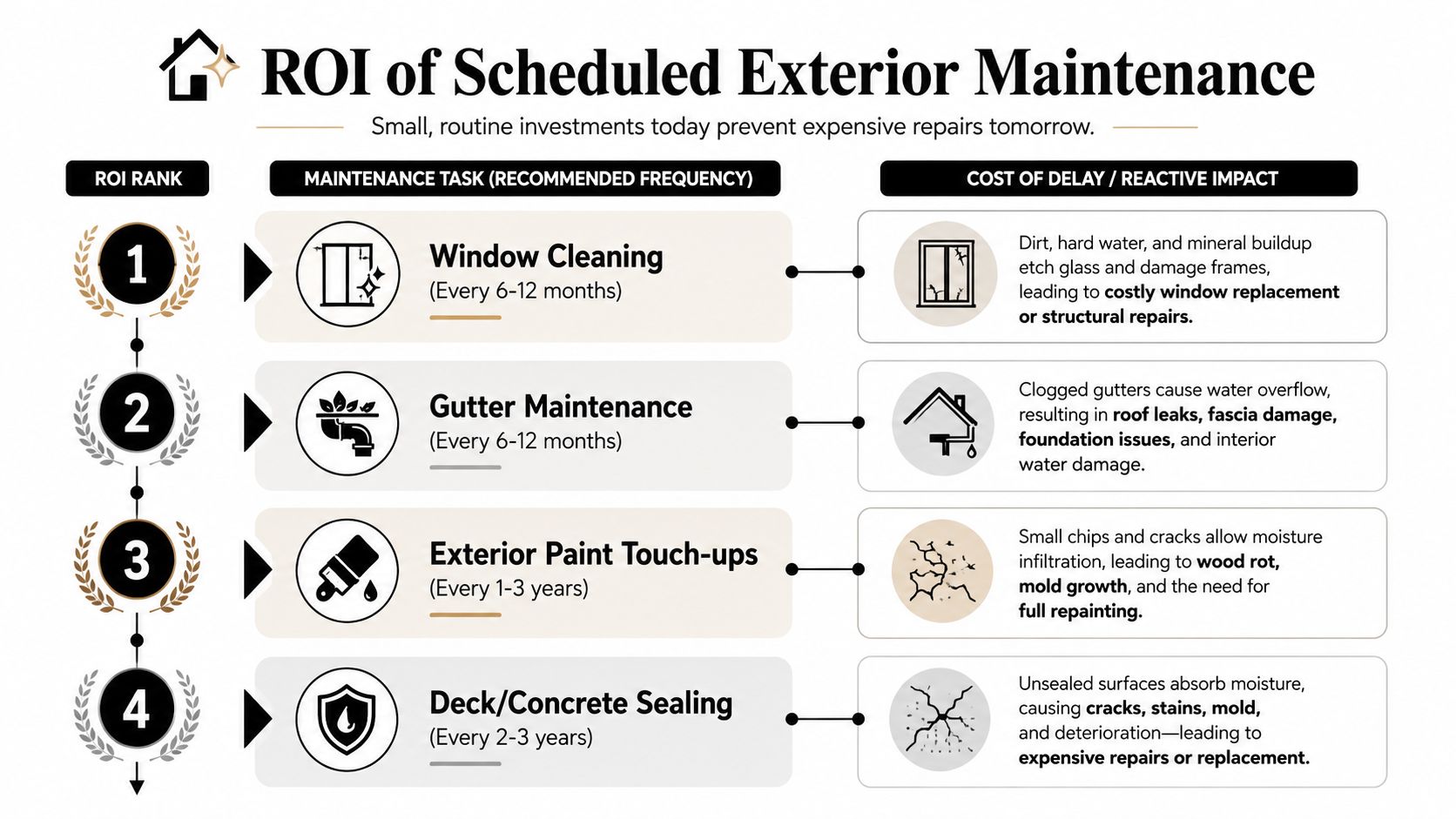
Not every maintenance task deserves equal priority. For Colorado Springs homes, I rank exterior care by how much damage it prevents and how quickly neglect becomes expensive.
Window cleaning comes first. Schedule professional exterior window cleaning every 6 to 12 months, with spring and fall as the most useful anchors. The window cleaning frequency guidance from This Old House recommends professional service twice yearly for most homes, with more frequent cleaning where traffic, pollution, or pollen create heavier buildup. Hard-water deposits and mineral residue can etch glass, especially on exposed south-facing windows. Screen cleaning and track cleaning should happen during the same visit because dirty screens and packed tracks undermine otherwise clean glass.
Put water control next
Clean gutters in late spring and late fall. Spring service removes winter debris and confirms that downspouts drain properly. Fall service clears leaves and roof debris before snow and freezing temperatures arrive. A clogged gutter can send water over the fascia, toward siding, or against the foundation, where freeze-thaw movement creates a much larger problem.
For a more detailed drainage routine, use this gutter cleaning and maintenance guide. Don't wait for visible overflow. Overflow during a storm is already evidence that the system has failed when you needed it.
Wash finishes before they fail
Pressure wash siding, walkways, patios, driveways, and decks annually, choosing the timing based on buildup and weather rather than a fixed date. UV-baked grime and organic growth can break down finishes, discolor concrete, and make painted siding look oxidized. Cedar siding and composite decking need the right pressure and technique. Too much pressure can scar wood or damage coatings.
After hail season, inspect the roof and siding. Check exterior caulk and seals around windows and doors, and reseal decks every few years when the finish begins to fade or water stops beading. Skipping these tasks can lead to etched glass, ice-dam leaks, oxidized siding paint, and split deck boards.
The cheapest protection is usually the work that keeps water, grit, and sunlight from attacking the surface in the first place.
DIY vs Hiring a Pro in Colorado Springs
DIY makes sense when the work is accessible, controlled, and easy to stop if conditions change. Interior window cleaning is usually a reasonable homeowner task for any pane you can reach safely. Ground-floor exterior glass and a single-story gutter section may also be manageable if you have a stable extension ladder, a hose-fed brush, basic safety glasses, and a clear working area.
Height changes the decision quickly. Cornell's window-washing program says exterior windows above 35 feet from the nearest ground or street surface shouldn't be cleaned with the prohibited ladder method, and a person must stand at the foot of any ladder longer than 18 feet while it's in use. Minnesota guidance also specifies a ladder landing working surface of at least 30 inches by 30 inches, clear of obstructions, with a slope no greater than 3:12, or 25%, when ladders are used. Review the Cornell window-washing safety program and Minnesota window-cleaning safety guidance before deciding that a ladder job is simple.

Use a clear task filter
- Window glass: DIY for accessible interior and ground-floor panes. Hire a pro for second-story and higher exterior windows.
- Gutters: DIY only when the roofline and ladder position are stable. Hire out steep pitches, awkward valleys, and any work requiring a ladder on uneven terrain.
- Painting: Small ground-level touch-ups can be DIY. High trim, roofline work, and repairs after hail belong with a qualified professional.
- Power washing: A homeowner can handle simple concrete when the equipment and technique are familiar. Cedar siding and composite decks should be handled professionally because incorrect pressure can etch wood or damage coatings.
- Roof inspection: Keep visual checks at ground level. Hire a professional for roof access or suspected damage.
Use biennial inside-and-out window cleaning as a dependable baseline. North-facing glass with less UV exposure may stretch to every three years, but visible spotting, pollen, construction dust, and hard-water buildup should override the calendar.
Water damage also deserves a hard boundary. If a gutter failure or window leak has already affected drywall, flooring, or insulation, don't treat it as a cleaning project. This AMPM Restoration Services guide explains why restoration work requires different equipment and judgment from ordinary home cleaning.
A Seasonal Maintenance Calendar for Front Range Homes
A calendar works better than a long checklist because each task has a trigger. Add these seasonal blocks to your phone, then move the appointment earlier when storms, pollen, or visible buildup demand it.
Spring, April through May
Spring is the reset point after winter.
- Post-winter window cleaning: Clean interior and exterior glass, screens, and tracks after pollen and winter grime become visible.
- Gutter flush: Flush gutters after the last freeze and confirm that each downspout sends water away from the foundation.
- Roof and siding inspection: Look for wind damage, loose trim, hail marks, cracked caulk, and displaced flashing.
- Deck rinse: Remove winter dirt before it settles into the finish or hides split boards.
- Irrigation startup: Check for leaks before regular watering begins.
- HVAC service: Schedule service before warm weather creates demand.
For larger properties or managed communities, exterior work should also fit access rules and resident movement. A property manager reviewing gated community access control should coordinate vendor entry before the first seasonal service window.

Summer, June through August
Summer maintenance responds to sun, dust, and monsoonal storms.
- Exterior window spot cleaning: Check glass monthly, especially where pollen, dust, or sprinkler minerals leave marks.
- Gutter check: Inspect after strong storms. Overflow, sagging, or separated joints require attention.
- Pressure washing: Clean walkways and patios when grime becomes slippery or visibly dark.
- Paint inspection: Examine south- and west-facing trim for fading, chalking, peeling, or open joints.
- Deck sealing check: Pour a small amount of water on the surface. If it absorbs quickly instead of beading, plan resealing.
The complete homeowner's checklist for exterior cleaning and maintenance can help you keep these exterior tasks in one place without losing the seasonal order.
Fall, September through October
Fall is the most important preparation window before snow and freezing temperatures.
- Final gutter clean: Remove leaves and roof debris before the first sustained freeze.
- Final window detailing: Clean glass and tracks while temperatures still allow comfortable exterior work.
- Foundation and downspout check: Confirm that discharge points aren't aimed toward the foundation.
- Exterior faucet winterization: Disconnect hoses and protect vulnerable plumbing.
- Leaf removal: Clear beds, roof valleys, window wells, and drainage paths.
- Weatherstripping inspection: Replace damaged seals around windows and doors before cold weather exposes drafts.
Winter, November through March
Winter isn't the season for unnecessary ladder work. Use visual checks from safe locations.
- Snow-load monitoring: Watch gutters and roof edges after significant snowfall.
- Ice-dam watch: Look for repeated ice buildup along eaves and signs of interior moisture.
- Condensation audit: Check interior glass for persistent moisture, damaged seals, or ventilation issues.
- Downspout observation: During a thaw, confirm that meltwater drains away from the home.
- Storm review: After high wind or hail, schedule a professional inspection if you see loose materials or new damage.
The Hidden Risks Most Homeowners Forget
A Colorado Springs homeowner can spend money on visible cleaning while missing the failures that create the largest repair bills. According to the Risk & Insurance coverage of home protection gaps, 73% of homeowners didn't have water leak detectors, and 77% lacked electrical fire monitoring devices. The same report found 27% were missing carbon monoxide detectors and 7% lacked smoke detectors. These are inexpensive prevention tools compared with water, fire, or smoke damage.
The report also found gaps outside the house. 66% of homeowners weren't following regular plans for exterior surfaces, 69% weren't following regular property-lot maintenance plans, and 74% weren't following regular foundation-care plans, according to the same Risk & Insurance coverage. Skipping these tasks turns a manageable seasonal expense into a larger repair budget.
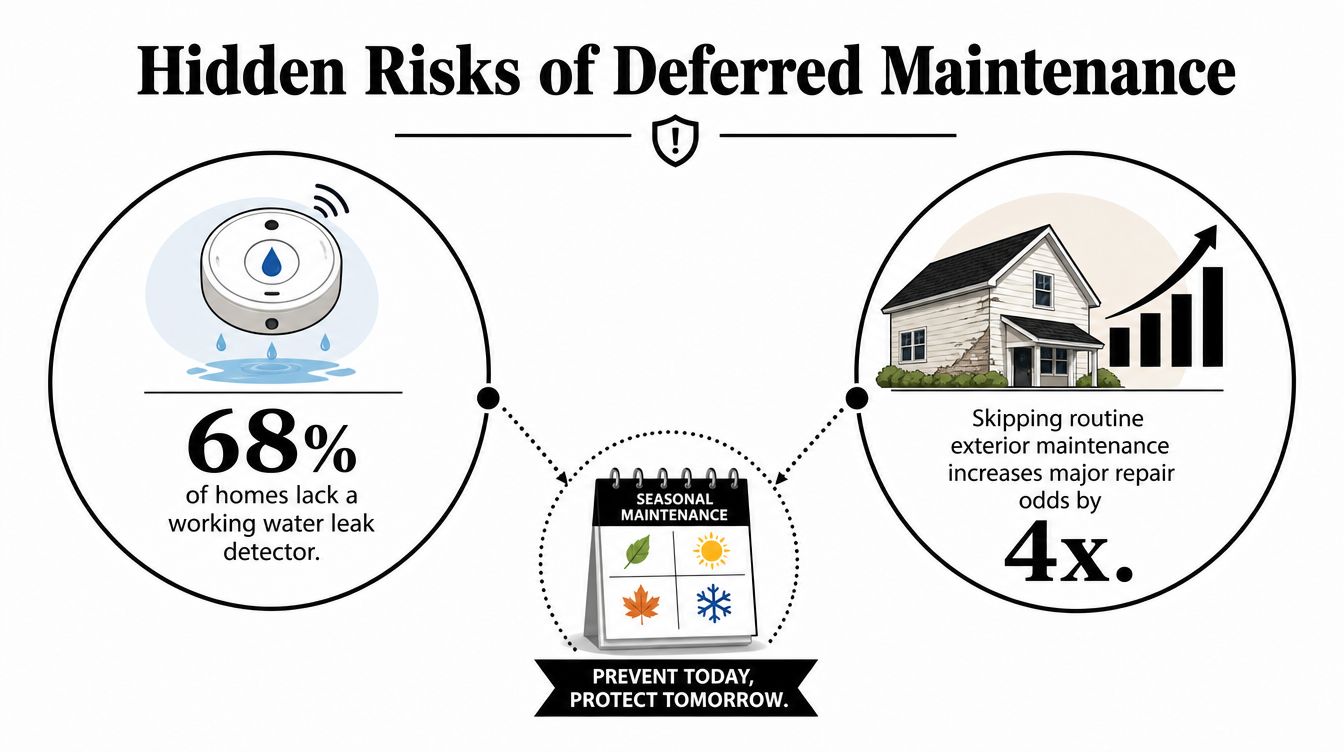
A neglected gutter can discharge water beside the foundation. Mineral deposits on exposed glass can become permanent etching, while organic buildup on siding can work into the finish until cleaning no longer restores its appearance. In Colorado Springs, high-altitude sun, wind, and rapid weather changes make these costs easier to prevent than to repair.
Budget for prevention by season. During the spring reset, check leak detection, drainage, and foundation runoff. After summer storms, inspect gutters, windows, siding, and exposed surfaces. Finish exterior cleaning and weatherstripping in fall, then monitor condensation, ice buildup, and indoor warning devices through winter. Deferred maintenance is not a separate category of risk. It's routine maintenance pushed into a more expensive season.
Budgeting and When to Schedule a Service
For a Colorado Springs home, start with an annual maintenance target of 1% to 4% of the home's value, then divide the money into three separate lines:
- Seasonal exterior cleaning: Windows, gutters, screens, tracks, siding, patios, and walkways.
- Planned reserve: Roof, HVAC, siding, deck, and other predictable aging components.
- True emergency fund: Storm damage, water intrusion, sudden system failure, or urgent repairs.
Outsource the job when the work rises above the first-story roofline, hard-water spotting resists ordinary cleaners, gutters overflow after a storm, or the ladder must stand on uneven Front Range terrain. Professional window cleaning is also the sensible choice for large panes, second-story glass, screen repair, track cleaning, and commercial properties where appearance and access need consistent scheduling.
Book spring window cleaning and pressure washing 4 to 6 weeks before the busy season if you want your preferred service window. Cultivate House Detailing provides residential and commercial window cleaning, gutter cleaning, pressure washing for siding, patios, walkways, driveways, and decks, plus screen repair for Colorado Springs and nearby communities.
Schedule your seasonal exterior care before the next storm turns a small task into a repair project. Visit Cultivate House Detailing to request a quote for professional window cleaning, gutter service, or pressure washing in Colorado Springs and surrounding areas.