
Commercial gutter cleaning in Colorado Springs typically costs $0.90 to $2.75 per linear foot, and most business projects land between $600 and $1,800. If you're pricing a retail center, office building, church, or multi-unit property, that range is a solid starting point, but the final number usually comes down to height, access, debris load, and how often the gutters are maintained.
If you're reading this before the next snow, during fall needle drop, or after noticing overflow staining on the siding, you're in the same position a lot of local property managers find themselves in. The problem usually starts small. A downspout runs slow, a corner spills during a storm, or tenants mention ice building up near an entry. Then it turns into roof-edge runoff, slippery walkways, and avoidable maintenance calls.
Colorado Springs adds its own complications. Properties near Black Forest and Monument deal with heavy pine needles that compact tightly inside gutters. Buildings closer to dense commercial corridors often collect a different mix of debris, including dust, trash, and shingle grit. Snow and freeze-thaw cycles can make existing clogs much more expensive than they looked in dry weather.
A generic online estimate doesn't usually account for those conditions. A useful quote does.
Why Gutter Maintenance Is Critical for Your Commercial Property
A commercial gutter system doesn't need to fail completely to cause expensive problems. It only has to stop draining properly in a few key spots. On a commercial property, that can mean water running over walkways, pooling around foundations, staining masonry, or backing up near roof edges when snow starts melting.
What Colorado Springs properties deal with
In Colorado Springs, the timing matters almost as much as the debris itself. A retail center can look fine in dry weather and still have packed material sitting in the troughs. Then a storm rolls through, temperatures drop, and water has nowhere to go.
For local managers, a few situations come up again and again:
- Pine needle buildup near wooded areas: Needles don't just sit loosely. They mat together, especially when they're wet, and they can block outlets fast.
- Snow and ice around entry points: Overflow at the wrong corner can create slick pedestrian areas and tenant complaints.
- Urban debris on business corridors: Dust, grit, leaves, and trash collect differently on commercial roofs than they do on detached homes.
- Multi-tenant visibility: When one section overflows, everyone notices. That includes customers, tenants, and board members.
Practical rule: Commercial gutter cleaning works best as preventive maintenance, not emergency cleanup after overflow has already started.
Why routine service is cheaper than reaction
Most property managers aren't asking for cleaning because they enjoy adding another line item to the budget. They're trying to avoid a larger repair conversation later. That's the practical reason routine service tends to make sense on commercial buildings.
A neglected system also makes future cleanings harder. Dry debris is one thing. Saturated debris, frozen buildup, and clogged downspouts are another. Once crews have to work around standing water, delicate gutter sections, heavy roof runoff, or blocked pedestrian access, the job becomes more complicated.
The biggest mistake I see in commercial settings is waiting until there's a visible overflow event. At that point, you're not just paying for cleaning. You're paying for urgency, tenant coordination, and sometimes additional troubleshooting that could have been avoided with a normal service cycle.
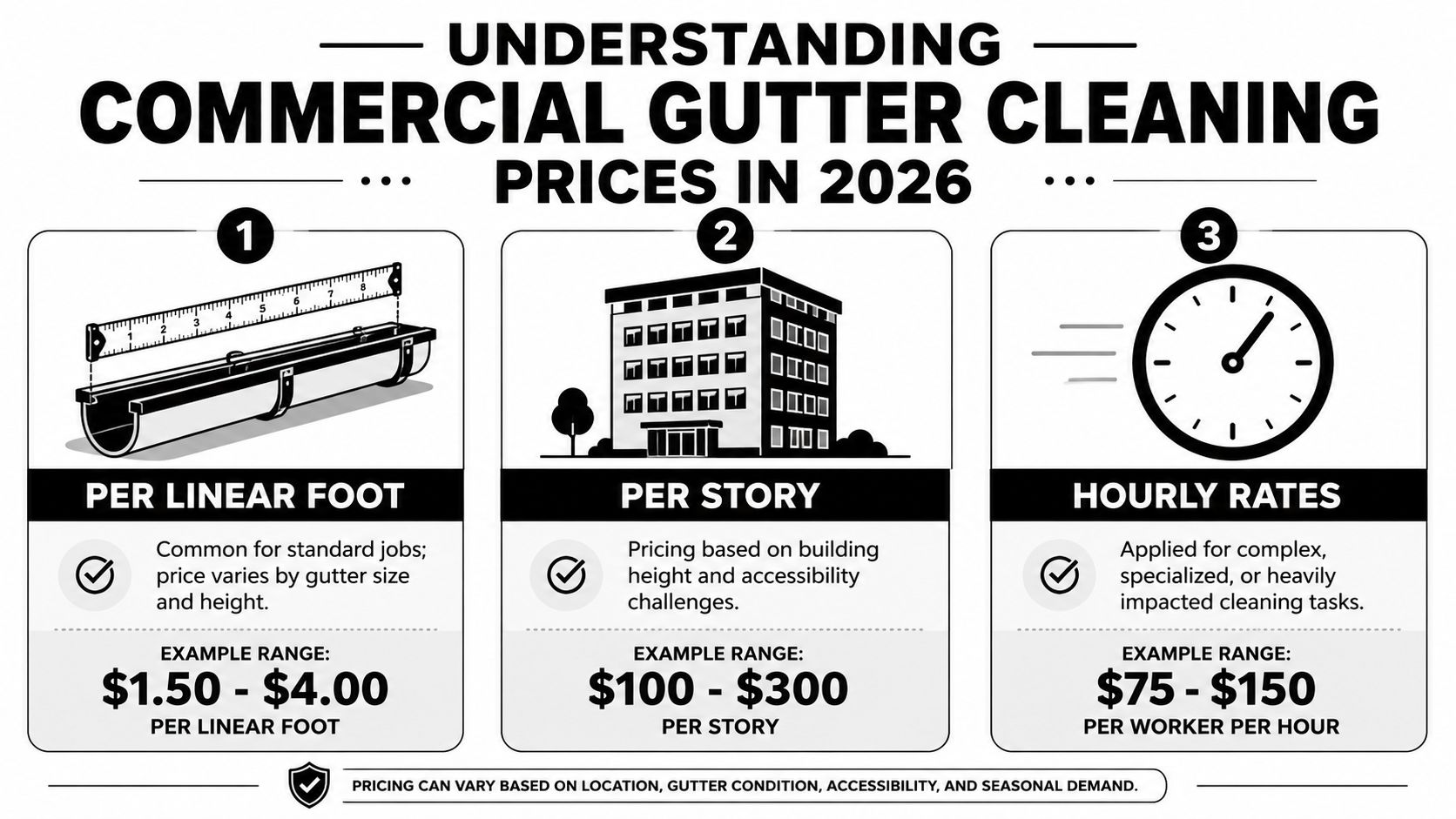
Understanding Commercial Gutter Cleaning Prices in 2026
A Colorado Springs property manager usually sees the price question show up after a storm cycle, a tenant complaint, or a winter inspection. By then, the issue is not just "what does gutter cleaning cost?" It is "what kind of building, debris load, and access situation are we pricing?"
Commercial gutter cleaning is usually quoted by scope, not by a flat menu price. For most properties, contractors price the work by linear footage, by labor time, or as a single project total. The right model depends on how predictable the job is.
The most common pricing method
Linear-foot pricing is still the standard way many commercial contractors build a quote. It works well on shopping centers, office buildings, churches, schools, and other properties with long, measurable gutter runs. A contractor measures the total run, checks the roofline, and adjusts for access, height, and debris conditions.
In Colorado Springs, that matters more than many national guides suggest. A building near Black Forest may collect dense pine needles and cones that pack tightly into troughs and downspout openings. A property closer to busier commercial corridors may have lighter organic debris but more grit, roofing granules, and windblown trash. Two sites with the same gutter length can land at different prices because one cleans out fast and the other takes real labor to clear properly.
What managers usually see on real quotes
Most commercial quotes in this market fall into one of three formats:
| Pricing Method | How It Works | Best Fit |
|---|---|---|
| Linear footage | Total gutter run is measured and priced | Standard commercial sites with clear scope |
| Hourly billing | Labor time drives the quote | Complex cleanouts, difficult access, troubleshooting |
| Project pricing | One number for the full scope | Managers who want simple budgeting |
Project pricing is common when the contractor has enough information to account for setup, cleanup, access restrictions, and debris removal in one number. Hourly billing shows up more often on problem jobs, especially when nobody knows yet whether the crew is dealing with simple surface debris, packed downspouts, ice-related blockage, or hidden sections behind parapets.
That distinction matters for budgeting. A straightforward one-story building with open access may be easy to price from a site visit and roofline measurement. A multi-tenant property with blocked access points, service lanes, or winter snow piles around ladder locations usually needs more caution in the quote.
Why commercial pricing differs from residential
Commercial work has a different cost structure than house gutter cleaning. Long continuous runs can be efficient. Site coordination can slow everything down.
On many Colorado Springs properties, the climate creates the biggest spread in pricing. Late-fall needle drop can turn a routine cleaning into a heavy debris removal job. Freeze-thaw cycles can leave crews working around icy sections and saturated buildup. Snowmelt also exposes drainage problems that were not obvious during dry weather.
Recurring service usually keeps pricing more predictable because the gutters are being cleaned before debris compacts and downspouts back up. One-off service after neglect is where estimates widen. The crew may need more time, more containment, and more troubleshooting, especially on buildings where overflow has already stained siding, entry areas, or walkways.
A low quote can still cost more later if the scope leaves out debris bagging, downspout flushing, or safe access planning. For commercial properties, clear scope beats a cheap number.
Key Factors That Influence Your Final Cost
On commercial properties in Colorado Springs, the final price usually comes down to labor time, access risk, and how much material has to come out of the system. Two buildings can have similar gutter runs and still land far apart on price because the crew is solving different jobsite problems.
Height access and site logistics
Access changes the job faster than owners expect. A single-story medical office with clear perimeter access is usually efficient. A taller building with snow piled at ladder points, fenced service yards, tight parking layouts, or delivery traffic takes more setup, more protection, and more time on site.
That is especially true here in winter and early spring. Freeze-thaw conditions around ladder feet, shaded north sides, and slushy access lanes can slow a crew down even when the gutter footage looks reasonable on paper. On some properties, the cleaning itself is simple. Getting to the work area safely is what increases the quote.

A few local conditions that commonly raise the price:
- Restricted setup areas: Courtyards, dumpsters, gates, and narrow alleys limit ladder or lift placement.
- Active storefronts or offices: Crews may need to cordon off walkways and work around customer traffic.
- Multiple roof transitions: Tie-ins, step-down sections, and hidden runs behind parapets take longer to inspect and clear.
- Seasonal obstacles: Snow berms, ice patches, and saturated ground can reduce safe access points.
Debris type affects labor
Debris type matters just as much as volume. In Black Forest and other pine-heavy areas, needles mat together, hold water, and plug outlets tightly. That kind of buildup often has to be removed by hand before downspouts can be flushed properly.
Downtown and corridor properties have a different problem. Roof grit, cottonwood fluff, trash fragments, and windblown sediment collect in the troughs and wash into the outlets. From the ground, the gutters may not look terrible. Up close, the system can be half full of wet silt that takes time to bag, rinse, and test.
The hardest jobs are usually the ones with compacted material, not just visible overflow.
If you are comparing building types or trying to set a rough budget before requesting bids, this Colorado gutter cleaning cost guide for local properties gives a useful baseline.
Gutter condition and maintenance history
The condition of the gutter system changes how aggressively a crew can work. Loose brackets, separated seams, rusted sections, poor slope, and patched downspouts all slow the process because the goal is to clear the line without causing more damage.
Service history affects price for the same reason. A property cleaned on a schedule usually stays in maintenance mode. A property that has been ignored through fall needles, winter snow, and spring runoff often needs heavier debris removal, more downspout troubleshooting, and closer inspection for overflow damage around entries and façades.
That is a real trade-off for budget planning. Skipping one cycle can save money short term, but the next visit often costs more because the crew is doing recovery work instead of routine cleaning.
What usually lowers the price
Property managers can control part of the cost before the crew arrives.
| Factor | Usually Lowers Cost When |
|---|---|
| Access | Equipment and ladders can be set safely without moving vehicles or working around snow piles |
| Debris load | Gutters are cleaned before pine needles and sediment compact |
| Scheduling | Service is booked before overflow creates an urgent callout |
| Site coordination | Tenant contacts, gate codes, and restricted areas are shared in advance |
Sample Estimates for Colorado Springs Properties
Real budgeting gets easier when you compare your site to a few familiar local property types. The numbers below use the commercial ranges already discussed and show how local conditions often shape the quote more than owners expect.
Common local scenarios
| Property Type | Est. Size (Linear Feet) | Common Challenges | Estimated Cost Range |
|---|---|---|---|
| Small downtown office building | Moderate gutter run | Tight access, pedestrian traffic, roof grit and urban debris | Often within the broader commercial project range |
| Northgate retail strip center | Larger continuous run | Storefront access coordination, signage, multiple downspouts | Often within the broader commercial project range |
| Black Forest HOA multi-building property | Extended total run across several buildings | Pine needles, heavier debris compaction, recurring maintenance needs | Often benefits from multi-unit pricing structure |
| Church or campus-style property on the west side | Mixed rooflines | Varying elevations, limited setup areas, tree debris in sections | Often priced by a mix of footage and access complexity |
These aren't fixed bids. They're planning examples. If you want a broader homeowner-facing baseline before comparing a commercial scope, this gutter cleaning cost guide for Colorado-area properties can help frame the conversation.
Scenario one downtown office
A small office near the urban core often looks simple from the street. The challenge is usually access, not size. If crews need to work around sidewalks, parked vehicles, and active entrances, setup becomes a larger share of the job.
These properties often have moderate debris loads, but the debris is messy. Instead of just leaves, crews may find grit, trash, and fine buildup in downspout outlets. That can push the quote toward project pricing rather than a quick footage-only estimate.
Scenario two retail strip in Northgate
This is one of the more predictable commercial layouts. Long, continuous runs make measuring straightforward, and the roofline is often easier to service than a fragmented property.
The issue is coordination. Managers need work done without disrupting storefront visibility, customer parking, or tenant operations. Quotes usually stay more stable here when access windows are defined ahead of time and the cleaning is part of regular maintenance instead of a once-in-a-while reset.
Scenario three HOA buildings near Black Forest
Local knowledge matters. Pine needles can create dense blockages that hold water and resist quick removal. A multi-building HOA may still receive more favorable pricing structure because the scope is larger and more repeatable, but the labor can be more involved than a similarly sized property elsewhere in town.
For Black Forest and Monument-area sites, the maintenance schedule matters almost as much as the initial quote. If you wait too long, the debris changes from routine to stubborn.
Scenario four west-side mixed-use or campus property
Older or more irregular rooflines create their own pricing issues. Different elevations, enclosed courtyards, and landscaping all slow production. Even when total footage isn't extreme, the quote can reflect the time needed to move safely between sections and confirm every run is draining properly.
The Importance of Safety Licensing and Insurance
The cheapest quote on commercial gutter work can become the most expensive decision on the property. That's because you're hiring people to work at height, near tenants, vehicles, storefronts, and walkways. If something goes wrong, the risk doesn't stay with the contractor alone.
What property managers should verify
Before approving any commercial gutter cleaning contractor, ask for current proof of insurance and confirm the company is operating professionally for the type of work being performed. If you want a practical overview of what businesses often review, this guide to 2026 contractor insurance requirements is a useful starting point.
The issue isn't paperwork for its own sake. It's liability control.
If a worker is injured, if equipment damages a vehicle, or if falling debris affects a customer area, you want to know the contractor prepared for commercial risk. A serious company should expect that question and answer it clearly.
Safe work protects the whole site
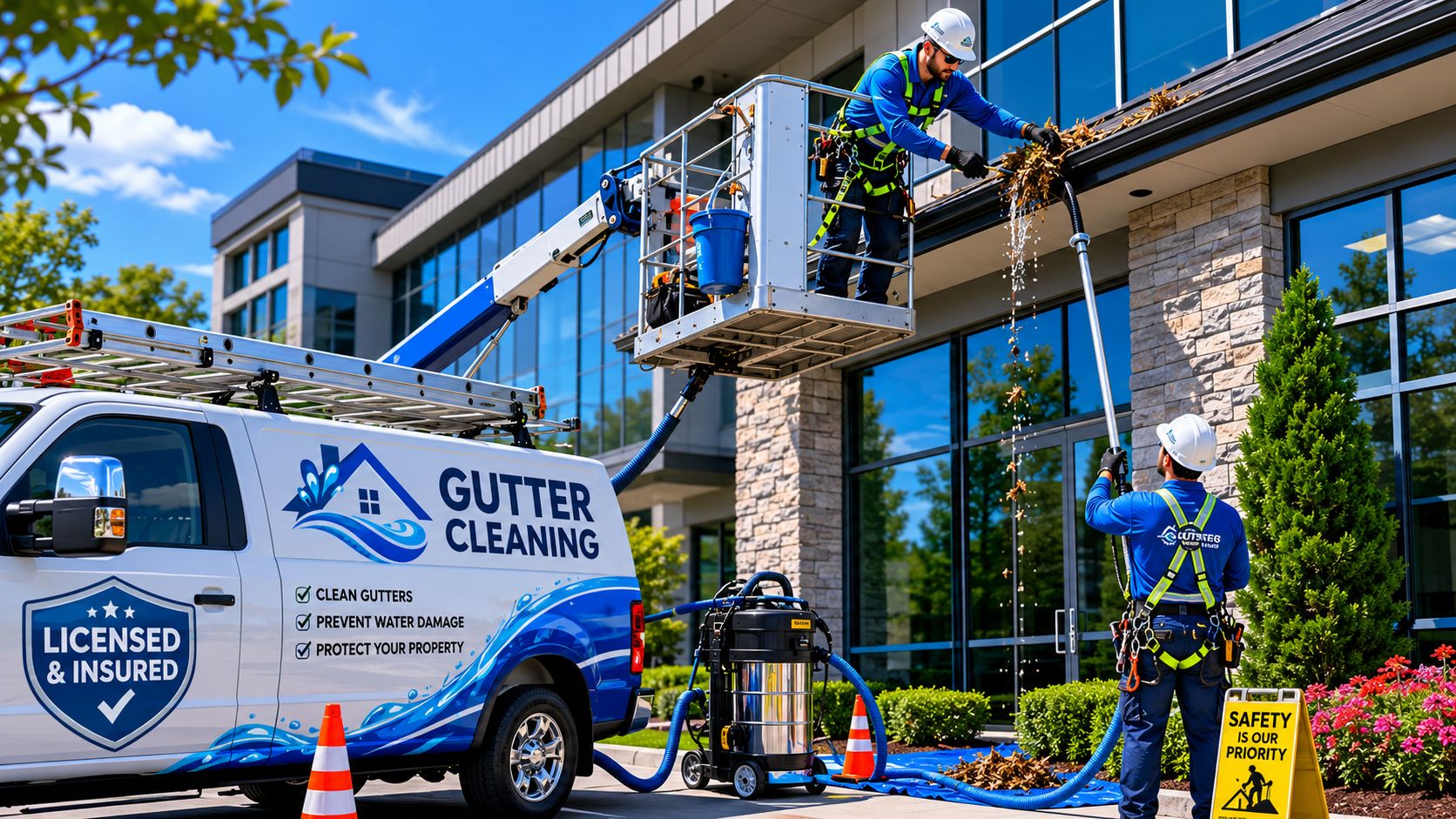
Commercial jobs require more than a ladder and a leaf blower. Safe crews think through access, pedestrian flow, equipment staging, and debris containment before cleaning starts.
That usually includes:
- Fall protection planning: Especially on taller or more complicated rooflines
- Controlled work zones: So customers, tenants, and staff aren't walking under active cleaning
- Appropriate equipment: Ladders, lifts, harnesses, and tools matched to the site
- Clear communication: On timing, restricted access areas, and cleanup expectations
A practical comparison of licensed gutter cleaners vs unlicensed work and the risk is worth reviewing if you're weighing bids that seem far apart.
Here's a look at the kind of equipment and planning commercial work can involve:
Why professionalism affects price
A properly insured and organized contractor may not be the lowest line on the spreadsheet. But they're usually pricing in the things that protect you. That includes labor practices, safer setup, and enough time to complete the work without rushing around occupied buildings.
Cultivate House Detailing handles commercial exterior cleaning with that safety-first approach, which is one reason detailed site-specific quotes matter more than phone-only guesses.
How to Get Accurate Quotes for Your Business
The fastest way to get a useful quote is to give the contractor enough detail to price the job correctly the first time. Commercial gutter cleaning cost gets harder to estimate when the scope is vague, and that's when change orders and misunderstandings start showing up.
What to have ready before you call
You don't need architectural plans. But you should have a few basics prepared:
- Building address and property type: Office, retail, church, HOA, mixed-use, or industrial
- Number of stories: Include any sections that are taller than the rest
- Known problem areas: Overflow corners, slow downspouts, ice-prone entries, or previous leak concerns
- Access details: Gates, locked areas, courtyards, tenant restrictions, loading zones, and best parking
- Service history: Whether the gutters are on a schedule or haven't been cleaned in a while
That information helps the estimator decide whether a footage-based quote is realistic or whether the site needs a more detailed inspection.
How to compare bids fairly
Don't compare quotes by bottom-line price alone. Compare scope.
Look for answers to these questions:
- Does the quote include downspout flushing or only gutter scooping?
- Is debris haul-away included?
- Has the contractor accounted for access restrictions and occupied areas?
- Will they provide proof of insurance if requested?
- Is the quote based on a site visit, photos, or a rough guess?
Bid check: A quote can be lower because the contractor is efficient. It can also be lower because key parts of the job were left out.
Some property teams use tools similar to Exayard construction estimating software to organize scopes and compare vendor proposals consistently. Even if you're not using formal estimating software, the same principle applies. Match line items before you judge the price.
What a clear estimate should feel like
A good estimate should be easy to read. It should identify the property, describe the work, explain any access assumptions, and note anything that could change the final price. If a contractor can't explain the quote in plain language, that usually creates problems later.
FAQs for Colorado Springs Property Managers
A property manager in Colorado Springs can oversee two buildings with the same square footage and end up with very different gutter needs. A retail strip near Academy may collect windblown trash and shingle grit. A Black Forest property can load up with pine needles and cones fast, especially after wind or wet spring weather. Add freeze-thaw cycles and heavy snow, and the right cleaning schedule depends on local conditions, not a generic calendar.
Frequently Asked Questions
| Question | Answer |
|---|---|
| How often should a commercial property schedule gutter cleaning in Colorado Springs? | For many Colorado Springs commercial properties, a good starting point is twice a year. Sites with pine trees, steep roof runoff, or recurring winter ice issues often need more frequent service. Black Forest and heavily treed HOA properties usually need closer attention than open commercial sites on the east side. |
| Can one contractor handle multiple properties on one account? | Yes. Property managers often prefer one vendor for multiple sites because it simplifies scheduling, site notes, invoicing, and approval flow. It also helps when each property has different debris patterns, access points, and service dates. |
| What if the crew finds damage while cleaning? | The crew should document it with photos and separate the cleaning scope from any repair recommendation. On commercial properties, common findings include loose gutter brackets, seam leaks, standing water from poor pitch, crushed downspouts, or sections pulled by snow load. Cleaning should not turn into unapproved repair work. |
| Will service disrupt tenants or customers? | It should be manageable with planning. Crews can work around opening hours, cordon off small ground areas, and stage ladders or lift access where foot traffic is lightest. On occupied sites, good communication matters as much as the cleaning itself. |
| Are annual contracts worth it? | For many properties, yes, especially if budgeting matters more than reacting to problems. Scheduled service reduces the chance of overflow during summer storms and helps avoid packed debris that is harder and more expensive to remove later. |
| Do HOA and multi-unit properties price differently from a single commercial building? | They often do. Repeated building layouts can make pricing more consistent, but large HOA sites may still cost more if access is spread out, upper roofs need lift work, or tree debris is heavy across the property. In Colorado Springs, that difference shows up often in townhouse communities near mature pines. |
The local takeaway
Colorado Springs properties do not follow one debris pattern or one maintenance cycle. Downtown buildings deal with urban debris and tight access. Northgate and Briargate sites can see strong wind exposure. Black Forest properties often need more cleanup because needles, cones, and roof valleys fill faster.
That is why property managers should ask specific questions. How much roof edge is included? Are downspouts checked? Is the quote based on actual site conditions, including snow-related wear and restricted access?
Regular gutter cleaning is easier to budget than interior leak calls, icy walkways, or fascia damage after an overflow.
If you're responsible for a commercial property, the useful next step is a quote that matches your building, your tree cover, and your access conditions. If you need a clear, site-specific estimate for your building or portfolio, contact Cultivate House Detailing. We can review your property, explain the scope in plain language, and help you budget commercial gutter cleaning around Colorado Springs conditions instead of a generic national average.
Looking for a professional to take care of it? Cultivate House Detailing offers gutter cleaning in Colorado Springs. Get a free quote.