A stained driveway in Colorado Springs can make an otherwise solid-looking property feel overdue for attention fast. Winter slush, wind-blown grit, pine pollen, and the kind of sun that bakes residue into concrete all leave a mark, and by the time spring rolls around, many homeowners are staring at patios, walkways, siding, and gutters that need more than a garden hose. Exterior pressure washing services solve that problem when the surface can handle it, but the skill is knowing what to wash hard, what to wash gently, and what to leave alone.
That surface question matters more than many realize. A clean slab of concrete and a painted wall don't respond the same way, and using the wrong method can etch, strip, or drive water where it shouldn't go. If you're comparing window cleaning near me searches with exterior cleanup, or you're trying to decide between professional window cleaning and a broader wash for the rest of the property, the same rule applies, match the method to the material.
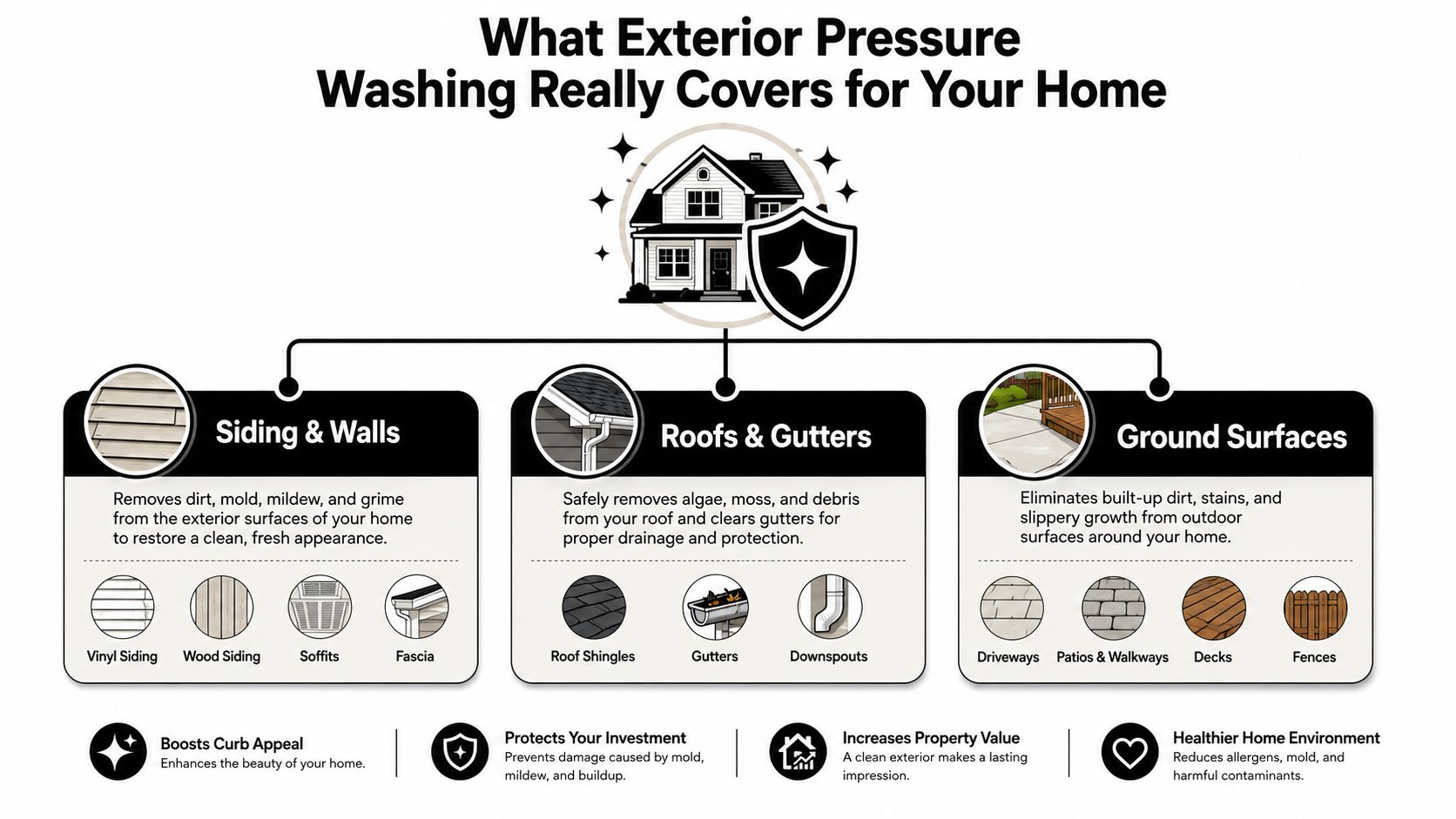
What Exterior Pressure Washing Really Covers for Your Home
A Colorado Springs homeowner usually notices the driveway first. After one winter, it's easy to see salt haze, tire marks, and dark runoff lines where snowmelt pooled and dried again. A proper exterior wash can handle that driveway, the front walk, the back patio, the siding near the entry, and the gutter exteriors that collect grime along the roofline.
The parts of a home that usually need attention
On most homes, the work breaks into a few common zones. Patios, walkways, and driveways are the obvious ones, because foot traffic and vehicle traffic leave behind the heaviest buildup. Siding and trim collect dust, pollen, and streaks that make the whole front elevation look tired even when the structure itself is in good shape.
Gutters and nearby fascia often get overlooked. Dirt lines, roof runoff, and decomposing debris around the top edge of the house can make the exterior look older than it is. If your property also has decks, fences, or masonry features, those may be included too when the material and condition make sense for washing.
Practical rule: if a surface gets walked on, driven on, or hit by runoff, it usually shows its age first.
What a homeowner should expect a quote to cover
A real quote should clearly separate the surfaces being cleaned. A driveway isn't the same job as a second-story siding wash, and gutter work isn't the same as rinsing a patio. When a contractor scopes the property well, they should be able to tell you what's included and what needs a different approach, especially if delicate materials are involved.
That's why surface care matters as much as the cleaning itself. For homeowners trying to understand the broader exterior maintenance picture, this roof and gutter care for Ohio homeowners piece is a useful reminder that top-edge maintenance and ground-level cleaning often affect each other, even when the work is on different parts of the property.
Pressure Washing vs Soft Washing for Different Surfaces
Pressure washing and soft washing aren't competing gimmicks, they're two different tools for two different jobs. Pressure washing uses force to lift stuck-on dirt from durable surfaces. Soft washing uses much lower pressure and relies more on the cleaning solution, which is why it's safer for paint, siding, roofs, and other materials that can't take a hard blast.
The mistake homeowners make is assuming stronger always means better. On concrete, that can be fine. On painted siding or a roof, it can turn a cleaning job into a repair bill.
A simple way to think about the method
Think in terms of surface hardness. Concrete, some masonry, and other tough ground-level surfaces can usually take proper pressure when the operator knows how to control it. Painted walls, vinyl siding, stucco, EIFS, and roofs usually need a gentler approach so the finish doesn't get damaged or water doesn't get forced behind the material.
The practical takeaway is simple. If a quote says every part of the house will get the same aggressive treatment, ask more questions. A careful pro should be able to explain why one surface gets higher force and another gets a soft wash instead.
| Surface | Best Method | Why |
|---|---|---|
| Driveways | Pressure washing | Durable enough for heavier cleaning when the operator controls the nozzle and distance |
| Patios | Pressure washing or soft washing, depending on the finish | Concrete can usually take more force, but decorative surfaces need caution |
| Walkways | Pressure washing | Commonly built for regular foot traffic and tougher rinsing |
| Siding | Soft washing | Reduces the risk of stripping paint, forcing water behind panels, or marking the finish |
| Gutters | Soft washing | Safer for painted metal and the surrounding trim |
| Roofs | Soft washing | Protects shingles and other roof materials from damage |
A good contractor will also adjust pressure and flow instead of pretending one setting works for every job. Industry guidance commonly ties commercial exterior cleaning to roughly 3,500 to 5,000 PSI and 4 to 8 GPM for heavy-duty work, but the right number depends on the substrate, not on a macho setting alone, as outlined in a commercial pressure washing guide. That's the difference between cleaning a surface and chewing it up.
Learn more about the methods homeowners compare
How a Professional Exterior Pressure Washing Visit Actually Works
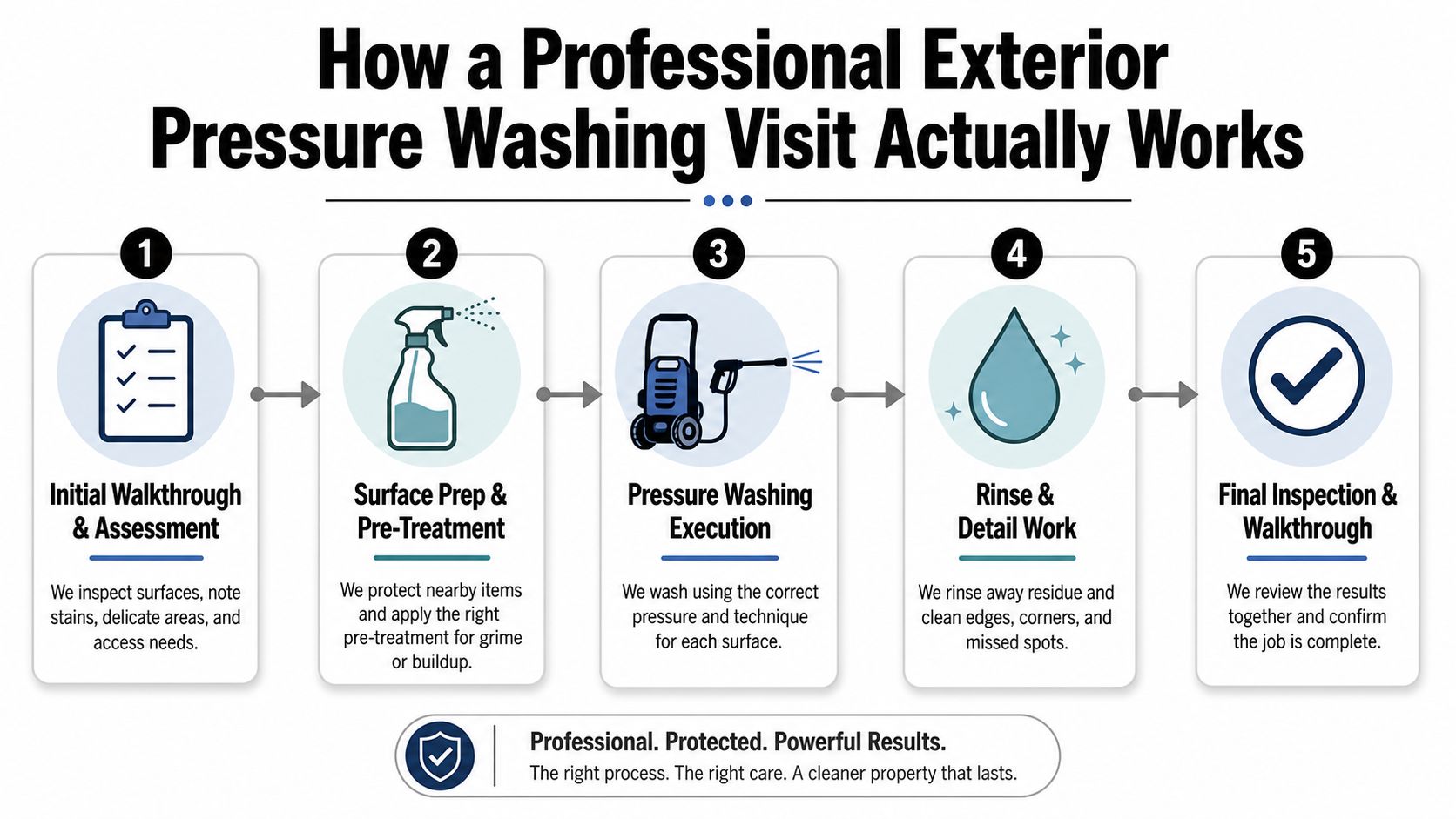
A solid job starts before the wand ever touches the surface. A trained crew should walk the property, spot soft materials, look at landscaping, and note where electrical fixtures, window seals, and outdoor furniture might need protection. Good prep saves time later, but it also keeps the work from becoming a mess.
The job usually follows a predictable sequence
Most professional visits move in a clean order. First comes the walkthrough, then pre-treatment for organic growth or stubborn stains, then the actual cleaning pass, then a rinse and detail work, and finally a walkthrough with the homeowner. That last step matters because it's where missed edges, splash lines, and spots near corners get checked.
A crew that skips the inspection is telling you they're rushing. A crew that takes time on the edges is showing you they care about finish quality, not just speed.
Field note: the difference between average and careful work is often visible at corners, around downspouts, and along the lower edge of siding.
Safety is part of the service, not an extra
Professional exterior cleaning also means controlling the job site. That includes ladder safety, careful wand handling near glass and fixtures, and not soaking plant beds or furniture that should have been moved. On a Colorado Springs property, wind can make overspray more annoying than people expect, so a crew has to pay attention to where the water and loosened debris are landing.
For oil, grease, and traffic residue, hot water can make a meaningful difference. Municipal specs for this kind of cleanup often call for 3,500 to 4,000 PSI with water at 200°F or higher, along with wastewater collection so runoff doesn't end up in storm drains, as noted in a municipal pressure washing specification. That's a reminder that some jobs aren't just about looks, they're about proper handling of contaminated residue too.
A service like Cultivate House Detailing fits into that kind of work when a homeowner wants pressure washing alongside other exterior maintenance, but the larger point is simple. A professional visit should look organized, controlled, and methodical from the first knock to the final rinse.
How Much Exterior Pressure Washing Costs in Colorado Springs
Pricing usually depends on the surface, the amount of buildup, and how easy the area is to access. A small, open driveway with light dirt is a very different job from a tall siding wash with oxidation, heavy staining, or awkward hose access. That's why a quote should reflect the property, not just the square footage on paper.
A homeowner comparing bids should watch for scope, not just the lowest number. If one estimate includes pre-treatment, detail work, and careful rinsing while another sounds like a quick spray-down, those aren't equivalent services.
What tends to move a quote up or down
The biggest variables are pretty straightforward. Square footage affects labor and water use. Staining level affects dwell time and pre-treatment. Height and access affect safety and setup time. Water source matters when the crew can't work efficiently from a normal spigot.
Bundled work can change the price too. A contractor who's already on site for siding may be able to add walkways or driveway cleaning more efficiently than a separate trip would allow. Optional services like paver sealing, gutter brightening, or screen cleaning may also come up when the property needs a more complete refresh.
How to judge whether a quote feels reasonable
The best way to evaluate a price is to compare what's being done, not just what's being said. A quote for a basic driveway rinse shouldn't be read the same way as a full exterior wash with pre-treatment and detail work. If you're trying to understand how contractors think about pricing by area and scope, this pressure washing pricing per square foot resource is a helpful reference point for the conversation.
A fair quote makes the surface, condition, and access obvious. A vague quote usually hides the real labor.
In practice, a pro will often look at your property, identify the surfaces that can be cleaned safely, and explain where pressure washing makes sense versus where soft washing is the smarter call. That discussion is worth more than a polished ad because it tells you whether the contractor understands the job in front of them.
Why Local Colorado Springs Conditions Change the Job
Colorado Springs isn't an easy climate for exterior surfaces. High UV exposure bakes grime into concrete and fades finishes faster than many homeowners expect. Winter freeze-thaw cycles open up pores and tiny cracks, which gives dirt and runoff more places to settle, and spring winds carry grit that acts like sandpaper on siding and trim.
That means the same driveway that looked manageable in late fall can look completely different by the time the snow is gone. It also means a contractor working here should read the property differently than someone used to a milder climate.
Local conditions affect both cleaning method and timing
Homes in Black Forest and Monument often deal with pine pollen and heavier natural debris. Out on the edge of town, wildfire-mitigation clearing can become part of the same exterior maintenance conversation, because brush removal, dust control, and keeping the property tidy all tie into how the home presents and how safely the grounds are maintained.
The right time to clean also matters. After a season of snowmelt, a lot of residue sits in the same low spots where water collected all winter. If that buildup is left alone, it tends to cling harder, which makes the next cleaning more involved.
Why local experience changes the quote
A local crew usually scopes the work with those conditions in mind. They know which surfaces are likely to need extra pre-treatment, where access will be awkward, and when a gentle method will protect the finish better than hard pressure. That can change both the price and the workflow.
When homeowners compare estimates, they should ask whether the company has worked on Colorado Springs homes with similar exposure, elevations, and materials. A contractor who knows the area can give a more honest read on what the exterior needs, instead of quoting a one-size-fits-all wash.
DIY Pressure Washing Versus Hiring a Local Pro
A rental washer looks inexpensive at first glance, and for a small patio or a quick refresh on a ground-level slab, DIY can make sense. The problem starts when the surface gets larger, the stains get older, or the work moves up near siding, windows, and roof edges. That's where the learning curve becomes expensive.
DIY also asks you to be your own equipment operator, safety lead, and quality control person. If you've never used different nozzles, adjusted distance properly, or handled overspray around delicate materials, the odds of an uneven finish go up fast.
Where DIY works and where it doesn't
A homeowner can usually handle a small, simple surface if the risk is low and the goal is just a seasonal refresh. A short driveway, a compact patio, or a modest walkway may fit that category. The job gets tougher when the surface is stained, raised, or attached to materials that don't tolerate pressure well.
Hiring a trained local crew makes more sense when the work includes multi-surface cleaning, roofline access, or any area where surface damage would be expensive to fix. A pro brings the right machine, the right nozzles, and the experience to switch methods instead of forcing the same approach on every material.
The tradeoff homeowners should actually weigh
The decision isn't just cost. It's time, safety, and finish quality. A rental might save money up front, but the job can eat a Saturday, and there's no cushion if you damage paint, etch concrete, or miss spots around edges.
For many homeowners, the difference shows up in how complete the result feels. A professional service usually looks more even, more controlled, and less likely to leave surprise streaks or water intrusion issues behind.
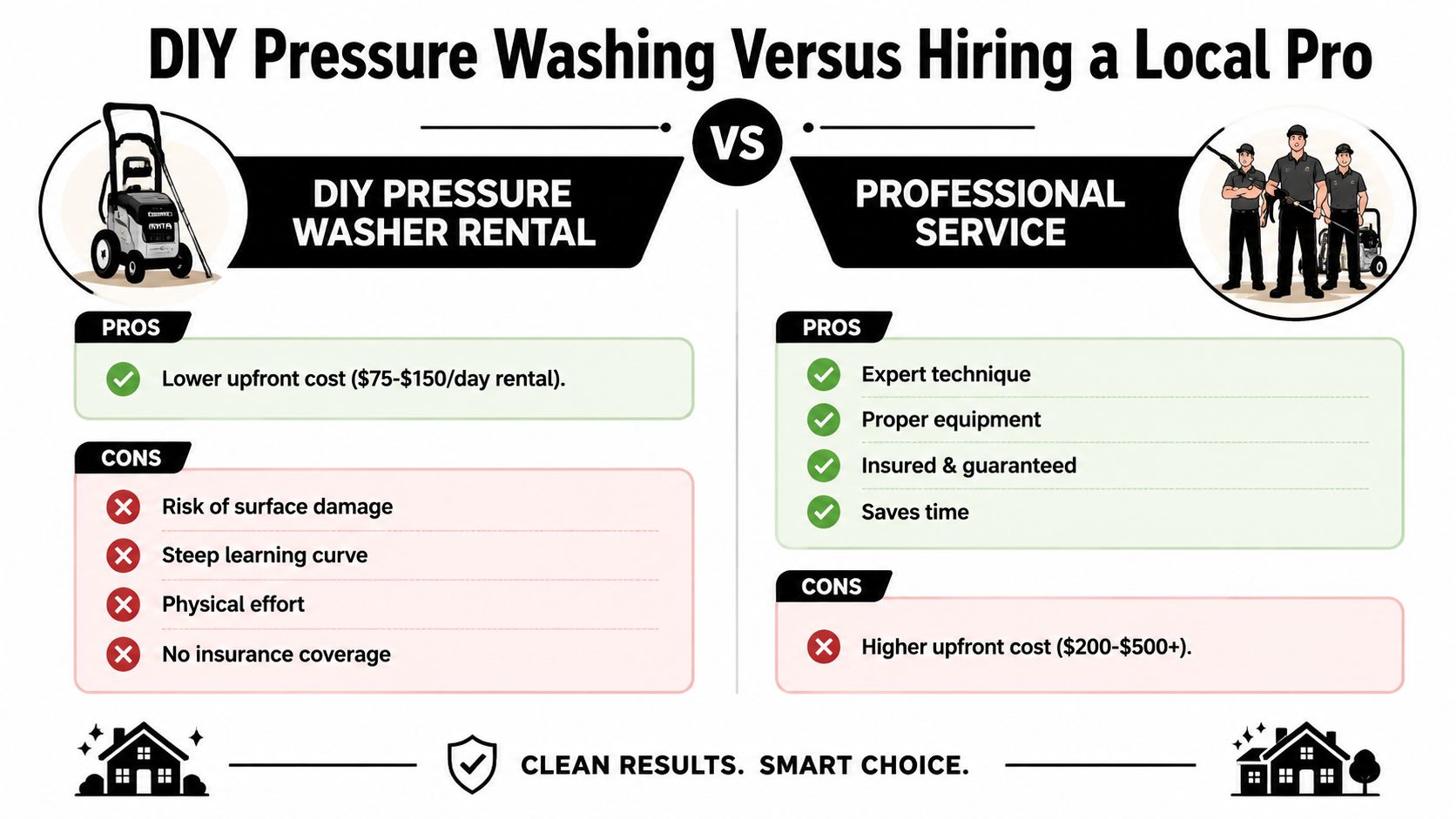
If the job is limited and low-risk, DIY can be enough. If the exterior has mixed materials, visible staining, or hard-to-reach areas, professional help is usually the safer call.
Choosing the Right Exterior Pressure Washing Company in Colorado Springs
The best contractor isn't the one with the flashiest ad. It's the one who can explain how they'll protect your home, what method they'll use on each surface, and what happens if they run into a material that shouldn't be hit with pressure. That's the standard homeowners should use when they compare exterior pressure washing services in Colorado Springs, CO.
A good company should be comfortable answering simple, direct questions. If they hesitate, overpromise, or dodge the topic of soft washing, that's a warning sign.
What to ask before you book
Start with the basics.
- Insurance: Ask for proof of coverage before anyone starts work.
- Similar local jobs: Look for references or examples from homes in Black Forest, Monument, Manitou Springs, or Woodland Park.
- Written scope: Make sure the quote explains what surfaces are included.
- Method: Ask which areas will be pressure washed and which will be soft washed.
- Before-and-after photos: Check that the company has examples from similar exterior materials.
- Water use and access: Confirm whether they need anything special from you before arrival.
If you're looking for a service provider that also handles related exterior work, Cultivate House Detailing offers pressure washing for patios, walkways, siding, and driveways alongside other home maintenance services, which makes it easier to coordinate exterior cleaning on one visit.
Red flags that usually show up early
Unusually low pricing can hide rushed work or missing prep. A vague quote can mean the crew hasn't looked closely at your property. A contractor who won't talk about PSI, soft washing, or delicate materials probably isn't planning to protect them.
If the explanation sounds generic, the cleaning plan probably is too.
Homeowners in Colorado Springs deserve a contractor who treats the exterior like a set of different surfaces, not one big blast zone. Ask for a walkthrough, ask the method question, and pick the company that gives you a clear, calm answer.
If your driveway, siding, or patio is ready for a proper cleanup, reach out to Cultivate House Detailing for a quote and a straightforward walkthrough. We help Colorado Springs homeowners choose the right cleaning method for each exterior surface, so the work looks sharp without creating avoidable damage.
Want it handled by a local crew? Cultivate House Detailing offers pressure washing in Colorado Springs. Get a free quote.