Gutter cleaning is the removal of leaves, pine needles, dirt, roofing granules, and other debris from roof-edge channels so rainwater can flow through downspouts and away from the foundation. In Colorado Springs, it also helps remove dry combustible material that can expose roof edges to windblown embers.
After a spring storm, you may notice water pooling beside the foundation, dark streaks below the roofline, or a downspout spilling directly against the wall. Beneath evergreen trees, the warning may be less obvious: dry pine needles settle into a dense mat that holds water, blocks outlets, and creates fuel near the roof edge.
That's why what is gutter cleaning matters beyond appearance. It's exterior maintenance that supports drainage, structural protection, and wildfire preparation. For homeowners and businesses looking for window cleaning in Colorado Springs, CO, gutter cleaning is often a practical companion service, especially when the same seasonal debris affects glass, screens, roof edges, and siding.
Why Gutter Maintenance Matters More in Colorado Springs
After a dry stretch, one blocked outlet can change how a storm affects your property. Colorado Springs homes commonly face windblown needles, fine debris, intense sun, and sudden rainfall. Debris can collect beneath trees, while heavy runoff spills over the fascia or drains beside the foundation when a downspout outlet is poorly positioned.
The U.S. Department of Energy's guidance on gutters and downspouts recommends using these systems to reduce saturation around foundation soil. Clear channels collect roof runoff and route it through downspouts. Blockages can wet siding, erode soil, stain exterior walls, and keep moisture concentrated near the structure.

Local debris creates a different maintenance problem
Pine needles behave differently from loose leaves. They settle around corners, outlets, and downspout openings, then compact into a layer that retains water. Gutter guards can limit larger debris, but fine needles and windblown particles may remain on top of, or beneath, the protection system. A visual check from the ground may miss that buildup.
Colorado's dry conditions also make roof-edge housekeeping part of wildfire preparation. Removing accumulated organic material reduces the fuel available near vulnerable roof edges. The specific ember-ignition evidence and Colorado mitigation guidance are addressed in the benefits section.
Practical rule: A clean gutter should move water reliably and contain no dry organic buildup that could add fuel at the roof edge.
The drainage principle is longstanding. Reported evidence places early gutter-like systems in the Indus Valley Civilization between approximately 3000 BC and 1500 BC, and Roman builders used rooftop and roadway drainage features. Modern systems serve the same basic purpose, but contemporary rooflines often include multiple slopes, joints, outlets, and materials. Those details make inspection important when cleaning, especially where runoff, debris, and fire exposure meet.
What Gutter Cleaning Actually Involves
A thorough service starts from the ground. The technician looks at roof access, tree cover, downspout locations, landscaping, electrical hazards, and visible signs of overflow before choosing equipment. That assessment matters because a safe method for a low single-story run may not suit a steep roof, fragile surface, or multi-level commercial building.
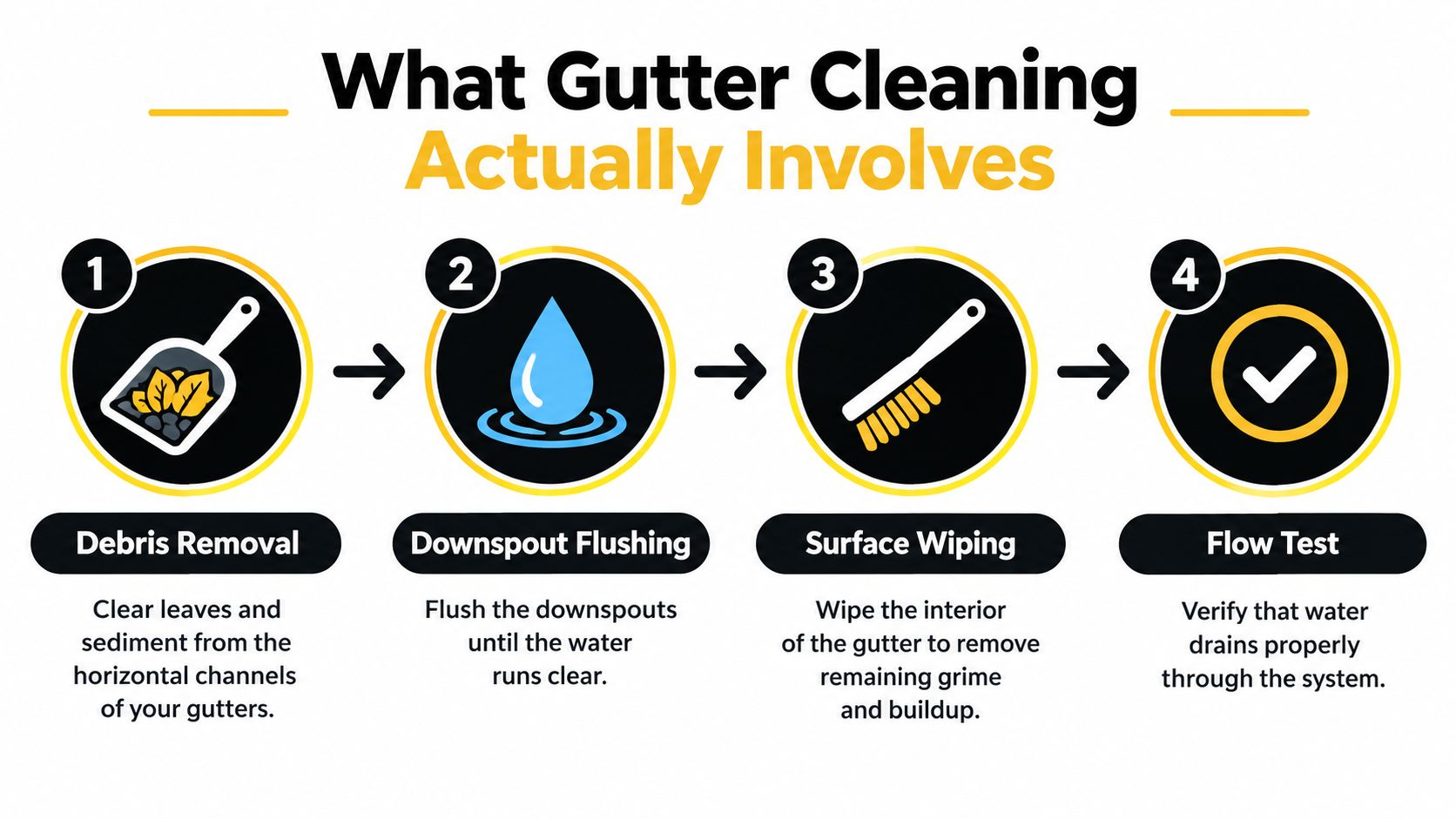
The work has four functional steps
-
Debris removal clears leaves, needles, sediment, roof granules, and compacted material from the horizontal gutter channel. Removing the visible debris restores the space needed for runoff to travel toward the outlet.
-
Downspout flushing checks whether the vertical path is open. A gutter can look clean while a blockage remains inside an elbow or lower section, so water should be run through the system until the outlet responds properly.
-
Surface detailing removes residue left behind after scooping and rinsing. This step helps reveal corrosion, separated joints, loose hangers, and standing water that debris may have concealed.
-
Flow testing confirms that water exits away from the structure rather than backing up, spilling over the front edge, or discharging against the wall.
A basic rinse isn't the same as functional verification. Cleaning removes obstructions, but it won't correct inadequate slope, damaged hangers, undersized outlets, corroded sections, or fascia damage. Those conditions should be documented separately so the owner can decide whether to repair, replace, or monitor them.
For a useful example of how a family-run exterior team approaches related gutter work, review how our family-run team handles gutters. The helpful distinction is between clearing debris and identifying a drainage defect that requires a different scope of work.
The process can also include bagging or removing debris rather than leaving it on the ground, checking roof-edge flashing where accessible, and noting discharge extensions that terminate too near the foundation. A dependable professional gutter cleaning visit should leave you with a clearer understanding of both the gutter condition and the water path.
Three Critical Benefits of Clean Gutters
Clean gutters provide three practical protections in Colorado Springs: they direct water away from the structure, reduce winter drainage problems, and remove combustible debris that can help carry wildfire embers. They do not make a property immune to damage, but they reduce exposures an owner can address.
Foundation drainage
Controlled runoff protects more than the roof edge. When needles, leaves, or sediment reduce the channel, rain can back up or spill over. The result may include wet siding, eroded soil, and saturated ground beside the foundation. Gutters and downspouts help limit that foundation-area saturation when they remain open and discharge water away from the wall.
A flow test can reveal defects that debris removal will not correct. A sagging run, separated joint, blocked outlet, or discharge point aimed at the wall can still leave the system performing poorly after cleaning. A dependable service should separate cleaning, inspection, and repair, so the owner knows whether the next step is clearing, maintenance, or a different scope of work.
For broader context on protecting exterior systems, see this guide to how clean gutters protect more than just your roof. Severe weather also warrants a wider check than the most obvious blockage. While this example describes a post-storm roof check for Florida homes, the same principle applies to Colorado hail and wind events: inspect connected roof and drainage components before assuming the problem is limited to visible debris.
Winter performance
Colorado's cold conditions make trapped water a practical concern. Debris that holds moisture at the roof edge can contribute to freezing complications, while restricted channels leave less room for runoff as snow and ice melt. Clear passages cannot guarantee that ice dams will not form, but they remove one avoidable obstruction from the drainage path.
Ember-fuel reduction
The wildfire benefit matters most around homes beneath pine trees or near dry vegetation. Dry needles in a gutter or along the roof edge can catch embers, exposing fascia and roof decking to heat and flame. Cleaning should cover the channel, corners, outlets, and reachable roof-edge debris. Bag and remove the material rather than leaving it beside the structure.
Gutter cleaning is one part of wildfire mitigation, not a complete fire-safety plan. Pair it with attention to roof materials, vents, vegetation, fences, decks, and other combustible exposures.
DIY Gutter Cleaning Versus Hiring Professionals
The right choice depends less on confidence than on access. A trained homeowner may be able to handle a low, accessible section from firm ground with suitable equipment, but height, slope, wet surfaces, repeated reaching, and unstable landscaping quickly change the risk.
The U.S. Consumer Product Safety Commission data summarized by Sacramento Gutter Guard describes ladder-related injuries treated in emergency departments as numbering in the hundreds of thousands annually in the United States. The same industry summary states that fractures represented 46% of ladder-fall injuries treated in emergency rooms. That doesn't predict what will happen at one property, but it shows why ladder work deserves more respect than a quick household chore.

Where DIY can make sense
A homeowner might consider doing the work when all of the following are true:
- Access is simple: The building is low enough for stable access, with firm, level footing and no need to lean the ladder against the gutter.
- The weather is suitable: The surface and ground are dry enough to reduce slipping and shifting.
- The task is limited: The owner can clear debris without overreaching, carrying awkward tools, or stepping onto a fragile roof.
- The outcome can be checked: Each downspout can be flushed and the discharge path observed from a safe position.
If any of those conditions fails, stopping is the sensible decision. A telescoping tool or gutter vacuum may reduce ladder exposure, but it doesn't automatically reveal loose hangers, poor slope, hidden blockage, or damaged fascia.
Where professional service earns its place
Qualified crews bring access planning, tool control, and a repeatable inspection process. OSHA guidance recommends selecting equipment appropriate to the task, inspecting ladders, training workers, and using alternative equipment for sustained high-altitude work. It also specifies that portable ladders should extend at least 3 feet above a landing and be secured to a rigid support when feasible, as outlined by the CDC and NIOSH construction fall guidance.
For high-altitude work, fall protection demands thorough planning. OSHA rules require personal fall-arrest systems to be rigged so an employee cannot free-fall more than 6 feet, or 1.8 meters, and call for suitable anchorages, equipment inspection, training, and prompt rescue capability under its fall-protection requirements.
Business owners and property managers should also understand the insurance and worker-protection considerations involved in exterior maintenance. A resource on tools and workers comp for cleaners offers useful background when evaluating a service provider's operational responsibilities.
When to Schedule Gutter Cleaning Services
A fixed calendar rule doesn't fit every Colorado Springs property. Tree density, pine-needle exposure, roof complexity, recent storms, and the results of previous flow checks provide better scheduling signals than an automatic appointment pattern.
The National Weather Service lists a maximum annual precipitation total of 27.58 inches in 1999 and a minimum of 6.07 inches in 1939 in its Colorado Springs climate records, based on records extending back to 1895 and climate normals for the 1991–2020 period. That variation, documented in the Colorado Springs climate records, supports a weather-aware maintenance plan rather than a rigid assumption about runoff.
Use the property as your schedule
- Inspect after major storms: Look from the ground for overflow, hanging debris, displaced sections, or a downspout that no longer appears to discharge correctly.
- Watch tree exposure: Evergreen branches near the roof can create recurring needle buildup that needs attention when the channel becomes compacted, not only when broadleaf leaves fall.
- Check roof complexity: Multiple valleys, long runs, and several outlets create more places for debris and blockages to hide.
- Respond to warning signs: Standing water, sagging runs, stained fascia, overflowing channels, and discharge close to the wall all justify prompt evaluation.
A seasonal visit can be useful, but it should be adjusted after each service. If the technician finds little accumulation and confirms good flow, the next interval may differ from a property that repeatedly collects dense needle mats. This guide to the best time for gutter cleaning can help homeowners think through seasonal triggers without treating a generic schedule as a guarantee.
Making the Right Choice for Your Property
The decision becomes clearer when you separate three questions. Can the gutters drain? Is the roof edge free of dry combustible debris? Can someone complete the work without unreasonable fall exposure? A yes to the first question doesn't answer the other two.
For a low home with stable ground, limited debris, and a homeowner who understands safe ladder positioning, DIY maintenance may be reasonable. Height, steep pitch, wet conditions, electrical hazards, fragile roofing, complex rooflines, or commercial buildings shift the balance toward qualified personnel.
Professional service should still have a defined scope. Ask whether the visit includes channel clearing, downspout flushing, flow verification, debris removal, and notes about damaged sections. Cleaning won't repair a separated joint or replace a failing hanger, but a careful technician can identify those problems before they become hidden behind more debris.
Good maintenance separates prevention from repair. You should know what was cleaned, what was tested, and what needs a different trade or service.
For Colorado Springs properties, gutter cleaning supports foundation drainage, winter runoff management, and ember-fuel reduction. It belongs in the same practical maintenance conversation as roof inspection and exterior cleaning, not in the category of cosmetic chores that can be ignored until the next storm.
Cultivate House Detailing provides gutter cleaning and fire-mitigation clearing for homes and businesses in Colorado Springs and nearby communities, including debris removal, rinsing, detailing, and inspection for visible damage. Visit Cultivate House Detailing to request a quote and schedule service that can also include residential or commercial window cleaning, screens, and other exterior maintenance.