The calls usually start the same way. A property manager in Colorado Springs wants the building to look festive before the holiday rush, but they don't want staff on ladders, extension cords draped where tenants walk, or a display that looks tired by mid-December. They want the property to stand out, and they want the process handled without creating a maintenance problem.
That's what makes commercial holiday light installation different from hanging a few strands at home. On a retail center, office building, restaurant, or mixed-use property, the display has to support the brand, hold up in winter weather, and fit the realities of access, tenant schedules, and liability. A good result looks cheerful. A professional result also stays secure, powers reliably, and comes down cleanly after the season.
In Colorado Springs, that balance matters. Wind, early snow, freeze-thaw cycles, and varied building materials all affect how lights should be designed and attached. The right plan protects both the appearance of the property and the people who use it every day.
Your Guide to Commercial Holiday Lighting in Colorado Springs
A week before the holiday rush, a retail center manager usually has the same question. How do we get the property looking festive without pulling maintenance staff off core work, adding slip-and-fall exposure, or ending up with half the lights out by the second weekend in December?
That question gets to the core value of commercial holiday lighting. On a commercial site, the display is part marketing asset, part seasonal operations project. It affects curb appeal, tenant satisfaction, after-dark visibility, and the amount of time your team spends dealing with outages, cords, timers, and post-season cleanup.
In Colorado Springs, those decisions carry real cost implications. Wind, snow, freeze-thaw cycles, and varied building surfaces can shorten the life of low-grade materials and create repeat service calls if the system is not planned correctly. A professionally managed installation helps control total cost of ownership by reducing rework, limiting disruption, and keeping liability with trained, insured crews instead of in-house staff.
For many properties, the business case is straightforward. A clean, reliable display supports the customer experience during a high-traffic season. It also gives property managers a predictable scope, a defined install window, and one point of accountability if something needs attention.
Start with the property's operating reality
The strongest projects begin with site conditions and management goals, not product catalogs. A shopping center with evening foot traffic has different priorities than a medical office, hotel, restaurant, or multi-tenant office building. Budget matters, but so do access restrictions, tenant hours, parking flow, snow removal routes, and who will respond if a section goes dark.
A workable plan usually includes four decisions:
Site review
Confirm rooflines, entry features, outdoor features, power access, and areas where installation could affect traffic or daily operations.Display scope
Choose where lighting will create the most visual return, such as roof edges, trees near entries, monument signs, columns, or common areas.System choices
Match LEDs, cords, attachment products, controls, and layout to the building materials, exposure, and service expectations for the season.Service approach
Set installation timing, maintenance response, takedown dates, and storage responsibilities before work starts.
Why this matters beyond appearance
Holiday lighting can help a property get noticed, but the bigger win is consistency. A display that turns on reliably every night and stays intact through winter weather reflects well on the businesses inside. It also protects your team from handling ladders, temporary wiring, and rushed repairs during the busiest part of the season.
Physical presentation also supports broader visibility efforts. If your team is working on both curb appeal and search presence, guidance on local SEO services can help connect how the property looks on-site with how local customers find businesses online.
The best commercial displays in Colorado Springs are usually the ones that feel planned. They fit the architecture, hold up through the season, and do their job without creating extra work for the property team.
Designing a Display That Delights Customers and Meets Goals
The design phase is where commercial holiday light installation either becomes a controlled project or a costly guessing game. A professional crew doesn't start by asking how many boxes of lights you want. They start by measuring the site, identifying constraints, and matching the display style to the property's purpose.
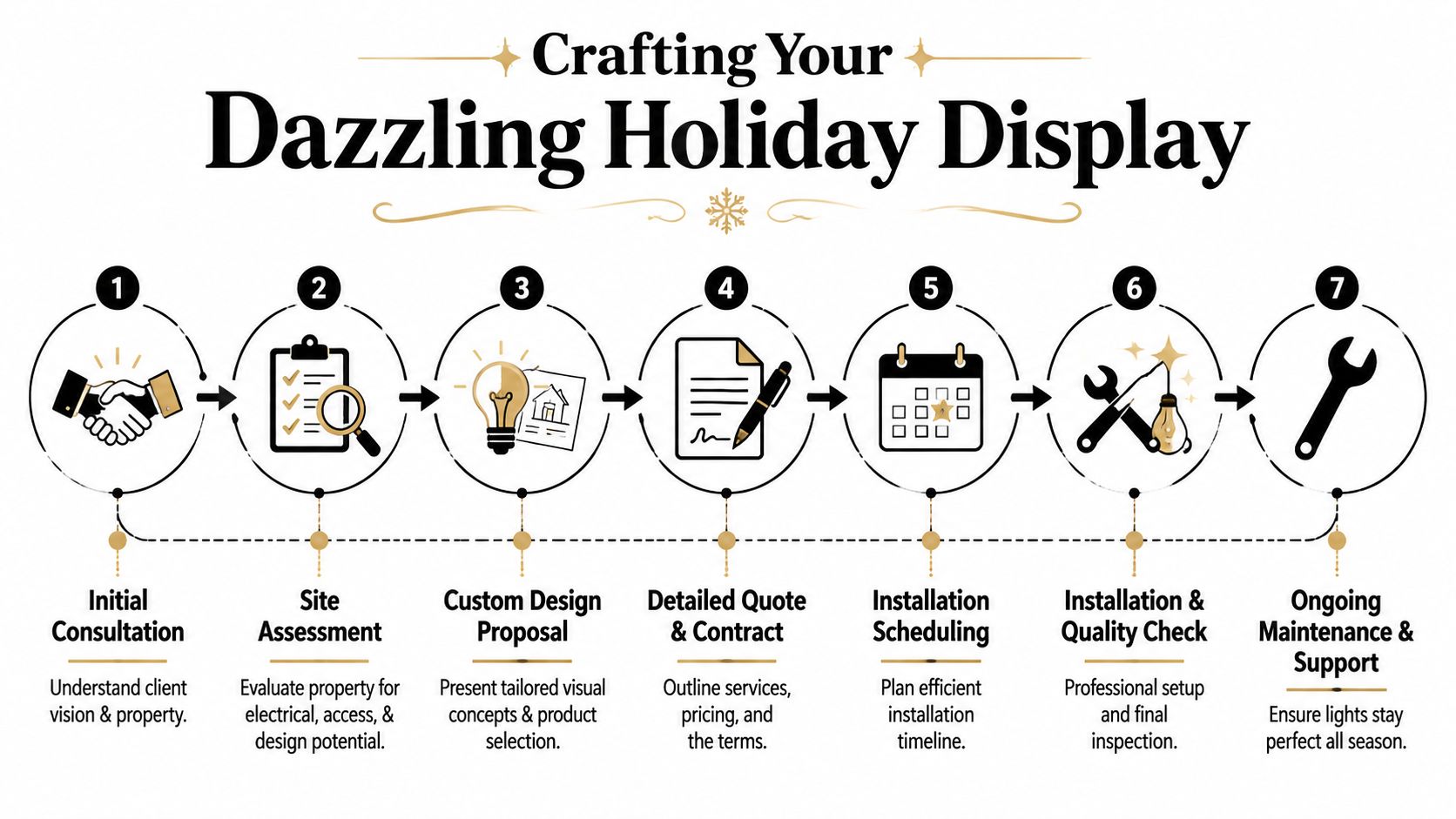
What a real site audit looks like
A useful quote is built from measurable scope. Installer guidance recommends budgeting roughly 1 to 3 minutes per linear foot for rooflines, 8 to 12 minutes per string for outdoor mini-lights, and planning takedown at about 25% of installation labor (installer quoting workflow benchmarks). That kind of workflow changes the conversation from “What do you think this will cost?” to “Here's what this property requires.”
A thorough walk-through usually accounts for:
- Roofline footage for eaves, peaks, parapets, and entry canopies
- Outdoor features such as trees, shrubs, columns, railings, and monument signs
- Access conditions including ladder moves, lift requirements, roof pitch, and pedestrian traffic
- Power locations so circuits, extension paths, and timer placement are planned cleanly
That structure is why commercial quotes vary so much. Two buildings with similar frontage can require very different labor if one has easy ground access and the other needs repeated repositioning around signage, planters, or tenant storefronts.
Design choices that work on commercial sites
Commercial properties usually benefit from restraint. Clean roofline outlining, wrapped trunks at entrances, and a few focal points often outperform cluttered displays. Customers notice balance. They also notice when one side of a property looks finished and another looks like it ran out of budget.
A practical design review should answer a few questions:
| Design question | Why it matters |
|---|---|
| What should people notice first? | Entry features and main facades should lead the design |
| Where does the property get seen at night? | Street-facing elevations usually deserve priority |
| What must stay clear? | Signs, cameras, drains, and service doors can't be blocked |
| What can crews maintain easily? | High-failure decorative elements create avoidable service calls |
Practical rule: If a feature is hard to access and easy to ignore from the street, it usually doesn't belong in the first draft of the design.
DIY works at home because the standard is personal. On a commercial property, the standard is public, repeatable, and tied to your reputation.
That's the main trade-off. A do-it-yourself approach may look cheaper at the start, but it often skips the measured planning that keeps the display consistent, serviceable, and safe across the full season.
Why Professional Installation is a Smarter Business Investment
A commercial property manager usually isn't deciding between “lights” and “no lights.” Instead, the decision is between a managed seasonal program and a string of small risks that land on staff time, tenant relations, and maintenance headaches.
The cheapest approach on paper often pushes hidden costs into other parts of the operation. Someone has to source materials, test strands, figure out attachment methods, schedule installation, handle outages, and remove everything later. If that work falls to in-house staff or a general handyman, the line item may look smaller, but the exposure gets wider.
Where the real value shows up
Professional installation protects value in ways that aren't obvious from a basic bid.
- Safer execution means the work is planned around access, weather, and occupied spaces.
- Cleaner presentation helps the display look intentional instead of pieced together.
- Less operational drag keeps your team focused on tenants, customers, and seasonal business demands.
- Faster problem resolution matters when a visible outage hits the front facade during peak season.
That matters even more on multi-tenant and customer-facing properties. A poor display doesn't just look uneven. It signals lack of attention.
Why outsourcing can be the better management decision
Property teams already outsource specialized work that carries risk or requires dedicated process. Holiday lighting belongs in that category. If you think about it the same way many owners think about outside expertise for other business functions, guidance on marketing outsourcing for small business offers a useful parallel. The point isn't that internal teams can't do the work. It's that not every task belongs on their plate.
A professional installer should be handling details such as:
Scope definition
What areas are included, and what's intentionally excluded.Electrical planning
Not in engineering jargon, but in clear terms about what can run where and why.Install sequencing
So entrances, parking patterns, and tenant access aren't disrupted more than necessary.In-season service
Because weather and wear don't care whether your maintenance team is already overloaded.
A polished display is the visible result. Risk reduction is the service you're actually buying.
For most commercial owners, that's the smarter investment. You're not paying someone just to hang lights. You're paying for a controlled outcome.
Managing Safety, Permits, and Electrical Requirements
A property manager usually notices the risk side of holiday lighting before the design side. One icy morning, a loose run starts swinging over a storefront entrance, a timer trips a circuit, or a cord ends up where customers cut across the sidewalk. At that point, the issue is no longer holiday decor. It is site safety, tenant experience, and liability control.
That is why commercial installation standards have to be built around secure attachment, correct power planning, and controlled access to the work area.
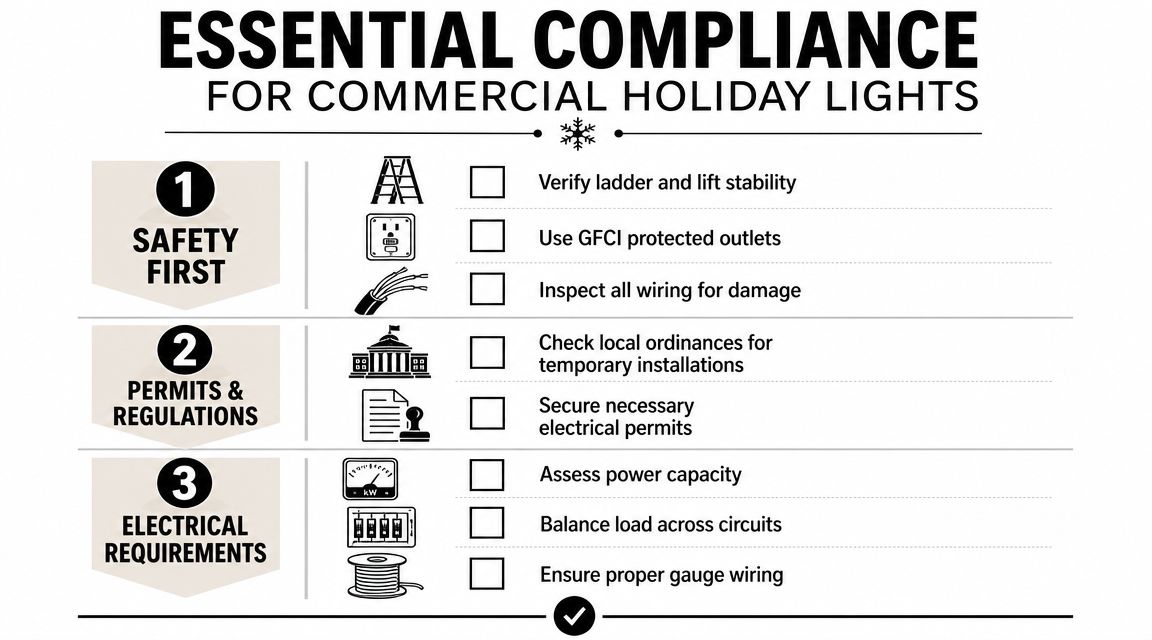
What the crew is checking before lights go up
Each building presents a different risk profile. A brick storefront raises questions about attachment points and how to avoid stressing mortar. Stucco requires methods that do not chip the finish or leave repair scars after takedown. Metal fascia can handle clean, straight runs, but only if the clips hold firm in wind and do not rub the surface all season.
Good crews assess more than appearance. They look at where people walk, where cords can be routed without creating trip hazards, where wind exposure will stress a connection, and how service calls would be handled if a section goes dark in December.
Falls are a major exposure on this type of work, especially on uneven winter surfaces and around rooflines. Property managers should expect a contractor to address access methods, crew training, and site controls with the same seriousness they bring to the display itself. A basic review of contractor fall safety risks helps frame why that matters from an insurance and vendor-selection standpoint.
Electrical planning in plain language
Commercial clients do not need a code seminar. They need to know the display will run reliably and stay within the limits of the available exterior power.
That starts with a site check. The installer should identify where power is coming from, whether the circuits are suitable for the planned load, how far cord runs will travel, and whether outdoor protection such as GFCI outlets is already in place where needed. Older buildings, long facades, and multi-zone displays usually take more planning because a layout that looks simple on paper can create nuisance trips or awkward service access once it is live.
A weak electrical plan increases total cost of ownership. Crews spend more time troubleshooting, outages stay visible longer, and property staff end up fielding tenant complaints during the busiest part of the season.
If a quote does not mention power sources, attachment approach, or site access limits, it is not detailed enough for a commercial property.
Permits are not required on every holiday lighting project, but they can come into play when the scope goes beyond temporary decorative installation. Electrical modifications, unusual mounting conditions, and certain site-specific property rules can all trigger additional review. The practical approach is to inspect first, confirm the scope, and clear any questions before the install date is on the calendar.
For Colorado Springs properties, it helps to review a provider's broader process for commercial holiday lighting services in Colorado Springs and ask direct questions about permit awareness, electrical checks, jobsite protection, and response time if weather knocks out part of the display.
The Right Equipment and Attachment Methods for Your Property
The quality of a commercial holiday light installation often comes down to two things most clients never see in the final photo. The first is access equipment. The second is how the lights are attached.
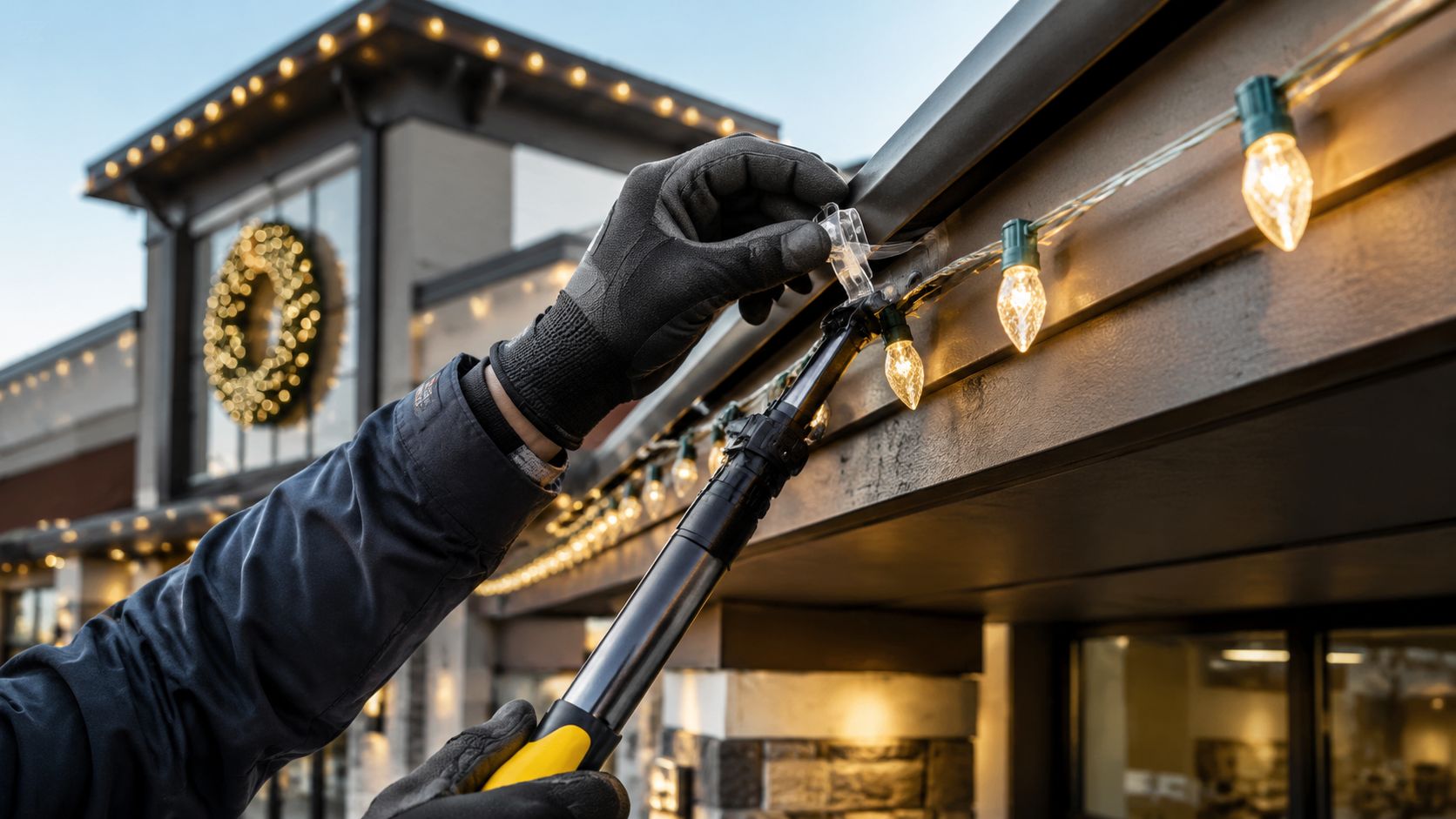
A single-story storefront with simple fascia may allow for fast ladder-based work. A taller facade, deep entry canopy, or tree line near customer walkways changes the equation quickly. Boom lifts, extension poles, stabilizers, and material-specific clips let crews work more precisely and reduce unnecessary contact with the building.
Why the attachment method matters
The wrong fastener can turn a seasonal display into a repair issue. On stucco, crews should avoid methods that crack the finish or leave ugly holes. On painted wood trim, overly aggressive staples or nails can create paint failure and moisture entry. On brick, attachment planning has to respect the surface and keep the run straight without forcing awkward tension points.
A few examples of what good practice looks like:
- Stucco facades usually need non-invasive attachment methods that hold securely without puncturing the finish.
- Metal edges and gutters often work better with clips designed for the profile, not improvised hardware-store solutions.
- Wood trim and fascia require fastening that stays neat and removes cleanly at season's end.
- Trees and outdoor features need ties and wraps that stay orderly and don't choke growth points or create a tangled removal job.
That equipment choice also affects worker safety. If you want context on the broader exposure involved with height-based trade work, this overview of contractor fall safety risks is useful background for understanding why access planning matters.
What property managers should ask to see
A professional quote should make it clear how the crew expects to reach the work and how the display will be secured. If the answer sounds improvised, that's a warning sign.
Ask for specifics such as:
| Question | What a good answer sounds like |
|---|---|
| How will you reach the upper facade? | Clear mention of ladders, poles, or lift access based on the site |
| How will lights attach to this surface? | Material-specific clips or fastening methods |
| How do you avoid damage at removal? | A defined removal process, not “we'll figure it out” |
| What happens after wind or snow? | A service process for inspection and correction |
Some providers, including Cultivate House Detailing, also offer seasonal lighting work as part of a broader exterior service operation. That can be helpful when the same team already understands commercial building access, presentation standards, and care around visible surfaces.
A short look at professional installation technique helps show why the details matter:
Understanding Pricing, Contracts, and Seasonal Service
Commercial holiday lighting gets easier to evaluate once you know how the pricing is built. Most confusion comes from comparing a simple install quote with a true seasonal service contract. They aren't the same thing.
Professional installation is commonly priced at $2.50 to $7 per linear foot including materials and labor, while full-service packages that bundle installation, takedown, and rental can range from $400 to over $1,800 depending on project scale (commercial holiday lighting pricing ranges). Those ranges are helpful as a starting point, but the key question concerns what the contract includes.
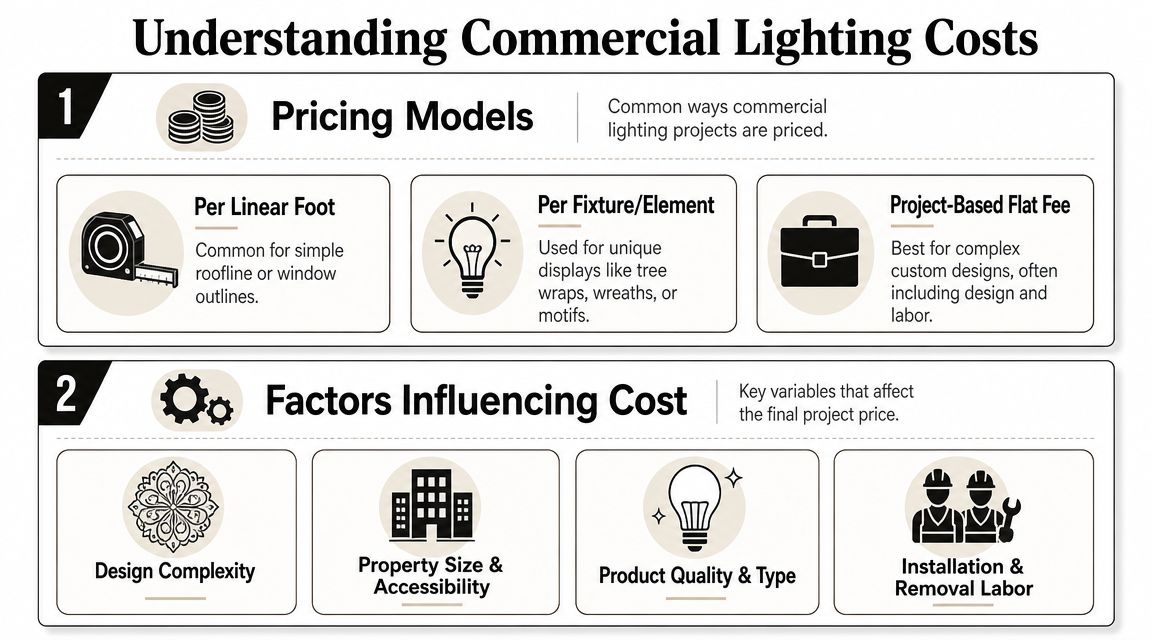
The main pricing models
You'll usually see a few structures in the market:
Per linear foot
Common for rooflines, windows, and other straightforward outlines.Per element or feature
Used for tree wraps, wreaths, garlands, poles, and specialty décor.Project-based seasonal contract
Often the clearest option for commercial properties because it bundles service into one managed scope.
The best fit depends on the property. A small, simple storefront may price cleanly by footage. A site with multiple elevations, landscaping, signage features, and ongoing support needs usually makes more sense as a seasonal package.
What should be in the contract
A commercial agreement should remove ambiguity. If it doesn't, you're likely to pay for that later in delays, change orders, or finger-pointing when something fails.
Look for these points in writing:
- Scope of installation with exact building areas, outdoor zones, and décor elements included
- Service terms for outages, weather-related corrections, and who to contact during the season
- Takedown timing so removal doesn't drag into late winter
- Storage or rental terms that explain who owns materials and where they live off-season
- Site access assumptions including work hours, lift needs, and restrictions around tenants or customers
The cheapest quote often excludes the very items that make the season run smoothly.
If you're budgeting this year's project, it helps to compare line items against a more specific professional Christmas light installation cost guide so you can see how scope affects final pricing.
A good contractor won't rush this conversation. Pricing transparency is part of the service.
Light Up Your Business This Season with Cultivate House Detailing
For a commercial property, holiday lighting should do more than look festive for a few weeks. It should help the site feel active, cared for, and welcoming during a busy season. Just as important, it should happen without creating extra strain on your staff or exposing the property to avoidable risk.
The long-term lens matters here. For commercial clients, total cost of ownership over 3 to 5 seasons is a key metric, including installation, takedown labor, storage, maintenance callbacks, and the energy savings that come with commercial-grade LEDs (holiday lighting total cost of ownership). That's why many property managers prefer a full-service arrangement. It turns a seasonal project into a more predictable operating expense.
Questions property managers ask before signing
How early should we schedule commercial holiday light installation?
Earlier is better, especially if the property has multiple buildings, tenant coordination needs, or limited install windows. Early planning gives more room for design decisions and cleaner scheduling.
What happens if part of the display goes out during the season?
That should be covered in the service terms. Before signing, ask who handles mid-season repairs, how requests are submitted, and what the process is after wind or snow affects the display.
Should we buy lights or use a service model?
That depends on how much internal storage, maintenance attention, and material management your team wants to own. Many commercial clients prefer a managed seasonal program because it reduces internal handling.
What liability questions should we ask?
Ask about worker coverage, certificates of insurance, site protection practices, and whether the installer has a clear plan for work at height, occupied spaces, and electrical safety.
What a good commercial partner should provide
The right provider should be able to speak clearly about design, access, safety, service, and removal without leaning on vague promises. Commercial clients don't need a sales pitch. They need a team that can make the property look sharp and keep the season manageable.
For businesses in Colorado Springs, Monument, Woodland Park, Manitou Springs, and nearby areas, that means choosing a contractor who understands local weather, visible curb appeal, and the operational realities of occupied commercial sites.
If you're planning a seasonal display for a storefront, office, restaurant, or multi-tenant property, Cultivate House Detailing is one local option to consider for exterior services and holiday lighting in the Colorado Springs area. Reach out to request a quote, review your property layout, and get clear guidance on scope, timing, and seasonal service.
Prefer to leave it to a professional? Cultivate House Detailing offers holiday lighting installation in Colorado Springs. Get a free quote.
Serving Woodland Park and the surrounding Colorado Springs area — see our window cleaning services in Woodland Park.