A lot of Colorado Springs homeowners end up in the same spot. The patio goes dark earlier than you'd like in winter, the front walk feels a little too dim after snow, and the house that looks sharp in daylight seems to disappear once the sun drops behind the mountains.
Good outdoor lighting fixes that, but only when it's planned for how people live here. Lighting colorado springs isn't just about making a home brighter. It has to handle wind, snow, hail, dust, HOA expectations, dark-sky rules, and in some neighborhoods, a real need to see and maintain defensible space around the home.
That matters for curb appeal, but it also matters for maintenance. Clean windows, washed siding, clear gutters, trimmed areas around the structure, and well-placed lighting all work together. If the lighting throws glare, spills into a neighbor's yard, or highlights the wrong parts of the property, the result looks off no matter how much work went into the exterior.
Homeowners usually start with one of three goals. They want a festive seasonal display, a permanent system they can use year-round, or outdoor lighting that makes paths, entries, and outdoor living spaces more usable after dark. Each one solves a different problem, and each one has trade-offs.
Brighten Your Colorado Springs Home Year-Round
One of the most common situations in Colorado Springs is a home that feels finished during the day but unfinished at night. The windows are clean, the entry is tidy, the stone and trim look great, but once evening hits, the property loses all that detail. The front porch feels flat, the walkway disappears into shadow, and the backyard stops being useful long before anyone is ready to go inside.
That usually starts the search for better lighting colorado springs options. Some homeowners want clean roofline lighting that works in every season. Others want holiday lighting that looks polished without spending a weekend on ladders. Some just want enough path and patio light to enjoy the yard without harsh glare.
A practical setup usually falls into three categories:
- Holiday lighting: seasonal, decorative, and designed to create a strong visual impact during celebrations.
- Permanent lighting: installed to stay in place and adjusted for everyday use, events, and holidays.
- Outdoor feature lighting: focused on paths, planting beds, architectural features, and outdoor living areas.
For homeowners who mainly want a polished seasonal look without handling installation and removal themselves, holiday lighting services in Colorado Springs are often the easiest fit.
What homeowners usually want most
The request often sounds simple. Make the house look better at night. In practice, that usually means balancing several goals at once.
Practical rule: The right lighting should help people move safely, make the home look cared for, and avoid drawing attention to the fixture itself.
In Colorado Springs, the smartest designs stay restrained. A clean roofline, a visible front entry, lit transitions on steps and walks, and soft accent lighting on landscaping usually outperform systems that try to flood the whole property with light.
What works better in this climate
High-altitude sun, sudden weather swings, and blowing debris are hard on exterior materials. Systems with exposed components, poor attachment methods, or fixtures placed where snow piles up tend to create maintenance headaches fast.
The better approach is a layout that serves the property year-round. It should look intentional in January, still feel useful in July, and support the rest of the home's exterior maintenance instead of fighting it.
Holiday vs Permanent vs Landscape Lighting
Most homeowners don't need more options. They need a clearer way to choose. The right system depends on what you want the lighting to do when you're not standing in the driveway admiring it.
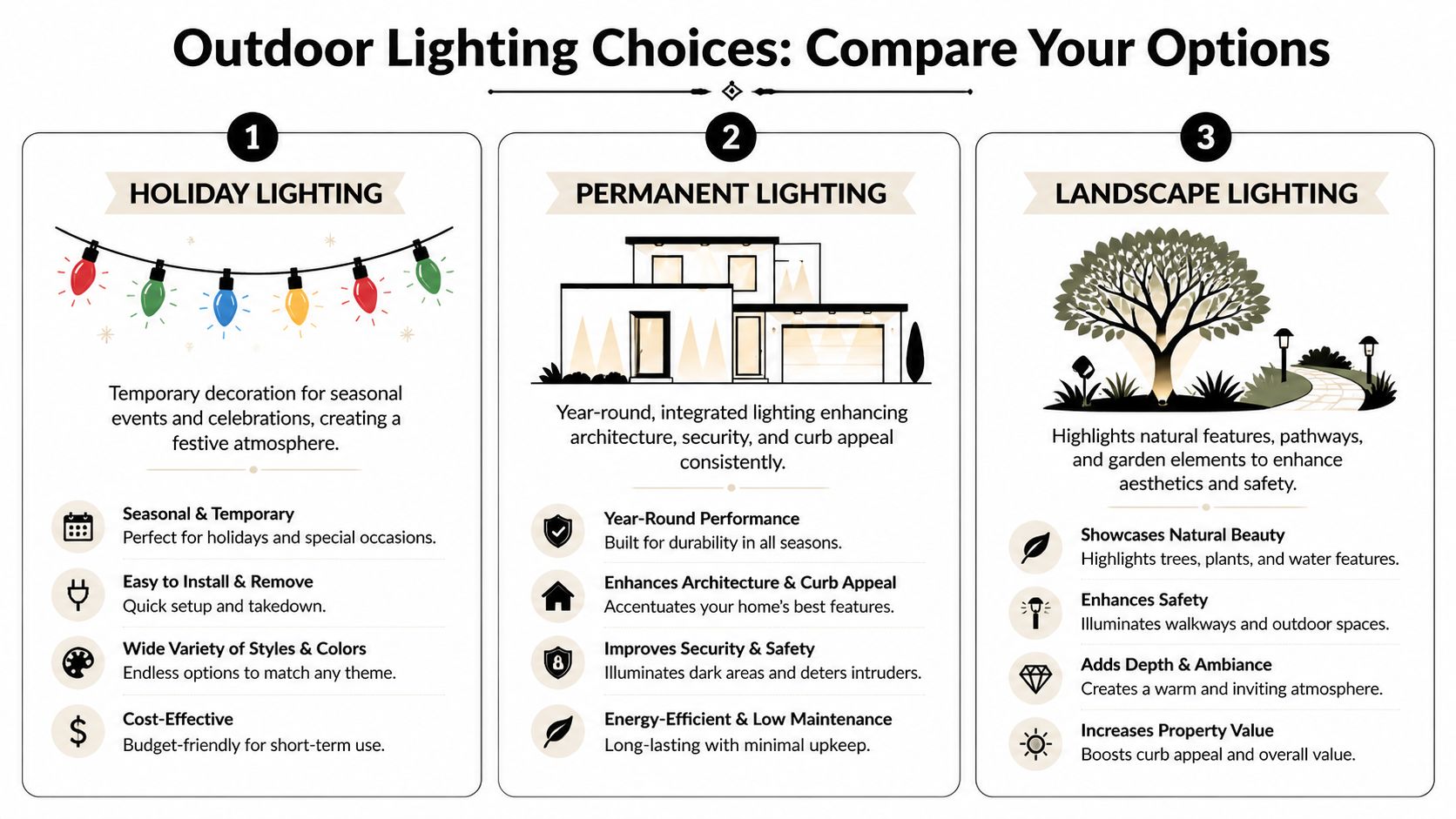
Outdoor Lighting Choices Compared
| Feature | Holiday Lighting | Permanent Lighting | Landscape Lighting |
|---|---|---|---|
| Primary use | Seasonal decoration | Year-round accent, security, and event lighting | Highlight paths, beds, entries, and yard features |
| Installation style | Temporary setup and removal | Fixed system integrated with the home | Fixture-based layout around the property |
| Visual effect | Festive and bold | Clean and flexible | Subtle and architectural |
| Best for | Homeowners who want a seasonal statement | Owners who want one system for daily use and holidays | Homes with walkways, patios, trees, and landscape features |
| Maintenance pattern | Seasonal service and storage | Occasional inspection and cleaning | Lens cleaning, aiming, and periodic adjustments |
| Flexibility | Strong during holidays, limited outside them | High flexibility across seasons and occasions | Best for consistent nightly use |
A lot of homeowners comparing systems end up looking closely at permanent lighting options because they want one installation that can shift from understated everyday lighting to holiday colors without starting over each year.
Holiday lighting fits one clear job
Holiday lighting is for people who want a strong seasonal look without making a permanent design decision. It works well for rooflines, peaks, wreaths, columns, and trees when the goal is celebration first.
The trade-off is obvious. It does one job very well, then comes down. If you're hoping the same setup will improve pathway safety in late winter or help define a patio in summer, temporary holiday lighting usually isn't the right tool.
Holiday lighting tends to make sense when:
- You love a seasonal display: The house becomes part of your holiday traditions.
- You don't want year-round hardware visible: Everything goes away when the season ends.
- You prefer a service model: Installation, takedown, and storage are often part of the appeal.
Permanent lighting solves the repeat problem
Permanent lighting is what many homeowners wish they had after a few years of seasonal installs. It stays in place, keeps the roofline and architecture crisp, and can usually be adjusted for normal evenings, parties, game days, or holiday themes.
Its strength is convenience. Once the system is installed correctly, the house is ready when you want lighting. No climbing, no staple damage, no rushed setup around weather windows.
A permanent system only looks premium if it's discreet in daylight. If you can spot every component from the street at noon, the design needs work.
That said, permanent lighting isn't ideal for every property. If the only goal is a few weeks of bold color at the end of the year, it can be more system than you need.
Landscape lighting changes how you use the yard
Outdoor lighting is usually less about spectacle and more about function. It helps people move through the property, frames the entry, adds depth to planting beds, and keeps patios from feeling cut off after sunset.
It's especially useful when the problem isn't the roofline at all. Maybe the walk to the front door is dark. Maybe the side yard gate is hard to see. Maybe outdoor seating feels disconnected from the house at night.
Outdoor illumination often works best for:
- Paths and grade changes: Safer movement after dark.
- Outdoor living areas: Patios, decks, and seating zones feel intentional.
- Architectural support: Stone, textures, and planting can complement the home instead of competing with it.
A simple way to decide
If your priority is holiday impact, choose holiday lighting. If you want flexibility all year, choose permanent lighting. If you want safer movement and a more usable yard, choose outdoor lighting.
Many properties eventually blend categories, but the first decision should be based on the main problem you're trying to solve, not the trendiest product.
Beyond Curb Appeal Lighting for Safety and Security
A guest pulls up on a January evening, the front walk is partly glazed over, and the step from the drive to the porch disappears into shadow. That is when outdoor lighting stops being decorative and starts doing real work.
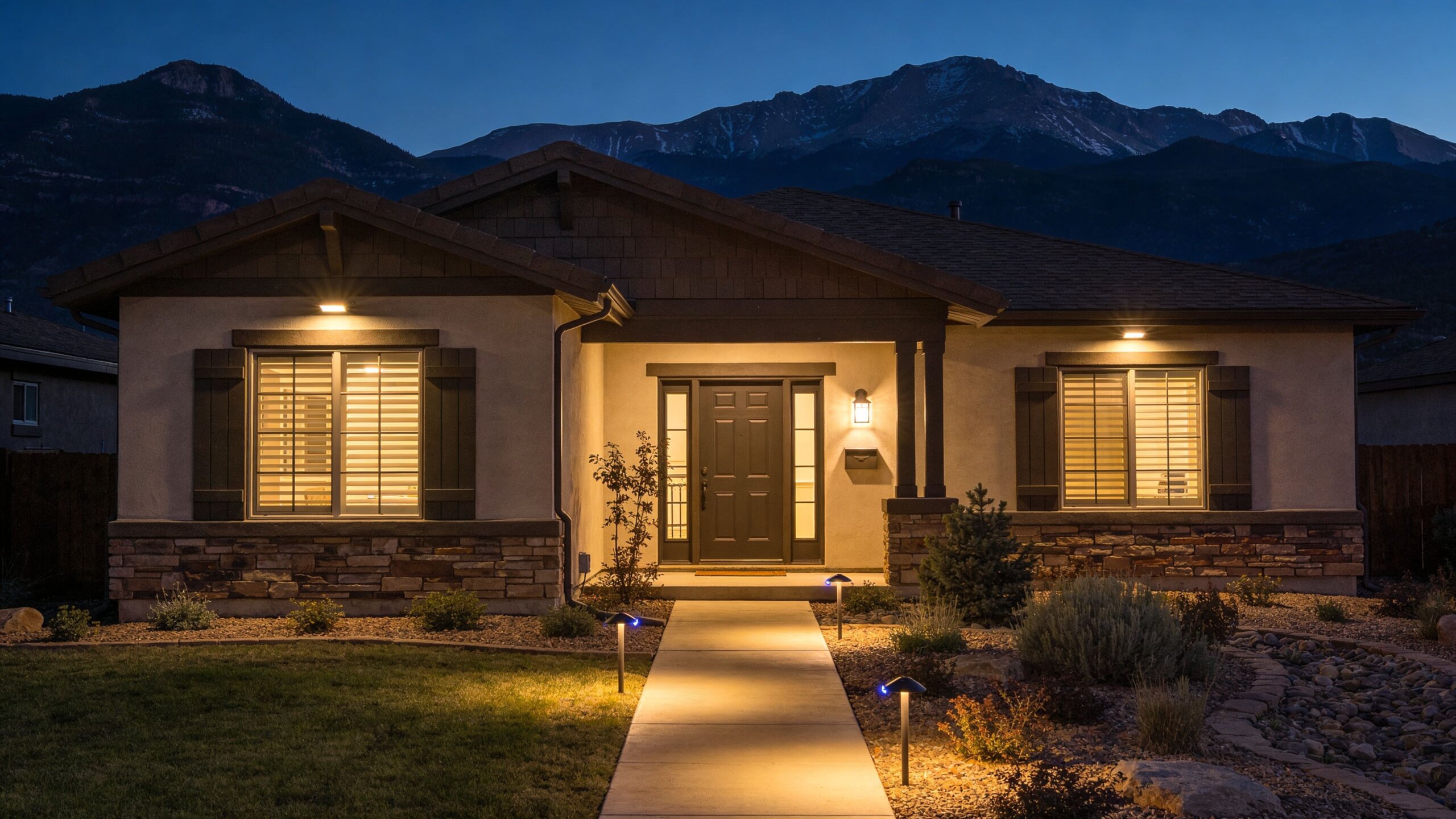
Colorado Springs homes deal with conditions that expose weak lighting fast. Freeze thaw cycles create slick edges at steps. Gravel walks shift. Grade changes look flatter than they are after dark. In foothills neighborhoods, homeowners also need to check gates, fence lines, and cleared areas without washing the whole property in glare.
Safer movement starts with the ground plane
The best safety lighting begins low, controlled, and intentional. It shows where a person should place a foot next, where the path bends, and where the elevation changes. That sounds simple, but fixture placement matters more than fixture count.
Entry lighting should let someone find the lock, read the threshold, and see any ice near the landing. Path lighting should reveal the walking surface, not create bright dots with dark gaps between them. Around patios and side yards, the goal is clear orientation, especially near gates, utility access, trash enclosures, and hose bibs that get used year round.
A few areas usually deserve priority:
- Front walk visibility: Helps guests and delivery drivers approach without guessing where the edge is.
- Steps and transitions: Reduces missteps during snow season and spring melt.
- Side-yard routes: Makes service areas easier to use after dark.
- Drive-to-entry connections: Improves the walk from parked car to front door.
Security lighting works better with control than with brightness
Flooding a house with harsh light often creates the opposite of security. Glare shrinks visibility, flattens depth, and leaves darker pockets outside the beam. A person standing at the window may see the reflection on the glass more than the yard beyond it.
Downward-focused fixtures usually do a better job. They keep the eye comfortable, make entries easier to monitor, and avoid the overlit look that can draw complaints from neighbors or HOAs. That matters here because Colorado Springs code and many communities expect exterior lighting to stay directed and restrained.
For homeowners collecting design inspiration, these landscape lighting ideas are useful because they show how subtle fixture placement can improve function without turning the yard into a spotlight display.
A short video helps show how effective outdoor lighting shapes a property after dark.
Fire-wise lighting matters in foothills communities
Homeowners in Black Forest, Peregrine, and other edge-of-city areas should plan lighting and fire mitigation together. Significant wildfires in the Pikes Peak region have made that practical connection hard to ignore. Good lighting helps homeowners inspect defensible space, check for buildup near fences and outbuildings, and move safely while handling routine maintenance after sunset.
This is also a maintenance issue. Fixtures buried in dense junipers or placed too close to dry seasonal growth can complicate trimming and cleanup. Lower-glare LED systems with careful aiming make it easier to see gutters, tree groupings, rock beds, and cleared perimeters without sending light upward or across the lot. In higher-risk areas, useful lighting supports inspection and upkeep first, then appearance.
Outdoor living feels safer when the space is clearly defined
People use outdoor areas more often when the edges are readable. A porch with a soft pool of light feels easier to enter. A patio with quiet perimeter illumination feels connected to the house instead of cut off from it. A backyard can stay calm and inviting without looking overlit.
That takes restraint. The smartest designs use enough light to guide movement, support visibility, and hold up to Colorado Springs weather, while still keeping the property comfortable at night.
Understanding Colorado Springs Lighting Codes and HOAs
A lighting plan can pass the eye test and still fail the review board. That happens in Colorado Springs more often than homeowners expect, especially in neighborhoods with strict architectural control and in areas where dark-sky standards are taken seriously.
The local code shapes more than fixture selection. It affects beam spread, mounting height, shielding, efficiency, and how much light can leave your property. In foothills and edge-of-city neighborhoods, those details matter even more because glare carries farther in thinner, clearer air and stands out against darker surroundings.
What full cutoff actually requires
Colorado Springs requires full cutoff light fixtures for exterior lighting. Under the city's code, no more than 10% of emitted lumens can be detected at angles exceeding 80 degrees from vertical, and no more than 2.5% at angles exceeding 90 degrees from vertical. The same code also requires exterior fixtures to produce at least 80 lumens per watt under the Colorado Springs outdoor lighting regulations.
In practice, that means the fixture needs to put light down on steps, entries, and usable surfaces instead of up into the sky or across the fence line. Homeowners usually notice the benefit right away. Lower glare makes the house easier to look at and easier to move around.
Older decorative fixtures are often the problem. They may fit the style of the home, but if the lamp is exposed or the shielding is weak, they create hot spots, eye strain, and neighbor complaints.
Code usually pushes the design in the right direction
A well-controlled system tends to look better here. It also holds up better under scrutiny from neighbors, HOA boards, and city reviewers.
The practical gains are straightforward:
- Less glare at eye level, which helps on stairs, walks, and drive approaches.
- Less spill into adjacent lots, which matters on tighter suburban parcels and larger custom-home sites alike.
- A cleaner nighttime appearance, because the light effect looks intentional instead of scattered.
- Better dark-sky alignment, which many Colorado Springs communities care about even when the HOA language is stricter than city code.
I tell homeowners the same thing during design reviews. If the brightest thing you see is the fixture itself, the system is usually aimed wrong or specified wrong.
Residential rules and HOA standards both matter
Residential exterior lighting standards used in local design guidelines typically call for fixtures that are shielded, directed downward, and limited in output. They also describe how light trespass is checked at the property line, with the reading taken a few feet above grade using a light meter aimed toward the source.
That testing method explains why small aiming errors create big problems. A fixture mounted a little too high, or tilted up for more “coverage,” can push light where it should not go. In Colorado Springs, that often shows up on second-story windows, alley-facing garages, and lots that back to open space.
HOAs often add another layer. Many neighborhood guidelines address fixture finish, color temperature, exposed wiring, visibility from the street, timer use, and how long seasonal or accent lighting can stay active. Some boards care just as much about daytime appearance as nighttime performance.
Where approvals usually get stuck
Approval problems usually come from predictable mistakes:
- Decorative fixtures with poor shielding
- Upward aiming that creates glare or sky glow
- Color temperatures that feel too harsh for the neighborhood
- Visible hardware or sloppy wire runs
- Plans submitted without checking both city rules and HOA requirements
This is one place where local experience saves time. A good installer knows how to choose fixtures that meet code, satisfy the neighborhood, and still make the house look right after dark. That same discipline matters on commercial work too, especially for owners comparing the best lighting for retail stores with what local code will allow.
The smart approach is simple. Start with compliant, downward-controlled fixtures. Match the finish and scale to the house. Keep the hardware discreet. Then aim and test the system on site, because paper approval does not guarantee good results once the lights turn on.
Professional Lighting for Local Businesses
Commercial properties don't get judged one detail at a time. Customers notice the whole experience at once. They see the storefront, the glass, the sign, the parking area, the walkway, and the general sense of whether the place feels open, maintained, and easy to approach after dark.

That makes lighting colorado springs a practical business decision, not just a cosmetic one. Retail stores, restaurants, office buildings, and dealerships all rely on visibility. If the facade is dim, the windows are streaked, or the fixtures are clouded with buildup, the property looks less inviting before a customer ever reaches the door.
Clean glass and clean light belong together
A well-lit storefront shows dirt fast, but that's not a reason to avoid lighting. It's a reason to coordinate maintenance better. Exterior window cleaning, fixture cleaning, and lighting upgrades should support the same goal: make the property easier to see and easier to trust.
For commercial properties in Colorado Springs, full cutoff fixtures are mandatory, and local commercial energy costs rose 15% in 2025, which has pushed many businesses toward LED upgrades according to the city code context for commercial lighting compliance. That's also where a smart maintenance bundle helps. Removing hard-water buildup from fixtures during window cleaning can improve light output and help the site perform the way it was designed to.
What business owners should prioritize
Commercial lighting should do more than make a building visible from the street. It should support movement, reduce visual confusion, and make the property look maintained during business hours and after close.
Strong priorities usually include:
- Entry clarity: Customers should understand where to go immediately.
- Facade presentation: Clean lines, readable signage, and balanced light.
- Operational safety: Better visibility around walks, doors, and service zones.
- Durability: Fixtures and placements that hold up in exposed conditions.
If you're comparing broader retail design approaches, this guide to the best lighting for retail stores is a helpful outside reference because it shows how fixture choice changes customer perception inside and out.
A business doesn't need more brightness everywhere. It needs the right brightness at the customer touchpoints that shape first impressions.
Where the service pairing makes sense
This is one place where a maintenance company can be useful beyond one task. Cultivate House Detailing handles exterior window cleaning and seasonal permanent lighting services, which means the glass, visible fixtures, and nighttime presentation can be handled as part of the same property care conversation.
That matters for shopping centers, offices, and dealerships where one neglected element can drag down the whole frontage. Clean windows under poor lighting still underperform. New lighting around neglected glass does the same.
The Cultivate Installation Process from Design to Delight
A Colorado Springs lighting project usually starts with a simple concern. The front walk disappears after sunset, the roofline looks flat at night, or the backyard feels unusable once the sun drops behind the mountains. Homeowners also want to know what the work will look like in daylight, how long crews will be on site, and whether the finished system will create problems with HOA rules, dark-sky expectations, or exposure in wind, hail, and snow.
A good process answers those questions before installation day.
Step One: Defining the Project's Purpose
The first design conversation should identify how the property needs to function after dark. One home may need clearer path lighting from the driveway to the entry. Another may need low-glare patio lighting for evening use, or subtle architectural lighting that gives the house definition without washing out the block.
That distinction matters in Colorado Springs. More output is not always better. In foothills neighborhoods and exposed lots, too much light can create glare, shine into neighboring property, and make the home feel harsher instead of safer.
Useful design questions include:
- Where does the family move at night?
- Which features deserve attention, and which should stay in the background?
- Does the system need to support everyday use, seasonal lighting, or both?
- Are there HOA expectations, dark-sky limits, or fire-mitigation concerns that affect fixture choice and placement?
Layout, equipment, and code need to match
The layout should be built around Colorado Springs conditions, not copied from a Pinterest board. Fixtures need to be shielded, aimed carefully, and selected with local standards in mind, as noted earlier in the article. The beam spread matters. Color temperature matters. Mounting height matters.
So does maintenance.
For example, lighting tucked too tightly into mulch beds can become a problem in dry areas where defensible space and cleanup matter. Fixtures placed where snow piles up or where irrigation hits them directly usually create service calls later. A solid plan accounts for nighttime appearance and how the system will hold up through summer dust, winter freeze-thaw cycles, and spring storms.
Installation should be clean and predictable
Once the design is approved, the installation itself should feel organized. Wires should be concealed as much as the structure allows. Attachment points should look intentional. Fixtures should sit where they can do their job without adding clutter to the daytime view.
On a well-run project, the crew should:
- Protect surfaces, beds, and walkways during setup
- Install mounts and routing with a clean finish
- Set each lighting zone after dark, not just by daytime guesswork
- Adjust any fixture that causes hot spots, glare, or spill beyond the target area
This is where experience shows up. A fixture can be technically installed and still be wrong for the house. I have seen lights mounted in places that made stone veneer glare, exposed every cord in daylight, or lit up second-story windows instead of the path below. Good installation avoids those mistakes before the homeowner has to point them out.
Final aiming is part of the install
Outdoor lighting always needs refinement after the initial setup. A beam may catch too much of a column and miss the steps beside it. A patio zone may feel brighter from inside the home than it does standing outside. A row of fixtures may need to be softened so the house reads evenly from the street.
The final walkthrough should check the property from several viewpoints. The sidewalk, the driveway, the main approach to the front door, and the rooms that look out onto the yard all matter. That is how Cultivate House Detailing finishes a lighting job properly. The system should look controlled, fit the architecture, and make the home easier to live with in every season.
Maintaining Your Outdoor Lighting Investment
Outdoor lighting doesn't need constant attention, but it does need routine care. Colorado Springs weather is hard on exterior systems. Dust settles on lenses, snow gets pushed around fixtures, hail can knock components out of alignment, and seasonal shifts change how the property looks after dark.
The first thing to check is performance, not hardware. Walk the property at night and see whether the light still lands where it should. A fixture can still turn on and still be doing the wrong job if it has shifted, dimmed behind buildup, or become blocked by plant growth.
What to check through the year
A simple maintenance routine keeps small issues from becoming bigger ones.
- Clean lenses and fixture faces: Dirt, mineral residue, and pollen can reduce clarity and make the beam look dull.
- Watch for aiming drift: Snow removal, yard work, and weather can nudge fixtures out of position.
- Adjust timers or controls seasonally: Sunset shifts a lot through the year, so the schedule should too.
- Inspect after major storms: Look for loose mounts, damaged housings, and buried fixtures.
- Trim back growth: Plants that looked perfect in spring can block light by midsummer.
Where lighting and cleaning overlap
Routine exterior maintenance helps more than people expect. Clean windows, clean fixtures, and clear surrounding surfaces make nighttime lighting look sharper and more even. A dirty lens or mineral-spotted fixture can make a well-designed system look weak.
The same goes for nearby surfaces. Debris in gutters, dust on trim, and heavy buildup on glass all affect how the property reads at night. If the goal is a polished exterior, lighting shouldn't be maintained in isolation.
Outdoor lighting ages better when the surrounding property is maintained with it. The system doesn't need to do all the work on its own.
When to call for service
If multiple fixtures are out, the beam pattern looks noticeably different, or the system no longer feels balanced, it's time for a professional check. The same applies after severe weather or if you're already scheduling window cleaning, gutter clearing, or other exterior work.
Handled early, most lighting issues stay simple. Left alone, they usually become more visible every night.
Get Your Free Lighting Estimate Today
If your home or business disappears after sunset, the fix usually isn't more light. It's better light. The right design improves safety, supports curb appeal, respects local rules, and helps the property stay useful long after dark.
That's especially true in Colorado Springs, where outdoor lighting has to do more than look nice. It has to hold up to weather, work with HOA expectations, fit dark-sky requirements, and make sense for the way the property is maintained. For some homes, that means permanent roofline lighting. For others, it means grounds lighting around entries and patios, or a seasonal display that looks polished without the hassle.
For commercial properties, the same principle applies. Clean windows, clear entries, visible facades, and compliant fixture choices all shape how customers experience the building.
If you're comparing lighting colorado springs options, start with your primary goal. Do you want a stronger first impression, safer movement, a more usable yard, or a system that carries the house through every season without repeated setup? Once that answer is clear, the right layout gets much easier to build.
If you're ready to talk through outdoor lighting, window cleaning, or exterior maintenance for your property, contact Cultivate House Detailing to request an estimate and discuss options for your Colorado Springs home or commercial building.
Serving Black Forest and the surrounding Colorado Springs area — see our window cleaning services in Black Forest.