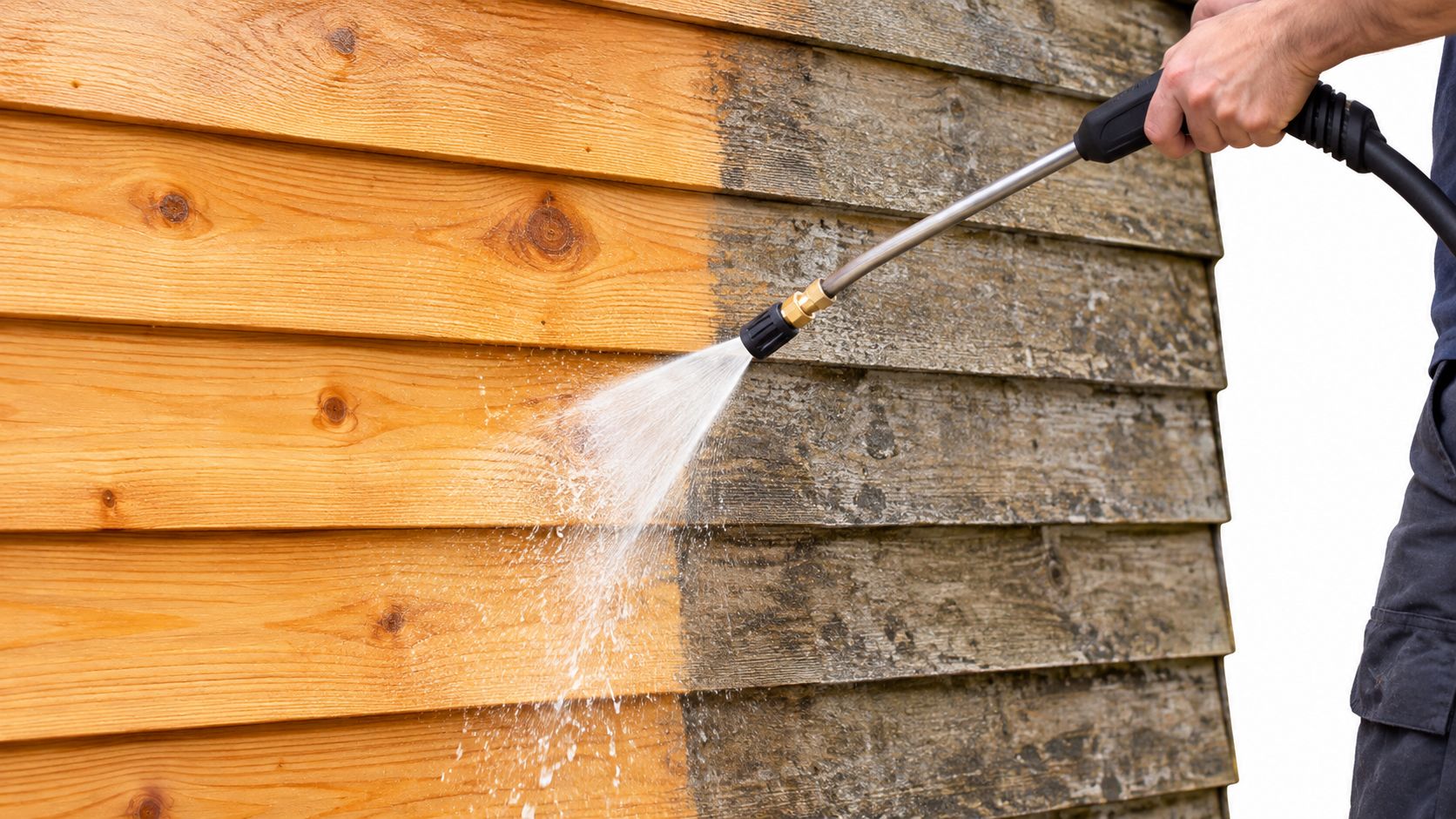
You step onto the deck with coffee in hand, ready to enjoy a Colorado Springs morning, and the boards don't look the way you remember. Dust has settled into the texture, spring pollen has glued itself to the surface, and the shaded corners near planters have picked up a dingy film. That usually leads to the same question: should you pressure wash it?
Sometimes yes. Often, not right away.
Composite decking pressure washing can clean a neglected deck well, but it's also one of the easiest ways to scar an expensive outdoor surface if you use the wrong tip, too much pressure, or the wrong cleaner. In Colorado, that risk goes up because our decks deal with windblown grit, intense sun, fast weather swings, and organic buildup that bakes on in exposed areas while lingering in shaded pockets.
Why Your Composite Deck Needs the Right Clean
A lot of homeowners assume a pressure washer is the automatic answer because it feels faster and more powerful. That's not always true with composite. Many premium composite products are built to stay low maintenance, and some manufacturers say their higher-performance lines can usually be cleaned with soap and water from a garden hose, with pressure washing reserved for tougher cases and early-generation products cleaned semi-annually, as noted in Trex care and cleaning guidance.
That matters because composite isn't wood. It doesn't respond well to the same aggressive cleaning habits people use on old fences, concrete, or heavily weathered lumber. If you blast the surface because it “looks tough,” you can leave behind fuzzing, streaks, gouges, or a permanently uneven finish.
Start with the least aggressive method
The smartest approach is to match the cleaning method to the problem.
If the deck just has:
- Loose dust and pollen from dry, windy days
- Light grime from foot traffic
- A little planter runoff or food residue
- Seasonal debris caught in corners and board gaps
A broom, hose, mild soap, and a soft brush may be all you need.
If the deck has heavier organic buildup, a slippery film, or residue that won't lift with hand cleaning, pressure washing can make sense. Even then, the machine is only part of the process. Cleaner choice, nozzle selection, dwell time, and rinse technique matter just as much.
Practical rule: If a hose and soft brush will solve the problem, that's usually the better choice for composite.
Why this matters more in Colorado Springs
Composite decks here deal with a mix of dry abrasion and sudden moisture. Wind carries grit onto horizontal surfaces. Pine needles and leaves collect in corners. Afternoon storms can leave damp debris trapped under furniture and planters. Then the sun comes back hard and bakes residue into the texture.
That combination is why a deck can look dirty even when it hasn't been “neglected.” It also explains why homeowners get tempted to overdo the wash. The dirt looks stubborn, so the instinct is to crank up the machine. On composite, that's often the wrong move.
A clean deck should look even, not blasted. The goal isn't maximum force. The goal is removing buildup without changing the face of the board.
Essential Prep Work Before You Power On
A lot of deck damage happens before the first pass of water. In Colorado Springs, I see homeowners do the hard part right and the setup part too fast. Then they end up chasing streaks, blasting at stuck debris, or forcing dirty runoff into places it should never go.

Clear the deck so you can actually inspect it
Take off the furniture, grill, mats, planters, toys, and anything else touching the boards. Composite hides problem spots under everyday items. Once the surface is open, staining patterns make more sense and you can tell the difference between surface grime, grease, hard water marks, and organic buildup.
This is also the right time to look for rubbed spots under chair legs, swollen debris in board gaps, black staining near planters, and traffic lanes that may need a gentler approach. If a board already shows scuffing or heat-related fading, treat it conservatively.
Sweep first, always
Dry debris turns into an abrasive slurry once water hits it. Grit from our wind here on the Front Range is hard on composite, especially on stairs and in textured grain patterns. A thorough sweep lowers the chance of grinding that grit across the face of the board while you clean.
Spend extra time on the places people rush past:
- Board gaps packed with pine needles, seed pods, or mulch
- Stair treads and riser corners where grit settles
- Perimeter edges against rail posts and siding
- Under planters, benches, and grills where damp debris sits longest
If the gaps are packed tight, loosen them by hand or with a plastic putty knife. Airflow matters on composite, and clogged gaps hold moisture longer after storms or sprinkler overspray.
Pre-rinse plants, then cool the deck surface
Before any cleaner goes down, wet nearby landscaping and the deck itself with a light rinse. That protects plants from incidental overspray and helps the cleaner spread more evenly across the boards.
Hot boards are trouble. On sunny Colorado afternoons, cleaner can dry too fast and leave you with patchy results. Early morning or a shaded window later in the day is usually the safer call.
Homeowners sometimes ask whether they need a power washer or a pressure washer for this kind of job. The difference is mostly about heated versus unheated water, and this breakdown of power washing vs pressure washing gives the plain-English version.
Protect the house before runoff starts
Close doors and windows facing the deck. Move cushions and fabric items indoors. Cover outlets or fixtures that should not take direct spray, and watch how runoff will travel before you start cleaning.
This matters most where the deck ties into painted trim, door thresholds, stucco, or lower siding. Dirty rinse water can leave stripes on the house, and repeated soaking around door assemblies is asking for trouble. A few towels at the threshold and careful spray direction save cleanup later.
If you're using a homeowner machine, cold water is usually the setup on site. For general exterior work, efficient cleaning for cars and homes explains why cold-water units are common and where they fit best.
Check the product line and the condition of the deck
Composite brands do not all respond the same way. Some boards handle washing with more margin for error. Others mark up faster, especially older boards, capped products with worn surfaces, or decking that has already been cleaned too aggressively in the past.
If you know the brand, pull the care instructions before you touch the trigger. If you do not know what was installed, slow down and inspect more carefully. That uncertainty is one of the biggest dividing lines between a safe DIY wash and a call to a pro. At Cultivate House Detailing, this is usually the point where we tell a Colorado Springs homeowner whether the deck is a good candidate for careful washing or whether hand-cleaning is the smarter investment.
Selecting Your Pressure Washing Gear and Cleaner
The machine matters less than the setup. A homeowner can damage composite with a decent pressure washer in minutes if the pressure is too high, the tip is too sharp, or the wand is held too close.
The pressure range that keeps you out of trouble
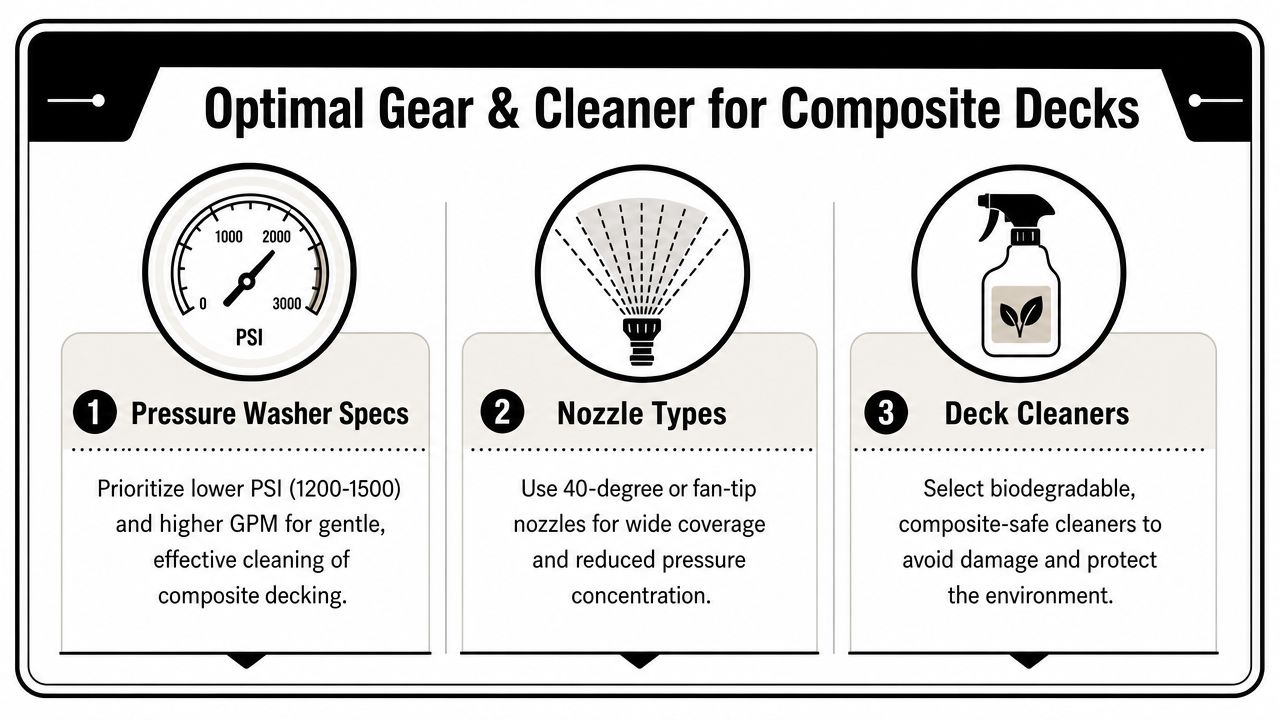
For most composite decking, the safe working range is 1,000 to 1,500 PSI, using a fan nozzle and keeping the nozzle at least 12 inches from the surface, according to California Floors' composite deck cleaning guide. Some specific Trex guidance cited there allows up to 3,100 PSI with a fan tip held at least 8 inches away, which is exactly why product-specific instructions matter.
That doesn't mean you should reach for the highest allowed number just because one product line can tolerate it. General field practice stays conservative because the actual-world variable isn't just the board. It's the operator.
PSI vs GPM in plain English
PSI is the force hitting the board.
GPM is the amount of water flowing through the system.
For composite, lower pressure with good rinse flow is usually the safer combination. You want enough water movement to carry away loosened grime, but not so much force that the spray starts cutting into the surface texture. If you're comparing machines, think “controlled rinse,” not “maximum blast.”
If you want a simple primer on how cold-water machines are used for efficient cleaning for cars and homes, that resource gives useful context on equipment behavior without overcomplicating it.
The nozzle you choose changes everything
A narrow tip concentrates force too tightly. That's where people get into trouble.
Industry guidance for composite cleaning commonly recommends a wide-angle fan nozzle, and professional technique often centers on a 40° fan tip with overlapping passes because it spreads impact across more surface area and lowers the chance of etch lines, as noted in EcoWash guidance on pressure washing a composite deck. A concentrated jet is the opposite of what you want on expensive deck boards.
| Setting | Recommendation | Reason |
|---|---|---|
| Pressure | 1,000 to 1,500 PSI for most composite decking | Helps clean buildup without cutting into the board surface |
| Nozzle | Wide-angle fan tip, commonly 40° | Reduces pressure concentration and lowers streaking risk |
| Distance | At least 12 inches from the surface in general guidance | Creates a safer wash pattern and helps prevent surface damage |
| Motion | Keep the wand moving with overlapping passes | Prevents lines, stop marks, and uneven cleaning |
| Product-specific exception | Some Trex guidance cited in industry sources allows up to 3,100 PSI at 8 inches with a fan tip | Confirms you must follow the exact product line and warranty terms |
Cleaner choice matters as much as machine choice
Use a mild cleaner or soap solution that fits composite decking. Harsh chemistry can discolor boards, leave residue, or create a blotchy finish that looks worse after drying.
A practical workflow from deck-cleaning guidance is to clear the deck, sweep grit, pre-wet the surface, apply a mild cleaner, scrub with a soft or nylon brush, and rinse with a fan tip rather than a concentrated stream, as described in Keystone Custom Decks' cleaning guide. One of the biggest mistakes is letting cleaner dry on the boards. Once that happens, residue can become its own cleanup job.
One more gear choice people confuse
People often mix up “power washing” and “pressure washing” as if they're interchangeable. In practice, the cleaning method and surface determine what's appropriate. If you want a simple breakdown of the difference, this pressure washing vs power washing comparison helps clarify why the gentler approach usually wins on composite.
A Step-by-Step Guide to Washing Your Deck
A composite deck in Colorado Springs can look clean at first glance and still dry with streaks, tiger-striping, or scuffed-looking patches if the wash technique is off. I see that after windy weeks here, especially on decks that collect grit from open lots, pollen in spring, and sprinkler overspray in summer. The goal is controlled cleaning that lifts grime without roughing up the face of the boards.
Clean a small area from start to finish
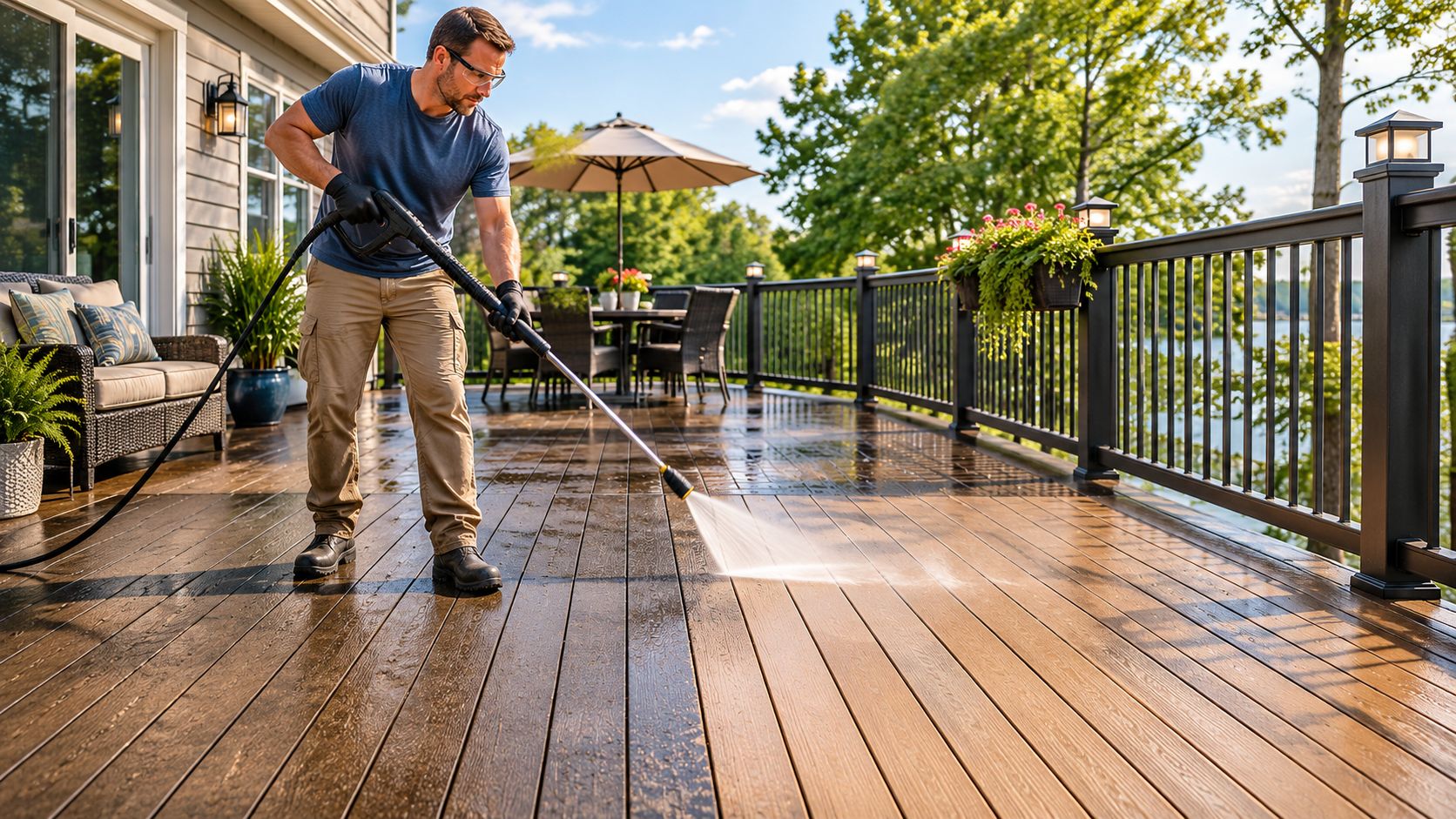
Work in sections you can fully manage before the cleaner dries. On a hot, dry Colorado afternoon, that section is usually smaller than homeowners expect.
A good sequence is simple. Apply cleaner to one section, give it a short dwell based on the product label and your decking manufacturer's guidance, scrub where grime is hanging on, then rinse that section completely. Broader deck-cleaning guidance often allows a few minutes of dwell time, but the practical rule is the same every time. Keep it wet, and do not let it bake onto the boards.
Use the brush to do the detailed work
Composite holds dirt in the grain and texture. Pressure alone does a poor job there, and pushing harder usually creates the damage people were trying to avoid.
After the cleaner has had time to loosen the soil, scrub traffic lanes, planter spots, grill areas, and board grooves with a soft nylon brush. That gives you a more even result and cuts down the temptation to chase one stubborn spot with the wand from too close.
This order works well on most decks:
- Apply cleaner to a manageable section.
- Let it dwell briefly per the label and decking guidance.
- Scrub textured or stained areas with a soft brush.
- Rinse the section fully before anything dries.
The expensive mistake is forcing results with pressure when brushing would have solved it safely.
Rinse with a steady pattern
Keep the spray moving in a consistent line along the boards. Long, even passes produce a cleaner finish than quick wrist flicks across several boards at once.
Follow each board as much as the layout allows, and overlap your passes so the rinse blends together instead of leaving visible stripes. Start with a little more distance than you think you need, then move closer only if the surface is not releasing the soil. On composite, patience beats aggression.
A few shop rules help:
- Keep your motion even
- Rinse with the board direction
- Overlap passes slightly
- Avoid repeated close passes on one spot
- Stop and brush again if a mark is not releasing
For readers who like comparing cleaning methods across other exterior surfaces, these Boat Juice boat cleaning methods are useful because they show the same principle. Finished surfaces hold up better when the wash is controlled and deliberate.
Watch how the motion looks
Reading the process helps. Seeing the pace and wand movement helps more.
Check each section before you move on
Inspect the area while it is still wet, then look again from an angle. Straight-on views can hide soap film and uneven rinsing, especially on darker composite boards.
If something still looks dirty, return to cleaner and brushing first. That is the safer correction. If you find yourself creeping closer and closer with the nozzle to win a fight with one stain, that is usually the point where DIY stops being a good investment and surface damage starts getting expensive.
Finishing Touches and Long-Term Maintenance
The final rinse decides how the deck looks after it dries. Even a careful wash can leave a dull film if cleaner lingers in grooves or against board edges.
Finish with a thorough rinse
Rinse every section completely with clean water, paying extra attention to low spots, board edges, and transitions near stairs. If runoff carries soap into a corner, flush it out before you call the job done.
Check around rail posts, under bench lines, and near the house. Those are the places where residue tends to hide.
A deck can look clean while it's wet and still dry with streaks if rinse water wasn't carried all the way off the surface.
Deal with leftover stains separately
Pressure washing isn't a cure-all. Grill grease, rust marks from furniture feet, and tannin stains from leaves often need spot treatment rather than more pressure.
A better approach is targeted cleaning with a composite-safe product and a soft brush. Test in a less visible area first, follow the decking guidance for your product line, and resist the urge to overwork one board trying to make a single spot disappear instantly. Uniform appearance matters more than forcing one small stain at the expense of the surface.
Build a simple annual routine
Most composite decks don't need frequent deep washing. They need consistent light maintenance so the deck never reaches the point where aggressive cleaning feels necessary.
A good routine looks like this:
- Sweep regularly so grit and organic debris don't settle into the texture.
- Rinse with a garden hose when pollen, dust, or light grime starts building.
- Keep gaps clear so water drains and air moves under the boards.
- Clean under planters and mats before moisture gets trapped for long periods.
If you stay ahead of debris, pressure washing becomes an occasional reset instead of a recurring chore. That's better for the deck and easier on your weekends.
Is DIY Worth the Risk? Signs You Need a Pro in Colorado Springs
Some decks are reasonable DIY projects. Some really aren't.
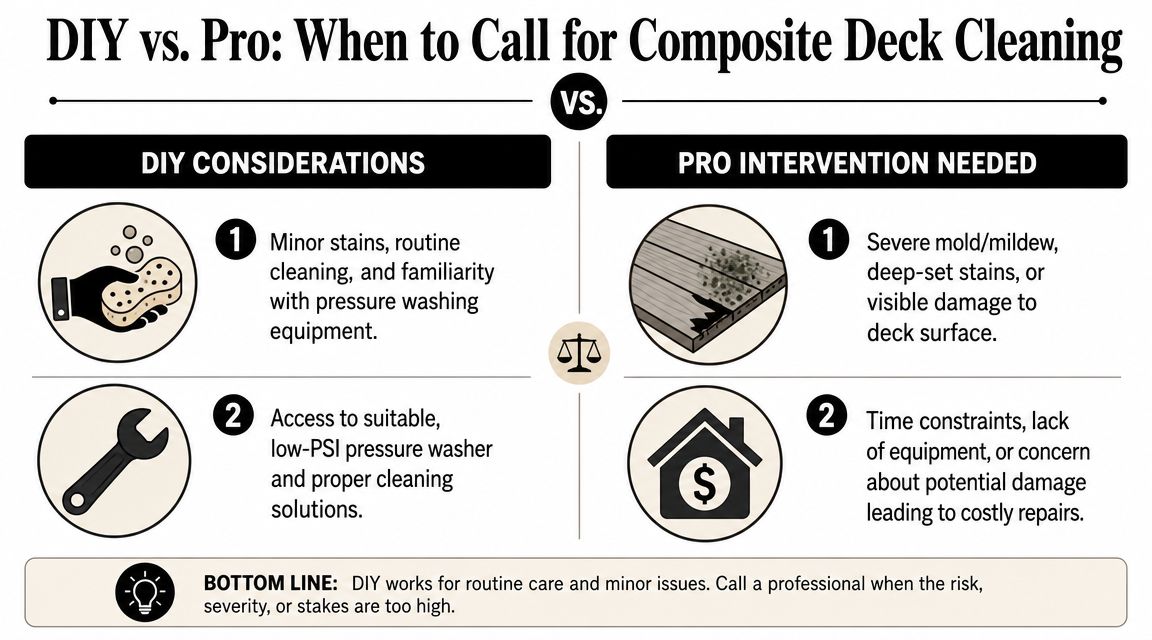
If you know the exact decking product, have the right machine and nozzle, and you're comfortable using a low-pressure technique, a routine cleaning can be handled carefully. But there are situations where hiring a professional is the smarter move because the downside of getting it wrong is expensive.
Call a pro when the material or warranty is unclear
If you don't know the decking line, don't guess. Manufacturer cleaning limits can vary, and one of the biggest DIY risks is accidentally voiding the warranty by using the wrong pressure, nozzle, or method. Many manufacturers set strict cleaning rules, and improper technique can leave damage that isn't covered, as noted in Rhino Hide's composite cleaning guidance.
That's one of the clearest reasons to bring in someone who works with exterior surfaces every day.
Some deck conditions raise the stakes
A professional is worth considering when you're dealing with:
- Persistent organic growth that keeps coming back in shaded zones
- Deep-set staining near grills, planters, or furniture lines
- Multi-level decks or steep stairs where equipment handling becomes a safety issue
- Visible wear that could worsen with even careful washing
- Time pressure that tempts rushed prep or rushed rinsing
Colorado Springs decks also take a beating from intense sun, blowing dust, and fast weather shifts. Those conditions don't just make surfaces dirty. They can highlight every inconsistency in the final finish.
What a professional really buys you
The value isn't just labor. It's judgment.
A trained exterior cleaner knows when pressure washing is appropriate, when soft hand cleaning is safer, and when a stain needs a spot-treatment approach instead of more water force. They also know how to protect surrounding surfaces, manage runoff, and produce a more even final result.
If you're comparing options for pressure washing in Colorado Springs, CO, look for a company that understands surface-specific cleaning, not just machine operation.
If the deck is expensive and the cleaning instructions are fuzzy, caution is cheaper than repair.
For homeowners in Colorado Springs, Monument, Black Forest, and nearby communities, that's usually the actual decision. Not “Can I spray this deck?” but “Is this worth risking the finish on a major outdoor investment?”
If you'd rather protect your deck and skip the trial-and-error, Cultivate House Detailing can help. We serve Colorado Springs and nearby communities with careful exterior cleaning that puts surface safety first. Reach out for a free quote if you want a professional opinion on your composite deck, pressure washing needs, or other exterior cleaning around your home.
Prefer to leave it to a professional? Cultivate House Detailing offers pressure washing in Colorado Springs. Get a free quote.
Serving Monument and the surrounding Colorado Springs area — see our window cleaning services in Monument.