A screen can fail in a hurry in Colorado Springs. A chinook gust snaps one corner loose, a pet pushes through a weakened panel, or months of strong sun leave the mesh chalky and brittle. The window still opens, but insects, dust, pollen, and debris now have an easy route inside.
That's when homeowners searching for framed window screen replacements often discover that a torn mesh isn't always the whole problem. The frame may be bent, the spline channel may be worn, or the screen may have stopped sitting flush in the window track. This guide explains when rescreening makes sense, when a full replacement is smarter, and how local weather should influence the materials you choose.
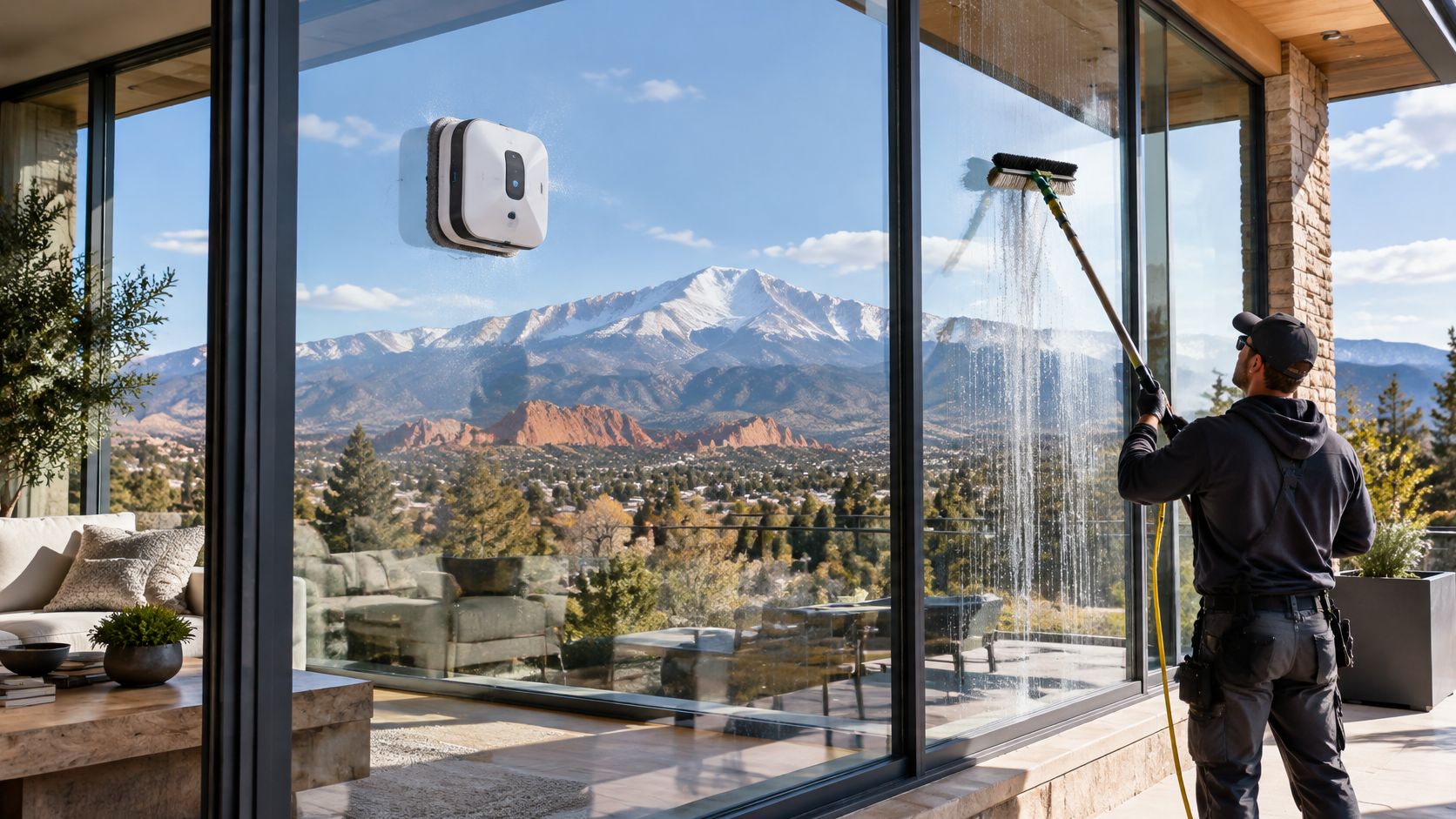
If dirty glass is part of the same maintenance problem, professional help can also cover exterior window cleaning, interior glass, screens, and tracks. A clean window paired with a sound screen gives your home a better view and a more complete seasonal refresh.
Why Colorado Springs Homeowners Replace Framed Window Screens
A common Front Range repair starts with one loose panel. After a windy afternoon, the homeowner finds a screen leaning against the patio door, one corner pulled free. Another homeowner notices that a south-facing screen has faded and turned brittle. In an older bungalow, the mesh may still look serviceable until a sparrow, pet, or repeated removal exposes a failing corner.
Colorado Springs conditions put several stresses on framed screens at once. Strong sun affects south- and west-facing openings, while wind carries dust and grit against the mesh and frame. Hail can leave small punctures that grow when the screen flexes. Pets create larger tears near the lower rail, and pests take advantage of gaps around corners that no longer hold tight.
The everyday consequences are easy to overlook:
- More indoor debris: Torn or loose mesh allows pollen, dust, and insects into rooms that rely on open windows for ventilation.
- Poorer weather protection: A screen can't stop every water intrusion, but a loose assembly can allow wind-driven moisture and debris to reach the sill.
- Repeated repair costs: A patch may solve the visible tear while leaving a weak frame that fails again.
- Reduced comfort: Homeowners often keep windows closed when screens won't stay secure, sacrificing fresh air and natural ventilation.
Practical rule: Start by inspecting the frame, not just the hole in the mesh.
A screen replacement decision usually comes down to whether the frame can still hold consistent tension and sit square in its track. If it can, replacing the mesh and spline may be enough. If it can't, a new framed assembly is more dependable than repeatedly repairing the same panel.
Local elevation, intense sunlight, wind exposure, and seasonal dust make this more than a generic hardware-store mesh swap. The right repair should match both the condition of the frame and the way that particular window faces the Colorado weather.
How Framed Window Screens Have Evolved Over Time
Today's modular screen kits make sense only when you understand how the product developed. References to woven wire for window screens appeared in 1822 in American Farmer, and Bayley and McCluskey filed U.S. Patent No. 79,541 in 1868 for screened rail-car windows intended to block sparks, cinders, and dust while preserving ventilation, as documented in the history of window screen technology. By 1874, the E.T. Barnum Company of Detroit advertised screens by the square foot, an early sign that standardized screen products were entering commercial use.
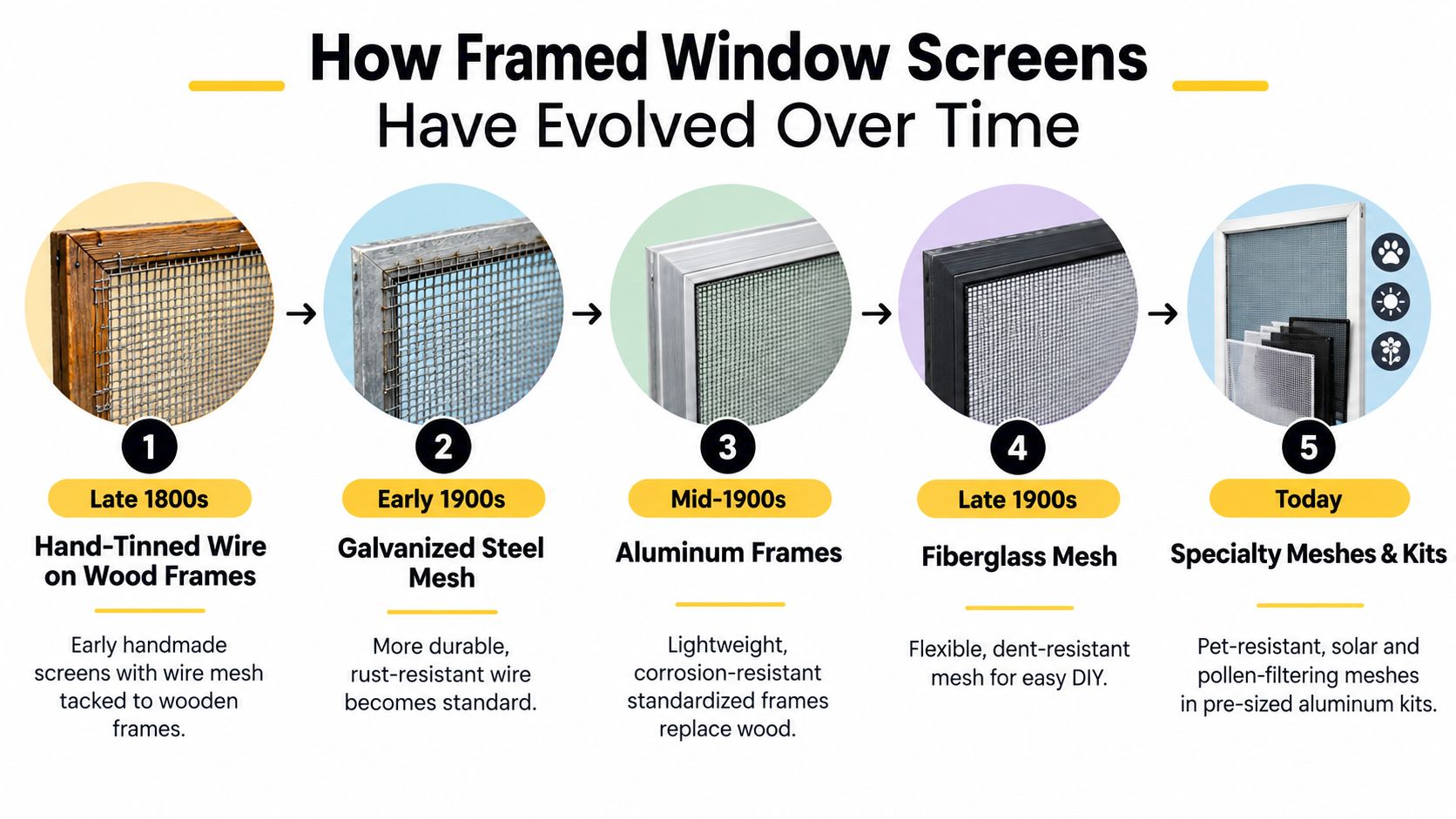
Material changes followed. Aluminum screens became widely available in the 1920s, fiberglass screens arrived in the 1960s, and plastic screens appeared in the 1970s, according to the same historical reference. Those shifts gave homeowners lighter frames, easier handling, and more choices for visibility, airflow, durability, and pest exclusion.
Older Colorado Springs homes may still have wood or steel components that behave differently from modern aluminum. Wood can swell, split, or rot near exposed edges, while steel can corrode at corners and along lower rails. Aluminum generally resists rust, but it can bend when a screen takes an impact or gets forced into a track.
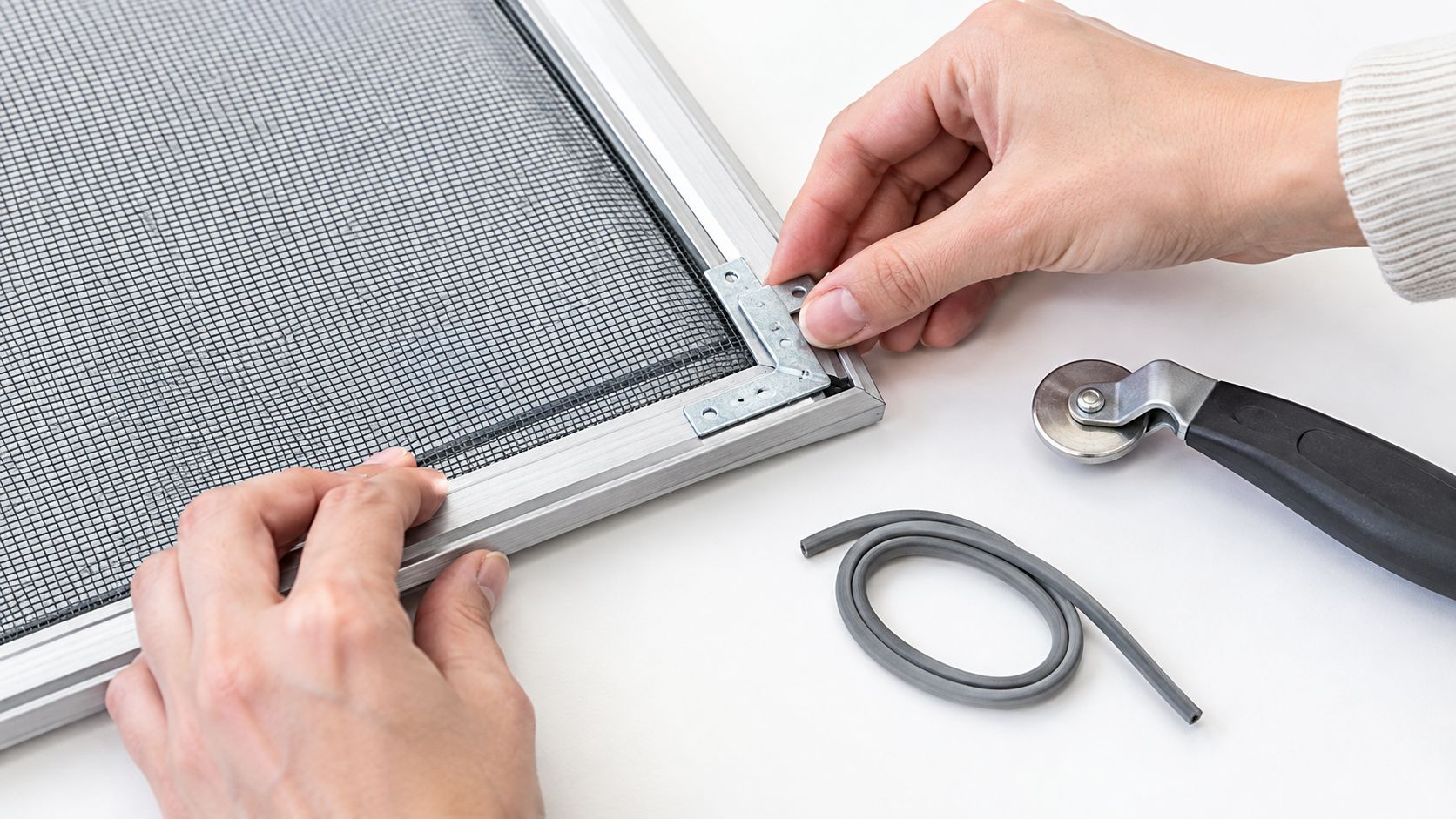
Modern kits rely on cut frame sections, corner connectors, mesh, and rubber spline. A standard aluminum screen-frame kit may include square-cut corners and vinyl spline, allowing a damaged assembly to be rebuilt from modular parts rather than ordered as an entirely unique product. That standardization is useful, but only when the frame profile, dimensions, groove, and attachment method match the window.
Frame Materials and Mesh Types Compared
Homeowners usually encounter a small group of frame and mesh choices. The best combination depends on whether the opening is exposed to strong sun, wind, pets, dust, or frequent removal.
Extruded aluminum is a practical choice for many residential openings. It's lightweight and resists corrosion, but a hard impact can bend the rails or distort a corner. Roll-formed aluminum generally uses a thinner profile and can work well on ordinary windows, though it has less resistance to rough handling. Wood suits period-style homes but needs closer inspection for swelling, rot, and loose joints. PVC or composite frames can remain stable and avoid some corrosion concerns, yet replacement profiles may be harder to source when a nonstandard shape is involved.
Mesh creates a separate set of trade-offs. Standard fiberglass is flexible and economical, while aluminum wire holds a firmer shape but can dent. Pet-resistant polyester is thicker and better suited to clawing or pushing, although the heavier weave can reduce airflow. Solar and no-see-um meshes use tighter or heavier constructions, so they may improve protection while making the window feel less open.
Standard mesh configurations include 16×18, 18×16, and 20×20, with the numbers representing wires per inch in each direction. 18×16 is commonly treated as a standard residential configuration, while 20×20 provides finer insect protection, as explained in this window screen buying guide.
| Material / Mesh | Lifespan (yrs) | Cost / sq ft | Best Fit |
|---|---|---|---|
| Extruded aluminum frame | Not fixed | Not fixed | Common residential frames where light weight and corrosion resistance matter |
| Roll-formed aluminum frame | Not fixed | Not fixed | Budget-conscious replacements with standard openings |
| Wood frame | Not fixed | Not fixed | Older homes where appearance and original profiles matter |
| PVC or composite frame | Not fixed | Not fixed | Newer or specialized openings where the correct profile is available |
| Standard fiberglass mesh | Not fixed | Not fixed | General insect control and good airflow |
| Aluminum mesh | Not fixed | Not fixed | Firmer mesh where dent resistance is preferred over flexibility |
| Pet-resistant polyester | Not fixed | Not fixed | Ground-floor windows exposed to pets or animal pressure |
| Solar or no-see-um mesh | Not fixed | Not fixed | Strong sun or smaller insects, with reduced airflow accepted |
The table leaves lifespan and cost open because the available verified material does not support a reliable universal figure for each combination. In Colorado Springs, choose by exposure rather than by price alone. A north-facing window may need ordinary fiberglass, while a sun-baked opening or pet-accessible panel may justify a reinforced option. For additional material details, compare available replacement screening material before buying.
Rescreening vs Full Frame Replacement
A new mesh won't correct a frame that no longer holds its shape. Before ordering supplies, remove the panel and check whether it sits square on a flat surface, whether the corners meet cleanly, and whether the spline channel still grips the retaining cord.
Five warning signs deserve attention:
- Bent corners: The panel won't sit square in the window track even after careful repositioning.
- Hairline cracks: Miter joints or corner connectors separate when the frame is handled.
- Corrosion pitting: The lower rail or channel has damaged areas that prevent a clean spline seat.
- Stripped grooves: The channel is crushed, widened, or too shallow to retain new spline.
- Chronic popping: The spline repeatedly works loose after installation.
A five-year-old aluminum frame with one torn panel is generally a sensible rescreening candidate when the corners and groove remain sound. A fifteen-year-old frame with three popped corners on a south-facing wall deserves a more cautious evaluation because repeated exposure and repeated failures point to the frame as the weak link.
| Condition | Likely Cause | Recommended Fix | Typical Cost |
|---|---|---|---|
| Straight frame, tight corners, clean channel | Mesh failure only | Rescreen | Not stated |
| Bent frame that can't sit square | Impact or weather stress | Full framed replacement may be appropriate | Not stated |
| Cracked or separated corners | Failed connector or frame joint | Replace frame assembly | Not stated |
| Damaged spline groove | Corrosion, crushing, or wear | Replace frame assembly | Not stated |
| Screen pops out repeatedly | Spline or channel no longer retains mesh | Diagnose groove, then rescreen or replace | Not stated |
Verified cost guidance places average replacement pricing at about $317 to $322 per screen in 2026, with professional-service ranges of roughly $147 to $515 and broader market ranges from about $50 to more than $1,200, depending on size, material, and customization, according to HomeAdvisor's screen installation cost guide. Those figures are broader market guidance, not a Colorado Springs quote. The practical rule remains simple: replace the mesh until the frame itself becomes the weakest link.
For homeowners comparing related screen components, a resource covering durable purifier screen parts can also help clarify how retaining materials and replacement parts differ across applications.
How to Rescreen a Framed Window Yourself
Rescreening a sound, square frame can be a satisfying weekend repair. It becomes frustrating when the frame is bent, the channel is damaged, or the screen has an unusual shape.
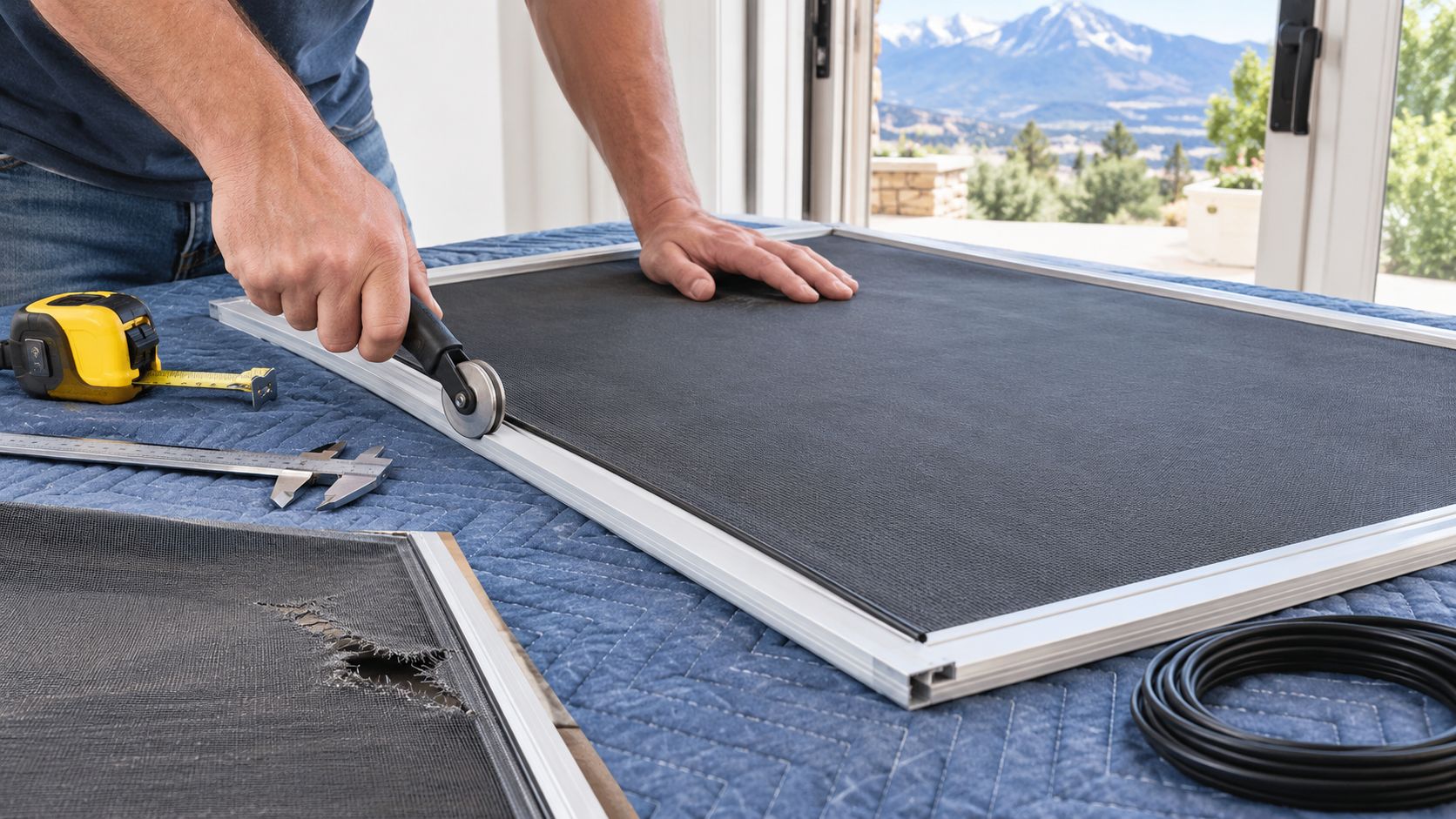
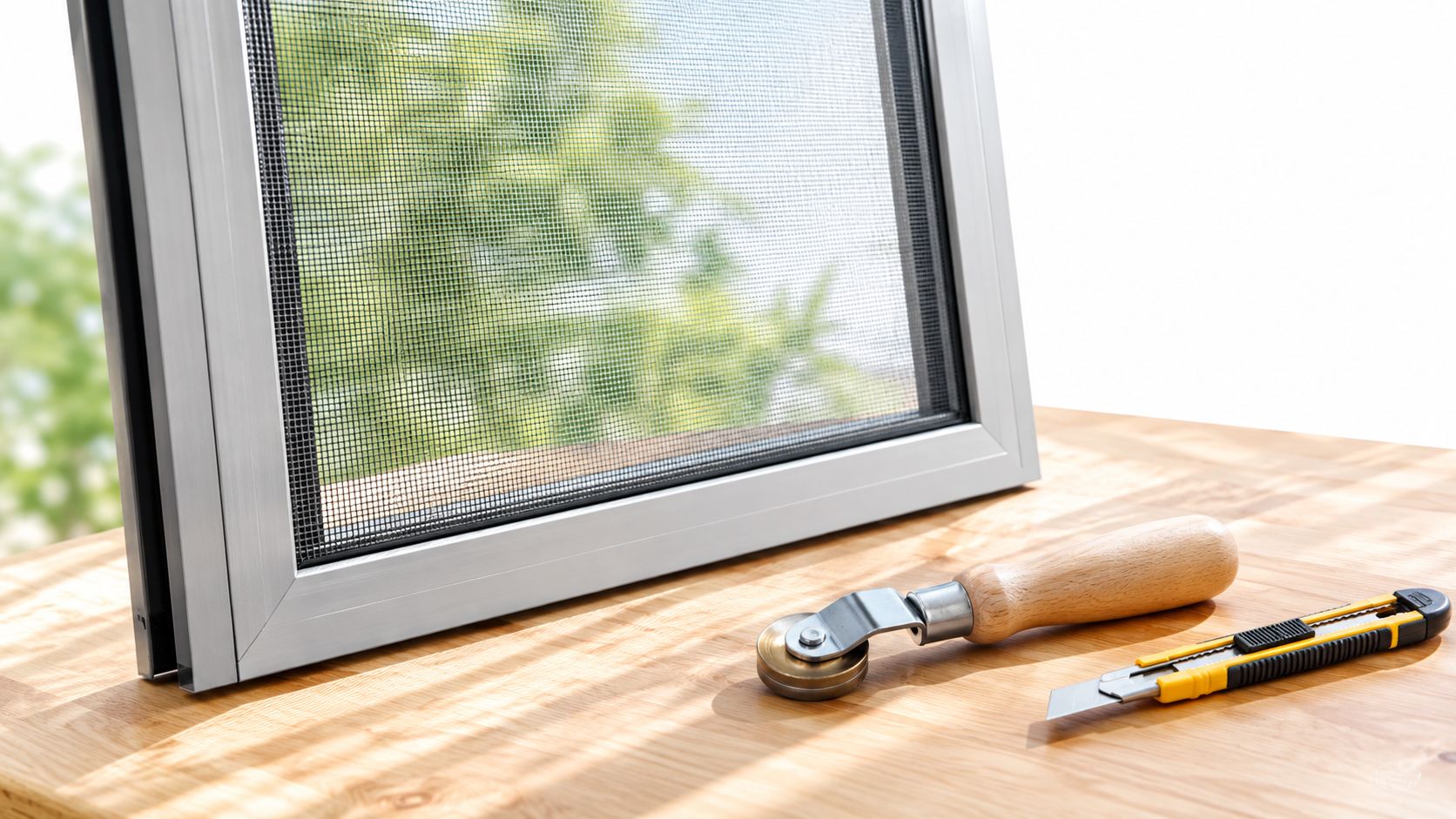
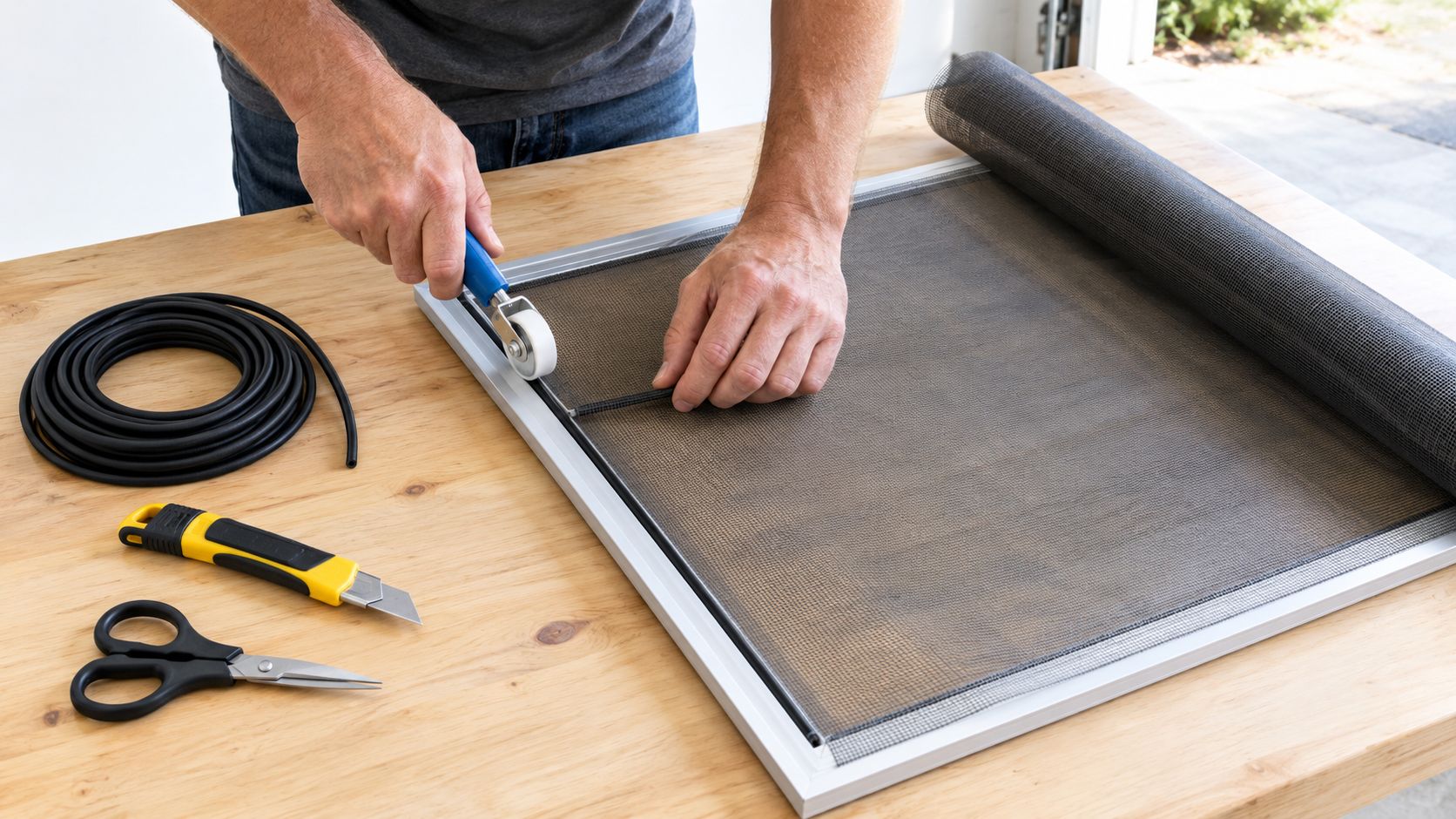
Gather a spline roller, replacement spline matched to the groove, a utility knife with a fresh blade, a flat work surface, and new mesh. The mesh should overlap the frame by about 1 inch on all sides before trimming, according to this DIY window screen repair guide. Standard fiberglass commonly pairs with 0.140-inch spline, while other frames and heavier meshes may require a different diameter, so check the channel rather than guessing.
Work in a controlled sequence
- Remove the old spline. Lift it from a corner with a small screwdriver, then pull it out without gouging the frame.
- Clean the channel. Brush away grit, old rubber, and compacted dust so the new spline can seat fully.
- Lay out the mesh. Center it over the frame with the excess extending evenly beyond every edge.
- Start at a corner. Use the convex wheel of the spline roller to press the mesh and spline into the groove.
- Move along the rails. Work outward from the starting corner, keeping moderate, even tension. Don't yank the fabric tight, because excessive tension can bow the frame.
- Seat the spline. Press firmly enough for the cord to lock the mesh, but avoid cutting or stretching the fabric.
- Trim last. Hold the knife against the outer edge of the installed spline and cut away the excess mesh with controlled strokes.
The most common mistakes are predictable. An undersized spline can pull free under wind or repeated handling, while an oversized spline can distort the frame or over-compress the mesh. Wrinkles often begin when the installer skips the corner technique or changes tension abruptly along one rail.
A do-it-yourself screen guide can help with basic preparation, but DIY has limits. Ground-floor windows with square aluminum frames are reasonable candidates. Casement screens, arched tops, damaged channels, and upper-story removals are better handled by someone equipped to measure, fabricate, and work safely.
The video below shows the rolling technique in context.
Before reinstalling the panel, wipe the spline groove and the window track. Removing grit helps the screen sit flush and reduces the chance that debris will force the panel back out of position.
Why Professional Installation Is Worth the Cost
Professional installation earns its value through accuracy, access, and repeatable finish quality. A technician can measure openings that aren't perfectly square, identify the correct frame profile, and select spline that matches the groove instead of forcing a close substitute.
A local screen professional also may have access to mesh options that aren't stocked in a typical home-improvement aisle. That matters when a south-facing opening needs stronger sun performance, a ground-floor window needs pet-resistant material, or a homeowner wants a darker insect screen with a cleaner outward view.
The finished details matter just as much. Correct rolling technique keeps the mesh evenly tensioned, prevents wrinkles and sags, and helps the panel sit flush in its track. The installer also has to account for clips, plungers, corner connectors, and other attachment parts that a basic rescreening kit doesn't solve.
Professional service makes particular sense when:
- The opening is difficult to reach: Second-story screens on stucco, brick, or steep landscaping create a real ladder concern.
- The frame is unusual: Older homes and specialty windows may not accept a standard kit.
- Several panels need attention: Batching the work avoids repeated measuring, removal, and reinstallation.
- The first repair already failed: A recurring pop-out usually deserves diagnosis rather than another patch.
DIY remains reasonable when the frame is sound, the window is on the ground floor, and you're comfortable learning the technique. For everything else, professional installation functions as protection against repeating the same repair.
Cultivate House Detailing provides window screen repair and replacement alongside residential and commercial window cleaning in Colorado Springs and surrounding communities. That combination can be useful when screens, tracks, exterior glass, and interior glass all need attention during the same maintenance visit.
Choosing the Right Local Screen Replacement Pro
A reliable hiring decision starts before anyone removes a screen. Ask for proof of Colorado business licensing, liability insurance, and worker's compensation coverage. Ladder work near stucco, brick, landscaping, or second-story windows creates risks that should be addressed in writing rather than left to assumption.
Ask how the work gets built
Confirm whether the provider measures and fabricates locally or installs pre-cut stock only. Wider openings can bow when the profile or dimensions are wrong. Ask which frame extrusions are available, whether the provider can work with rolled or heavier-wall aluminum, and whether bronze or white frames can be matched closely.
Mesh descriptions should be specific. Ask for the manufacturer and product specification rather than accepting a general label such as “pet screen.” Phifer, ADFORS, and FlexScreen are recognizable names homeowners may encounter, but the actual mesh gauge, weave, color, and intended use still matter.
Review the service details
Read reviews for punctuality, care around interiors, dust control during spline rolling, and how the company handles callbacks. A workmanship warranty should identify whether it covers mesh, corners, spline retention, and installation errors. It should also state the length of coverage clearly.
Turnaround can vary between mobile service and shop drop-off. Ask whether the provider serves your part of Colorado Springs and nearby communities such as Manitou Springs, Fountain, or Monument, and whether the work can be completed at your property or requires transport.

Request a written estimate that itemizes the mesh type, frame material, labor per window, measurements, expected timeline, and any trip fees. A clear quote makes it easier to compare rescreening with a full framed window screen replacement, and it gives you a record of what the installer agreed to provide.
If the same visit includes streak-free residential window cleaning, screen cleaning, track cleaning, or commercial window cleaning for a storefront, ask that each service appear separately on the estimate. You'll know what you're paying for and can schedule seasonal maintenance without guessing which details were included.
Cultivate House Detailing offers window screen repair and replacement, along with streak-free residential and commercial window cleaning in Colorado Springs and nearby communities. Visit Cultivate House Detailing to request a written quote and schedule help with damaged screens, hard-to-reach glass, exterior window washing, or interior window cleaning.