You know the feeling. The sun is out, the Front Range looks sharp, and your windows should be showing off Colorado Springs at its best. Instead, you see dust, water spots, streaks, and that hazy film that seems to collect faster here than it should. On a one-story home, that's annoying. On a second-, third-, or fourth-story property, it turns into a real access problem.
That's usually when people start searching for window cleaning near me or wondering how to clean high rise windows on their own. It sounds simple until you're dealing with tall glass, changing weather, awkward angles, and the risk of losing control of a pole or ladder. For homeowners and property managers in Colorado Springs, CO, clean windows aren't just about appearance. They affect your view, your natural light, and how well your home or storefront presents from the street.
This guide is written as a safety-first look at professional window cleaning for mid-rise residential and commercial properties in Colorado Springs. If you're weighing a DIY attempt against hiring help, this will make the decision clearer.
Enjoying Colorado Views Through Crystal-Clear Windows
A lot of properties in Colorado Springs are built to capture the view. Maybe it's a bank of tall glass facing Pikes Peak. Maybe it's a stairwell window that pulls in morning light. Maybe it's a commercial frontage where clean glass changes the whole first impression. When those windows get dirty, you notice it every day.
The frustrating part is that the dirt here isn't always dramatic. It's often a layer of fine dust, dried spotting, and residue that slowly flattens the view. Add strong sun, wind, and quick weather swings, and windows can go from decent to dull fast. Homeowners often clean the easy panes and leave the highest ones for later, which usually means they stay dirty much longer than the rest.
Why high windows get ignored
It's not laziness that leads to the job's avoidance. It's avoided because the work gets complicated fast once glass moves above easy reach.
Common situations we see around Colorado Springs include:
- Tall entry windows that sit over stonework, shrubs, or sloped ground.
- Rear-facing glass with decks, window wells, or landscaping that makes ladder placement awkward.
- Commercial window cleaning needs where upper panes stay visibly dusty long after the lower storefront glass is wiped.
- Large fixed windows that don't open and can't be reached safely from inside.
A property can look mostly clean and still feel off because the highest glass is catching light in all the wrong ways.
Clean upper glass changes the whole appearance of a home or business because your eye goes straight to whatever reflects the most light.
What people usually want fixed
By the time someone starts looking for window cleaning in Colorado Springs, CO, the request is usually more specific than “wash the windows.” It's closer to this:
| Problem | What the owner actually wants |
|---|---|
| Streaks on upper panes | A clear, even finish from top to bottom |
| Hard-to-reach exterior glass | Safe access without ladders on risky ground |
| Spotting after irrigation or weather | Cleaner-looking glass that stays presentable longer |
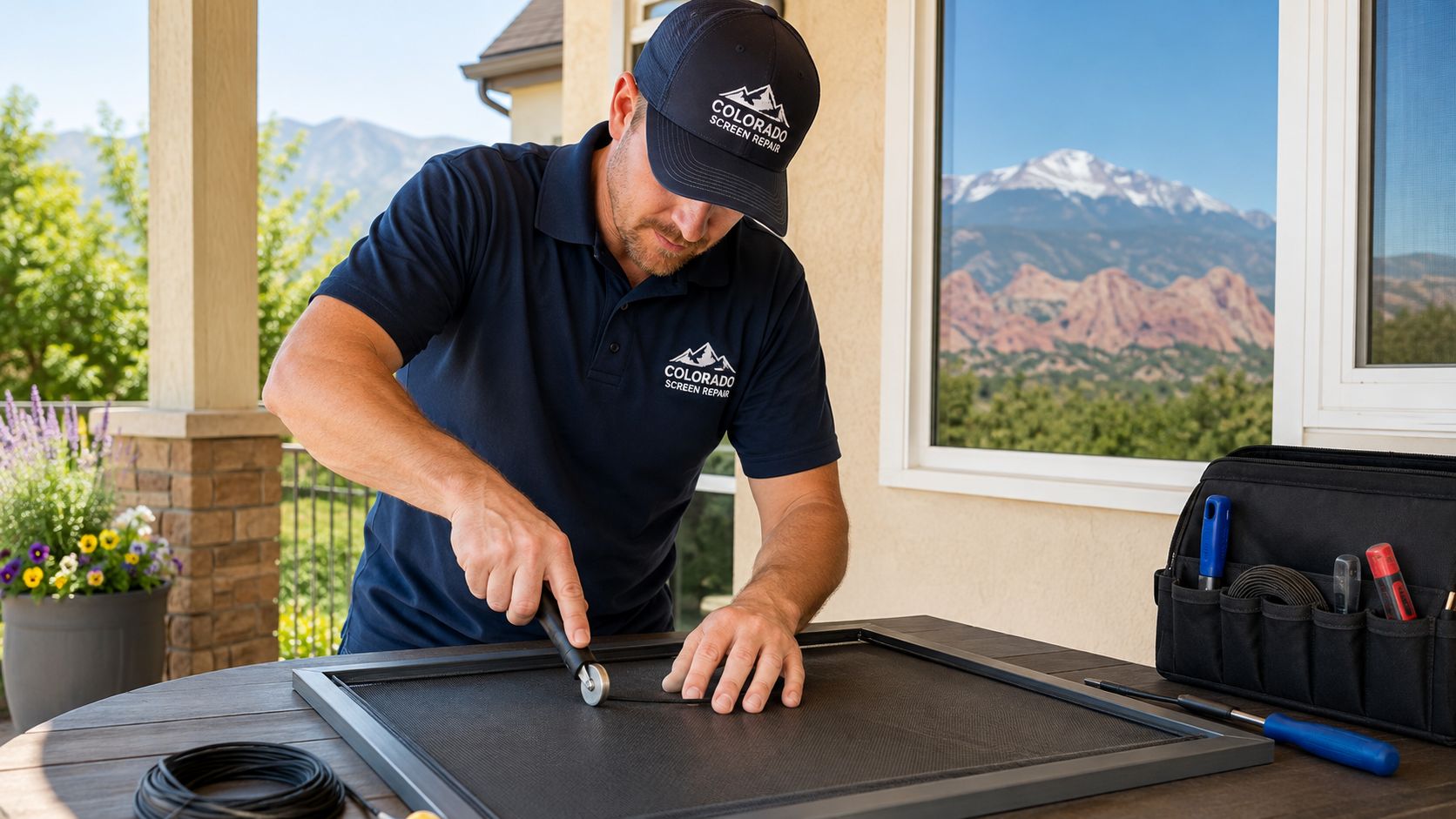
| Dingy frames, screens, and tracks | The whole window area to look maintained |
That's where a local service matters. The job isn't just getting water on the glass. It's knowing how to clean what's high, what's awkward, and what's exposed without turning the project into a safety gamble.
For homes and businesses around Colorado Springs, the appeal of professional exterior window cleaning, interior window cleaning, screen cleaning, and track cleaning is simple. You get the light and view back without spending your weekend figuring out how to reach a window that was never meant to be a casual DIY task.
The Dangers and Disappointments of DIY High Window Cleaning
Once windows move past the first story, DIY stops being a normal cleaning project and starts becoming an access problem. That distinction matters. A bucket, a household squeegee, and a ladder might work on patio doors. They don't reliably solve fourth-story glass over uneven Colorado ground.
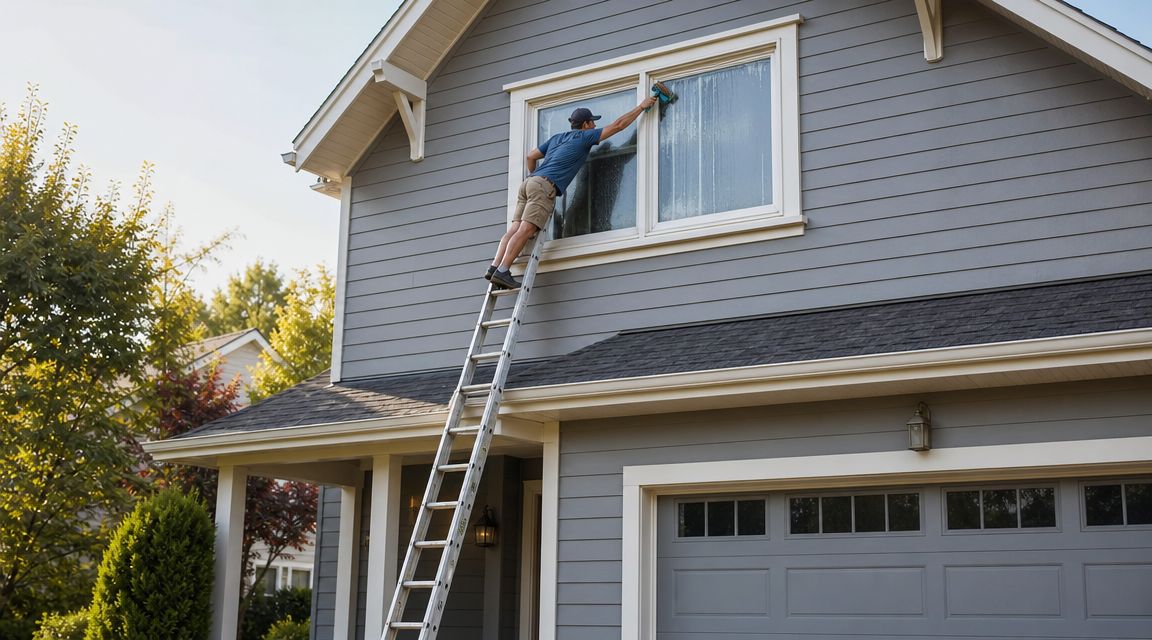
A lot of failed DIY attempts begin with good intentions and bad assumptions. People assume the hard part is the cleaning. Usually, the hard part is staying stable, controlling the tool, and not putting pressure where it doesn't belong. If the ground slopes, the wind picks up, or the glass is farther out than it looked from below, the plan falls apart quickly.
The real risks aren't minor
Tall ladder work introduces more than inconvenience. It brings in fall risk, broken landscaping, dented gutters, scratched frames, and damaged screens. Even if nothing goes wrong physically, people often overreach, rush, or work in poor conditions just to finish.
Colorado Springs adds its own complications:
- Uneven surfaces around walkways, decorative rock, mulch beds, and retaining edges
- Sudden gusts that make poles and ladders harder to control
- Strong sun that dries solution too fast and leaves visible residue
- Hard water exposure that doesn't lift easily with basic soap-and-rinse methods
For a homeowner, that's a rough combination.
A closer look at the safety side is worth reading in Cultivate's guide on why professional window washers are safer than DIY cleaning.
Consumer tools often disappoint
Even when the DIY attempt feels safe enough, the result usually isn't what people hoped for. Consumer squeegees skip. Pole attachments wobble. Store-bought soap can leave film. The upper corners stay dirty because the angle is wrong, and the lower half gets redone three times while the highest edge still shows runoff marks.
Here's where DIY commonly breaks down:
- Pole flex makes precise control harder the farther you extend it.
- Dirty blades drag contamination from one pass to the next.
- Too much solution leaves drips at the frame.
- Too little technique turns a wash into a smear.
Practical rule: If you can't keep the tool stable, square to the glass, and moving smoothly, you won't get a clean finish no matter how much effort you put in.
There's also the time cost. High-window DIY usually takes longer than expected because every mistake compounds. You stop to move the ladder, rewet the glass, fix a missed corner, wipe drips, and fight the sunlight. That's why many people who start out wanting to save money end up deciding they'd rather hire a professional window cleaning team and be done with it.
The Professional Method for High-Rise Window Cleaning
There's a reason the trade moved toward specialized access and specialized tools. According to this history of window cleaning equipment and methods, the modern era of high-rise cleaning is tied to the shift in skyscraper design in the 1950s, and a major practical milestone for mid-rise work came in the 1960s as pole systems moved into commercial window cleaning. The same source notes that water-fed pole systems can reach up to five stories and are considered a gold-standard approach for many jobs because they allow workers to clean safely and effectively from the ground using pure water.
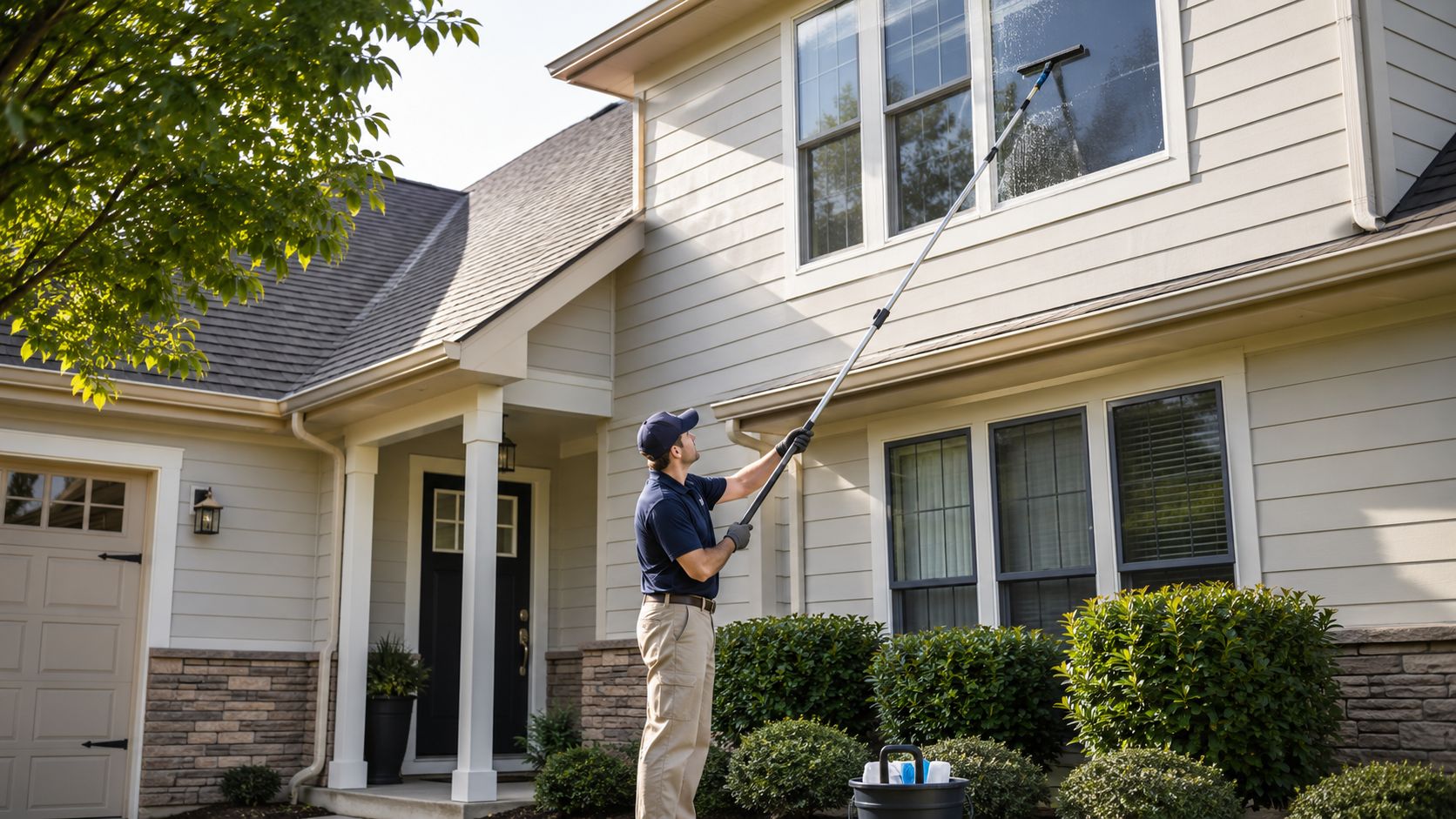
That matters for properties in Colorado Springs because many homes and low-rise commercial buildings fall right into that range. For up-to-four-story work, the safest and cleanest method is often not climbing higher. It's using the right system from below.
How the process works on real properties
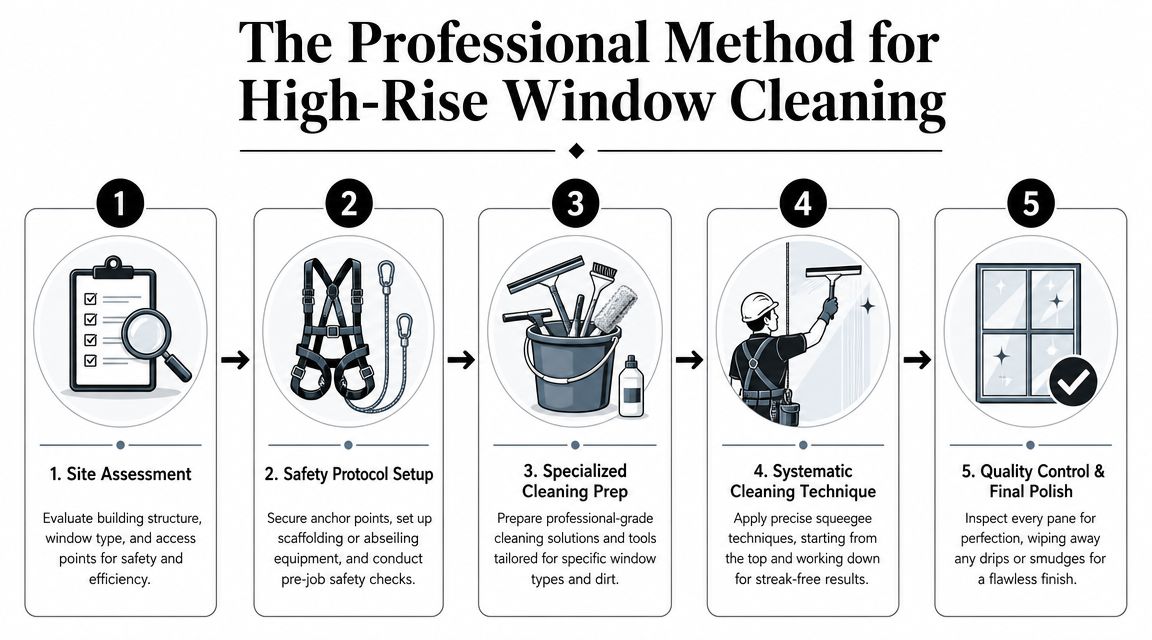
Professional high-window cleaning isn't one motion repeated over and over. It's a sequence.
Site assessment
The tech checks height, access, glass type, landscaping, power lines, footing, and the safest working path around the property.Tool selection
For many mid-rise jobs, that means a water-fed pole system with a brush head and purified water delivery. Current systems use fiberglass or carbon-fiber poles and self-contained reverse-osmosis setups in many applications, which is a major step up from consumer-grade gear.Controlled agitation
Dirt is loosened with the brush rather than just sprayed and pushed around.Pure-water rinse
Purified water helps the glass dry cleaner because it isn't leaving the same mineral content behind.Detail checks
Frames, edges, and any problem panes get extra attention before the crew moves on.
Here's a look at the method in action:
Why water-fed poles outperform basic DIY setups
A good water-fed system solves several problems at once. It reduces ladder dependence. It improves reach. It gives the technician better consistency across multiple panes. On many exterior jobs, it also improves rinse quality because the cleaning water itself is part of the result.
That's especially helpful for:
- Residential window cleaning on tall façades
- Commercial window cleaning for offices, retail, and mixed-use properties
- Exterior window cleaning where access from inside isn't possible
- Buildings with landscaping or terrain that make constant ladder movement inefficient
If the safest position is on the ground, a professional setup should let the cleaner stay there whenever the building and window layout allow it.
For up-to-four-story residential and commercial work in this area, Cultivate House Detailing uses the same safety-first thinking. The value isn't just having longer poles. It's using a system that matches the building, the conditions, and the finish the customer expects.
Techniques for a Flawless Streak-Free Finish
Safe access gets you to the glass. Technique is what makes the glass look right when the job is done. Here, many DIY attempts fall apart. People often assume a streak-free window comes from the soap or the squeegee alone. It doesn't. It comes from precise movement, clean edges, and knowing when a pass needs to be redone.
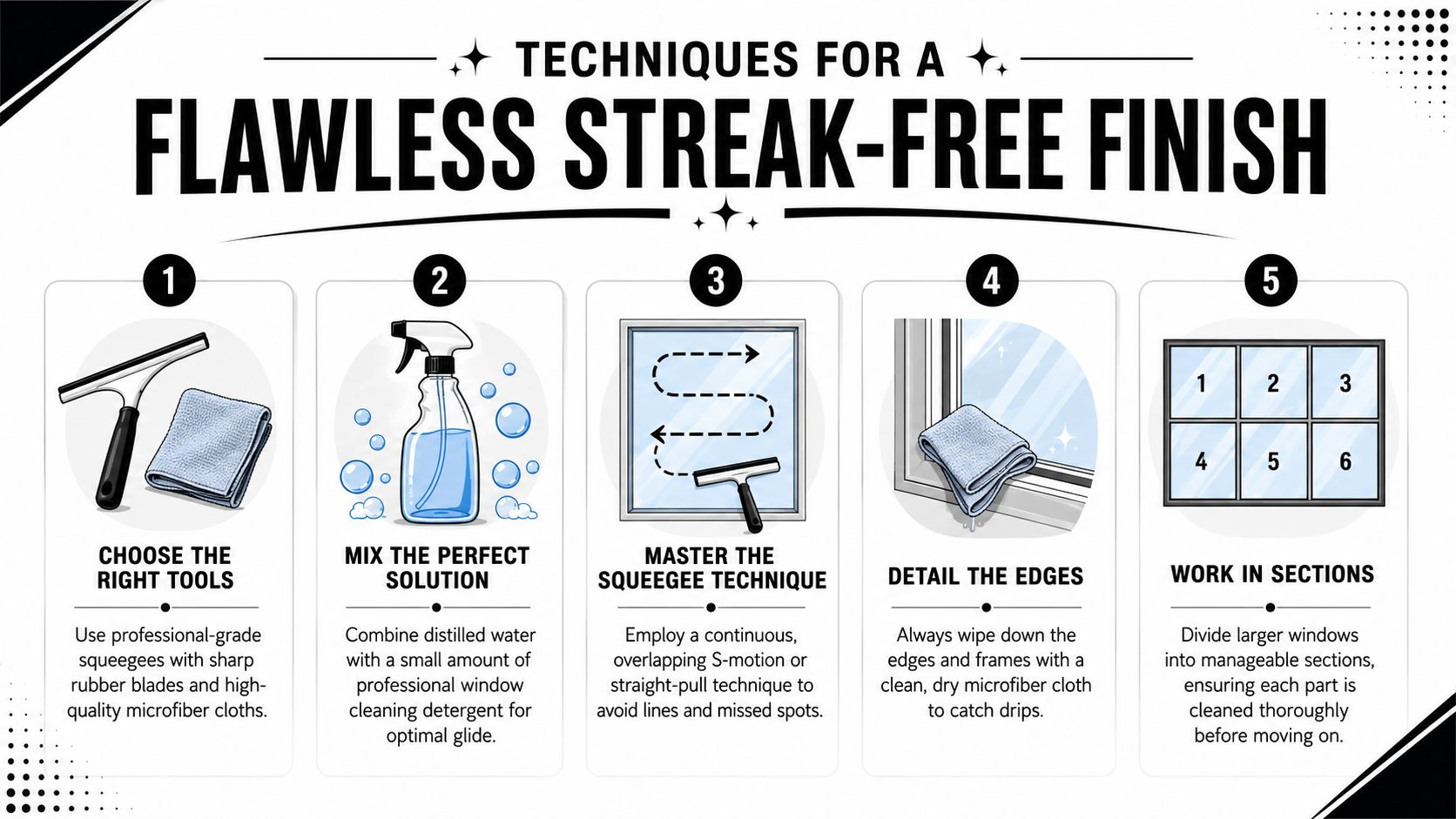
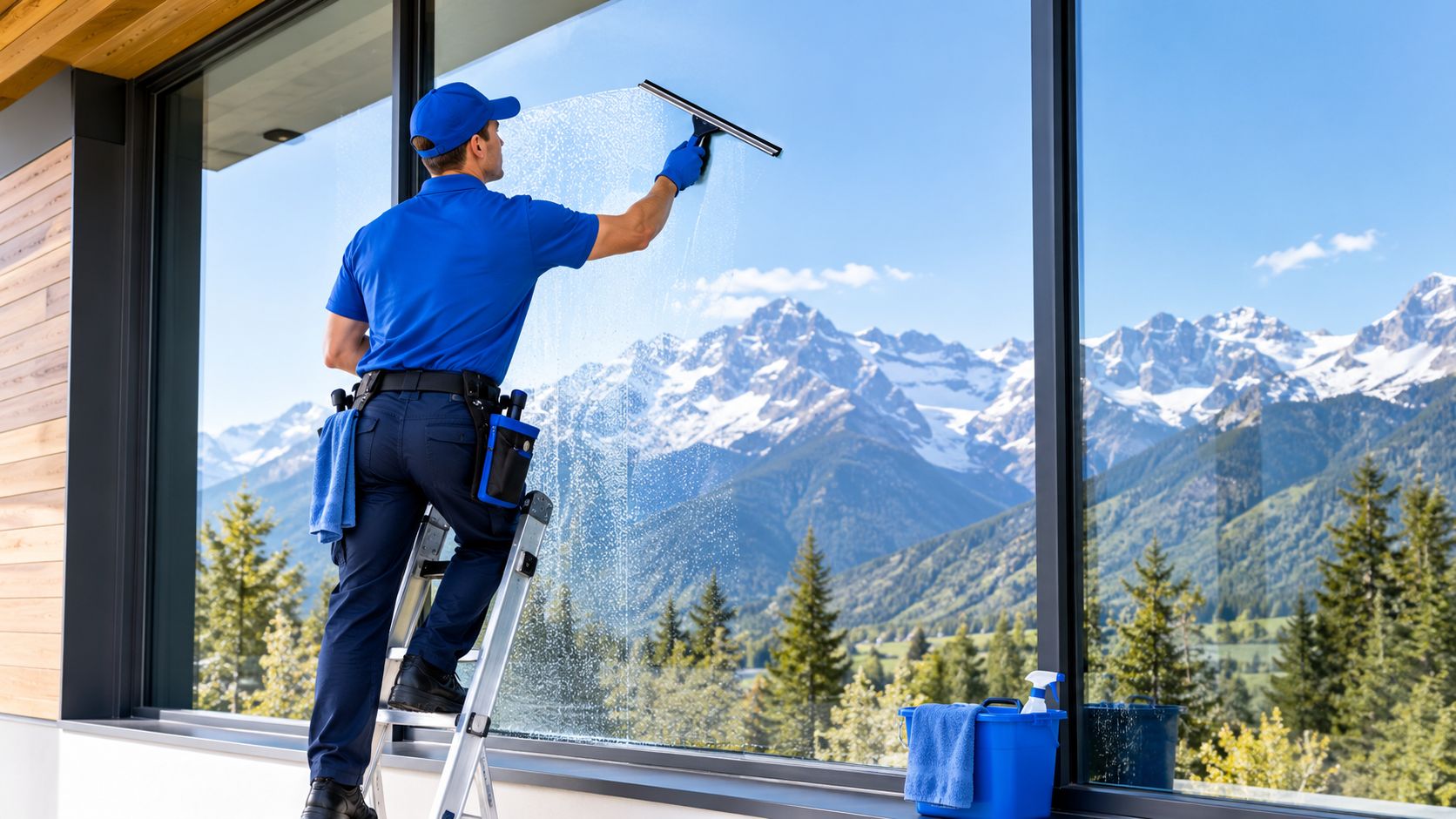
According to this high-rise cleaning technique guide, the key to a streak-free finish is the classic S-pattern squeegee method, which keeps the blade in continuous contact with the glass. Professionals start at the top, use overlapping strokes, wipe the blade after each pass, and detail corners and edges with microfiber cloths because those areas are the most common source of streaks.
What the S-pattern actually solves
The S-pattern isn't just a stylistic move. It helps control where dirty water goes. Instead of leaving random channels or stopping and restarting all over the pane, the blade stays in contact and carries moisture downward in a controlled path.
That reduces problems like:
- Lines left behind by broken contact
- Water trails at the edge of each pull
- Dirt transfer from one section to the next
- Wet corners that dry into visible marks
A specialist training reference in the same source family adds a simple field benchmark. If the wiped edge leaves more than about one finger-width of water from the frame, the pass should be redone rather than buffed. That's a practical detail many non-pros never learn.
Why Colorado conditions expose bad technique
In Colorado Springs, weak technique shows up fast. Direct sunlight can dry solution too quickly. Wind can reduce control. Hard water spotting can stay visible even after the pane is technically “washed.”
That's why experienced cleaners adjust rather than forcing the same routine on every window.
| Situation | Better professional response |
|---|---|
| Direct sun on glass | Work the cooler side first or change timing |
| Wind on upper panes | Use a safer method with more control |
| Heavy edge runoff | Tighten the squeegee line and redo the pass |
| Mineral spotting | Use a method suited to residue, not just loose dirt |
For readers who want a closer look at the craft side of clean glass, this article on why streak-free windows depend on the right tools and techniques explains why results depend on both equipment and skill.
Hard water stains need a different mindset
Hard water staining is common on Colorado properties. Sprinklers, runoff, and repeated mineral exposure leave behind deposits that don't behave like dust or pollen. They don't easily wash off because they've bonded to the surface over time.
That's where judgment matters. Some panes need standard cleaning. Some need restoration-minded treatment. Some are at the point where aggressive DIY scrubbing can do more harm than good.
The mistake is treating every dirty window like it's just dusty. Stains, residue, and baked-on mineral spotting need different handling than surface soil.
That's one reason streak-free window cleaning is a skilled trade, not just a chore. The finish depends on reading the glass correctly before the first pass ever starts.
Common Mistakes and When to Call for Professional Help
It's not carelessness that typically leads to trouble. Instead, trouble arises from underestimating where a project shifts from manageable to risky. That line comes sooner than many homeowners expect.

Consumer Reports advises that a low-risk workflow for high windows involves a telescoping pole, but their guidance is also direct about the main failure point. In their guidance on cleaning high windows safely, they flag loss of control from an overextended pole as a primary failure mode and say that if you can't control the pole, it's time to stop and hire a professional to avoid injury or property damage.
Mistakes that create bad results or bad situations
Some errors only leave streaks. Others create a real hazard.
Cleaning in direct sunlight
Solution dries too fast, which makes residue and drag marks more likely.Using too much pressure
More force doesn't mean more clean. It often means poorer control.Ignoring the edges
Most visible streaks show up at corners and frames.Overextending a telescoping pole
Once control drops, the risk goes up quickly.Treating mineral stains like loose dirt
That usually leads to frustration, repeated passes, and no meaningful improvement.
A simple decision check
If any of these apply, it's smart to stop and book help:
| Sign | What it means |
|---|---|
| The windows are on the third or fourth story | Access is no longer routine household cleaning |
| The ground is sloped, landscaped, or obstructed | Safe setup gets harder fast |
| The pole feels unstable or difficult to steer | You're already at the point Consumer Reports warns about |
| Spots remain after normal washing | The issue may be mineral staining, not dirt |
| You're working around specialty glass or delicate finishes | Mistakes become more expensive |
If you hire any exterior service company, it also helps to understand what quality follow-through should look like. A useful primer on understanding contractor workmanship warranties gives homeowners a practical way to think about accountability after the work is done.
Some jobs are DIY jobs. High exterior glass often isn't. The moment control, footing, or visibility starts to feel uncertain, the safe choice is to step back.
That's not giving up. That's making a sound maintenance decision.
Your Local Solution in Colorado Springs: Cultivate House Detailing
Once you've seen what's involved in how to clean high rise windows safely, the appeal of hiring it out becomes pretty obvious. You're not just paying for someone to wash glass. You're paying to remove the risk, the wasted time, the trial-and-error, and the inconsistent finish.
For high-access work, that professional framework matters. One industry article summarized by Designing Buildings in its history of skyscraper window cleaning notes that fatalities for high-rise window cleaners in the US averaged one per year between 2010 and 2014, which underscores how much standardized safety equipment and procedures have changed the risk profile of the work. The point for a property owner is straightforward. Safe results come from systems, training, and process, not from improvising on the day of the job.
What a service visit should feel like
In Colorado Springs and nearby communities, homeowners and property managers usually want the same things from a window cleaning service near me search:
- Clear quoting
- Punctual arrival
- Respect for landscaping and property
- Consistent communication
- Clean glass without the hassle
That applies whether you need residential window cleaning for a tall custom home or commercial window cleaning for an office, storefront, restaurant, or mixed-use property. Good service should also account for the details people notice right away, including screen cleaning, track cleaning, and the condition of the surrounding window area.
Why local experience matters
Colorado Springs properties come with their own challenges. Wind exposure, sun angle, dust, irrigation spotting, and varied lot layouts all affect how a job should be approached. A local company understands that a steep side yard, rock landscaping, or a tall rear elevation changes the workflow.
That's where a focused local provider makes life easier. Cultivate House Detailing serves Colorado Springs and nearby communities with up-to-fourth-story residential and commercial window washing, along with related exterior cleaning services that help the whole property look maintained rather than partially cleaned.
If your windows are hard to reach, constantly streaking, or long overdue, the safer move is often the simpler one. Let trained professionals handle the height, the technique, and the finish so you can enjoy the view again.
If you're ready for window cleaning in Colorado Springs, CO, request a quote from Cultivate House Detailing. We handle residential and commercial window cleaning with a safety-first approach, clear communication, and the kind of streak-free results that let your views do what they're supposed to do.
Need it done properly the first time? Cultivate House Detailing offers residential window cleaning in Colorado Springs. Get a free quote.