
Dirty windows usually don't look that bad until the sun hits them. Then every streak shows up. In Colorado Springs, that moment often comes fast. Morning light reveals dust, pollen, sprinkler spots, and the haze that builds up when high-altitude sun dries a pane before a basic spray-and-wipe routine can finish the job.
That's why homeowners searching for window cleaning near me or window cleaning in Colorado Springs, CO are often dealing with the same problem. They've already tried paper towels, store-bought glass cleaner, or a weekend DIY approach, and the windows still look cloudy from the sidewalk or dull from the living room. The issue usually isn't effort. It's process, tool choice, and knowing how local conditions change the job.
Your Guide to Crystal Clear Colorado Springs Views
If you live in Colorado Springs or nearby communities, clean windows aren't just about glass. They're about the view. A home in Black Forest, Monument, Manitou Springs, or Woodland Park can have incredible natural light and mountain scenery, but dirty panes flatten everything. Dust collects fast here. Hard water spots cling to exterior glass. Pollen and debris settle into frames and screens, then get dragged back onto the glass during rushed cleaning.

A typical Colorado Springs homeowner runs into the same cycle. The outside glass looks dusty after a windy stretch. The inside starts showing fingerprints, dog nose prints, or a light film near frequently opened windows. Then a quick wash leaves more streaks than expected because the glass dried too quickly, the water wasn't clean enough, or the edges were never detailed.
Why Colorado windows are frustrating to clean
Some places let you get away with average technique. This area usually doesn't. Our dry air and bright sun expose every shortcut.
- Hard water spotting: Mineral-rich water leaves visible marks when it dries on glass.
- Seasonal buildup: Spring pollen, summer dust, fall debris, and winter grime all create different cleaning challenges.
- High visibility: Big views mean flaws stand out more, especially on large picture windows and upper-story glass.
- Mixed surfaces: Screens, tracks, frames, and hardware all hold dirt that can ruin the finish if cleaned in the wrong order.
Clean glass isn't only about what you remove from the pane. It's also about what you keep from getting back onto it.
Why homeowners look for professional window cleaning
The professional window cleaning industry keeps growing because regular maintenance matters. The U.S. industry was valued at over $808 million in 2025 and is projected to grow 13% between 2020 and 2028, with regular maintenance often involving 3 to 4 exterior cleanings per year according to window cleaning industry statistics compiled here. That aligns with what property owners already see in real life. Waiting too long makes the work harder, the spots more stubborn, and the final result less predictable.
For both residential window cleaning and commercial window cleaning, the goal stays the same. Restore clarity, protect the glass, and make the property look cared for.
The Professional's Toolkit and Essential Prep Work
A professional finish starts before the glass gets wet. That's the part most DIY attempts miss. People grab a bottle and towel, but pros begin with setup, surface prep, and the right tools for the type of glass, the amount of buildup, and the access involved.
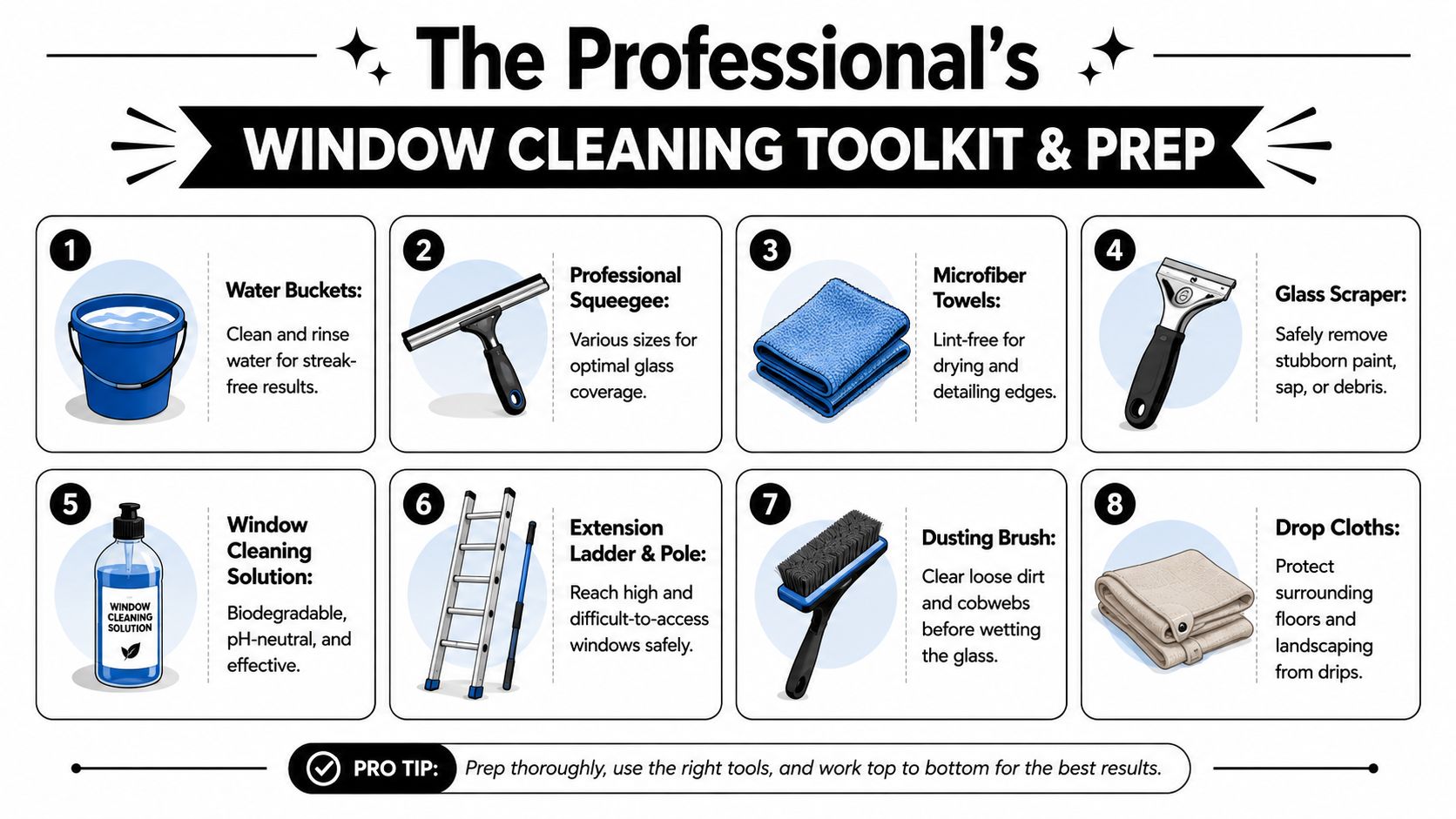
What professionals actually use
A proper professional window cleaning kit usually includes more than one towel and one squeegee. Different panes and access points need different tools.
| Tool | What it does | Why it matters |
|---|---|---|
| Professional squeegee | Pulls solution evenly off the glass | Reduces residue and streaking |
| Scrubber or washer sleeve | Loosens dirt before squeegeeing | Lifts grime instead of smearing it |
| Microfiber cloths | Detail edges and dry frames | Leaves less lint than paper towels |
| Buckets with clean water | Hold wash solution and rinse water | Dirty water creates dirty results |
| Dusting brush | Removes dry debris first | Keeps grit from becoming mud |
| Extension pole or water-fed pole | Reaches upper glass safely | Helps clean high windows without poor ladder angles |
| Drop cloths | Protect floors, trim, and landscaping | Keeps interior and exterior work controlled |
| Safe scraper, when appropriate | Removes stuck-on debris | Used carefully to avoid damage |
For homeowners curious about the gear itself, this guide to professional window cleaning equipment gives a good overview of what separates trade tools from household substitutes.
Prep is where streak-free results begin
The sequence matters. Frames, tracks, and hardware should be cleaned and dried first, followed by a dry-wipe to remove dust before wet-cleaning the glass. According to Pella's window cleaning guidance, that sequence reduces common streaking pitfalls by approximately 40%.
That number makes sense in practice. If loose debris stays in the track or on the frame, the first pass of water pulls it right back across the pane. Now the glass is wet, the dirt is mobile, and every stroke spreads contamination.
The prep checklist that actually works
Before washing the glass, professionals handle a few essential tasks:
- Dry-remove debris first. Cobwebs, dust, loose grit, and pollen should come off dry.
- Clean the frame and sill. Otherwise runoff carries dirt onto the glass later.
- Check the screen. A dirty screen can make clean glass still look dull.
- Protect nearby surfaces. Interior floors, furnishings, and exterior landscaping need basic protection.
- Start with fresh water. Once the bucket turns cloudy, the cleaning quality drops with it.
Practical rule: If the frame is still dirty, the window isn't ready to wash.
This is also where interior window cleaning, exterior window cleaning, screen cleaning, and track cleaning come together. Homeowners often think only the pane matters, but the whole assembly affects the final appearance.
Mastering the Art of the Streak-Free Squeegee
The squeegee is the dividing line between amateur and professional window washing. Used well, it leaves clean, clear glass in a controlled pass. Used poorly, it leaves chatter, lines, drips, and wet edges that dry into streaks.
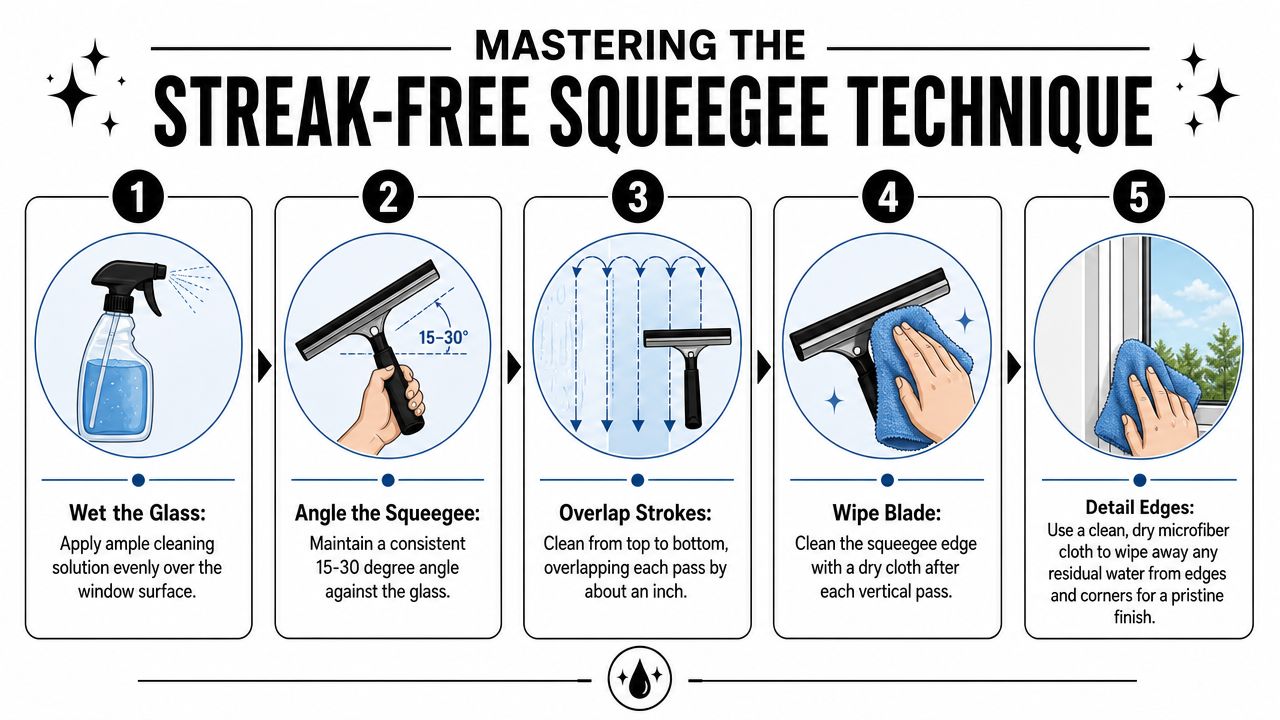
The angle, pressure, and overlap
The core mechanics are simple, but they have to be consistent. Expert technique calls for a 30-degree angle between the handle and the glass, smooth overlapping passes of 2 to 3 inches, and wiping the blade after each stroke. In the same guidance, professionals using the S method or cut-in method reported 95% streak-free success rates on eighth-story windows in this supporting demonstration reference.
Another trade detail matters too. The hand position should stay about 3 inches from the glass surface with consistent pressure and overlap into the previous dry pass, as outlined in this IPC whitepaper on squeegee technique. That hand position helps keep the rubber edge engaged evenly across the pane.
How the motion works on the glass
Most pros don't stop and restart in random sections. They control the water and move it intentionally.
- Start at the top: Gravity is going to move water downward anyway, so the process should work with that.
- Keep the glass evenly wet: Dry patches create drag and chatter.
- Overlap each pass: Small overlaps prevent thin missed lines between strokes.
- Wipe the blade every time: A dirty or wet blade edge transfers residue right back onto the pane.
- Detail the edges last: Corners and seals often hold the last bit of water.
Here's a visual walkthrough of the motion in action.
Why common DIY methods fail
Spray-and-paper-towel cleaning usually struggles for three reasons. First, it doesn't remove enough water fast enough. Second, it often pushes dirt around instead of lifting it. Third, it leaves lint and uneven pressure marks behind.
Professional cleaners also avoid working in direct sun whenever possible. For a streak-less finish, the building should be on the shady side, and the squeegee blade should be dried with a cloth after every single stroke, according to IPC's professional do's and don'ts for window cleaning. Shade slows evaporation and gives the cleaner control over the finish.
Use less panic, more pattern. Fast hands don't create clear windows. Controlled passes do.
Interior glass, exterior glass, and screens
Interior window cleaning usually requires tighter control around floors, trim, and furnishings. Less runoff matters. Edge detailing matters more because indoor light catches corner residue easily.
Exterior window washing often calls for more scrubbing up front because that's where pollen, dirt film, bug residue, and water spotting sit. The pane may need multiple scrub passes before the squeegee ever comes out.
Screens need their own treatment. A clean window behind a dirty screen still looks dusty. Screens should be removed carefully when possible, brushed or washed gently, and fully dried before going back in place. Pushing too hard on mesh can stretch it or pop corners loose, so this is one of those small details that affects the finished look more than homeowners expect.
Solving Tough Problems Like Hard Water and High Windows
Some windows don't need a basic cleaning. They need problem-solving. Hard water stains, oxidized residue near frames, and upper-story access issues are where DIY methods usually stall out.
Hard water isn't ordinary dirt
Hard water spots bond to the glass differently than loose dust or seasonal film. If sprinklers hit the windows regularly, minerals can build layer by layer. A standard soap mix may improve the appearance, but it often won't fully correct the problem.
That's why hard water stain removal is a separate skill from routine window washing. The wrong pad, scraper, or chemical can scratch glass, damage seals, or leave a hazy patch that looks worse in direct light. Homeowners dealing with mineral spotting can learn more about the process in this guide on how to remove hard water stains from windows.
High windows change the risk
Hiring a professional service stops being a mere convenience and begins to be the safer choice. According to IPC Worldwide's safety coverage on working at height, approximately 30 workers suffer serious accidents each year in the UK due to working at height. The exact number is less important than the lesson. High-access window cleaning needs planning, equipment, and training.
For homes and buildings in Colorado Springs, upper-story work often involves:
- Water-fed telescopic poles: Useful for high glass that can be cleaned effectively from the ground.
- Stabilized ladder setups: Necessary only when conditions and access support safe use.
- Site-specific judgment: Sloped ground, landscaping, decks, and weather all affect the approach.
High windows tempt people into bad decisions. A short ladder, uneven ground, and a quick job mindset is a rough combination.
When to call for professional help
A homeowner can usually handle light interior touch-ups. But these situations are better left to trained technicians:
- Fourth-story or hard-to-reach windows
- Persistent mineral spotting
- Large commercial storefront glass
- Windows above landscaping, wells, or awkward rooflines
- Glass that needs restoration, not just washing
That applies to both residential window cleaning and commercial window cleaning. The right result comes from choosing the method that fits the risk, not forcing the easiest tool into a job it wasn't meant to do.
What to Expect When You Hire Cultivate House Detailing
Hiring a local service should feel simple. Homeowners and property managers usually want the same things. Clear communication, an honest quote, an on-time arrival, and windows that look better when the light shifts later in the day.

The service experience from start to finish
The process usually starts with a quote request. For window cleaning in Colorado Springs, CO, that means discussing the property type, how many sides of glass need attention, whether screens and tracks are included, and whether there are upper-story or hard water issues in play.
Once the job is scheduled, a professional crew should arrive prepared to protect the property and work efficiently. Indoors, that often means careful movement around floors and furnishings. Outside, it means managing hoses, poles, ladders, and runoff responsibly around landscaping and entryways.
What good scheduling looks like
Window cleaning works best as maintenance, not as a once-every-few-years rescue job. Professional standards call for cleaning exterior glass 2 to 4 times yearly to remove dirt, grime, and pollutants that obscure visibility and degrade the glass over time, with more frequent service in dust-prone areas according to Valcourt's guide to professional window cleaning.
That recommendation fits Colorado Springs well. Some homes need seasonal service. Some businesses, especially storefronts and offices with customer-facing glass, benefit from a recurring schedule that keeps the property looking consistent.
Why local businesses invest in visibility
For commercial properties, clean glass is part of presentation. Retail storefronts, restaurants, offices, and service businesses all benefit when exterior and interior glass look maintained. Business owners thinking about visibility more broadly often also look at tools like seo software for local businesses so their physical presence and online presence both reflect the same level of care.
A good window cleaning visit should end with a quick walkthrough, a chance to point out any remaining concerns, and a clear sense of what the next maintenance interval should be.
The best service calls don't feel chaotic. They feel organized, respectful, and easy to say yes to again.
Enjoy Your View and Protect Your Investment
A lot of homeowners call after the same moment. The sun hits the front windows just right, and every streak, dust line, and hard water spot shows up at once. Clean glass fixes the view, but the bigger win is protecting the parts of your home those deposits sit on week after week.
Professional window cleaning helps preserve the glass, frames, tracks, and nearby finishes. It also brings more daylight indoors and sharpens curb appeal without a remodel or a big project. The polished result people notice at the end comes from small decisions made correctly before the squeegee ever touches the pane.
The result homeowners want
Homeowners in Colorado Springs usually want three things. Clear glass from both sides, screens that do not throw dust back onto clean windows, and a service that solves the problem without leaving drips, residue, or extra cleanup behind.
Our local conditions make that harder than many guides admit. Windblown dust, pollen, sprinkler overspray, mineral-heavy water, and fast weather swings can undo a rushed job in a hurry. Good technique matters, but so does good judgment about timing, tools, and products.
The environmental side of the trade matters here too.
The chemical trade-off many guides skip
Strong soap is not always better soap. Some products cut through grime fast but leave behind runoff that is rough on landscaping, soil, pets, and drainage areas around the home. For most residential glass, a professional gets better long-term results by using the least aggressive product that will still break the bond of dirt, pollen, and mineral residue.
That trade-off matters in Colorado Springs, where many homes have rock beds, tight drainage paths, and irrigation overspray near the foundation. Harsh chemicals can solve one problem on the glass while creating another below it. A careful cleaner knows how to balance performance, surface safety, and runoff control instead of chasing a quick shine with stronger chemistry than the job requires.
That is one reason homeowners hire a pro instead of copying a "professional-grade" product list from a generic article.
Done right, window cleaning leaves the house brighter, the exterior better cared for, and the view back where it belongs. If you're ready to stop fighting streaks, spots, and hard-to-reach glass, contact Cultivate House Detailing for a quote. They provide professional residential and commercial window cleaning in Colorado Springs and nearby communities, with careful service, clear communication, and results that help you enjoy your view again.
Looking for a professional to take care of it? Cultivate House Detailing offers residential window cleaning in Colorado Springs. Get a free quote.