You get home in Colorado Springs after sunset, and the front walk is half-dark, the side yard disappears into shadow, and the porch fixture you picked up at a big-box store throws more glare than light. That's usually the moment homeowners start looking up outdoor lighting installation services, because the problem isn't just appearance anymore, it's safety, visibility, and whether the property feels finished after dark. The right setup depends on three practical thresholds, project size, voltage type, and whether the lighting is meant to stay up year-round or come down seasonally.
Outdoor lighting installation services matter because they turn a dark yard into a usable part of the home, but the work only goes well when the scope is clear from the start. A small accent job, a low-voltage grounds layout, and a permanent holiday system are all very different projects, even if they use the same word, “lighting.” In a market that keeps expanding, outdoor lighting is clearly more than a decorative add-on. One industry analysis valued the global outdoor lighting market at USD 17.06 billion in 2024 and projected USD 28.43 billion by 2030 with a 9.4% CAGR from 2025 to 2030. A separate report estimated the outdoor lighting services market at USD 8.3 billion in 2024 and USD 12.5 billion by 2033 at 5.0% CAGR from 2026 to 2033. Grand View Research
For a Colorado Springs homeowner, that growth shows up in practical ways. More people want usable patios, safer paths, stronger curb appeal, and systems that can stand up to Front Range weather without constant fiddling. If you're trying to get your bearings before you call for a quote, start with what you want the lighting to do, how big the project is, and whether you're looking at a permanent system or a seasonal display. That simple filter saves a lot of back-and-forth later, especially when you're comparing a pathway upgrade, a façade accent plan, and a full property design.
Why Outdoor Lighting Installation Services Matter in Colorado Springs
A lot of projects start the same way. A homeowner walks the yard at dusk, notices the front entry looks flat, the back steps disappear, and the side gate feels like an afterthought. That's when outdoor lighting stops feeling optional and starts looking like part of the home's basic function.
The three decisions that shape every job
The first decision is project size. A few path lights around a front walk are one thing, but a full-property layout with trees, steps, retaining walls, and driveway edges is a different build entirely. The second is voltage type. Low-voltage systems are often the right fit for outdoor lighting applications, while line-voltage additions, new exterior circuits, or anything tied into existing home electrical should be treated as licensed electrical work. The third is permanent versus seasonal. Holiday lighting and permanent display lighting bring their own mounting, storage, and control questions, while outdoor and accent lighting are usually designed to stay in place year-round.
Colorado Springs adds its own practical layer. Strong sun, fast temperature swings, and freeze-thaw cycles can expose weak materials, loose cable runs, and fixtures that were never installed for long-term durability. A local installer who works these conditions day after day tends to think about fixture placement, mounting method, and cable protection differently from someone who only sees them on paper.
Practical rule: if the light has to survive weather, foot traffic, and changing seasons, it should be treated like a system, not a string of parts.
If you're comparing resources, it helps to look at examples that focus on real outdoor use. A reference like stunning deck and fence lighting can help homeowners visualize how accent lighting changes a property without turning it into a runway.
Four service categories homeowners usually ask for
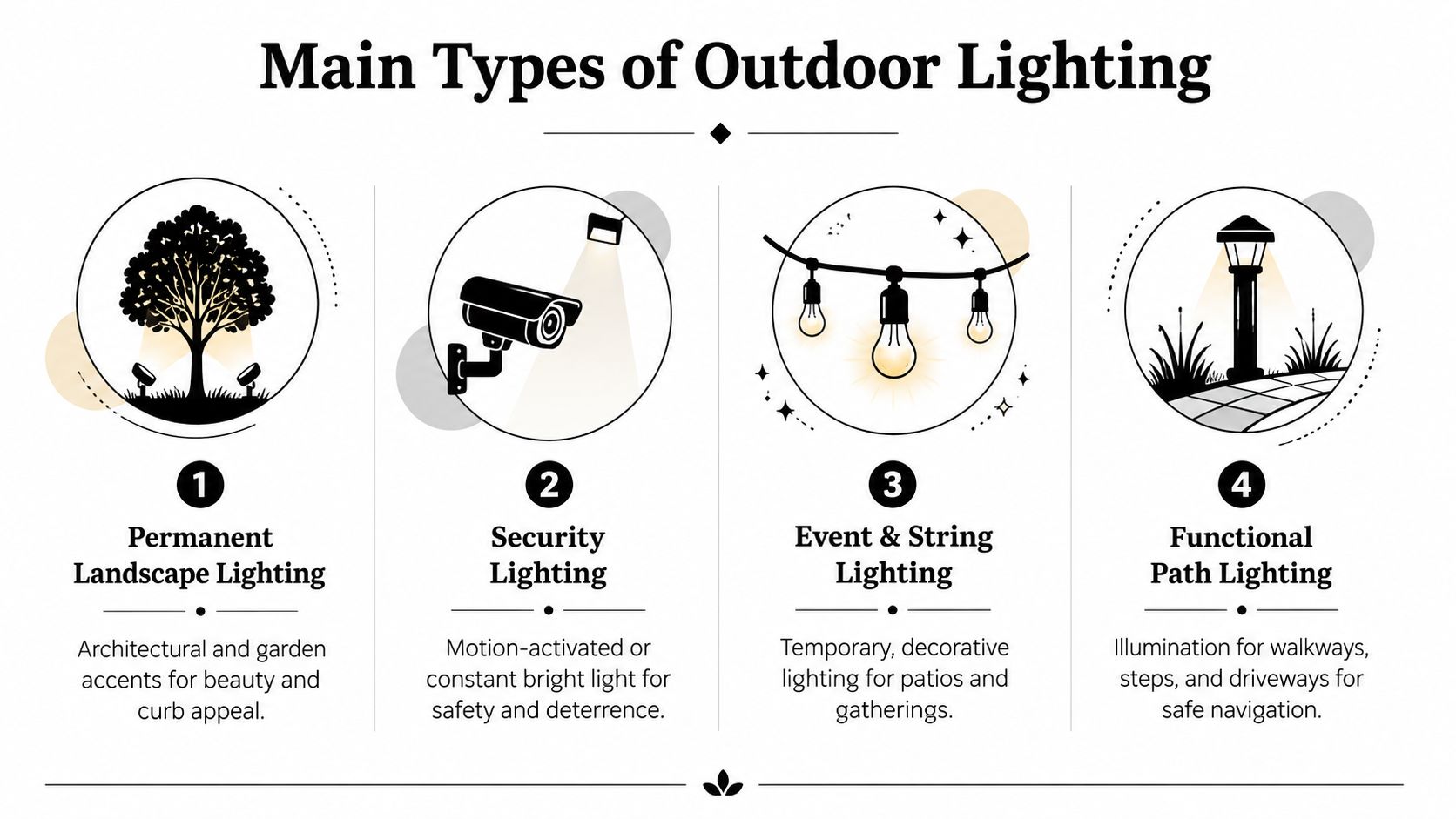
Most calls fall into one of four buckets. Garden lighting highlights garden beds, trees, and architectural lines. Accent lighting draws attention to stonework, columns, or entry features. Security and pathway lighting improves visibility where people walk and where activity needs to be seen. Permanent or holiday lighting supports year-round curb appeal or seasonal displays that stay neat and controlled instead of hanging loosely from gutters.
When you know which bucket you're in, the contractor conversation gets easier. You're not asking for “lights,” you're asking for the kind of lighting that fits your home, your usage, and your maintenance tolerance. That's the right starting point before anyone starts sketching fixture locations or talking about transformers.
Main Types of Outdoor Lighting Installation Services
Permanent landscape lighting and accent lighting
Outdoor lighting is the category most homeowners picture first. It's the soft uplight on a tree, the wash on a stone wall, the small fixture tucked near a bed edge, or the path light that keeps a walkway readable without overpowering the yard. Accent lighting is similar, but the goal is more focused. It highlights one feature, an entry arch, a textured façade, a specimen tree, or a front porch detail.
These projects are often low-voltage and can be planned in phases. A simple front-yard layout may be a one-day job, while a larger property with multiple planting areas, hardscape edges, and several trees takes more planning. Permanent systems make the most sense when the goal is consistent curb appeal and a polished look that stays in place.
Security and pathway lighting
Security lighting works differently. It's about visibility, deterrence, and making movement safer around dark areas. Motion-activated fixtures near side yards, brighter coverage for driveways, and well-placed path lights near steps or garage approaches all belong here. These installs can be straightforward, but they need correct placement more than raw brightness.
Pathway work is one of the most practical categories because it solves everyday problems. Guests need to see the next step, family members need to move through the yard without guessing, and service providers need access without using flashlights. In many homes, this is the category that blends best with outdoor area lighting.
Holiday and permanent display lighting
Holiday and permanent display lighting are visually different from standard outdoor work. Temporary event lighting and seasonal roofline displays usually focus on presentation, while permanent systems are built to stay installed and look intentional all year. One internal resource on permanent outdoor lighting installation is useful here because permanent systems demand cleaner routing, tighter alignment, and better planning than a quick seasonal setup.
A quick comparison helps:
| Type | Main purpose | Typical feel | DIY-friendly? |
|---|---|---|---|
| Landscape and accent | Beauty and depth | Subtle, layered | Sometimes |
| Security and pathway | Safer movement | Functional and direct | Sometimes |
| Holiday and permanent display | Seasonal or year-round visual impact | Highly visible | Usually better with a pro |
What a Professional Site Assessment Actually Looks Like
A good site walk starts with questions, not tools. The installer wants to know whether you care most about security, entertaining, front-yard curb appeal, or a holiday look that doesn't require a ladder every season. That conversation shapes where fixtures go, what kind of output is needed, and whether the project stays low-voltage or moves into licensed electrical work.
What gets checked before installation day
On a real walk-through, a qualified installer looks at the home's architecture, the planting beds, and the places where people move at night. They check sun and shade patterns, note where trees will block light over time, and look for sprinkler heads, root zones, and grade changes that could interfere with cable routing. They also inspect transformer placement, access to a GFCI-protected outlet, and any existing wiring that could conflict with the new work.
A careful assessment prevents most of the problems that homeowners think are “normal” after the job is done, like uneven coverage, obvious fixtures, or cables that were placed too close to other landscape systems.
Different properties need different approaches. A single-family home near Austin Bluffs has different priorities than a storefront in Manitou Springs or an HOA-managed townhome with common-area restrictions. Commercial sites often need cleaner sightlines, more uniform coverage, and better coordination around customer access.
What you should ask during the walk-through
If a contractor is rushing through the visit, that's a warning sign. Ask who is handling the electrical work, whether the plan includes fixture aiming, and how the installer handles adjustments after dark. Those answers tell you whether you're getting a real design process or a quick sales visit.
One practical sign of a serious assessment is documentation. Good installers leave notes, measurements, and sometimes on-site lux readings so the final setup can be compared against the design intent later. That matters because a light that looks fine during the day can still be too bright, too narrow, or aimed at the wrong angle once the sun goes down.
When the walk-through is done well, the homeowner has a clear picture of the scope before any trenching begins. That's the right time to compare options, not after fixtures are already in the ground.
Typical Costs and Pricing Models
Outdoor lighting quotes get confusing fast because contractors may bundle fixture work, wiring, controls, and cleanup in different ways. A straightforward residential job often starts in the low thousands, and a larger project can climb when the layout gets more complex, the wiring needs change, or the property needs extra ground repair after trenching. Permanent display lighting and holiday lighting can also follow a different pricing model from accent and security lighting, so the right comparison starts with the type of job, not just the total price.
For Colorado Springs homeowners, the biggest cost split usually comes down to three practical thresholds. Small DIY-friendly low-voltage kits sit at one end. Mid-size permanent or seasonal installs sit in the middle. Jobs that need line-voltage work, new circuits, or code-sensitive electrical changes belong at the higher end and may require a licensed electrician.
How contractors usually price the work
Per-fixture pricing is common for accent and security lighting because each head adds labor, cable, aiming time, and troubleshooting. A contractor may also use a flat-rate project when the scope is easy to define, such as a front elevation, a driveway edge, or a few entry points. Holiday and permanent display lighting is often priced seasonally or by linear footage, because roofline length, mounting detail, and controller setup matter more than a simple fixture count.
The fixture itself is only part of the bill. Transformer upgrades, dedicated circuits, trenching through hardscape, smart controls, and follow-up adjustments all add labor and materials. If a property has older wiring, tight access, or landscaping that has to be protected and restored, the quote usually moves higher for reasons that show up on the job site, not on the product sheet.
| Project Type | Typical Range | Average | What Drives Cost Up |
|---|---|---|---|
| Residential outdoor lighting | $2,000 to $6,000 | $4,000 | More fixtures, trenching, hardscape, controls |
| Complex property-wide installs | Higher-end projects | Can reach $7,500 or $15,000+ | Electrical upgrades, landscaping conflicts, larger scope |
| Seasonal or permanent display lighting | Varies by layout | Quote-based | Roofline length, mounting detail, controllers |
How to compare quotes fairly
Two bids can look far apart even when the actual work is similar. One estimate may include aiming, controller setup, and cleanup, while another only covers the basic install and leaves the rest for later. Ask what is included, what gets charged as an add-on, and whether annual service is part of the package or billed separately.
A homeowner in Colorado Springs gets better value by comparing scope, not just the headline number. The lower bid is not the better bid if it skips transformer work, proper burial depth, or a final walkthrough that confirms the lights perform the way the plan promised. HomeAdvisor points to that same basic range, which is useful when you're sanity-checking a bid.
The Installation Process and Typical Timeline
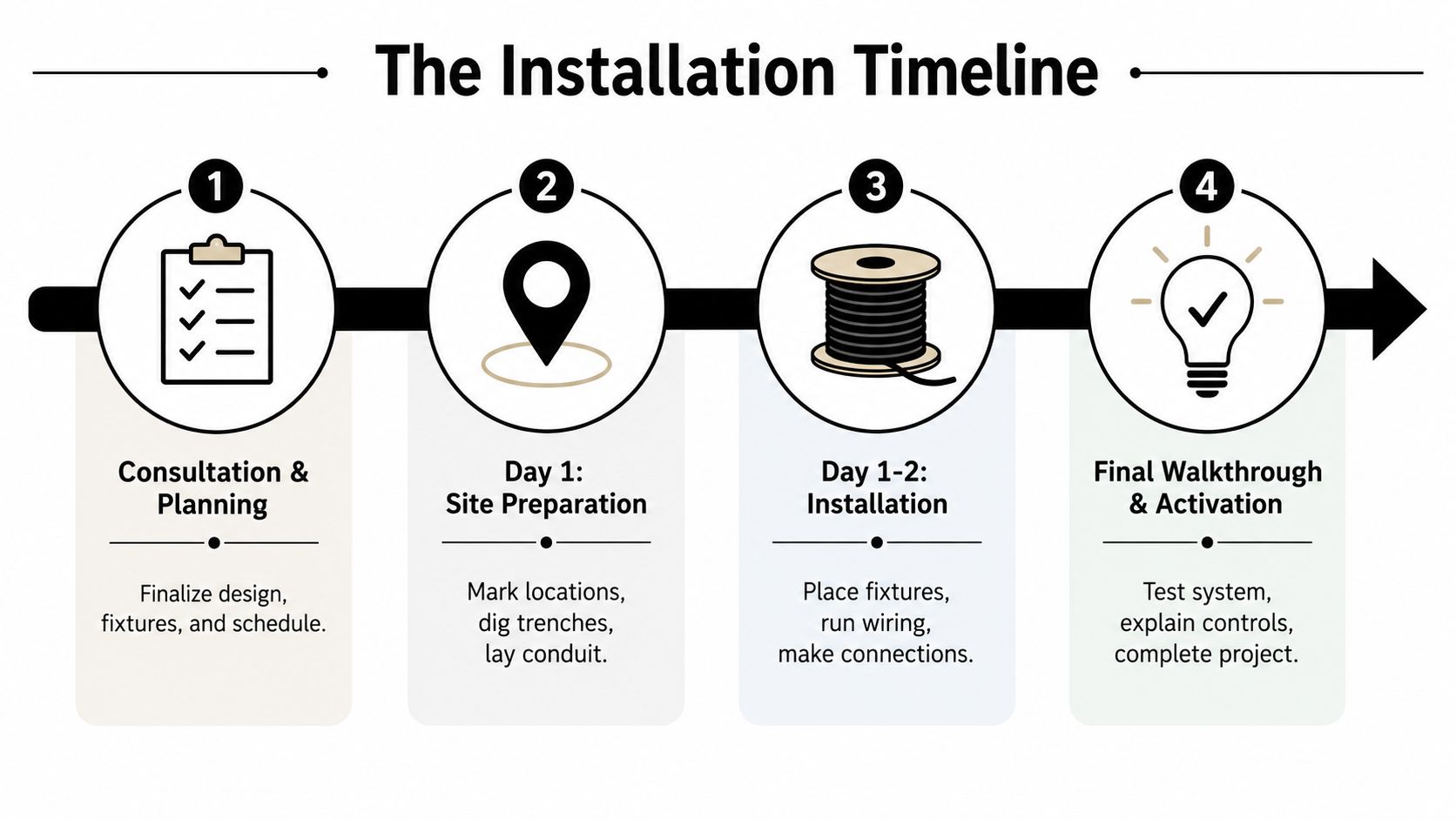
A clean install usually follows a simple sequence, but the details matter. First, the crew marks fixture locations and checks the layout against the home, the beds, and the walking paths. Then they run low-voltage cable or route line-voltage feeds, depending on the job, before mounting fixtures and making the connections.
What happens on the ground
The hands-on work is more orderly than most homeowners expect. Cable runs get placed so they're protected, fixtures are anchored or staked, and transformers are connected in a way that supports future service. If the project includes timers or smart controls, those get programmed before the team leaves.
Commissioning is a vital stage. This involves the installer testing the system, checking output, adjusting aiming, and confirming the lights match the design intent in real conditions. That often includes a nighttime pass, because outdoor lighting looks very different at dusk than it does during daylight.
Typical timeline depends on scope. A small accent job may wrap in a single afternoon. A larger accent and security install on a bigger lot often takes one to three days. Permanent holiday lighting can take a long workday or more, especially when channel alignment has to stay clean across the whole roofline.
What a proper handoff includes
The end of the job should feel organized, not rushed. Expect a walkthrough of the controls, a quick explanation of how to adjust schedules, and any warranty paperwork or maintenance notes. A good installer also leaves diagrams or notes that make future repairs easier.
If the crew disappears before sunset and never comes back to check the lights at night, the job probably wasn't fully finished.
The best projects are the ones where the homeowner knows what was installed, how it's controlled, and what to do if a fixture gets bumped later. That clarity saves time on both sides.
Safety and Code Considerations Homeowners Often Miss
A lot of people think outdoor lighting is a weekend project because the fixtures look simple. That's only true for part of the category. Once a project touches line-voltage wiring, new exterior circuits, weatherproof terminations, or local permitting, it stops being casual work.
Three rules that keep people out of trouble
If you're tying into a 120V circuit or adding new exterior electrical, plan on permits and proper inspection where required. If you're only adding 12V fixtures downstream of an existing transformer, you're often in DIY territory, assuming the layout stays simple and safe. If the system crosses public sidewalks, driveways, or commercial lots, expect stricter rules and more scrutiny.
Homeowners also miss the small but important details. Outdoor transformers should sit near a GFCI outlet, exterior wiring may need inspection before burial, and weather-rated connections matter in damp or exposed areas. Those points are scattered across consumer advice, but they become much more important when someone is pulling wire through soil and around structures. Home Depot's landscape lighting guide touches on those practical issues, even though most homeowners still don't get a simple decision rule from it.
Where the line is between DIY and pro work
The boundary is pretty clear in practice. Low-voltage outdoor lighting downstream of an existing transformer can be homeowner-friendly if the layout is straightforward. Anything involving new electrical, weatherproof exterior circuits, or code-sensitive commercial access should be handled by a licensed electrician or a contractor who uses one.
For businesses and multi-unit properties, the bar is higher. A commercial walk area or shared entry often needs stricter placement and more careful coordination. That's why a resource like commercial outdoor lighting installation matters for property owners who need a cleaner, compliance-aware approach.
A simple way to think about risk
- Low-voltage, simple layout: often manageable.
- New wiring or line-voltage tie-in: bring in a licensed pro.
- Shared access areas or public edges: expect permits and tighter rules.
Safety isn't just about avoiding shocks. It's also about making sure the system lasts, passes inspection where needed, and doesn't create a problem when winter weather, irrigation, or foot traffic shows up.
Maintenance and Seasonal Care That Protects Your Investment
Outdoor lighting shouldn't be treated as a set-it-and-forget-it purchase. A system that looked sharp in spring can start to look tired by midseason if nobody cleans the lenses, checks the aim, or updates the control schedule. Colorado weather makes that even more important because freeze-thaw cycles and sudden changes can move fixtures and expose cable runs.
The seasonal checklist that actually helps
Start with the lenses and housings. Pollen, dust, and hard-water spots can dull the output and change how the light reads at night. Then check for cable heave, especially after winter, because shifting soil can lift stakes or expose low-voltage lines.
Trimming matters more than people expect. Shrubs and perennials grow into beam paths, and that turns a careful lighting plan into a patchy one. It also helps to verify transformer output and reset timers or smart-controller schedules as daylight changes through the year.
LED systems usually need less bulb-style maintenance than older halogen or incandescent setups. Older systems still need regular lamp swaps and more hands-on attention. Holiday and permanent lighting also need a decision about storage, year-round use, or seasonal removal, depending on how the system was designed.
The easiest maintenance plan is the one tied to the seasons, not to a panic repair after a fixture fails.
For homeowners who want to understand the electrical side of an exterior project, an electrical guide for sheds can be a useful reference point because it shows how outdoor power decisions change once you move beyond simple plug-in equipment.
When to call a service provider
A quick seasonal visit makes sense when you don't want to get on a ladder, dig up a buried cable, or troubleshoot a control box in cold weather. That's especially true for permanent lighting, high fixtures, or systems that need a fresh aiming pass after landscaping changes. A short maintenance appointment now is usually easier than a full repair later.
The goal is simple, keep the system looking intentional. If the lights still follow the design, the property keeps the clean, finished look you paid for.
How to Choose and Vet a Reliable Local Installer
The strongest bids are not the cheapest ones, they're the ones that answer the hard questions up front. A reliable Colorado Springs installer should be clear about who handles the electrical work, whether permits are pulled when needed, and what happens if a fixture shifts or a control fails after installation. That level of detail matters more than polished sales talk.
What to verify before you sign
For line-voltage work, confirm a valid Colorado electrician's license. Ask for a certificate of insurance, not just a verbal promise that they're covered. Then ask for a portfolio of similar local projects and references you can contact.
A strong proposal should spell out the scope, fixture counts, cable layout notes, brands, timeline, warranty terms, and whether aiming and commissioning are included. If the quote is vague, the job probably will be too. That's the kind of detail homeowners should expect whether the project is a front entry, a commercial façade, or a permanent rooftop display.
If you're comparing control systems as part of a broader exterior upgrade, even something like how cellular gate openers work can help you think more clearly about automation, access, and reliability outdoors. The same principle applies here, simple controls work best when the underlying installation is solid.
A quick vetting checklist
- License and insurance: verify both before work begins.
- Relevant experience: look for similar homes, storefronts, or HOAs.
- Written scope: make sure materials, labor, and controls are listed.
- Warranty and service: know what's covered after the first night.
One practical option in Colorado Springs is Cultivate House Detailing, which offers permanent lighting and holiday light installation as part of its exterior service lineup for homeowners and property managers. The value is in having one local crew handle the measuring, cutting, installation, and setup so the finished system fits the property cleanly.
If you're ready to get your yard, entry, or building front working better after dark, schedule a walk-through with a local installer and ask for a detailed quote. Visit Cultivate House Detailing to request service and start planning outdoor lighting that fits your home, your budget, and your Colorado Springs property.
Need it done properly the first time? Cultivate House Detailing offers holiday lighting installation in Colorado Springs. Get a free quote.
Serving Manitou Springs and the surrounding Colorado Springs area — see our window cleaning services in Manitou Springs.