You're looking through the kitchen window on a cold Colorado Springs morning. Frost traces the edges, road salt dulls the lower glass, and the sun is only beginning to reach the view toward Pikes Peak. The question isn't whether the windows look dirty. It's whether today is safe for exterior window cleaning, or whether a professional should wait.
Window washing in winter can deliver excellent results, but it isn't a calendar-based service. Wind, sunlight, glass temperature, frost, condensation, access conditions, and drying time all matter. That's especially true for residential window cleaning and commercial window cleaning in Colorado Springs, where a mild midday can change quickly once shade or wind reaches the glass.
Cultivate House Detailing serves Colorado Springs and nearby communities with professional window cleaning for homes and businesses, including interior window cleaning, exterior window washing, screen cleaning, and track cleaning. The right service plan starts with honest judgment. Sometimes the best recommendation is to clean. Sometimes it's to wait.
Why Winter Window Washing Is a Judgment Call
A homeowner may call because hard-water marks have clouded the view, salt haze has collected along the lower panes, or fireplace soot has settled on interior glass. Condensation rings can make a recently cleaned window look dirty again within days. Those problems are real, but winter adds another question: can the glass and surrounding surfaces handle the cleaning process today?
Cold-weather washing differs from summer work because the liquid film can freeze before a squeegee removes it. Water can also turn walkways, decks, sills, and ladder footing into slip hazards. A streak-free result requires more than a strong solution. It requires the crew to read the property and the weather together.

What changes from one side of the house to another
A sunny south-facing pane may warm enough for a carefully managed service visit while a shaded north-facing pane remains icy. A protected storefront may be workable when an exposed upper window is receiving constant wind. Glass temperature can differ from the air temperature, and the forecast alone can't show whether the solution will freeze on contact.
That's why local scheduling should focus on conditions rather than promises. A professional window cleaning company working in Colorado Springs has to consider the homeowner's priorities alongside surface temperature, wind, sun exposure, glass condition, and safe access. The same decision applies to a home in Black Forest, a retail property in Monument, or an office near central Colorado Springs.
Practical rule: If water can't be removed before it freezes, the job should wait.
Homeowners who manage service marketing or contractor operations can also find useful planning ideas in these local lead generation tips for contractors. For customers, the practical takeaway is simpler: ask whether the provider evaluates the actual property before committing to exterior work.
For seasonal planning, this guide to the best time to clean windows can help you think beyond one unusually warm afternoon. Winter window washing is worthwhile when the conditions support safe access, controlled water use, and complete drying. When they don't, waiting protects the glass, the property, and the people doing the work.
The Conditions That Decide the Job
Colorado Springs winter weather makes a simple temperature rule unreliable. NOAA-based climate information lists an average winter temperature of approximately 32°F, with typical winter highs around 45°F and lows around 19°F. The area also averages about 160 nights at or below 32°F and roughly 87 days with measurable precipitation annually, according to NOAA-based Colorado Springs climate information.
Those numbers explain the problem. A forecast can look mild while the glass stays cold enough to freeze cleaning solution. Shade, wind, elevation, recent snowfall, and overnight frost all change the job.
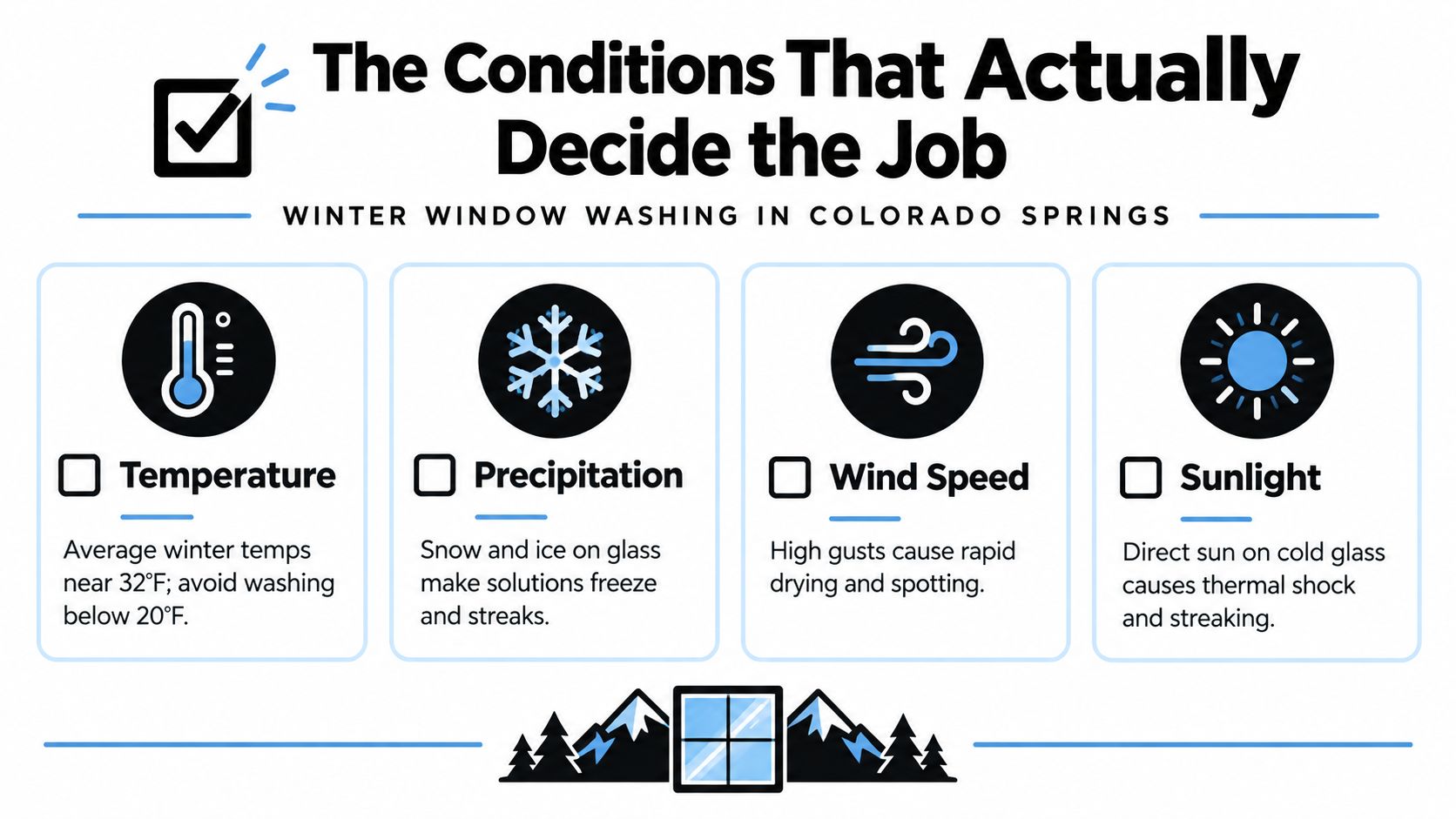
The four checks that matter most
Temperature gives you a starting point, not a finish line. The pane itself may be colder, especially on shaded sides of the house or building.
Wind changes the equation fast. It lowers the effective temperature and speeds evaporation, so a solution that works in calm air can freeze or dry unevenly in gusts.
Sunlight helps in one spot and hurts in another. Direct sun can warm a pane enough to make it workable, but uneven heating can also leave streaks or create thermal stress.
Surface condition decides whether the job is safe at all. Frost, ice, snow-covered frames, and wet walkways can shut down a job even when the window is easy to reach.
The liquid film matters more than the bucket. Plain water freezes at 32°F (0°C), and a thin film on cold glass can freeze faster than bulk water because the pane pulls heat from it. Once ice forms behind the squeegee, the tool drags frozen bands across the surface instead of clearing water cleanly. Scraping those spots raises the chance of residue and scratches. The right move is to test a small section first and stop if the solution starts freezing. One professional equipment source recommends avoiding exterior work when the effective temperature, including wind chill, falls below 25°F (-4°C), as explained in this cold-weather window cleaning guide.
A homeowner-friendly screening rule
Look at the glass and the access route before you book residential or commercial service. If the pane is dry, free of frost, exposed to workable conditions, and surrounded by safe footing, a professional can usually proceed. If ice is still on the glass, runoff will hit an icy walkway, or wind makes controlled squeegee work impossible, reschedule.
A south-facing pane in afternoon sun may be serviceable while a north-facing pane stays below freezing. That is the point. Winter window washing should be scheduled by conditions on the property, not by a blanket rule about the season.
Equipment and Technique Adjustments for Cold Glass
Cold glass demands a different process. The objective isn't to flood the pane and hope the solution stays liquid. It's to use a controlled amount of water, remove it quickly, and dry every place where drips could freeze.
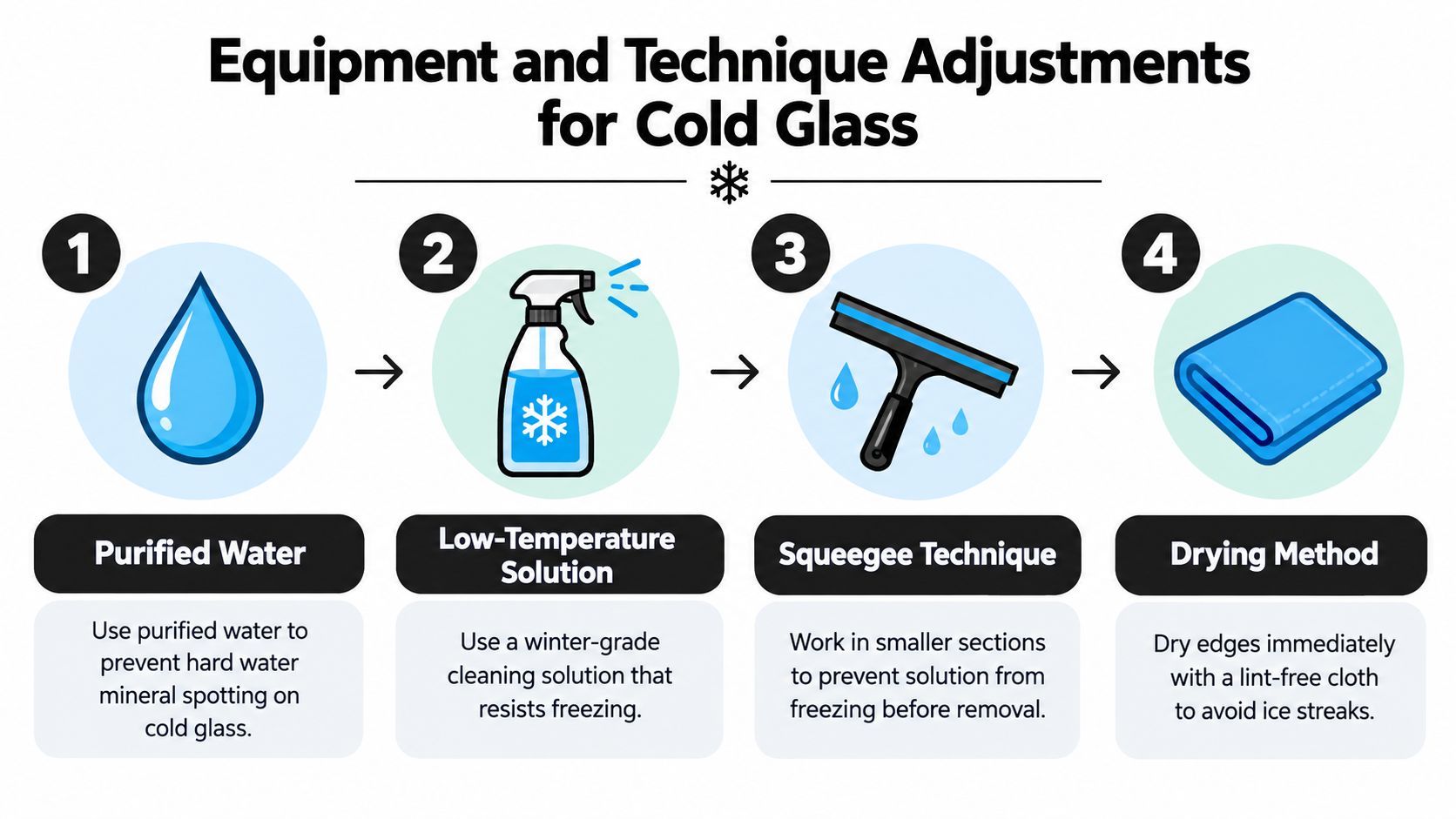
Professional crews often use purified water to reduce mineral spotting, especially when cold conditions leave less time for correction. A winter-rated solution should have a documented low-temperature operating range. Don't assume that any alcohol, detergent, or improvised mixture is suitable for every type of glazing, seal, frame, or finish.
Use controlled heat, not hot water
Hot water should not be applied to frozen or very cold panes. A sudden temperature difference can create thermal stress in the glass and may damage adjacent sealants or frames. A technical cleaning guide recommends lowering hot-water-system settings by 10 to 20°F from normal winter operation and testing a small area first, as described in this winter window cleaning weather guide.
Lukewarm water is the safer working choice. It provides enough cleaning power without forcing a sharp temperature change across a pane that has been exposed to freezing air.
Keep the liquid moving
Technique controls freezing as much as solution choice does.
- Start low: Working from the lower portion upward can allow the first pass to pre-warm the glass above it.
- Work smaller areas: Smaller sections reduce the time that liquid sits exposed to cold air.
- Move quickly: Rapid, overlapping squeegee strokes remove the film before freezing begins.
- Dry the edges: Sills, tracks, frame corners, and seals should be dried immediately with a clean, lint-free cloth.
- Remove grit first: Road salt and abrasive debris should be cleared before wet cleaning to reduce the chance of dragging particles across the glass.
These principles apply to a Black Forest home, a Monument storefront, or a multi-story office in central Colorado Springs. Cultivate House Detailing uses professional tools and adapts its cleaning solution for colder conditions, with service decisions based on whether the weather allows safe, clean work.
For homeowners comparing equipment approaches, these window cleaning tools and tips provide useful background on squeegees, cloths, and workflow. You can also learn more about deionized water window cleaning when mineral spotting is a recurring concern.
Condensation, Frost, and the Building-Performance Side of Winter
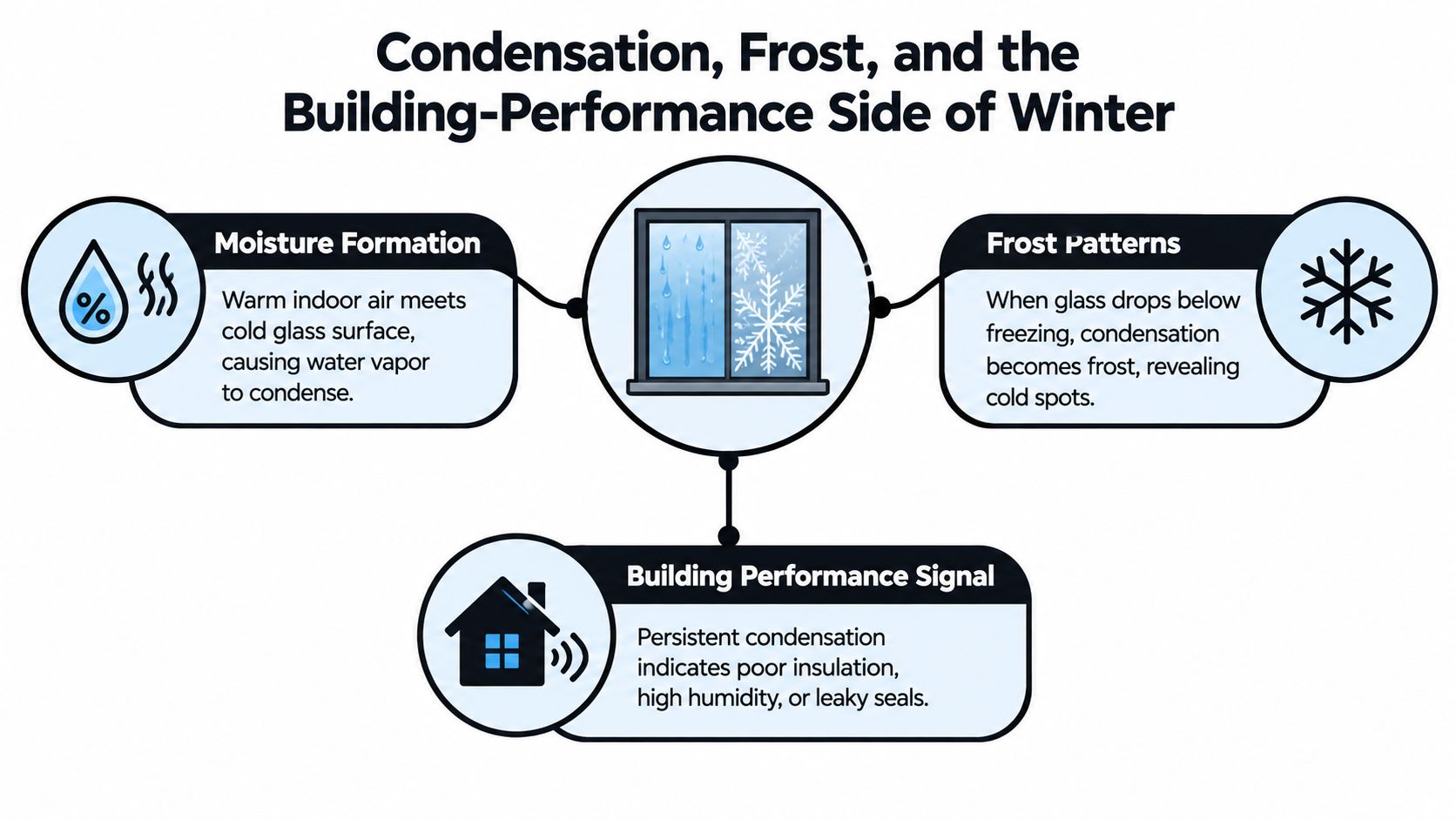
Foggy glass is often treated as a cleaning problem. That's incomplete. Condensation forms when a glass surface falls to or below the indoor dew-point temperature, which means warm indoor moisture is meeting a sufficiently cold pane.
A clean window can still fog. Cleaning removes dirt, salts, and residue, but it doesn't correct high indoor humidity, inadequate ventilation, air leakage, poor insulation, or a failed seal. Repeated moisture on the same panes deserves attention beyond another round of streak-free window cleaning.
Why moisture deserves a maintenance response
A peer-reviewed energy-simulation study modeled cold-climate building zones classified as ASHRAE Zones 5, 6, and 7. When the model included the reduced insulating performance associated with condensation, annual heating energy use averaged 8% higher than in a baseline model that ignored condensation, according to the condensation energy-simulation research.
That modeled average isn't a universal penalty for every Colorado Springs property. It does establish a practical connection between persistent window moisture and whole-building heating demand. Water or ice around glazing can reduce effective thermal resistance, allowing more heat loss through the window assembly.
EPA guidance explains that cold-season air holds less moisture, so water commonly condenses on cold surfaces such as window glass. The agency also notes that prolonged excess humidity can damage building materials and support mold growth, as outlined in its guidance on controlling moisture in the home. For many commercial and institutional buildings, a winter indoor dew point around 35°F is identified as a prudent compromise.
What a service visit should identify
A professional crew can clean visible deposits, but the visit should also prompt useful observations:
- recurring condensation in the same rooms
- standing water in tracks and sills
- frost concentrated along particular edges or corners
- moisture patterns that vary by window orientation
- signs that ventilation or humidity deserves follow-up
Homeowners and property managers should treat repeated fogging as a building-maintenance signal. A cleaning company can document what it sees, while HVAC, insulation, or building-envelope professionals may need to investigate the cause.
A humidifier may support comfort in a dry home, but adding moisture without monitoring condensation can worsen a window problem. This guide to winter humidifier perks is useful background, but the correct humidity level depends on the building and its symptoms. More frequent washing isn't the answer when the same panes repeatedly collect water.
A Winter Go or No-Go Checklist Before Booking Service
Use the property, not just the forecast, to make the call. Exterior window cleaning in Colorado Springs makes sense when the glass is free of active ice, the access route is stable, the wind is manageable, and the crew can remove and dry the solution before temperatures drop again.
As covered above, avoid exterior work when the effective temperature, including wind chill, falls below 25°F (-4°C). The practical test is simple, a small section should stay wet long enough to clear cleanly. If the solution starts freezing, drags across the pane, or leaves icy bands, stop and reschedule.
| Condition | Go Ahead | Reschedule |
|---|---|---|
| Glass temperature | Pane is dry and appears safely above freezing | Frost, ice, or a visibly frozen surface remains |
| Air and wind | Conditions are comfortably above freezing with manageable wind | Effective temperature is near or below 25°F (-4°C) |
| Test patch | Small area stays liquid and clears cleanly, with the squeegee moving smoothly and leaving a quiet, even wipe | Solution starts freezing, the squeegee drags, squeaks, or leaves streaked ice lines |
| Sun exposure | Light reaches the glass without creating sharp hot and cold areas | Uneven sun, shade, or concentrated heat creates abrupt changes |
| Access | Ladder, roof, deck, sidewalk, and entry areas are dry and stable | Snow or ice threatens footing or public access |
| Drying time | Sills, frames, and walkways can dry before temperatures drop | Water will remain on surfaces and refreeze |
Check access before checking the view
OSHA identifies snow and ice as winter workplace hazards. That matters for ladders, roofs, decks, sidewalks, and entry areas, not just the window itself. A reachable pane is still a bad job if the crew has to stand on an icy surface or leave frozen runoff where customers and residents walk.
Thermal shock deserves its own check. Do not use hot water on frozen glass, do not direct concentrated heat at a cold pane, and do not create abrupt uneven wetting. Pilkington explains that a 40°F difference between the center and edge of glass can create approximately 2,000 psi of stress, calculated at about 50 psi for every 1°F difference, in its technical bulletin on thermal stress. Book during the warmest part of the day and make sure glass, frames, walkways, and equipment can dry before evening.
Residential and Commercial Winter Service Differences
The same cold-weather rules apply to homes and businesses, but the reasons for booking and the logistics of the work are different. Residential customers usually notice the problem from inside. Commercial customers often see it first in the public-facing appearance of the property.
Residential window cleaning priorities
A single-family home may need exterior window cleaning for hard-water spotting, salt film, fireplace residue, or cooking buildup. Interior window cleaning can brighten rooms during shorter winter days, while screen cleaning and track cleaning remove debris that traps moisture and dirt.
Multi-story access requires more planning, especially for homes with windows up to the fourth story. A professional crew must evaluate ladder placement, rooflines, decks, snow, ice, and nearby landscaping before starting. Homeowners preparing for showings or pre-holiday gatherings may want the glass cleaned quickly, but the safest service date is still the one that allows proper drying and stable footing.
Commercial window cleaning priorities
Storefronts, restaurants, offices, auto dealerships, grocery stores, and retail properties have a different pressure. Streaks can show under parking-lot lighting, entry glass collects fingerprints and salt, and cleaning may need to happen around business hours. A crew also has to manage ladders, water, signage, customers, delivery routes, and public walkways.
A property manager may prefer recurring commercial window cleaning rather than a single seasonal visit. A recurring plan can coordinate exterior window washing with pressure washing for patios, walkways, siding, and driveways, along with gutter cleaning and fire-mitigation clearing. That approach reduces the number of separate access disruptions and gives the building owner one maintenance conversation.
A storefront doesn't need the same schedule as a private home, but both need the same honest answer about glass temperature, wind, ice, and access.
For either property type, the service should clarify what is included. Ask whether the estimate covers interior window cleaning, exterior glass, screens, tracks, hard-water stain removal, frame drying, and difficult-access windows. Clear scope matters more in winter because a partial job can leave wet areas or unsafe runoff behind.
Timing Your Winter Wash and Booking With Cultivate House Detailing
The strongest winter service window usually comes from watching for workable weather, not waiting for a fixed date. Late fall is often a practical time to clean before sustained freezes. A mid-winter thaw can also work when the day is calm and sunny. The stretch before spring deserves attention because snow, road salt, grit, and residue may have accumulated across the glass and frames.
That doesn't mean every warm afternoon is suitable. The crew still needs to inspect the glass, test the solution, evaluate wind, and confirm that water can be removed before refreezing. In nearby communities, local conditions can differ from central Colorado Springs. Elevation and exposure matter in Black Forest, Monument, Manitou Springs, and Woodland Park.
Bundle the work that winter exposes
A seasonal window cleaning visit can include more than glass. Homeowners and property managers may combine:
- Exterior window washing: Remove salt haze, dirt, and residue when conditions support safe drying.
- Interior window cleaning: Clear fingerprints, fireplace soot, cooking film, and condensation marks.
- Screen and track cleaning: Remove trapped debris that holds moisture near the frame.
- Pressure washing: Refresh patios, walkways, siding, and driveways when surfaces are safely serviceable.
- Gutter cleaning: Clear accumulated debris before runoff creates additional exterior problems.
- Fire-mitigation clearing: Address applicable exterior vegetation and debris concerns as part of broader property maintenance.
Cultivate House Detailing provides these services for residential and commercial customers in Colorado Springs and surrounding service areas. The company's winter approach uses professional equipment, cold-weather solution adjustments, and rescheduling when conditions are too cold for safe, clean work.
What to expect when you schedule
A useful estimate should account for building height, access, glass condition, interior or exterior scope, screens, tracks, and weather exposure. On the service date, customers should expect a punctual crew, careful preparation, controlled water use, professional tools, attention to detail, and clear communication if conditions change.
Winter window washing is a smart maintenance decision when the property is ready for it. It's a risky shortcut when ice, wind, or freezing glass makes clean removal impossible. Request a quote from Cultivate House Detailing when the forecast and surfaces look favorable, and let the crew confirm the final go or no-go decision on site.
Cultivate House Detailing provides residential and commercial window cleaning in Colorado Springs, including interior and exterior glass, screens, tracks, and difficult-access windows, with related pressure washing and gutter services. For condition-driven winter window washing, visit Cultivate House Detailing to request a quote or schedule service when your property is ready.