
If you're in Colorado Springs, you've probably seen the pattern. A dry spell, a windy afternoon, a little pine needle drop, then one hard rain or spring melt and water suddenly spills over the gutter edge instead of moving cleanly through the downspouts. It doesn't take a dramatic storm for a small gutter problem to turn into a home protection problem here.
That matters more along the Front Range than many national guides let on. Local homes deal with pine needles, grit, roof granules, freeze-thaw swings, and in some neighborhoods, wildfire ash and defensible-space concerns. A gutter that looks only mildly dirty from the ground can already be holding enough packed debris to slow drainage and leave water sitting in the trough.
Residential gutter cleaning isn't just a seasonal chore. In Colorado Springs, it's part of protecting the roofline, siding, foundation, and the areas around your home that see the first impact when drainage fails. Homeowners usually notice the early warnings the same way: overflow at one corner, a downspout that dribbles instead of drains, or a dark line on the siding after runoff misses its path.
Your Local Guide to Residential Gutter Cleaning in Colorado Springs
You walk out after a spring storm, and the gutter over the front entry is spilling water in a sheet. From the ground, it looked fine the day before. Up close, the trough is packed tight with pine needles, roof grit, and the muddy buildup that forms after a few wet and dry cycles.
That pattern is common in Colorado Springs. Gutters here collect more than leaves. They catch ponderosa and spruce needles, granules washed off aging shingles under strong sun, windblown dirt, and in some areas, ash and fine debris that matter for wildfire cleanup as much as drainage. A system can look only half full and still drain poorly because the outlet or downspout elbow is already choked down.
Local terrain makes the problem more specific.
Homes near the foothills, under mature pines, or in exposed neighborhoods often need a tighter cleaning schedule than the generic advice you see in national articles. Snowmelt can reveal slow sections that never show up during a quick summer rain. Summer downpours hit hard and fast. In fire-prone areas, dry needles sitting in gutters also add fuel at the roof edge, which turns routine maintenance into part of basic home hardening.
Good gutter service is not just scooping debris out of a channel. It means checking flow, clearing the downspouts, watching for standing water, and making sure the system is doing its job as one of the home's effective roof drainage systems.
I see the same mistake every year. Homeowners wait until they spot obvious overflow, but the clog usually started weeks earlier. By then, the packed debris has had time to settle, hold moisture, and create a heavier, denser blockage that is harder to clear completely.
What homeowners need in Colorado Springs is simple. A gutter cleaning service that understands pine needle buildup, freeze-thaw stress, steep rooflines, and the added fire-risk concerns that come with debris at the eaves. That local understanding is what turns gutter cleaning from a checklist item into smart preventive maintenance.
Why Gutter Cleaning Is Your Home's First Line of Defense
A summer storm rolls over the Springs, rain hits hard, and the gutter that looked "mostly fine" an hour earlier starts pouring water straight over the edge. Now the problem is no longer in the gutter. It is on the fascia, against the siding, and collecting near the base of the house.

Water problems start at the roofline
Gutters have one job. They collect roof runoff and move it to a safe discharge point before that water can soak the materials wrapped around your home.
When they clog, the runoff takes the shortest path it can find. On Colorado Springs homes, that often means water slipping behind the gutter, splashing over the front, or dumping in one concentrated spot near a corner. I have seen minor gutter neglect turn into rotted trim, stained siding, washed-out mulch beds, and saturated soil along the foundation line. The cleaning itself is usually simple. The repair work after a season of overflow is not.
That is why gutters are part of the home's effective roof drainage systems, not just a metal trough attached at the eaves.
Failure follows a familiar pattern
Overflow tends to damage the same areas again and again:
- Foundation edges: Repeated runoff can over-saturate the soil and increase the chance of water working back toward the structure.
- Siding and trim: Splash-back leaves stains, keeps surfaces wet longer, and can shorten the life of paint and wood components.
- Fascia and soffits: Water that rolls behind the gutter often shows up here first.
- Entry walks, beds, and lower-grade areas: Concentrated discharge can erode soil, shift mulch, and create slick spots during colder weather.
The pattern matters because it helps homeowners catch the issue before it turns into a larger repair. A small overflow mark is usually a warning, not a cosmetic nuisance.
Debris creates more than a drainage problem
Wet gutter debris stays heavy, especially after spring snowmelt or back-to-back summer storms. That extra weight puts strain on hangers, seams, and corners. In shaded areas, the material breaks down into a dense muck that is harder to flush and easier to miss if someone only skims the top.
In Colorado Springs, there is another concern. Dry pine needles packed along the roof edge add fuel in a place homeowners should keep as clean as possible. For homes in higher-risk areas, gutter cleaning supports basic wildfire mitigation as much as water control. National guides rarely treat that as part of gutter maintenance, but local homeowners should.
Prevention is cheaper than correction
Homeowners often wait until they see obvious spillover. By that point, water has usually been escaping in small amounts for a while, especially during heavier rain or uneven snowmelt.
Regular cleaning keeps the system working the way it was built to work. It also gives you a chance to spot loose brackets, sagging sections, separated joints, and downspouts that are discharging too close to the house before those smaller issues create bigger ones. Around Colorado Springs, that kind of prevention is not busywork. It is one of the simplest ways to protect the roof edge, the exterior walls, and the ground around the foundation.
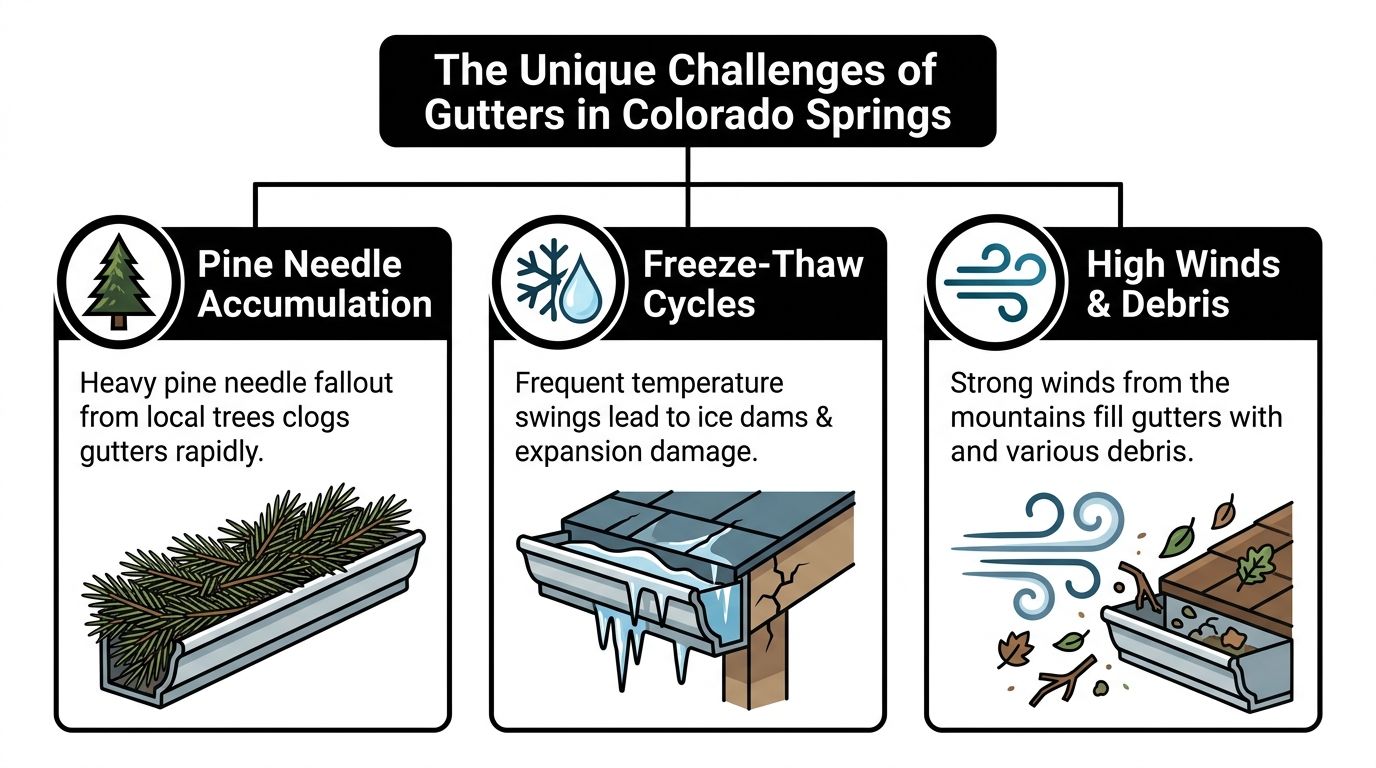
The Unique Challenges of Gutters in Colorado Springs
Colorado Springs homes ask more from a gutter system than many homeowners realize. Local conditions don't just fill gutters faster. They create a different kind of debris load and a different kind of failure pattern.
Pine needles don't behave like broad leaves
A lot of national advice is written around leafy climates where debris falls in a predictable autumn wave. Colorado Springs often looks different. Pine needles can shed steadily, work into corners, bridge over outlets, and lock together in a way that slows water before the gutter looks fully packed.
Once that mat forms, finer material starts collecting under it. Roof grit, dust, and broken-down organic matter settle into the channel and create a dense sludge. That's why local gutters can drain poorly even when someone has already scooped out the obvious debris.
For homes near heavier tree cover, this is one reason general guidance falls short. As noted in Colorado-focused guidance on seasonal gutter timing gaps, standard advice to clean gutters once a year is often insufficient for Colorado's climate because of heavy pine needle debris, spring snowmelt, and wildfire ash.
Freeze-thaw cycles expose weak drainage
A gutter can limp through a mild rain and still fail during melt conditions. Colorado Springs sees temperature swings that reveal every low spot, partial blockage, and underperforming downspout.
When water can't clear the system fast enough, it sits. Standing water is a problem on its own, but in colder conditions it also raises the chance of ice formation in sections that should be draining freely. That extra weight stresses hangers and seams, and repeated freezing can make a marginal gutter section sag more over time.
A gutter that drains slowly in spring often tells you more than one that merely looks dirty in fall.
This is one of the most important differences between local and generic residential gutter cleaning. In Colorado Springs, a thorough service isn't just removing what fell in. It's checking whether the cleaned system moves water the way it should once the debris is gone.
Wind and roof grit add a fine-particle problem
Front Range wind carries more than leaves. It pushes twigs, seed material, dust, and fine roof debris into the gutter line. On asphalt shingle roofs, granule shedding adds another layer of sediment that many homeowners don't notice from the ground.
That matters because fine particles behave differently than larger clogs. They settle into downspout transitions and elbows. The gutter may appear open across the top while the bottleneck sits deeper in the system.
A lot of poor cleanings stop too early. The visible debris is gone, but the sediment that slows the drain remains.
Wildfire ash changes the maintenance picture
Some neighborhoods around Colorado Springs also deal with a factor that many national articles barely mention: fire season residue. Even when a home isn't near active flames, ash and windblown debris can collect at the roofline and in gutters.
For homeowners in or near wildland-urban interface areas, clean gutters are part of sensible exterior maintenance. Combustible buildup doesn't belong tucked against the roof edge. The practical goal is simple. Remove the material before it sits, compacts, and mixes with other debris.
Timing matters more here
Because local debris sources don't arrive all at once, residential gutter cleaning works better on a seasonal strategy than on a vague annual reminder.
A practical local rhythm often includes attention after spring debris and melt, then again around fall buildup. Some homes need more frequent checks if they sit under pines, catch wind-driven roof debris, or collect ash after a rough season.
Short version:
- Pine-heavy properties: Check more often because needles create dense, stubborn outlet clogs.
- Snowmelt-prone rooflines: Watch for slow-draining sections that reveal pitch or blockage problems.
- Wind-exposed homes: Expect more grit and fine sediment than broad leaf piles.
- Fire-aware properties: Treat gutter debris as something to remove promptly, not something to ignore until later.
That combination is why local experience matters. Colorado Springs gutters don't just get dirty. They load up in ways that call for a different maintenance standard.
DIY vs Professional Gutter Cleaning Which Is Right for You
Some homeowners are comfortable doing their own residential gutter cleaning. Others would rather never step on a ladder again. Both positions are understandable. What matters is whether DIY gives you the result and level of safety your home needs.
The honest appeal of DIY
The case for doing it yourself is straightforward. You control the schedule, avoid a service appointment, and keep the upfront cost in your own hands. For a single-story home with simple access and very light debris, some homeowners can manage routine cleanup without much trouble.
The problem is that gutter cleaning rarely stays as simple as it sounds. The work gets more difficult when the roofline is higher, the debris is packed, the downspouts are slow, or the gutters need more than a quick scoop-out.
Where DIY usually falls short
The biggest issue is safety. According to the guidance highlighted in this discussion of ladder-fall risk and homeowner liability concerns, ladder falls are a leading cause of accidental injury and death for homeowners, which is one reason professional gutter cleaning is better viewed as risk management than as a luxury.
The second issue is incomplete cleaning. Many homeowners remove the visible mat of leaves or needles and assume the job is done. It often isn't. Fine sediment remains in the trough and downspouts, and that leftover material is what causes many "mystery" drainage problems later.
A third issue is diagnosis. A gutter can still perform poorly after debris is removed if the section is sagging, the outlet is partially blocked, or the pitch isn't draining properly. DIY cleaning often handles the mess but misses the reason the mess keeps causing overflow.
If you don't test water flow after cleaning, you don't actually know whether the system is working.
A realistic side-by-side comparison
| Factor | DIY Approach | Professional Service (Cultivate House Detailing) |
|---|---|---|
| Safety | Homeowner assumes ladder risk and footing risk | Crew handles elevated work as part of the service |
| Debris removal | Usually hand-scooping and bucket cleanup | More complete cleaning process with system clearing and testing |
| Fine sediment | Often left behind because it isn't obvious | Addressed as part of a thorough cleaning approach |
| Problem spotting | Easy to miss slope issues, hanger problems, or slow downspouts | Functional issues are more likely to be identified during service |
| Time | Often takes a large part of a day | Usually faster and more systematic |
| Peace of mind | Depends on your comfort level and thoroughness | Better fit for homeowners who want the system checked, not just emptied |
Why many homeowners hire it out
For busy households, the value isn't only in getting debris out. It's in knowing somebody handled the dangerous part, cleaned beyond the obvious mess, and checked whether the gutters drain.
That becomes even more important when you're comparing qualified providers to casual labor. If you're weighing that decision, this guide on licensed gutter cleaners vs unlicensed work and the risk is worth reading before you book anyone.
DIY still has a place for some homes and some owners. But if the roofline is high, the debris is dense, or the system has a history of overflowing, professional residential gutter cleaning is usually the safer and more reliable route.
Our Gutter Cleaning Process From Quote to Completion
A Colorado Springs homeowner usually calls after seeing one of three things. Water spilling over the front gutter during a summer storm, pine needles packed tight under the roof edge, or a sheet of ice forming above the entry after a cold snap. In this area, a gutter service has to solve the actual drainage problem, not just remove what is easy to see from the ground.

It starts with a quote that matches the home
The first step is looking at the roofline, access points, gutter length, downspout count, and the kind of debris the property collects. A house under ponderosas near Black Forest usually needs a different plan than a home in a newer subdivision with lighter leaf debris. Needle buildup packs down hard, holds moisture, and can hide outlet clogs, so the quote should reflect that reality.
Good scheduling details matter too. Homeowners should know when the crew is arriving, whether gates need to be open, and if vehicles should be moved away from work areas. That kind of communication keeps the visit smooth and helps protect landscaping, patios, and access around the house.
If you want a clearer breakdown of what affects pricing and scope, this guide explains what you're really paying for in gutter cleaning service.
Cleaning has to address what Colorado Springs gutters actually collect
On local homes, the job usually starts with hand removal of larger debris. That includes pine needles, cones, leaves, seed clusters, roof grit, and the heavy composted material that settles in low spots. Hand removal lets the crew see the gutter bottom, the outlets, and any hidden trouble around hangers or seams.
After that, the system needs to be cleared the rest of the way. Fine sediment is what often causes the frustrating callbacks. It washes into downspouts, hangs up in elbows, and slows drainage even when the gutter looks clean from above. In Colorado Springs, that matters before summer downpours and before winter freezes, because slow-moving water is more likely to overflow or sit long enough to contribute to ice formation.
A solid workflow usually includes:
- Removing packed debris by hand so the channel and outlets are visible.
- Clearing remaining sediment from the gutter run.
- Testing each downspout to confirm water can move through the full line.
- Watching for poor flow at corners, elbows, and long runs.
- Hauling away debris instead of leaving it in beds or on concrete.
That cleanup step matters more here than many national articles admit. Dry needles dropped beside the home are still fuel. In a region where wildfire mitigation is part of routine exterior maintenance, debris needs to leave with the crew.
Water testing shows whether the system is actually working
A gutter can look fine and still fail the moment water hits it. I have seen plenty of runs that looked clean from the ladder but backed up as soon as they were flushed because an elbow was packed tight or a downspout had years of gritty buildup inside it.
For homeowners who want to see what a service visit can look like in practice, this short video gives helpful visual context:
Water testing is also where drainage flaws show up. Slow movement can point to improper slope, a loose section, or a spot that holds water long enough to freeze when temperatures drop. Those are the details that separate a quick debris scoop from maintenance that protects fascia, walkways, and the foundation.
Field rule: Clean gutters still need a flow test. Appearance alone does not confirm drainage.
What completion should look like
By the end of the visit, the gutters should be cleared, the downspouts checked, and any visible problem areas pointed out in plain language. Homeowners should know whether the system is draining well, where buildup was worst, and whether any sections may need repair or adjustment before the next storm cycle.
Cultivate House Detailing provides this kind of residential gutter cleaning for Colorado Springs homes and nearby communities. The standard is simple. Clear the debris, verify flow, clean up the property, and note issues before they turn into overflow, ice, or fire-fuel buildup.
Standards like that are worth expecting from any reputable provider, whether you are hiring locally or comparing service models in other markets such as Snohomish window and gutter services.
How to Choose the Best Gutter Cleaning Service in the Pikes Peak Region
Hiring the right company usually comes down to the questions most homeowners forget to ask. The cheapest quote can still be the most expensive outcome if the crew leaves sediment in the system, misses drainage issues, or isn't prepared to work safely around your home.
Ask how they verify drainage
A professional shouldn't stop at debris removal. One of the clearest signs you're dealing with someone experienced is whether they check gutter pitch and water movement.
The standard matters here. Residential gutters should slope 1/4-inch for every 10 feet toward the downspout, and standing water after flushing is a sign that the gutter may need adjustment, according to Home Depot's gutter cleaning and slope guidance. That kind of slope verification is the sort of diagnostic step that separates surface cleaning from actual maintenance.
Look for answers, not sales lines
A solid company should be able to answer practical questions like these:
- What does the service include: Ask whether they hand-remove debris, flush the system, and test downspouts.
- How do you handle cleanup: The debris should leave with the crew, not stay in flower beds or on the driveway.
- Will you point out visible issues: Homeowners benefit when a cleaner notes sagging sections, pooling water, or damaged attachments.
- Are you insured for this work: Work at height should never feel casual.
If you want a sense of how reputable providers are presented in a service marketplace, browsing a listing like these Snohomish window and gutter services can be useful. Not because the location is relevant to Colorado Springs, but because it shows how service categories, expectations, and provider details are often organized for homeowners comparing options.
Written quotes matter
Verbal pricing leaves too much room for misunderstanding. A written quote helps you compare scope, not just price. It also helps you spot when one company is pricing a full cleaning and another is pricing a quick blow-out.
Homeowners who want a better sense of what drives price can review this explanation of what you're really paying for in gutter cleaning services. It's a practical way to compare bids without treating every quote as if it covers the same work.
Signs of a stronger local fit
In the Pikes Peak region, the better questions are local ones. Do they understand pine needle buildup, spring melt behavior, and wind-driven debris? Do they treat gutter cleaning as part of exterior water management, not just trash removal?
A good hire usually sounds specific. They talk about drainage, downspouts, sediment, slope, and cleanup. A weaker hire talks mostly about how fast they can be done.
Protect Your Home Today with Cultivate House Detailing
A lot of gutter problems in Colorado Springs show up right when the weather turns. One warm afternoon starts the snowmelt, one cold night refreezes what did not drain, and one windy day packs the troughs with pine needles from the lot behind the house. By the time water spills over the edge, the gutter has usually been struggling for a while.
That is why I tell homeowners to treat gutter cleaning as part of protecting the house, not just tidying up the roofline. In this area, clogged gutters do more than leave streaks on the fascia. They can dump water next to the foundation, hold damp debris against the roof edge, and leave behind dry needle buildup that no one wants sitting around during fire season.
Professional service helps because the job is not only about scooping out debris. The value is confirming that water can move through the full system, that downspouts are clearing, and that small trouble spots get caught before the next heavy rain, hailstorm, or freeze does the diagnosing for you.
If you have seen overflow, slow drains, staining, or visible buildup, handle it now.
Cultivate House Detailing provides residential gutter cleaning for Colorado Springs homeowners who want the debris removed, the flow checked, and the job done without spending a Saturday on a ladder. Request a quote if your gutters are due for service or if the last storm made it clear the system is not keeping up.