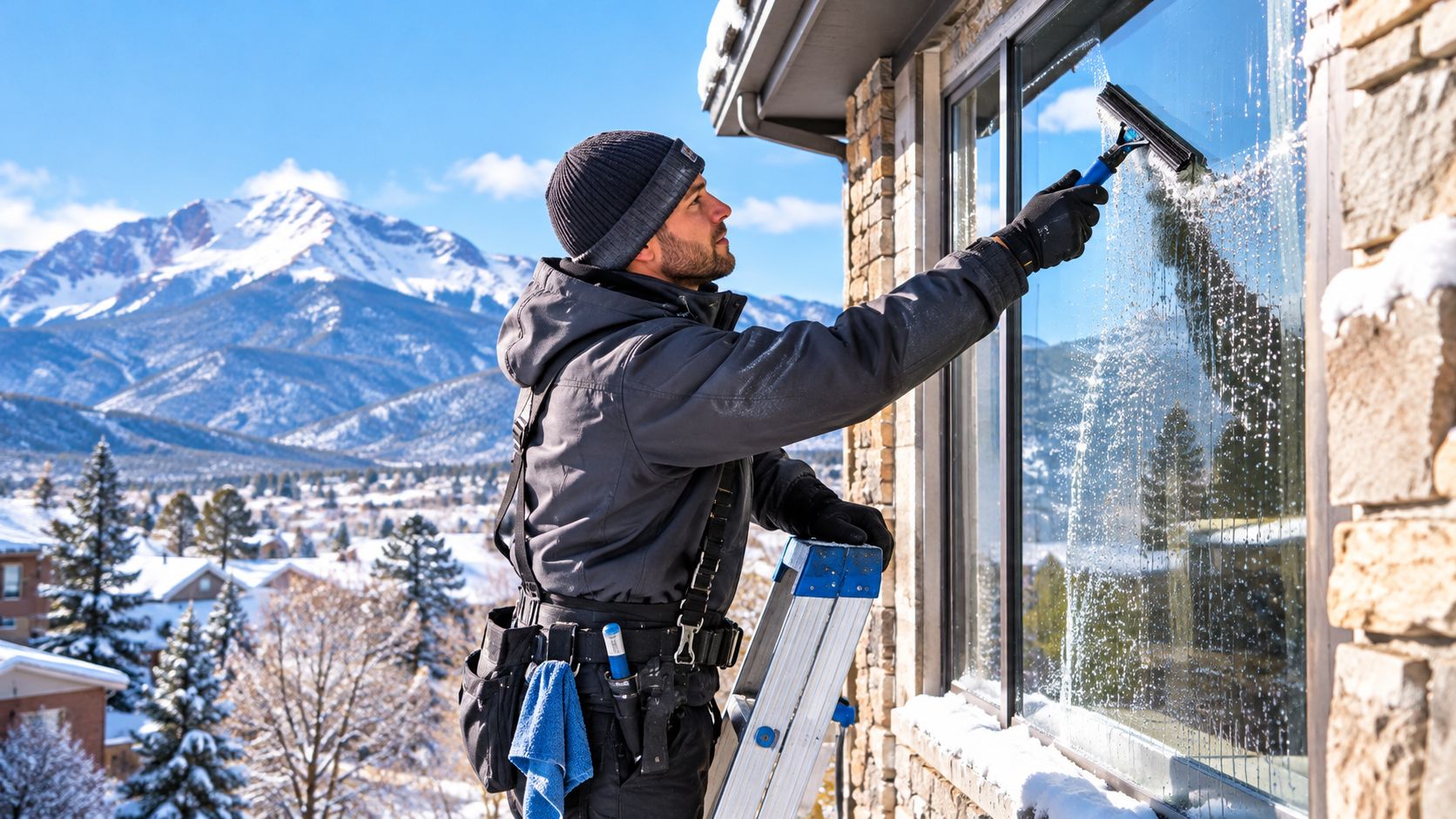
If you're getting quotes for window cleaning in Colorado Springs, CO, there's a good chance you're comparing price, availability, and whether the company can reach that awkward second-story glass over the garage or the high panes above a walk-out basement. Most homeowners and property managers also have a quieter question in the back of their mind. Is this crew going to do the job safely?
That question matters more than many people realize. Exterior window cleaning, gutter cleaning, roofline work, and upper-story access all put workers near ladders, edges, and uneven terrain. A clean result is only part of a professional service. The other part is whether the company follows real fall protection requirements, uses the right equipment, and makes smart decisions on your property.
For customers looking for professional window cleaning, this isn't about learning every OSHA rule. It's about knowing what separates a responsible contractor from someone taking shortcuts. When you know what to look for, it's much easier to hire with confidence.
Why Safety Compliance Matters for Your Colorado Springs Property
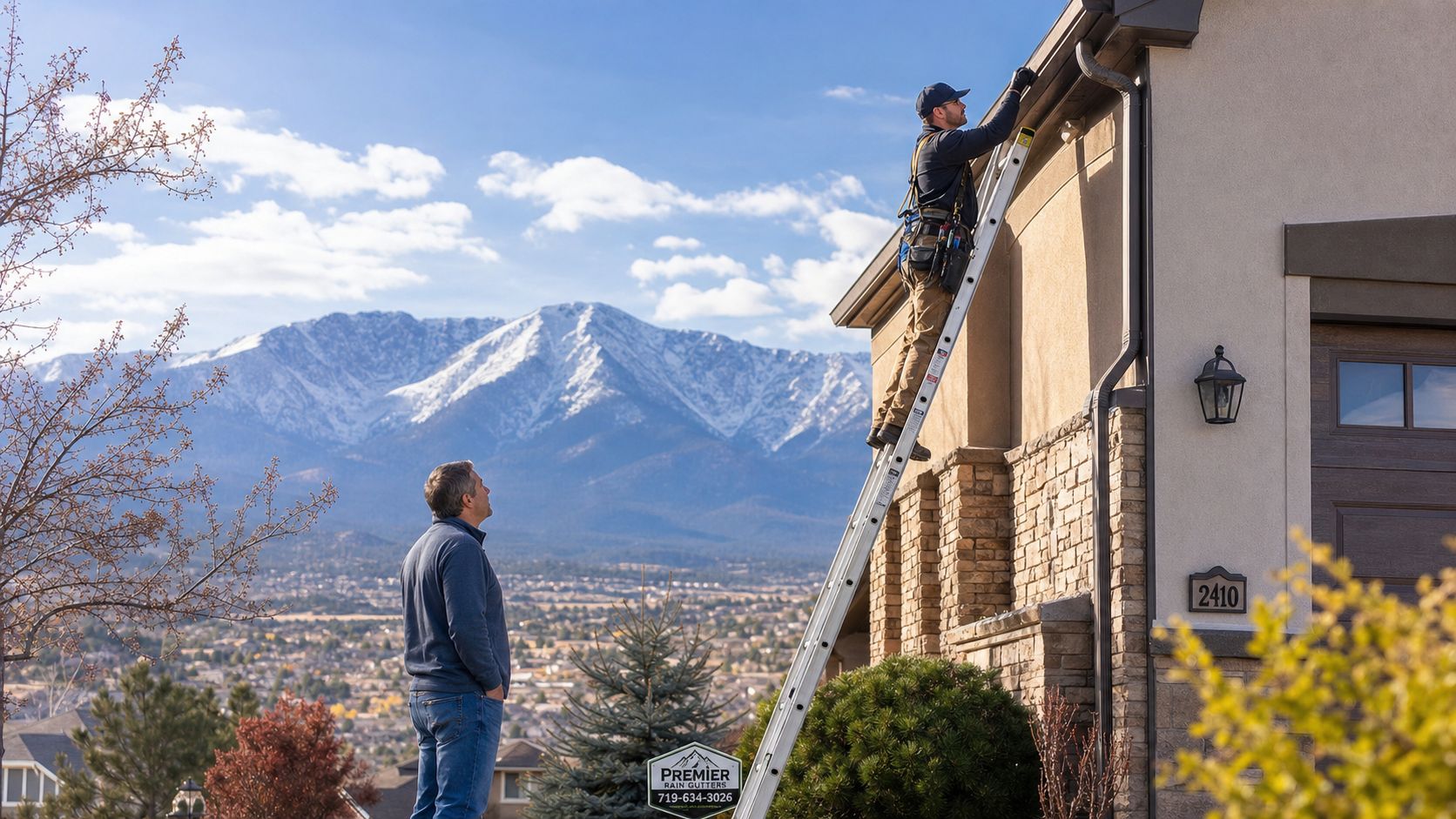
A common scene plays out like this. A crew arrives to handle exterior window washing, one technician sets an extension ladder, and within minutes someone is working high above a driveway, deck, or rock bed. From the ground, it's hard to tell whether you're watching a professional process or a risky one.
That uncertainty is reasonable. Falls remain a serious issue on job sites. The U.S. Bureau of Labor Statistics reported 244,000 non-fatal fall injuries in 2021, and in 2024 falls accounted for roughly 37.6% of construction-related deaths according to this fall protection standards overview. For a homeowner or property manager, those numbers reinforce a simple point. Safety isn't a side topic. It's part of the service you're buying.
What customers usually notice first
Many don't start by asking about anchor points or rescue planning. They notice things like:
- A ladder placed fast on uneven ground without much adjustment
- A worker stepping near a roof edge with no visible backup system
- No clear setup process before upper-story work starts
- A rushed attitude that treats safety checks like a delay
Those signs don't automatically prove a violation, but they should make you ask better questions.
Practical rule: If a company acts casual about height, it may act casual about your property too.
Why this matters beyond the worker
When a crew works unsafely, the risk doesn't stay limited to the person on the ladder. Unsafe access can lead to damaged gutters, broken landscaping, scuffed siding, cracked roof materials, and chaotic decision-making in the middle of the job. A company with a real process usually protects the property better because its team thinks ahead.
For owners who manage retail, office, or mixed-use buildings, this issue is even more visible. If you want a broader facility perspective, this workplace safety compliance guide offers a useful overview of how formal safety thinking supports better contractor oversight.
In Colorado Springs, where homes often sit on slopes and commercial access conditions vary, the safest contractor is usually the one that looks more methodical, not more flashy.
Understanding Fall Protection Requirements in Simple Terms
The easiest way to understand fall protection requirements is to think of them as the point where a company must stop relying on caution alone and start using specific protective measures.
For many exterior cleaning situations, the number customers hear most often is the 6-foot trigger in construction. OSHA also uses a 4-foot baseline in general industry, as outlined on the agency's fall protection guidance. For practical purposes, homeowners usually care about what that means on a real property. If a worker is performing a task high enough above a lower level, the company may need defined controls rather than just experience and balance.
The simple version homeowners can use
If someone is cleaning second-story windows, working near a roof edge, or moving around surfaces at height, you should expect the company to have a safety plan that fits the task.
That doesn't always mean every job looks the same. A professional may use a ladder for one part of the work, ground-based extension tools for another, and a personal fall protection setup for a different access point. The key is that the method should match the hazard.
OSHA's guidance also makes clear that the issue isn't just height. Tasks near open-sided edges, ramps, walkways, and skylights can trigger protection requirements in ways many customers wouldn't expect. That's one reason surface-level advice often misses the core point.
Why one rule doesn't fit every property
Colorado Springs homes aren't built from a single template. A flat driveway and straightforward front elevation create one access situation. A steep side yard, retaining wall, or rear deck over a lower grade creates another.
A good mental model is this:
| Property condition | What a responsible company considers |
|---|---|
| Second-story windows over flat ground | Ladder stability, access angle, tie-off needs, tool choice |
| Windows above sloped landscaping | Lower-level distance, footing security, alternate access methods |
| Roof-adjacent glass or skylight areas | Edge exposure, fragile surfaces, whether conventional access is appropriate |
If you've ever looked at a stair railing and thought, "That seems too low to trust," you already understand the logic. The built environment needs protective systems where a fall would matter. This overview of railing safety considerations is helpful because it shows how safety standards often focus on practical prevention, not appearances.
A safe contractor doesn't guess from the driveway. The crew evaluates the work area before anyone goes up.
For residential window cleaning and commercial window cleaning, that evaluation is one of the clearest signs you're hiring a company that takes compliance seriously.
When Safety Rules Apply to Exterior Cleaning Jobs
A lot of customers assume fall protection only comes into play when someone is standing on a roof. In reality, the trigger is often tied to the task itself and the surrounding hazards.
OSHA's construction standard makes that clear in its requirements for walking and working surfaces. Protection can be required not just because of height, but also around holes, skylights, ramps, and dangerous equipment. For exterior cleaning, that means a contractor has to assess the whole work zone, not just measure from the ground and call it good.
Everyday situations that change the risk
Take a house in Black Forest with tall rear windows above a walk-out basement. From the front, the elevation may not look extreme. From the back, the lower-level distance is a different story. A crew that prices the work without thinking about that change may show up with the wrong ladder setup or no alternate plan.
A Monument property can create a different problem. Windows may sit above decorative rock beds, sloped terrain, or narrow side-yard access. The glass itself isn't the issue. The issue is whether the worker can maintain safe footing and avoid being pushed toward a bad angle or overreach.
Roofline and skylight work deserves extra attention
Now consider a commercial or mixed-use property in Colorado Springs where upper glass sits near a flat roof edge. Or a home where a crew is cleaning windows and also clearing debris near skylights. Those jobs can trigger safety needs that a customer won't recognize unless they know what to watch for.
A skylight is a good example. People often treat it like solid roof area because it looks substantial from below. A trained crew doesn't make that assumption. It treats the surrounding work zone as a hazard assessment problem.
On exterior cleaning jobs, the question isn't just "How high is the worker?" It's also "What is the worker next to?"
What this means for hiring
This is why low-detail estimates can be risky. If a company talks only about panes, pricing, and scheduling, but says nothing about access conditions, it's leaving out part of the job.
Smart property owners should expect questions such as:
- Where are the highest windows located
- Is there sloped ground, decking, or a walk-out basement
- Are there skylights, roof edges, or fragile surfaces nearby
- Will the crew need ladder access, roof access, or water-fed pole work
Those questions don't slow the project down. They help the contractor choose a method that fits the property, which is exactly what responsible exterior window cleaning should look like.
What Professional Fall Protection Looks Like in Action
A customer doesn't need to memorize standards to recognize a serious setup. Professional fall protection usually looks organized, deliberate, and a little slower at the beginning. That's a good sign. The crew is building the job correctly before the cleaning starts.
One helpful way to think about it is as a hierarchy. The safest method is often the one that removes exposure first, then limits it, then arrests a fall if one happens.
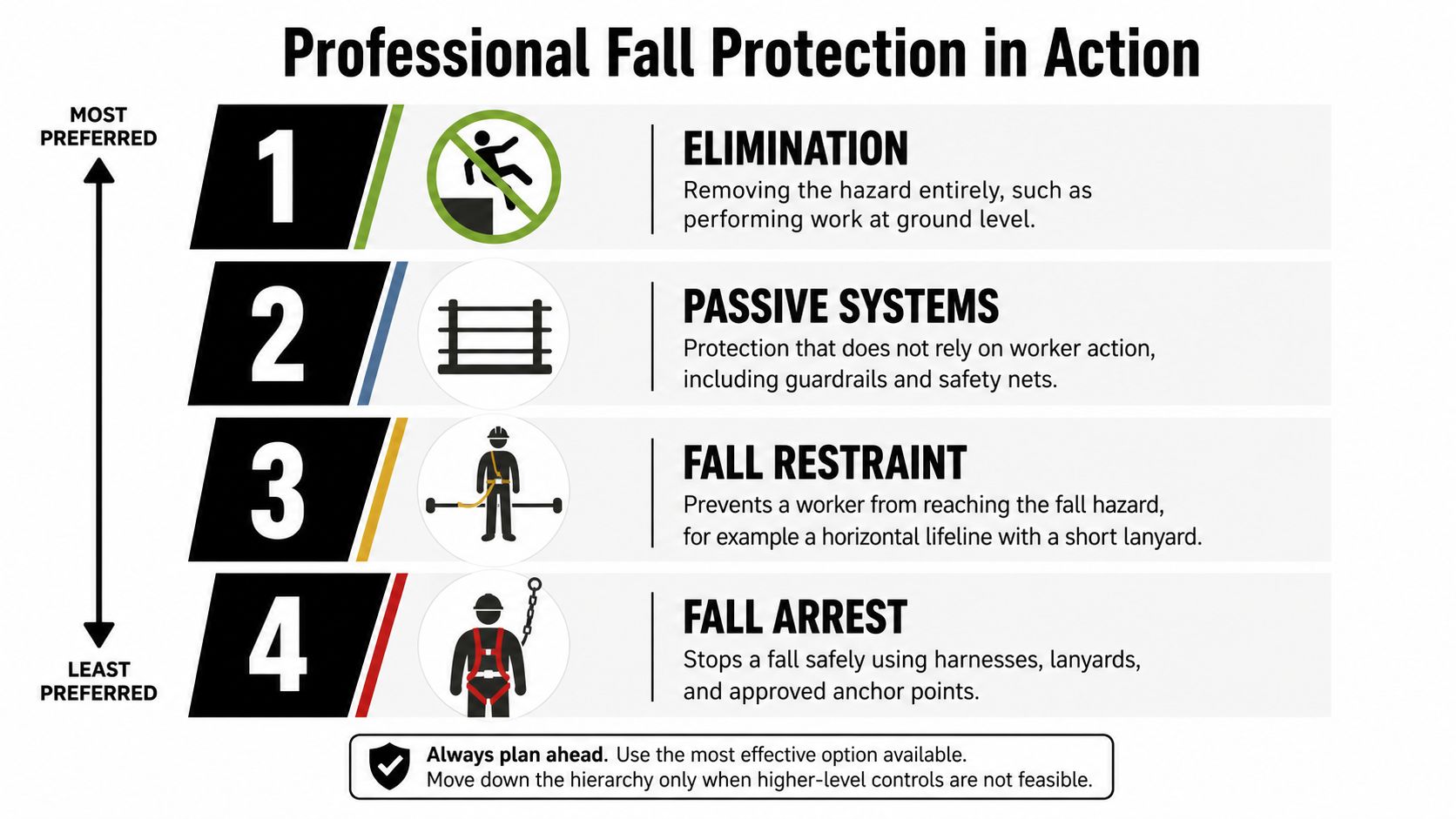
The systems you may actually see on site
For many exterior cleaning jobs, the visible options include guardrails, warning setups in limited conditions, ladder control measures, and personal fall arrest systems.
A compliant PFAS is made up of the A-B-C components: anchorage, body wear, and connecting device, as explained in this fall protection equipment guide. In plain language, that means there must be a secure point the system attaches to, a properly fitted full-body harness, and the correct lanyard or lifeline connecting the two. Those parts must work as one integrated system, and the setup should be supervised by a competent person.
What each part tells you
| PFAS part | What you should expect |
|---|---|
| Anchorage | A real, intentional attachment point. Not a random object chosen in the moment. |
| Body wear | A full-body harness adjusted to the worker, not loose straps hanging off. |
| Connecting device | A lanyard or lifeline selected for the access situation and movement path. |
A harness by itself doesn't mean much. If the anchor is poor or the line allows a dangerous swing path, the setup can still be wrong.
For readers who are curious how high-access glass cleaning methods differ across building types, this article on how to clean high-rise windows gives useful context on why access planning matters as much as the cleaning itself.
This short video helps make the equipment side easier to visualize before a crew ever arrives on site.
What doesn't inspire confidence
Some warning signs are easy to spot once you know them:
- Harness without a visible plan for where it connects
- Improvised anchor choices made after the worker is already in position
- Loose, poorly fitted gear that looks borrowed rather than assigned
- No discussion of rescue or retrieval if a fall were arrested
Cultivate House Detailing states that it uses proper safety gear for high-window access, which is the kind of factual, task-specific safety statement customers should look for from any company offering upper-story service.
Beyond Equipment The Importance of Expert Training
Safety gear only helps when the crew knows how to use it correctly. That's the part many customers never see. A truck can carry ladders, harnesses, standoffs, roof brackets, and lifelines, but none of that guarantees sound judgment on your property.
The difference shows up in decisions. A trained crew knows when a ladder angle isn't right, when ground conditions make a setup questionable, when an anchor location creates a swing hazard, and when a task should be done from a different position entirely. An untrained crew often notices the problem later, after someone is already committed to the wrong approach.
Why the competent person matters
On jobs involving fall hazards, oversight by a competent person or qualified person matters because that person is responsible for identifying hazards and selecting workable controls. To a customer, that may look like a lead technician walking the property first, checking access points, and telling the team what method will be used where.
That's exactly what you want. The safest companies don't leave high-access decisions to improvisation.
The presence of gear is reassuring. The presence of judgment is what really protects people.
Training affects the whole job quality
Proper training doesn't just reduce injury risk. It usually improves service quality too.
A well-trained exterior cleaning crew is more likely to:
- Inspect equipment before use instead of discovering a problem mid-job
- Choose the right access method for glass over landscaping, decks, or sloped grades
- Protect delicate surfaces by avoiding rushed ladder movement against gutters, trim, and siding
- Work with a rescue mindset so no one is relying on luck if something goes wrong
For homeowners booking residential window cleaning and managers arranging commercial window cleaning, this is one of the easiest places to separate a polished company from a cheap bid. Ask who supervises height-related work. Ask how the crew evaluates unusual access conditions. Ask what happens if the original plan doesn't fit the site.
Vague answers are useful information.
Checklist for Hiring a Safe Contractor in Colorado Springs
Most customers don't need to become safety experts. They need a short list of questions that reveals whether a contractor has real systems or just confident sales language.
This is the kind of checklist worth using before you book window cleaning near me results, whether you're hiring for a home in Colorado Springs, a storefront in Manitou Springs, or a property near Monument.
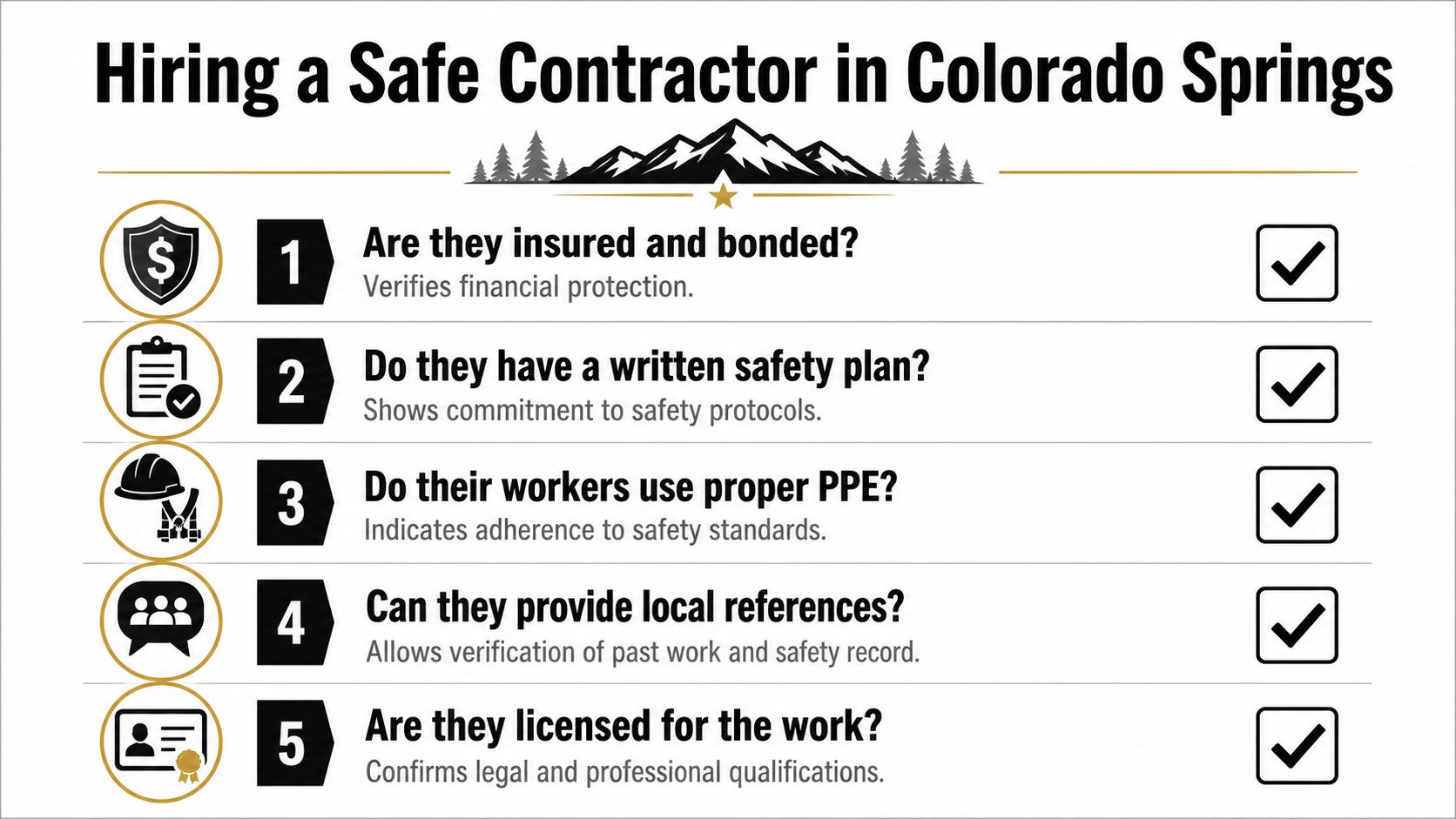
Questions worth asking before anyone climbs
Are you insured and bonded for this type of work?
Insurance should match the actual service being performed, especially if the job involves upper-story access, ladder work, or roof-adjacent cleaning.Do you have a written safety plan for work at heights?
A serious company doesn't rely on memory or habit alone. It has a repeatable process.How do you handle second-story or difficult-access windows?
Listen for specifics. Good answers mention evaluation, equipment choice, and property conditions.What fall protection system do you use when the job requires it?
You don't need a lecture. You do need a clear answer that shows the company understands the difference between carrying gear and using it correctly.Who supervises the crew on higher-risk jobs?
This helps you learn whether decisions are structured or improvised in the field.
What strong answers sound like
A reliable contractor will usually describe the process in ordinary language. It may mention property walk-throughs, ladder setup checks, access limits, equipment inspection, and when a task requires a different approach than the original estimate.
Weak answers often sound like this:
| Weak response | Better response |
|---|---|
| "We've been doing this a long time." | "We assess the access points first and choose the method that fits the hazard." |
| "Our guys are careful." | "Higher-risk work is supervised, and we use the right protective system when the task requires it." |
| "Don't worry, we've got ladders." | "Some windows are ladder-accessed, others are better handled with extension tools or controlled tie-off." |
If you want a practical look at one part of safe access, this page on window cleaning ladder use is a useful reference for understanding how ladder choice affects both safety and results.
A final customer filter
Ask yourself one simple question after the estimate. Did this company talk about your property as if access conditions matter?
If the answer is yes, you're probably dealing with a more professional operation. If the answer is no, the lower price may come with risks you never intended to buy.
Choose Safety and Shine with Cultivate House Detailing
When you hire a company for professional window cleaning in Colorado Springs, CO, you're not just paying for clean glass. You're trusting that crew to work around your home or building with good judgment, proper equipment, and respect for the risks involved.
That's why safety belongs in the buying decision. It affects who shows up, how they set up, how they move around your property, and whether the final result feels reassuring or stressful. Clean windows should brighten the property, not leave you wondering how close the crew came to a bad accident.
What peace of mind looks like
For homeowners, it means not having to second-guess upper-story work, ladder placement, or roofline access. For property managers and business owners, it means a contractor who understands that professionalism includes process, documentation, and hazard awareness, not just streak-free glass.
That matters in Colorado Springs and nearby communities where access conditions vary so much from one property to the next. A flat commercial frontage, a hillside home, and a multi-level residence with rear elevation changes don't call for the same approach.
Why careful customers usually make better hires
Customers who ask about fall protection requirements usually aren't being difficult. They're paying attention to the right things.
They understand that good exterior window cleaning, interior window cleaning, screen cleaning, and track cleaning should come with a process that protects people and property. They also know that a company willing to explain its safety approach is often the same company that communicates better, plans better, and performs more consistently.
If you're comparing bids in Colorado Springs, Monument, Manitou Springs, Black Forest, or nearby areas, keep the standard simple. Hire the company that treats access and safety as part of the craft, not as an afterthought.
If you'd like a quote for Cultivate House Detailing, reach out for a no-obligation estimate. You can get clear answers about access, safety, and service options for your home or commercial property, then book window cleaning with confidence.
Prefer to leave it to a professional? Cultivate House Detailing offers residential window cleaning in Colorado Springs. Get a free quote.