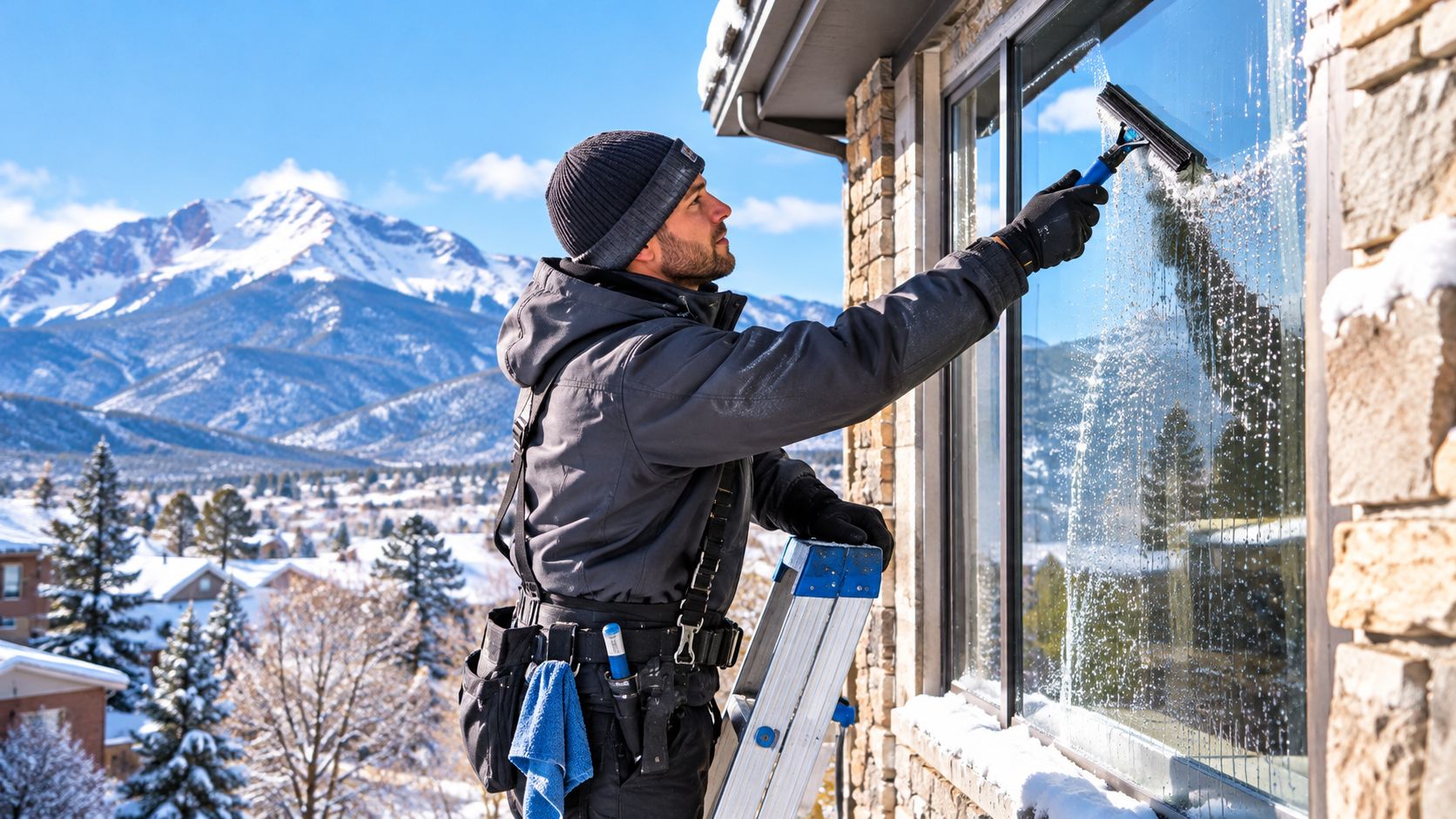
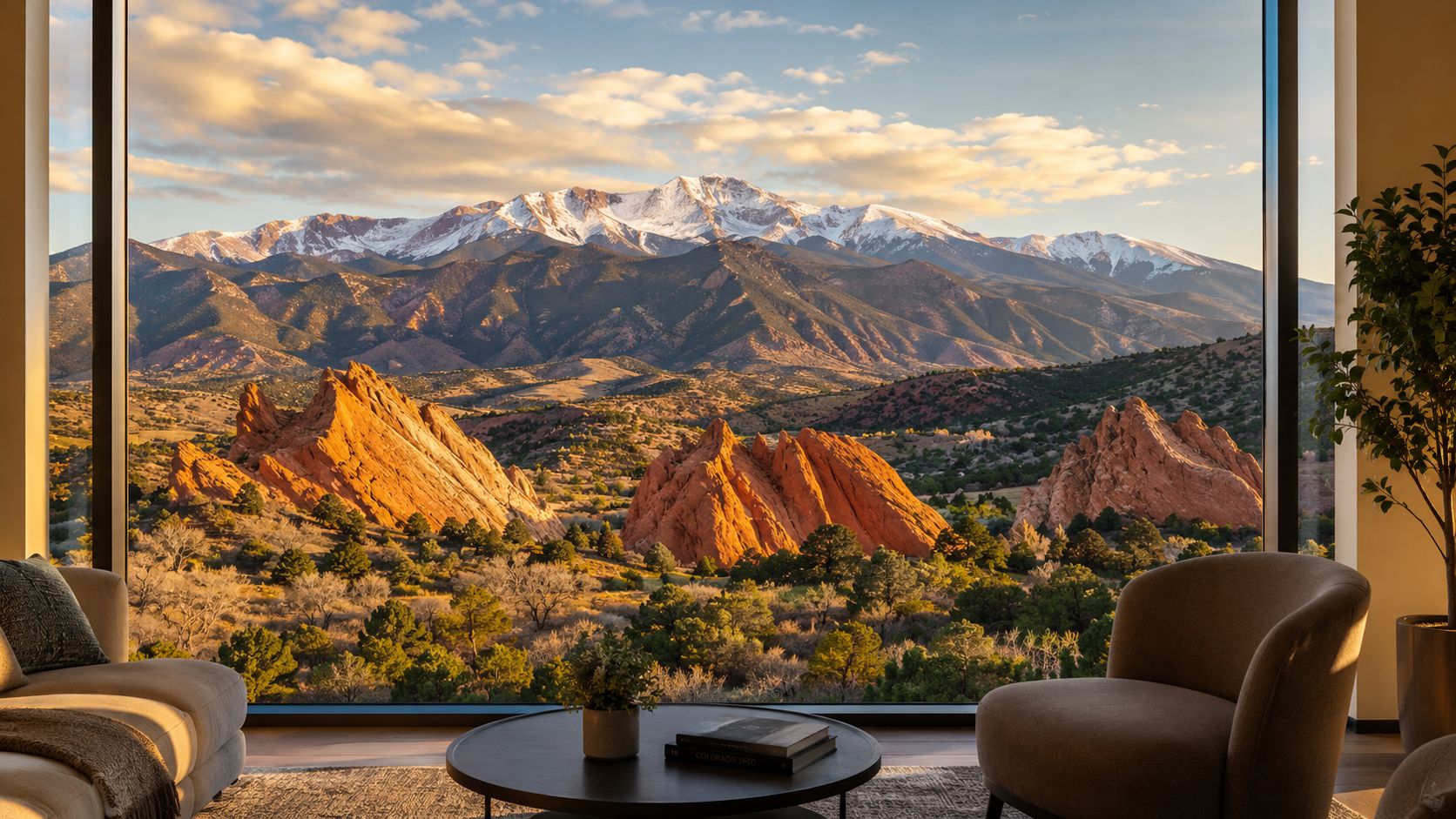
You bought the home for the light, or leased the building for the visibility. Then Colorado Springs does what it always does. Wind moves dust across the Front Range. Afternoon sun turns every streak into a spotlight. Sprinklers leave mineral spots on lower panes. Before long, the same windows that frame Pikes Peak or Garden of the Gods start muting the view.
For many properties, a standard ladder setup handles the job just fine. For others, it doesn't. Tall entry glass, hillside construction, atriums, stacked balconies, sloped grades, and mid-rise façades create that awkward middle ground where the glass is too exposed or too difficult for basic methods, but the building doesn't call for a giant construction-style access setup either.
That's where rope access window cleaning fits. It gives trained technicians a controlled way to reach difficult glass with less ground disruption than scaffolding and more flexibility than many lift setups. For Colorado Springs property owners who care about clear views and safe service, it's often the most practical answer.
Enjoy Your Colorado Springs View Through Spotless Windows
A lot of window problems in Colorado Springs aren't about neglect. They're about exposure.
A home facing west catches intense evening sun, and every small streak shows up. A business near a busy road gets a fine layer of dust on exterior glass faster than expected. A house built into a slope in Manitou Springs or on a custom lot with tall rear-facing windows may have beautiful sightlines, but those same sightlines are hard to maintain.
Where homeowners feel it first
The frustration usually starts with one or two problem areas:
- Upper-story picture windows that collect dust and water spots but can't be reached safely from the ground
- Stairwell or entry glass that sits above a landing or uneven grade
- Windows over patios, sunrooms, or landscaping where ladders are difficult to place
- Rear elevations with a drop-off that make a simple exterior window cleaning appointment more complicated than it looks
These aren't rare situations in Colorado Springs, CO. They're common on custom homes, view properties, and multi-level builds.
Clean glass changes a room in a way fresh paint can't. You notice it most where the window was supposed to be part of the experience.
Why commercial owners notice it too
On the commercial side, the issue is usually presentation and access at the same time. Mid-rise offices, apartment buildings, hotels, dealerships, and storefronts need consistent glass care, but they also need walkways open, entrances usable, and the property looking professional while the work happens.
That's why rope access window cleaning has become such a useful option for certain jobs. It helps bridge the gap between “someone on a ladder” and a full heavy-access setup. For the right building, it lets a crew work efficiently on hard-to-reach windows while keeping the site cleaner and less congested at ground level.
For owners who've been putting off a difficult section of glass because it seems inconvenient, expensive, or risky, the main takeaway is simple. There is a professional way to handle those windows. It isn't improvised, and it isn't guesswork.
What Is Rope Access Window Cleaning
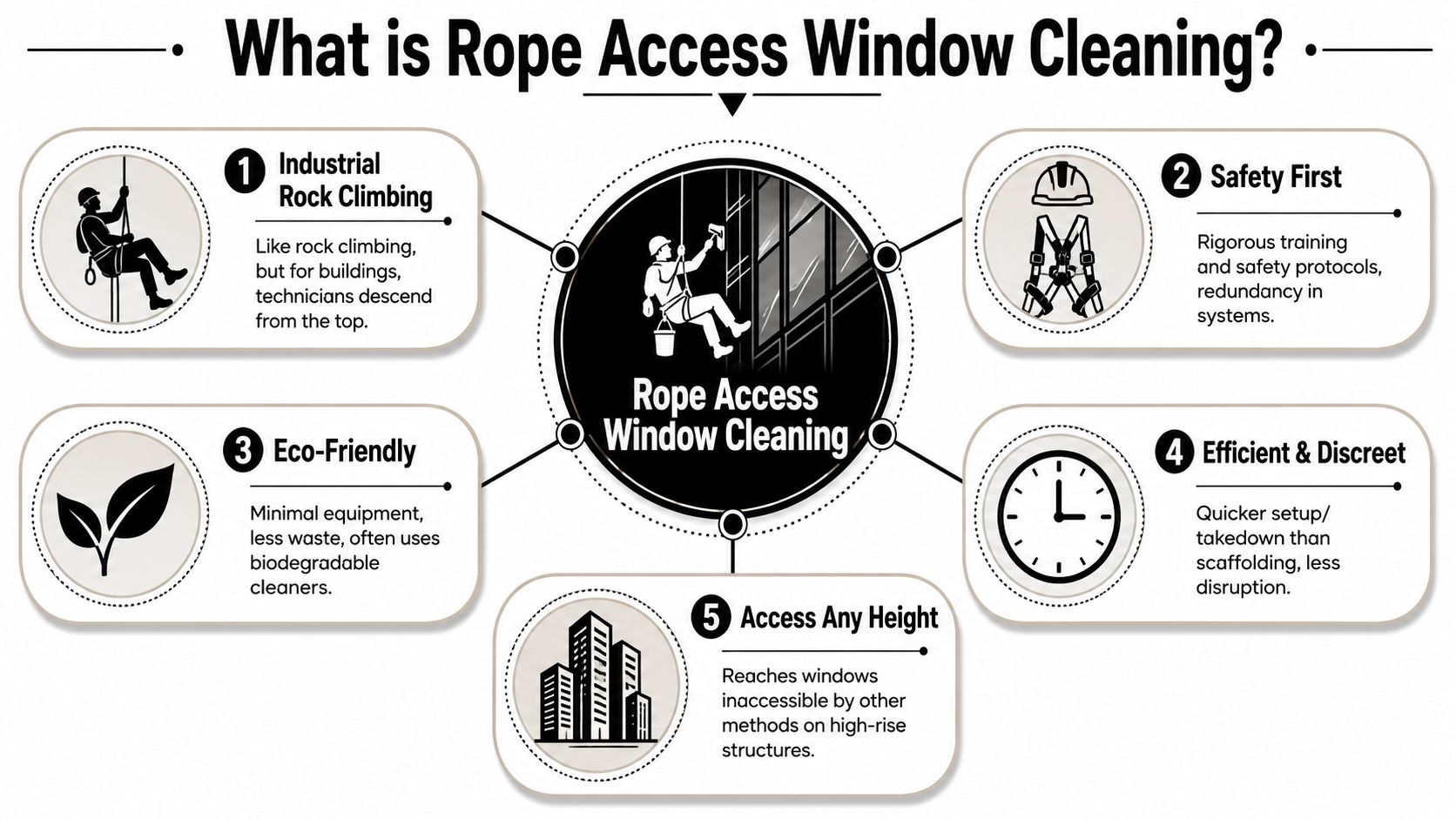
Rope access window cleaning is building access that works a lot like controlled climbing. Technicians descend or position themselves on ropes from secure anchor points so they can clean glass that's difficult to reach by ladder, scaffold, or lift.
That doesn't mean someone is “just hanging from a rope.” It means the worker is attached to a planned system designed for movement, backup protection, and controlled work positioning.
The simple version
If you've ever watched a trained climber rappel, you already understand the basic idea. The difference is that building work uses specialized equipment, formal procedures, and job-specific planning.
A typical rope access setup includes:
- A working line that supports the technician during the task
- A backup safety line that stays independent of the main line
- A harness and descending equipment that allow controlled movement
- Anchors at the structure chosen for the building and the work being performed
- Tools carried for the task, such as squeegees, applicators, scrapers where appropriate, towels, and water-fed or hand-cleaning equipment depending on the surface and conditions
Why property owners should care
The big advantage isn't that the method looks impressive. The advantage is access.
Rope systems can let technicians reach glass above setbacks, around architectural features, over lower roofs, or down façades where a lift can't park or extend effectively. On homes, that might mean a difficult wall of glass above a steep backyard. On commercial properties, it might mean upper windows above canopies, landscaping, or busy pedestrian areas.
A short video helps make the concept easier to picture.
It's a mature trade, not a stunt
Some owners first hear “rope access” and assume it's unusual. In reality, it sits inside a long-established professional window-cleaning market. In the UK, a major market, industry analysis projects the Window Cleaning Services market at £467.0 million in 2026, covering 2,475 businesses, and specifically lists rope access as one of the service methods alongside reach-and-wash and hydraulic access equipment, according to IBISWorld's UK window cleaning industry analysis. The same analysis says the number of UK window-cleaning businesses grew at a 6.6% CAGR between 2021 and 2026, which supports the view that rope access sits within a stable, expanding service sector.
That matters because owners want proven systems, not experiments. Rope access window cleaning is best understood as one professional access method among several. Good contractors choose it when it matches the building, the scope, and the safety plan.
Practical rule: The best access method is the one that reaches the glass safely with the least unnecessary disruption.
Our Commitment to Safety and Certification
The first question most owners ask is the right one. Is this safe?
The answer depends on the crew, the planning, and the discipline behind the work. Rope access done casually should worry you. Rope access done under formal standards is a different thing entirely.
What qualified crews follow
Published safety guidance for window cleaning using rope access is clear. Technicians should always be attached to at least two independently anchored safety systems, and each job should have a specific rescue plan in place before work begins, as outlined in this rope access window cleaning safety guidance. That same guidance also notes that rope-access work should be introduced gradually under careful supervision and that systems must account for job-specific risks and foreseeable hazards.
That's the standard owners should expect. Not broad promises. Actual procedures.
Why certification matters
In practice, property owners will often hear names like IRATA and SPRAT. Those credentials matter because they point to structured training, practical assessment, and clear work-at-height expectations.
You don't need to become an access expert to hire a company wisely. You just need to know what serious providers do differently:
- They plan the site first. Anchors, drop zones, roof access, public protection, and rescue steps are reviewed before the work starts.
- They inspect gear and systems. Ropes, connectors, descenders, harnesses, and anchors aren't “close enough” items.
- They work with redundancy. Backup protection isn't optional.
- They adapt to conditions. Wind, weather, roof layout, and façade design affect the plan.
For a helpful overview of what safe planning should account for, review these fall protection requirements for elevated work.
What good safety looks like on site
A well-run rope access job usually looks calmer than people expect. The crew controls the work area, protects people below, manages tools carefully, and moves with purpose instead of speed for its own sake.
A property owner should see signs of preparation such as:
| What you notice | Why it matters |
|---|---|
| Controlled roof access | Keeps the work organized from the start |
| Clearly managed drop zone | Protects residents, employees, and visitors below |
| Two-line attachment system | Builds in independent fall protection |
| Crew communication | Helps technicians coordinate movement and task changes |
| Job-specific rescue planning | Prepares the team for problems before they happen |
If a contractor treats safety paperwork as a nuisance, they'll probably treat the rest of the job the same way.
Safety in rope access window cleaning isn't a marketing extra. It's the service. Clean glass only matters if the method protecting your property and the crew is sound from the first anchor point to the final walkthrough.
Comparing Rope Access with Scaffolding and Lifts
No access method wins every time.
That's important because owners make better decisions when the comparison is honest. Rope access is excellent in specific situations, but there are jobs where scaffolding or a lift makes more sense. The right choice depends on the building, the ground conditions, the shape of the façade, and how much disruption the site can tolerate.
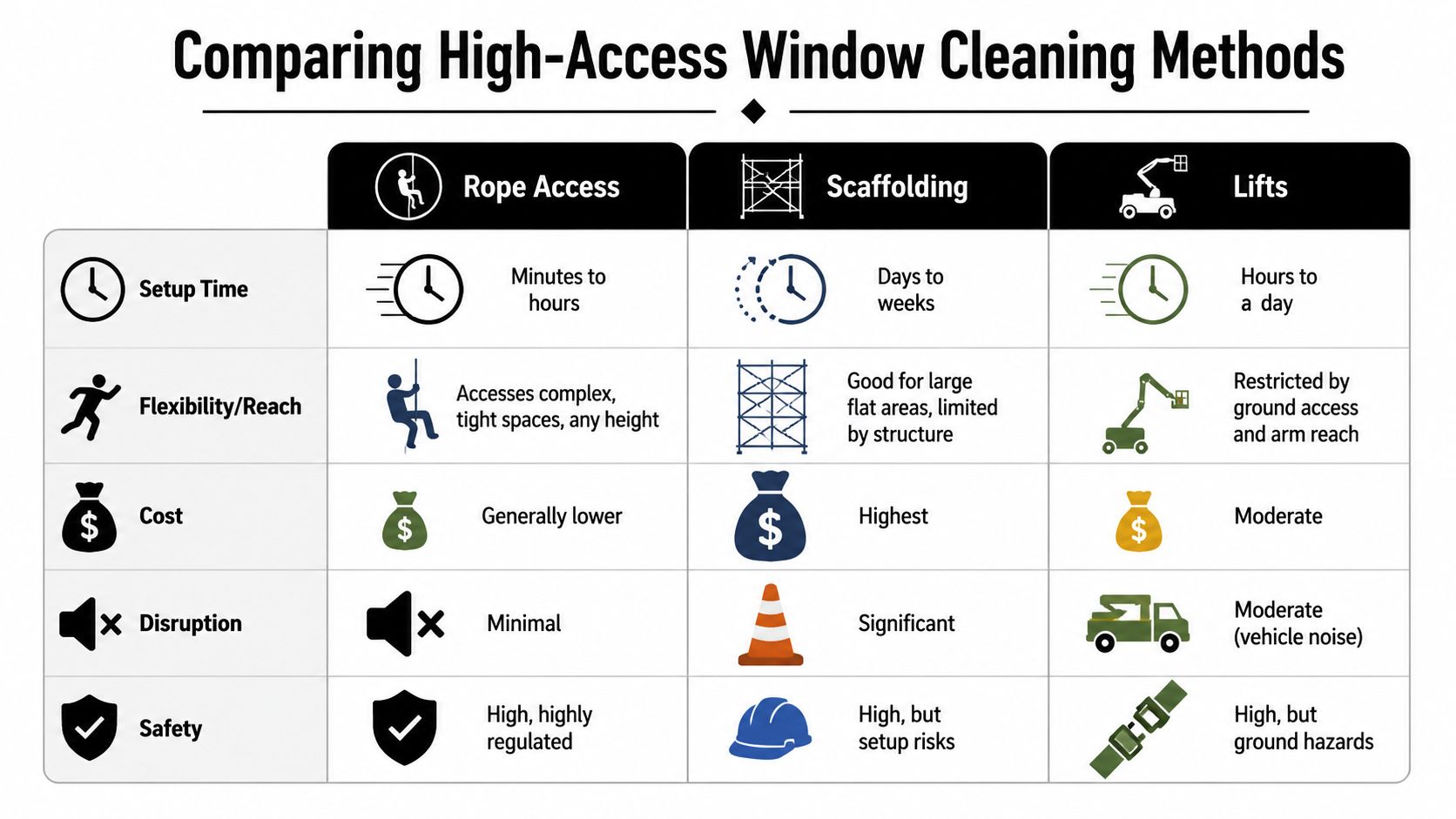
Where rope access usually stands out
Rope access is often strongest when the glass is hard to reach but the crew doesn't need a large platform or major material handling. Think narrow side yards, entry canopies, stepped rooflines, interior courtyards, or mid-rise exteriors where parking a boom lift is awkward.
Its practical strengths are usually:
- Fast mobilization for the right site
- Less ground congestion than scaffold towers or large equipment
- Better reach on irregular façades
- Useful access above obstacles such as landscaping, awnings, or lower roof sections
A detailed look at access options for taller buildings appears in this guide on how professionals clean high-rise windows.
When scaffolding makes more sense
Scaffolding is often the better fit when workers need to stay in one area for extended periods or when the scope goes beyond cleaning into heavier repair or restoration work. It creates a stable work platform and can be the right answer for broad, flat elevations that need repeated access over time.
The trade-off is obvious on occupied properties. Scaffolding takes space, changes the site, and usually creates more visual and logistical disruption.
When a lift is the practical middle option
Aerial lifts work well when the site has reliable ground access and the building geometry matches the machine's reach. For some commercial properties, especially those with open parking or broad setbacks, a lift can be efficient and straightforward.
But lifts also have limits. Sloped terrain, soft ground, parked vehicles, tight courtyards, overhead obstructions, and reach constraints can all complicate what looked easy on paper.
A quick side-by-side view
| Method | Best fit | Main drawback |
|---|---|---|
| Rope access | Complex façades, limited ground space, hard-to-reach glass | Needs proper anchors and weather cooperation |
| Scaffolding | Long-duration work, broad repair scope, repeated stationary access | Highest site disruption |
| Lift | Open ground access, medium-height exterior work, simple approach paths | Limited by terrain and machine reach |
Good contractors don't force one method onto every building. They match the access plan to the property.
For many Colorado Springs buildings, especially those with uneven grades, custom architecture, or active public areas, rope access window cleaning lands in a very practical sweet spot. It can reduce site clutter while still reaching the glass that matters most.
Is Rope Access Right for Your Colorado Springs Property
In Colorado Springs, the best candidates for rope access usually aren't giant towers. They're the properties that are awkward enough to challenge ladders and lifts, but common enough that owners deal with the same frustration every season.
Homes that often benefit
Residential rope access work tends to make sense when architecture and terrain combine to create difficult exterior glass.
A few local examples come up often:
- Hillside homes in Manitou Springs where the rear elevation drops away sharply
- Multi-story homes with large view windows facing the mountains or open space
- Custom homes in Black Forest or on larger lots with tall gables, stairwell windows, or glass above lower roof sections
- A-frame and contemporary homes with large panes placed high above patios, decks, or landscaping
These homeowners usually aren't looking for something fancy. They just want a safe way to get hard-to-reach windows cleaned without damaging roofing, plantings, siding, or outdoor living areas.
Commercial properties in the middle range
Commercial rope access is especially useful for mid-rise and specialty properties where appearance matters but access is inconvenient.
That often includes:
- Office buildings with upper glass above entry plazas
- Hotels and apartment communities that need recurring service with limited disturbance
- Auto dealerships where curb appeal and uninterrupted lot access matter
- Retail and mixed-use buildings with canopies, signs, or pedestrian zones below the work area
On these sites, owners and managers usually care about two things at once. They want streak-free glass, and they want tenants, guests, or customers to keep moving normally while the work happens.
It's also becoming a broader maintenance tool
Another practical shift is that rope access crews are often used for more than window cleaning alone. Industry service listings show technicians increasingly handle bundled exterior tasks such as pressure washing, façade work, painting, caulking, and related maintenance on the same visit, which supports a more consolidated approach for building upkeep, as shown by industrial rope access service offerings.
For a property manager, that can be useful when the building has several small exterior needs at once. One planned mobilization can be simpler than coordinating separate vendors for glass, sealant touch-ups, and façade cleaning.
Signs your property may be a fit
If you're unsure whether rope access window cleaning is the right option, these are usually the clues:
- Your windows are hard to reach safely from a ladder
- A lift would struggle with slope, access, or obstructions
- Scaffolding feels excessive for the scope
- You want minimal disruption around entrances, patios, or common areas
- The property has premium views that are worth maintaining properly
Not every home or building needs rope access. Many don't. But for that awkward category of properties found all over Colorado Springs, CO, it can be the cleanest and most workable solution available.
Hiring a Professional The Cultivate House Detailing Checklist
If you're comparing providers, ask direct questions. A reputable company should be comfortable answering them without dodging, rushing, or hiding behind vague language.
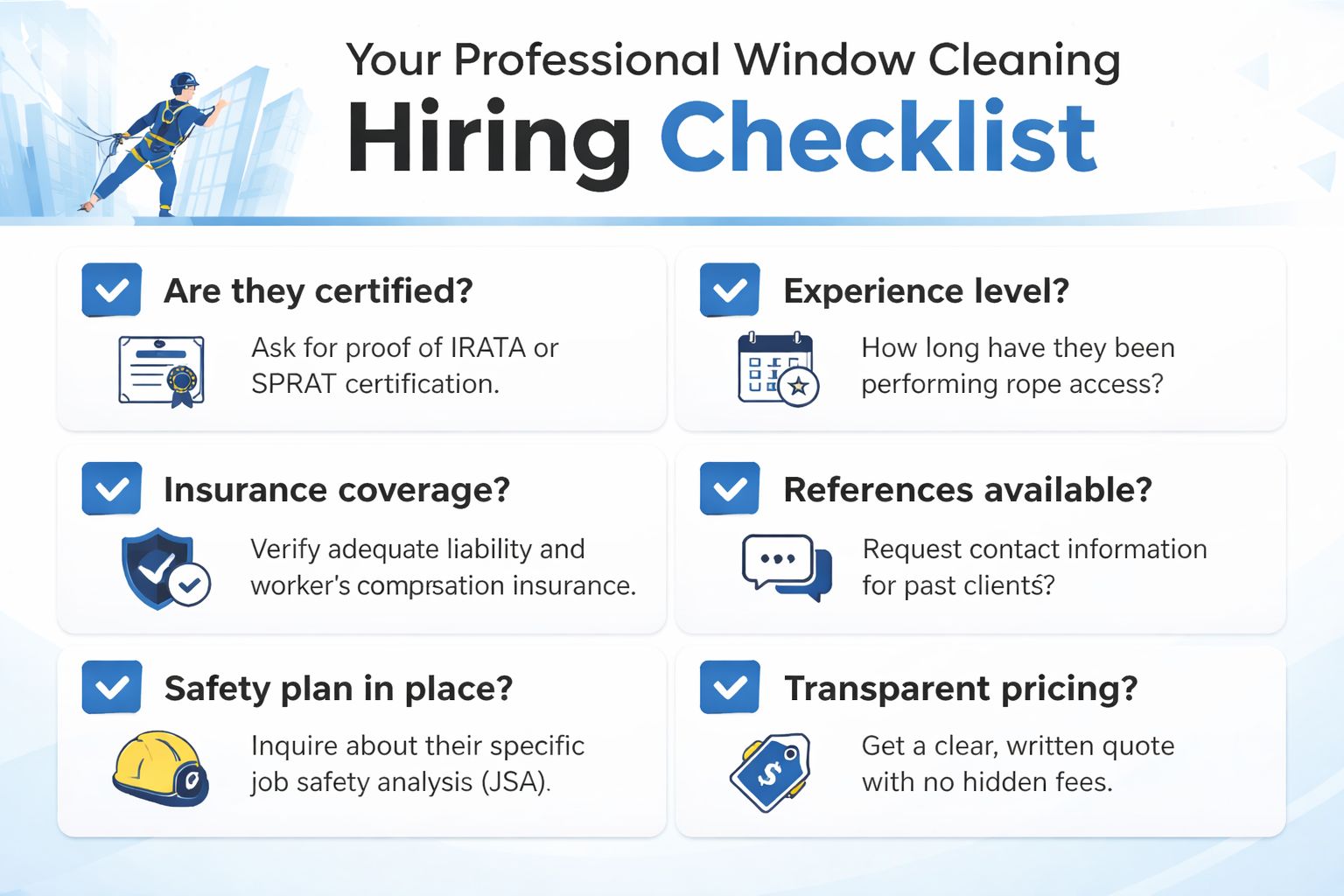
Questions worth asking before you book
- Are your technicians IRATA or SPRAT certified? If a company offers rope access window cleaning, they should be clear about training and qualification.
- Can you provide proof of liability and workers' compensation insurance? Don't settle for a verbal yes.
- What's your site-specific safety plan? Ask how they handle anchors, public protection, weather decisions, and rescue readiness.
- Have you worked on properties like mine in Colorado Springs? A hillside home and a mid-rise office create different access challenges.
- What exactly is included in the quote? Clarify exterior window cleaning, interior glass, screen cleaning, track cleaning, hard water stain treatment, and any access-related limitations.
- How will you protect the property during the work? This matters around landscaping, roof areas, balconies, signage, and customer entrances.
What strong answers sound like
Good companies are specific. They can explain their process in plain language. They don't act irritated when you ask about insurance or safety. They can tell you what method they recommend and why, even if that method isn't rope access.
A useful hiring standard is simple:
Choose the contractor who explains the work clearly, documents the risk, and treats your property like an active jobsite instead of a quick side task.
A final filter for homeowners and managers
If a provider seems eager to give a low number before discussing access, safety, or scope, be careful. Difficult glass isn't expensive because it's dirty. It's expensive when the access method is wrong, rushed, or underplanned.
For residential window cleaning, commercial window cleaning, interior window cleaning, or exterior window cleaning in Colorado Springs, the best results usually come from a contractor who sees the whole picture. Glass condition, building layout, safety requirements, and customer experience all need to line up.
If you need professional window cleaning for difficult-access glass in Colorado Springs, CO, Cultivate House Detailing can help you figure out the safest and most practical approach. Whether you're dealing with a complex residential home, a mid-rise commercial property, or windows that have been ignored because they're hard to reach, contact Cultivate House Detailing to request a quote and schedule service.
Want it handled by a local crew? Cultivate House Detailing offers residential window cleaning in Colorado Springs. Get a free quote.
Serving Manitou Springs and the surrounding Colorado Springs area — see our window cleaning services in Manitou Springs.