Your Colorado Springs patio is probably getting used hard right now. It's where coffee happens on bright mornings, where kids and dogs cut across all summer, and where winter grime seems to settle in every joint and corner. Between intense sun, windblown dust, spring pollen, hail, and freeze-thaw cycles, patios here don't stay clean for long.
Pressure washing can bring a tired patio back to life fast, but it can also leave permanent marks if you go at it with too much pressure or the wrong technique. That's the part most quick guides skip. Good results come from matching the machine, nozzle, cleaner, and method to the surface you have.
At Cultivate House Detailing, we see that difference all the time around Colorado Springs. A concrete patio in one neighborhood can handle far more than a weathered flagstone patio in another. If you want a smart DIY approach, these pressure washing patio tips will help you clean safely, avoid common mistakes, and know when it makes sense to call in a pro. If you're also working on the full outdoor space, this guide on achieving long-lasting outdoor tile beauty is worth bookmarking too.
1. Choose the Right PSI for Your Patio Surface
A lot of patio damage starts with good intentions and one bad setting on the machine. Homeowners see dirt, turn the pressure up, and end up carving lines into concrete or knocking sand out of paver joints.
The safer approach is to match the pressure to the material and start lower than you think you need. On a plain broom-finished concrete slab, you usually have more room for error. On stamped concrete, older patios, pavers, and natural stone, that margin gets small fast. Around Colorado Springs, our freeze-thaw cycles already put stress on surface pores, edges, and joints. Add high-pressure washing to a weathered patio, and weak spots show up immediately.
Match the cleaning force to the material
A basic concrete patio can often handle moderate pressure with the right nozzle and distance. Decorative surfaces need more restraint. Flagstone can flake. Pavers can lose joint material. Stamped concrete can show etching or lighter streaks once it dries, especially if the color or sealer is already fading from Colorado's strong UV exposure.
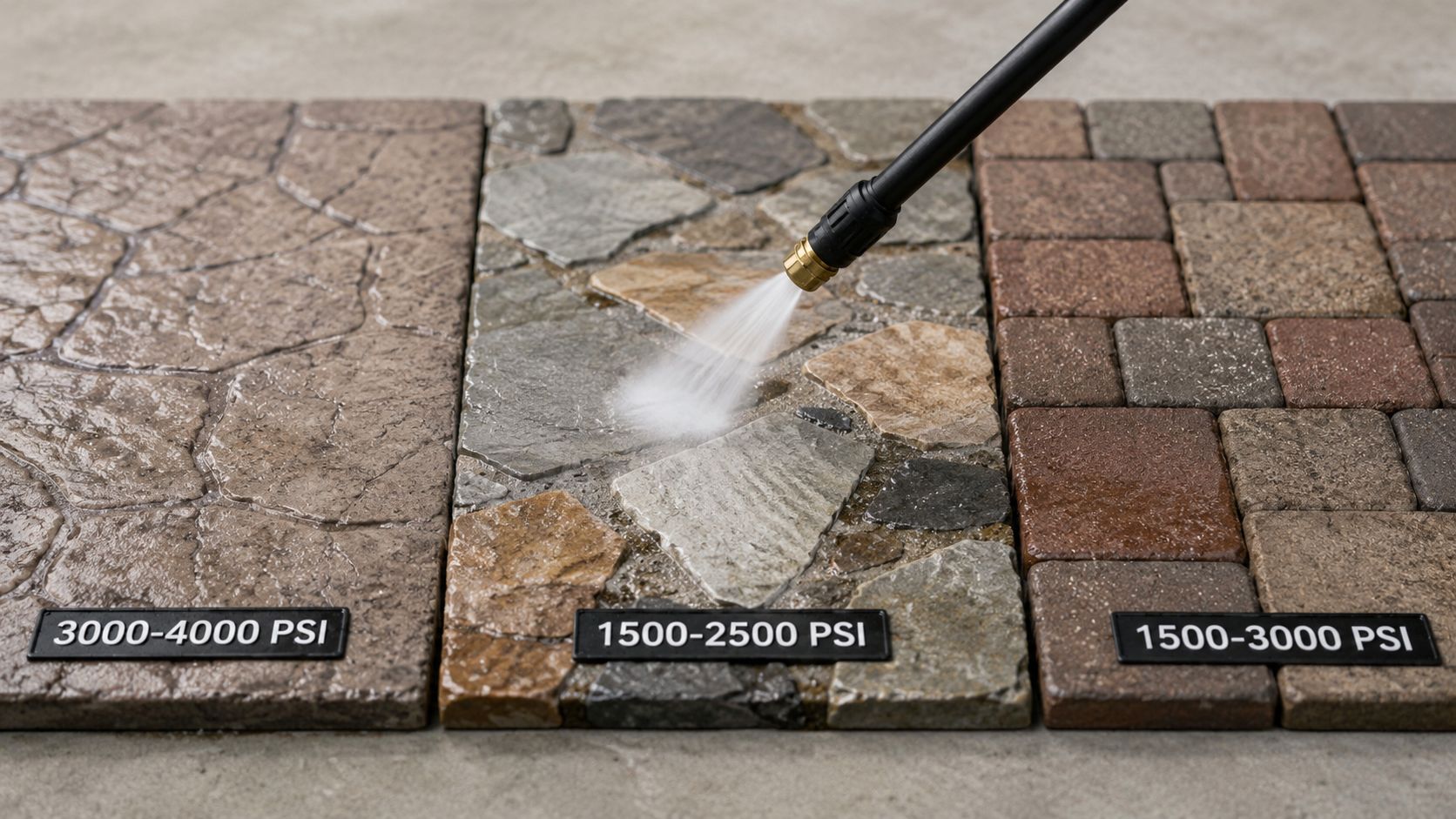
If you're washing flagstone in Woodland Park, pavers in Monument, or a stamped patio here in Colorado Springs, test a small hidden area first. Watch for rough texture, lighter color, loose joint sand, or visible striping after the surface starts to dry. Those are early signs that the setup is too aggressive.
Practical rule: Use the least aggressive setup that gets the job done. You can increase pressure in small steps. You usually cannot reverse etching or surface scarring.
A few habits make a big difference:
- Start with a wider fan nozzle: It spreads force more evenly and is safer for general patio cleaning.
- Hold a steady working distance: Sudden changes in distance create zebra stripes and uneven results.
- Avoid the temptation to chase every stain with more pressure: Dark spots often need cleaner, dwell time, or repeated passes.
- Pay attention to joints and edges: These areas fail first, especially on older pavers and stone patios.
Professional crews build jobs around surface condition, not just machine specs. That's the key gap between a rushed DIY wash and a clean patio that still looks good a month later. At Cultivate House Detailing, we treat PSI as one part of the setup, along with nozzle choice, surface age, joint condition, and how Colorado weather has already affected the material. That standard is worth using at home too.
2. Pre-Treat with the Right Cleaning Solution
If your patio is dark with algae, spotted with grease, or holding onto winter grime, water alone usually isn't the smartest first move. Pre-treatment does the heavy lifting so you don't have to chase stains by turning the pressure higher and higher.
This matters a lot on patios that sit in shade, especially north-facing areas in Black Forest or spots tucked under trees where moisture hangs around. On those jobs, a good cleaner often does more for the final result than a stronger machine does.
Let chemistry reduce the amount of force you need
Use a cleaner that fits the problem. Degreaser for cooking grease or drip spots. A mildew or algae treatment for green buildup. A stone-safe cleaner for natural stone where harsh chemistry can create its own issues.
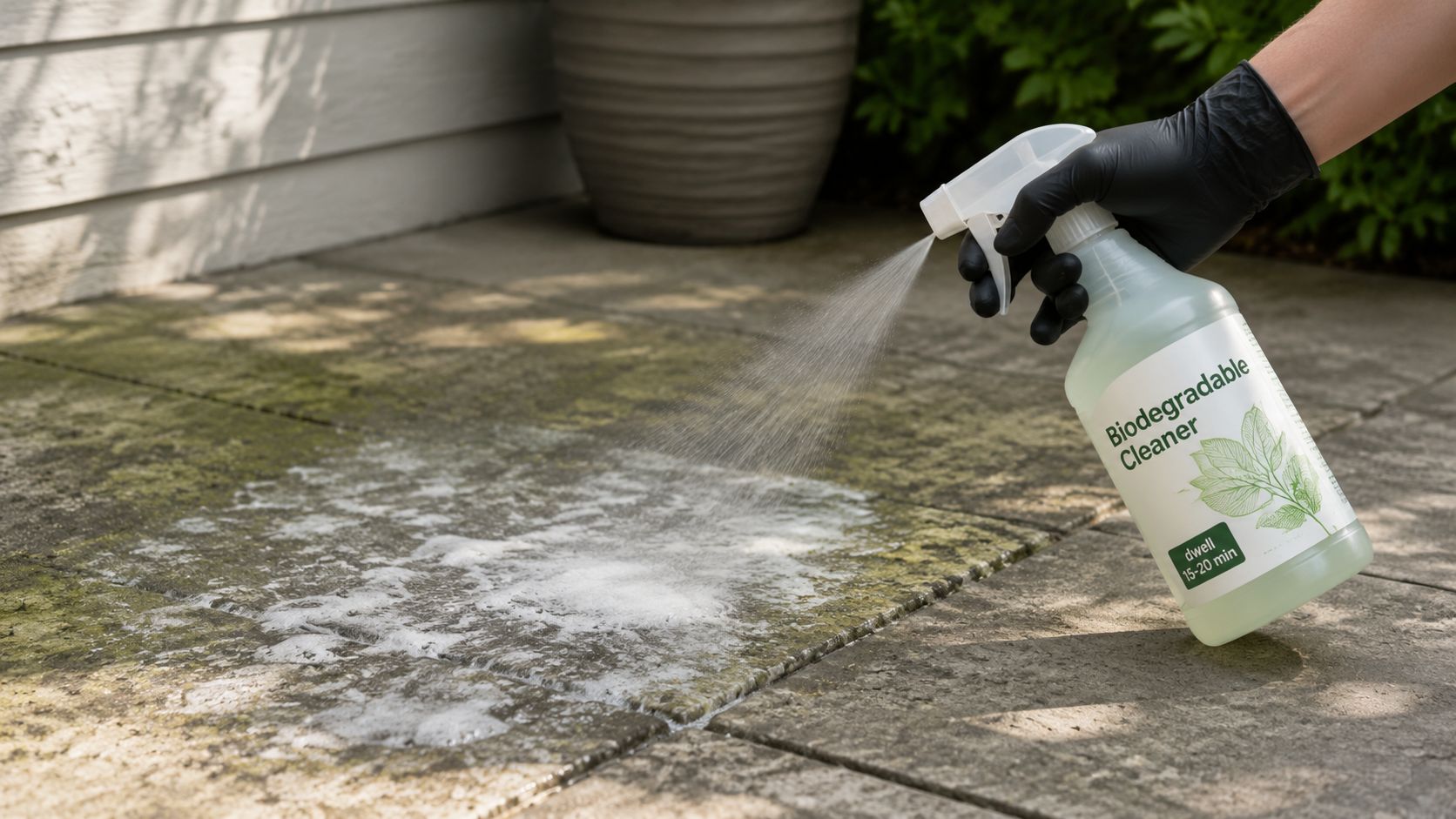
The key is patience. Apply it evenly, let it dwell according to the product directions, and keep it from drying too fast in direct sun. Colorado's dry air can shorten your working time, so shaded mornings usually give you more control than late afternoon heat.
A few practical examples:
- For food and grill areas: Treat grease before you rinse, or you'll just spread it wider.
- For moss between pavers: Pre-treat, then rinse with a controlled fan spray instead of trying to blast the joints clean.
- For spring grime on decorative surfaces: A milder cleaner plus lower pressure usually preserves the finish better than an aggressive wash.
If you have to hold the nozzle extremely close to remove a stain, stop and change your approach. That usually means the stain needs treatment, not more pressure.
Rinse thoroughly after the cleaner has done its work. Leftover residue can attract dirt, create slippery patches, or interfere with sealer later on.
3. Maintain Proper Technique with Angle, Distance, and Direction
A patio can be the right pressure and still come out looking patchy. I see that a lot around Colorado Springs. The problem usually isn't the washer. It's the way the spray is being used.
Most uneven results come from three mistakes. Holding the tip too close, changing the angle every few seconds, and pushing dirty water back across areas you already cleaned. On a patio with any slope at all, runoff starts working against you fast, especially in places like Manitou Springs where water rarely sits still.
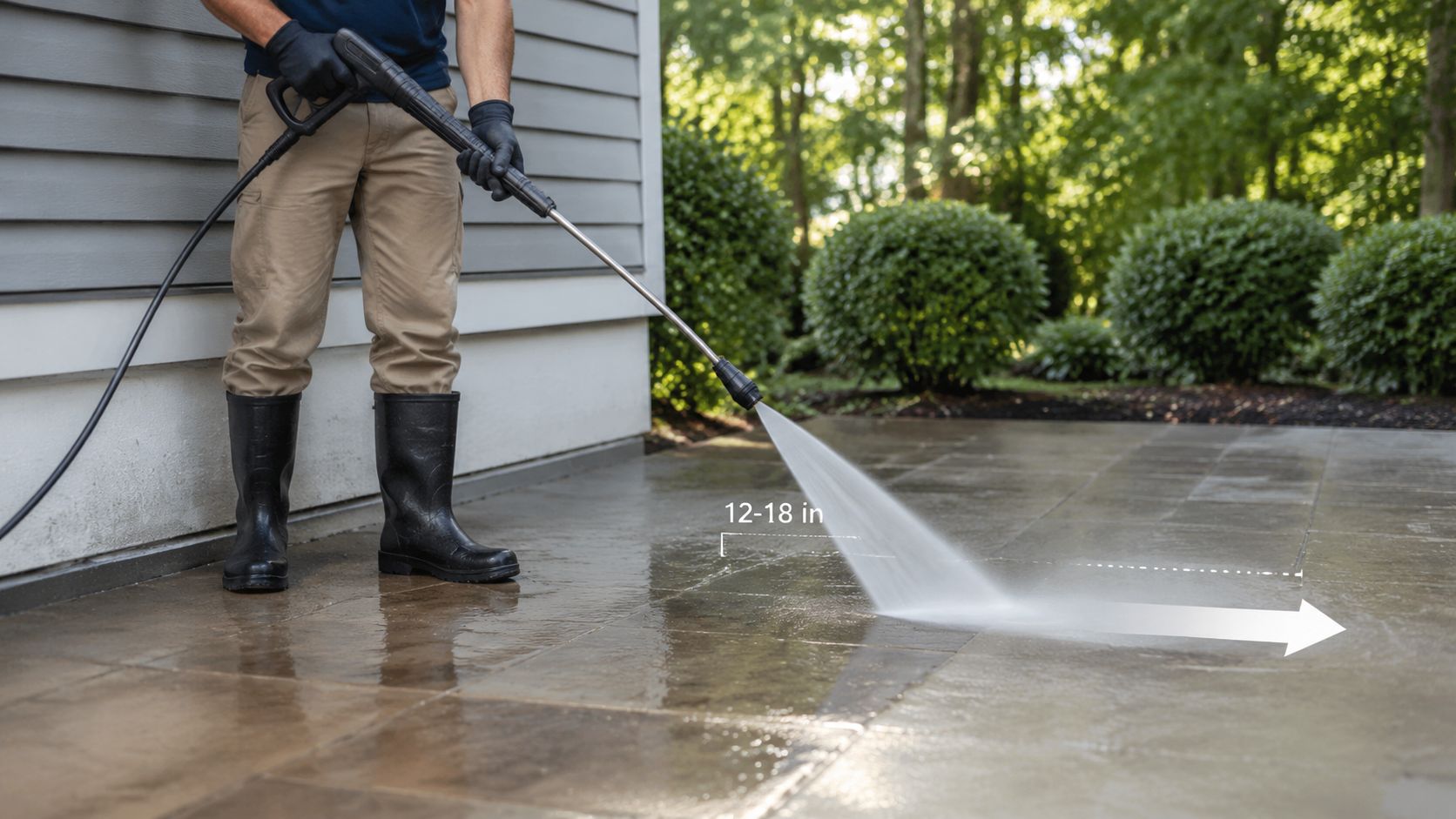
Here's a look at the kind of controlled motion that produces a cleaner finish:
Keep your passes consistent
Start in a less visible spot and dial in your distance before you clean the main patio. For most surfaces, a slight angle works better than pointing the spray straight down. It lifts soil and carries it forward instead of driving water deeper into joints, seams, and small surface flaws.
Pros aim for repeatable passes. That means steady speed, a consistent standoff distance, and overlap from one pass to the next. If one strip gets a slow pass and the next gets a quick one, you'll usually see it after the patio dries.
A simple pattern helps:
- Pick one direction: Side to side or top to bottom both work. Stick with one so the finish dries evenly.
- Overlap each pass slightly: That prevents striping and missed edges between passes.
- Watch the runoff path: Move grime away from the house, door thresholds, and garage edges.
- Back off on joints and edges: Paver sand, mortar, and weak corners can wash out before the center does.
A short demo can help if you're trying to dial in your movement before you start on a visible area:
Colorado adds a couple of wrinkles here. Afternoon wind can push overspray onto siding and windows, and our freeze-thaw cycle punishes patios that already have tiny cracks or loose joints. If water gets forced into those spots, winter tends to finish the job. Clean the surface dirt off the patio. Don't chase soil out of the patio.
This is also the same habit we use on larger exterior jobs. Controlled angle, controlled distance, controlled rinse path. If you want a good reference for how that approach carries over to siding and other surfaces, this guide on how to clean house exterior surfaces safely follows the same basic standard we use in the field.
4. Wear Real Safety Gear, Not Just Old Clothes
A lot of patio mishaps happen in the first few minutes. The slab is already getting slick, overspray is bouncing back, and the wand has more force than expected. Old jeans and yard shoes do not do much in that situation.
Start with footwear that grips well on wet concrete or stone. Then add wraparound eye protection, work gloves that still let you control the trigger, and hearing protection if you are running a gas machine. If you are using a cleaner before washing, switch to chemical-resistant gloves and wear sleeves and pants that keep overspray off your skin.
Good gear does two jobs. It protects you from grit and chemicals, and it helps you stay steady enough to do cleaner work.
A practical setup looks like this:
- Shoes with traction: Wet patios get slick fast, especially on algae, smooth concrete, and shaded pavers.
- Eye protection: Dirty spray carries sand, debris, and cleaner back toward your face. Regular glasses leave too much open.
- Gloves with grip: You need control when the wand kicks on and when your hands get wet.
- Hearing protection: Gas units are loud enough to wear on you during a longer job.
- Clothing that covers skin: Useful around corners, windy edges, and any area where cleaner may drift back.
Colorado Springs adds a couple of safety wrinkles. Wind can shift spray without much warning, and our dry air can make people underestimate how tiring an hour behind a washer can be. On older patios, freeze-thaw wear also means loose edges, small surface flakes, and weak joints underfoot. That is one reason pros slow down and set up the work area before they ever start washing.
Do the same at home. Move lightweight furniture, keep kids and pets out of the area, and pay attention to runoff near door thresholds, outlets, and garage entries. If you are cleaning beyond the patio, this guide on how to clean house exterior surfaces safely shows the same safety habits we use in the field.
5. Seal the Patio After It's Clean and Fully Dry
A freshly washed patio looks great for a minute. The question is how long it stays that way.
Sealing is where many DIY jobs fall short. Homeowners spend the time cleaning, then skip the protection step that helps the surface resist future staining and weather exposure. In Colorado Springs, that matters because patios deal with intense sun, quick weather swings, snowmelt, and repeated freeze-thaw cycles.
Protect the surface you just worked to restore
Different materials need different sealers. Concrete, pavers, and natural stone don't all respond the same way, and the wrong finish can change the look more than you wanted. Some sealers deepen color. Some stay more natural. Some add a bit of sheen that looks great on one patio and too glossy on another.
Wait until the patio is fully dry before sealing. If moisture is still trapped in the surface or joints, you can lock in haze, create uneven absorption, or shorten the life of the coating.
A smart approach looks like this:
- Choose for the material: Use a product made for your specific patio surface.
- Test before full application: Check appearance on a small hidden section first.
- Watch the weather window: Don't seal right before rain, freezing temps, or heavy evening moisture.
This is especially useful for stamped concrete patios in sunny exposures and porous stone patios that tend to darken with moisture. The right sealer won't make the patio maintenance-free, but it usually makes routine cleaning easier and helps preserve the appearance you just paid for in time and effort.
6. Check Your Equipment Before You Start
You roll the washer onto the patio, hook everything up, squeeze the trigger, and the machine sputters. Or worse, the spray fan comes out uneven and etches a stripe before you realize the tip is partly blocked. That is a frustrating way to start, and in Colorado Springs it happens more than people expect because equipment often sits through winter, then goes straight back into service.
A quick pre-check saves time, protects the surface, and keeps small equipment issues from turning into repair bills. It is the same habit pros use before washing concrete, stone, or patio pavers that need a little more joint protection.
Spend five minutes checking the parts that fail first
Start with the hose and gun. Look for bulges, cracked outer jackets, loose fittings, and drips at the connections. If a hose fails under pressure, the job stops right there.
Then check the nozzle. A worn tip changes output, and a clogged tip distorts the spray pattern. On a patio, that can leave obvious lines, especially on sealed concrete or weathered stone. If the machine has quick-connect fittings, make sure they seat fully and lock in place.
Before startup, run through this short checklist:
- Hose and fittings: No cracks, leaks, or loose couplers
- Nozzle tip: Clean opening, correct spray angle, no visible wear
- Water supply: Strong flow from the spigot before the machine is turned on
- Pump protection: Never run the washer without adequate water feeding the pump
- Power source: For electric units, keep plugs and connections away from standing water
- Engine check: For gas units, confirm fuel, oil, and any obvious signs of leakage
Colorado adds one more trade-off. Freeze damage is not always obvious. A pump or hose can survive storage in appearance and still fail once pressure builds. If the unit was stored in a garage that dipped below freezing, inspect it more carefully than you would in a milder climate.
Rental units deserve extra scrutiny. They are convenient, but they usually see hard weekend use from one homeowner after another. Test the spray pattern on a less visible section first, not in the center of the patio.
The same mindset applies if your patio connects to a composite deck or steps. Homeowners who are also installing Trex decks need to be even more careful about overspray, tip choice, and machine condition near finished surfaces. A bad nozzle on concrete is annoying. A bad nozzle near composite trim can leave permanent marks.
Pressure washer manufacturers and market analysts expect steady demand for this equipment over the next several years, but easy access does not equal safe setup. A machine can be popular, rentable, and still be in poor working order. Check it before every job. That is how professionals avoid preventable damage, and it is one of the simplest ways to get a more even result at home.
7. Understand the Surface Before You Wash
Before you think about nozzles, cleaner, or technique, identify what you're cleaning. That sounds obvious, but it trips people up all the time.
A patio may look like plain concrete from the yard and turn out to be stamped concrete with a tinted finish. What looks like solid stone could be a softer material with aging joints. Even within one patio, the main field and border can react differently.
Surface ID changes the whole job
Concrete walkways can usually tolerate stronger cleaning, while aluminum siding can dent and shingle siding shouldn't be pressure-washed, according to the same consumer guidance referenced earlier. That matters because patio work rarely happens in isolation. Overspray and runoff often hit nearby steps, rails, siding, and doors.
For homeowners dealing with pavers, joint care becomes part of surface identification too. If the patio relies on sand-filled joints, aggressive washing can strip out material and leave the field unstable or weed-prone after it dries.
A few common Colorado examples:
- Stamped concrete patios: Easy to stripe or dull if you clean too aggressively.
- Flagstone patios: Often need a gentler hand and better runoff control.
- Paver patios: Clean well, but joints need protection before, during, and after washing.
If your patio includes pavers, Cultivate House Detailing's page on power washing patio pavers is a useful next step because paver cleaning has its own set of risks.
Some of the most expensive patio damage starts with a wrong assumption about the material, not a wrong move with the wand.
One area that beginner guides often miss is drainage. Guidance on patio washing notes that dirty slurry can clog drains, and poor-drainage sites may leave standing water that needs manual cleanup rather than “washing harder” (drainage and slurry guidance for patio pressure washing). If your patio regularly stays wet in low spots, solve that practical issue instead of trying to blast your way through it.
If your outdoor space includes composite decking next to the patio, it also helps to understand how different materials are built and finished. This overview of installing Trex decks gives useful context on adjacent surfaces that shouldn't be treated the same way as concrete or stone.
Pricing can also help set expectations. Thumbtack reports national average hourly pressure-washing costs of $75 to $90 and an average patio pressure-washing price of $252 to $447, while Housecall Pro's 2026 pricing guide places most residential pressure-washing jobs between $150 and $500 and notes flatwork is commonly priced at $0.15 to $0.75 per square foot. That's one reason many homeowners choose to DIY straightforward patio cleaning but hire help for stained, delicate, or drainage-prone surfaces.
7-Point Patio Pressure-Washing Tips Comparison
| Item | Implementation complexity | Resource requirements | Expected outcomes | Ideal use cases | Key advantages |
|---|---|---|---|---|---|
| Choose the Right PSI (Pounds Per Square Inch) for Your Patio Surface | Moderate, requires identifying material and adjusting settings | Adjustable pressure washer, nozzle set, PSI gauge, test area | Effective cleaning with minimal surface damage | Patios with varied materials (concrete, pavers, natural stone) | Prevents damage, extends surface life, achieves optimal clean |
| Pre-Treatment with Appropriate Cleaning Solutions Before Pressure Washing | Moderate, select correct chemistry and dwell times | Biodegradable cleaners, sprayer/applicator, PPE, water for rinse | Improved stain removal, lower required pressure, less water use | Algae/moss-prone areas, oil/grease stains, shaded patios | Reduces pressure needs, improves results, eco-friendly options |
| Maintain Proper Technique: Angle, Distance, and Directional Control During Pressure Washing | High, requires practiced skill and consistency | Trained operator, fan nozzles, ergonomic wand control | Uniform cleaning, reduced gouging, protected adjacent structures | Large surfaces, sloped patios, detailed finishes | Produces professional, even results and minimizes surface damage |
| Safety Equipment and Personal Protective Equipment (PPE) Requirements | Low, procedural adoption and enforcement | Safety glasses, slip-resistant boots, chemical gloves, hearing protection, first aid kit | Fewer injuries, regulatory compliance, reduced liability | Commercial jobs, DIY projects, any chemical use or loud equipment | Protects personnel, lowers liability, inexpensive risk mitigation |
| Post-Pressure Washing Patio Sealing and Protection Recommendations | Moderate, timing and product selection are important | Appropriate sealer (penetrating/membrane), applicators, dry weather window | Extended lifespan, UV and moisture protection, slower re-soiling | Newly cleaned patios, high-UV climates, commercial properties | Long-term protection, improved appearance, less frequent cleaning |
| Equipment Maintenance and Pre-Operation Safety Checks | Moderate, routine schedule and documentation required | Maintenance tools, spare hoses/nozzles, fluids, logs, trained staff | Fewer failures, consistent performance, longer equipment life | Contractors, rental fleets, regular seasonal operations | Prevents downtime, increases safety, reduces repair costs |
| Understanding Your Patio Surface Material Before Beginning Pressure Washing | Moderate to high, diagnostic knowledge often needed | Inspection tools, reference specs, test patches, manufacturer info | Correct method selection, minimized damage, accurate estimates | Older homes, mixed-material patios, high-value surfaces | Enables tailored treatment, avoids costly mistakes, informs sealing/chemicals |
Enjoy a Flawless Exterior When to Call the Pros
A patio refresh can absolutely be a good DIY project. If your surface is straightforward, your equipment is in good shape, and you're willing to move slowly, these pressure washing patio tips can help you get a clean result without beating up the surface. For many homeowners in Colorado Springs, that's enough to handle routine buildup and seasonal dirt.
But there are limits, and it's smart to respect them. If you're not sure what material you have, if the patio has old joints, if runoff drains toward the house, or if stains keep coming back no matter how much you wash, that's usually where professional help starts making more sense. The same goes for decorative concrete, natural stone, steep or awkward layouts, and patios surrounded by siding, doors, or windows that can be affected by overspray.
A pro brings more than a stronger machine. They bring judgment. They know when to back off pressure, when to pre-treat instead, when standing water points to a drainage issue, and when sealing will help preserve the finish after cleaning. That's the difference between a patio that looks freshly restored and one that looks freshly blasted.
Around Colorado Springs, from Monument to Manitou Springs, exterior cleaning also tends to work best as a whole-property approach. A bright patio next to dusty windows, spotted screens, or grime-covered walkways never looks fully finished. If you've already put in the effort to improve one part of the exterior, it often makes sense to clean the surrounding surfaces too.
Cultivate House Detailing provides pressure washing and window cleaning for homeowners and businesses in Colorado Springs and nearby communities. If you want a professional finish, or you'd rather skip the setup, testing, cleanup, and risk of damage, getting a quote is the easy next step. A clean patio should make your outdoor space more enjoyable. It shouldn't become a weekend of guesswork.
If your patio, windows, or other exterior surfaces need attention, Cultivate House Detailing can help with pressure washing and streak-free window cleaning in Colorado Springs and nearby communities. Reach out for a free, no-obligation quote and get your exterior cleaned with clear communication, careful methods, and service that fits your property.
Need it done properly the first time? Cultivate House Detailing offers pressure washing in Colorado Springs. Get a free quote.