A Colorado Springs homeowner may notice green algae streaks, windblown dust, or dull siding after a long winter and assume the answer is simple: rent a pressure washer and spray until the color comes back. That approach can work on the right material, but siding isn't concrete. The wrong pressure, nozzle, or spray angle can damage the surface or push water behind the wall.
Pressure washing for siding is a technique-sensitive form of exterior maintenance. Vinyl, fiber cement, wood, aluminum, and shingle siding all respond differently, and Colorado Springs homes face added exposure from intense sun, wind, freeze-thaw cycles, and seasonal debris. This guide explains what works, what doesn't, and when a siding-safe professional service makes more sense than a weekend rental.
Why Pressure Washing for Siding Is Worth Thinking Through Carefully
After a windy spring in Colorado Springs, dust often collects along lap joints, window trim, and shaded sections of siding. Add winter moisture and organic growth, and a once-bright exterior can develop dark streaks or green algae. A careful wash can restore the appearance quickly, but a careless spray-down can turn a cosmetic cleanup into a building-envelope problem.
Siding panels overlap by design. Those seams shed water when rain travels downward, but a pressure washer aimed upward can force water into the overlaps. Water may then reach sheathing or insulation instead of draining across the face of the siding. The exterior can look spotless while moisture remains hidden behind it.
Practical rule: Siding needs controlled water flow and cleaning chemistry, not maximum machine power.
Concrete is hard and dense, so operators commonly use much higher pressure on it. Siding is lighter, jointed, and often painted. The same nozzle that removes embedded grime from a driveway can etch a finish, lift paint, loosen a panel, or drive water into a wall cavity.
Pressure washing became popular because it can clean exterior surfaces faster than manual scrubbing with a brush and hose. Consumer Reports notes that some siding materials can typically withstand pressure washing, but it also warns that trapped water behind siding can encourage mold growth. Its guidance on algae cleaning methods provides useful background for homeowners comparing chemical treatment with mechanical cleaning.
The risk is behind the surface
Colorado's climate makes hidden moisture especially important. Water trapped behind siding can encounter freeze-thaw conditions, while strong ultraviolet exposure can stress paint, caulk, and other exterior details. A clean-looking wall isn't proof that the wash was safe.
The operator should inspect the siding before touching the trigger. Loose panels, cracked sections, failed caulk, damaged trim, and gaps around windows or doors all change the plan. Homes built before 1978 require extra caution because exterior paint may contain lead and should be tested before pressure washing, as Consumer Reports explains in its pressure washer surface safety guidance.
Which Siding Types Can Handle Pressure Washing and Which Cannot
The first decision isn't PSI. It's material identification. A technician who treats every wall as vinyl is already working from the wrong starting point.
Consumer Reports identifies vinyl and fiber cement as siding types that can typically withstand pressure washing when handled correctly. Wood clapboard can also be washed, but it needs a gentler approach. Aluminum siding can dent, and shingle siding should not be pressure-washed at all.
| Siding material | Pressure wash safe? | Recommended method | Primary risk |
|---|---|---|---|
| Vinyl | Yes, with controlled settings | Detergent application followed by a wide-fan rinse | Water intrusion, cracking, or distortion |
| Fiber cement | Generally, with careful technique | Low-pressure chemical cleaning and controlled rinsing | Finish damage and moisture at joints |
| Wood clapboard | Limited, with caution | Soft-wash-first cleaning and gentle rinsing | Raised fibers, paint damage, and water entry |
| Aluminum | Not a routine pressure-washing target | Low-pressure cleaning after a material inspection | Dents and finish damage |
| Cedar or asphalt shingle siding | No | Non-pressure cleaning methods selected for the material | Loss of granules, breakage, and water intrusion |
Match the method to the wall
Vinyl is forgiving compared with several other materials, but it still has lap joints and can move under excessive pressure. Fiber cement is rigid, yet its paint and seams still deserve controlled treatment. The fact that a surface feels hard doesn't mean it should receive a narrow, aggressive stream.
Wood clapboard is where soft washing becomes especially valuable. Detergent can loosen organic staining before rinsing, reducing the temptation to compensate with more pressure. Wood siding may also show raised fibers or stripped paint after an overly forceful pass.
Aluminum deserves a visual inspection before any washing. A dented panel may not reveal its weakness until a stream hits it, and a painted finish can show uneven wear after aggressive cleaning.
Shingle siding is the clearest stop sign. Cedar and asphalt shingles contain textured or layered surfaces that can break, lose protective material, or absorb water when pressure is applied. For a broader material-by-material overview, this guide to cleaning house siding is a useful planning reference.
Check the home before choosing a machine
Look at the underside of laps, the areas around windows and doors, exterior outlets, vents, and any visible cracks. Don't assume that a machine's advertised PSI is a safe operating pressure at the wall. Distance, nozzle width, angle, and the condition of the siding determine the force the surface receives.
The Right Settings, Nozzles, and Detergents for Siding
A safe siding wash uses chemistry to do much of the work. The machine should move loosened soil and rinse away residue, not blast contamination off through force alone.
For vinyl siding, one operator workflow uses detergent application at 100 to 200 PSI, a 25-degree nozzle, and a stand-off distance of about 12 to 18 inches. The detergent is applied from the bottom upward so wet chemistry doesn't streak across dry areas, then allowed to dwell for 10 to 15 minutes before rinsing from the top downward at 200 to 500 PSI with a 25-degree or 40-degree fan tip. These settings and sequence come from the vinyl siding operator guide.
The same guidance pairs the workflow with a 1 to 2 percent on-surface sodium hypochlorite mix plus surfactant for organic growth. It warns not to exceed 2 percent, because stronger concentrations can damage paint and vegetation. Protect nearby plants, windows, doors, and sensitive finishes before applying any solution.
Use the nozzle and distance as safety controls
For rinsing, industry guidance commonly places vinyl siding around 1,200 to 1,600 PSI, while wood siding is often kept around 1,200 to 1,500 PSI with a 40-degree nozzle to reduce fiber raise. A wide fan spreads the water across the surface. A narrow tip concentrates force in one small area.
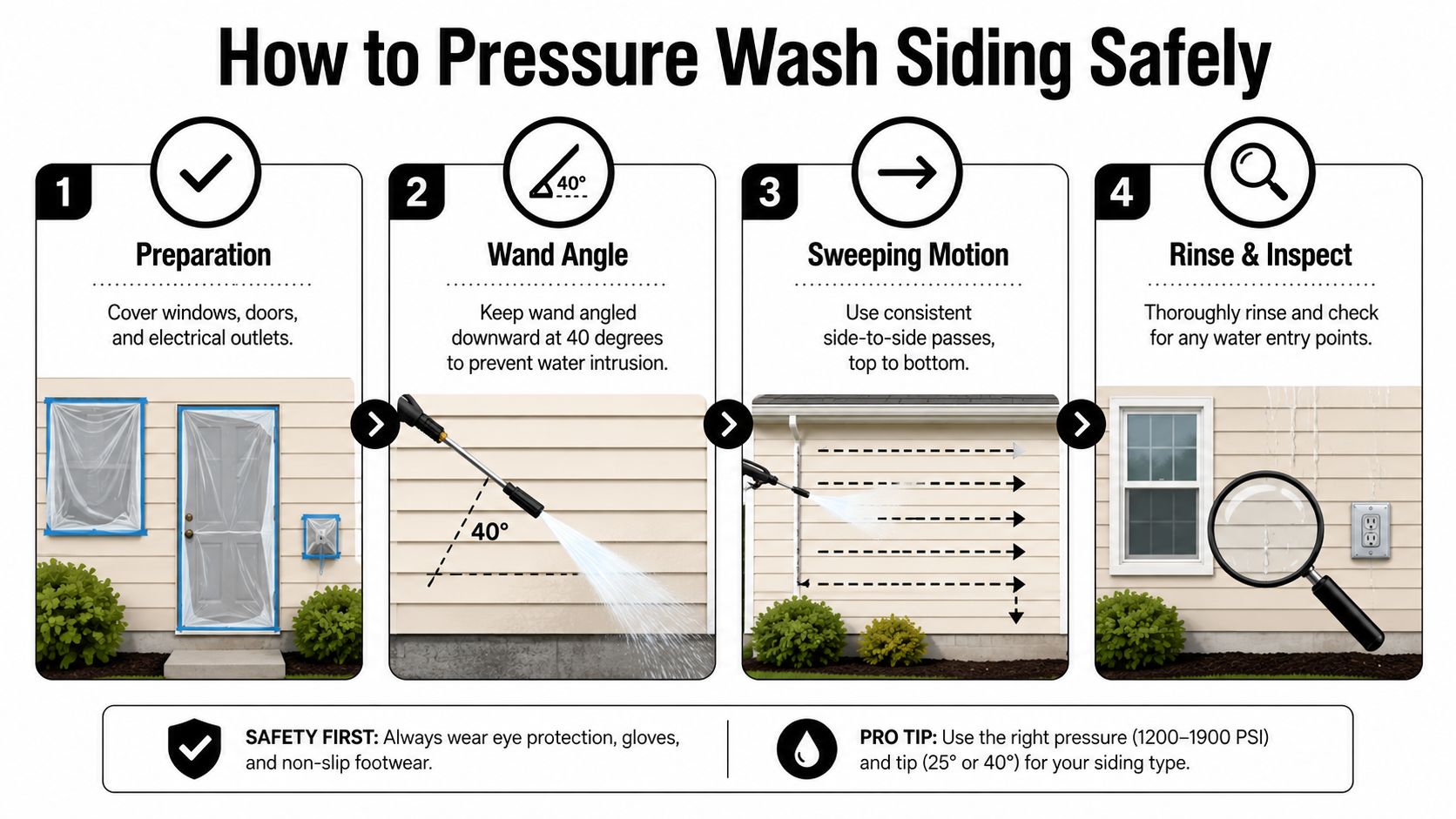
The nozzle should generally be a 25-degree or 40-degree fan tip, held about 12 to 24 inches from the siding. Moving closer increases effective pressure, so backing away is a real adjustment, not a minor convenience. Avoid zero-degree tips and don't use hard-surface settings just because they clean faster on concrete.
Control the dwell time
Work in manageable sections. A practical guide recommends 8 to 10 foot sections, particularly in hot weather, so detergent doesn't dry before rinsing. Drying solution can leave residue, create uneven results, and encourage an operator to increase pressure unnecessarily.
For a visual demonstration of equipment movement and siding technique, watch this siding pressure-washing video.
A useful equipment comparison is available in this guide to pressure washers for house siding. The machine matters, but technique matters more. A lower-output washer in skilled hands is safer than a powerful machine used at close range with the wrong tip.
How to Pressure Wash Siding Without Driving Water Behind the Walls
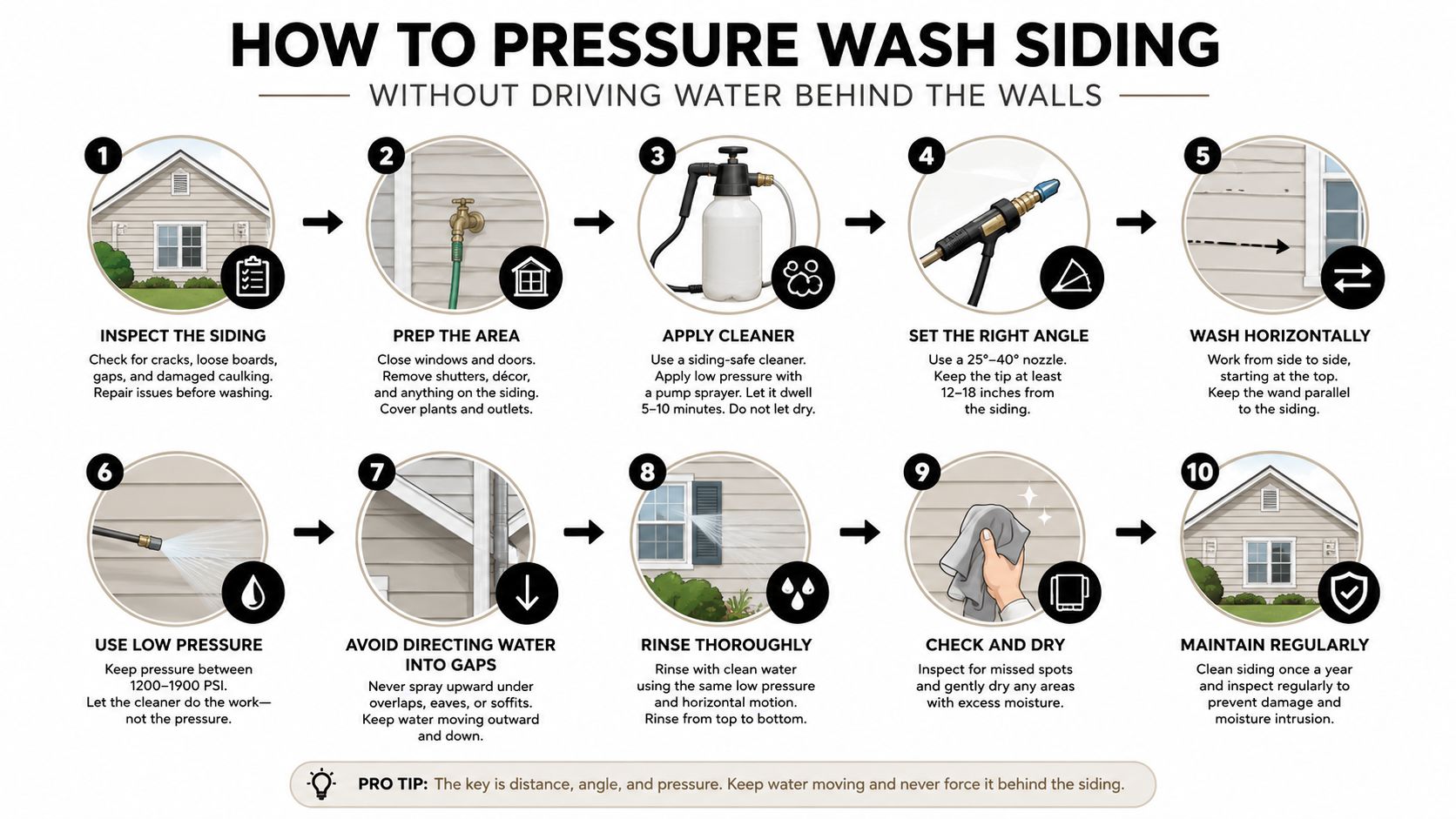
Water intrusion usually begins with one of three choices: spraying upward, getting too close, or aiming a concentrated stream at a seam. Each choice changes the direction and force of the water at the exact places where siding is meant to shed runoff.
Keep the wand angled downward, with the spray traveling across the face of the siding rather than underneath its laps. Maintain roughly 12 to 24 inches of stand-off, and use a wide 25-degree or 40-degree fan tip. These controls reduce concentrated impact and make it less likely that water will enter around joints, trim, windows, and doors.
Treat openings and seams as no-spray zones
Consumer Reports specifically warns operators to avoid spraying into gaps around windows, doors, and lap joints. Those locations deserve slower passes and a more conservative angle, especially on older homes or walls with visible sealant failure.
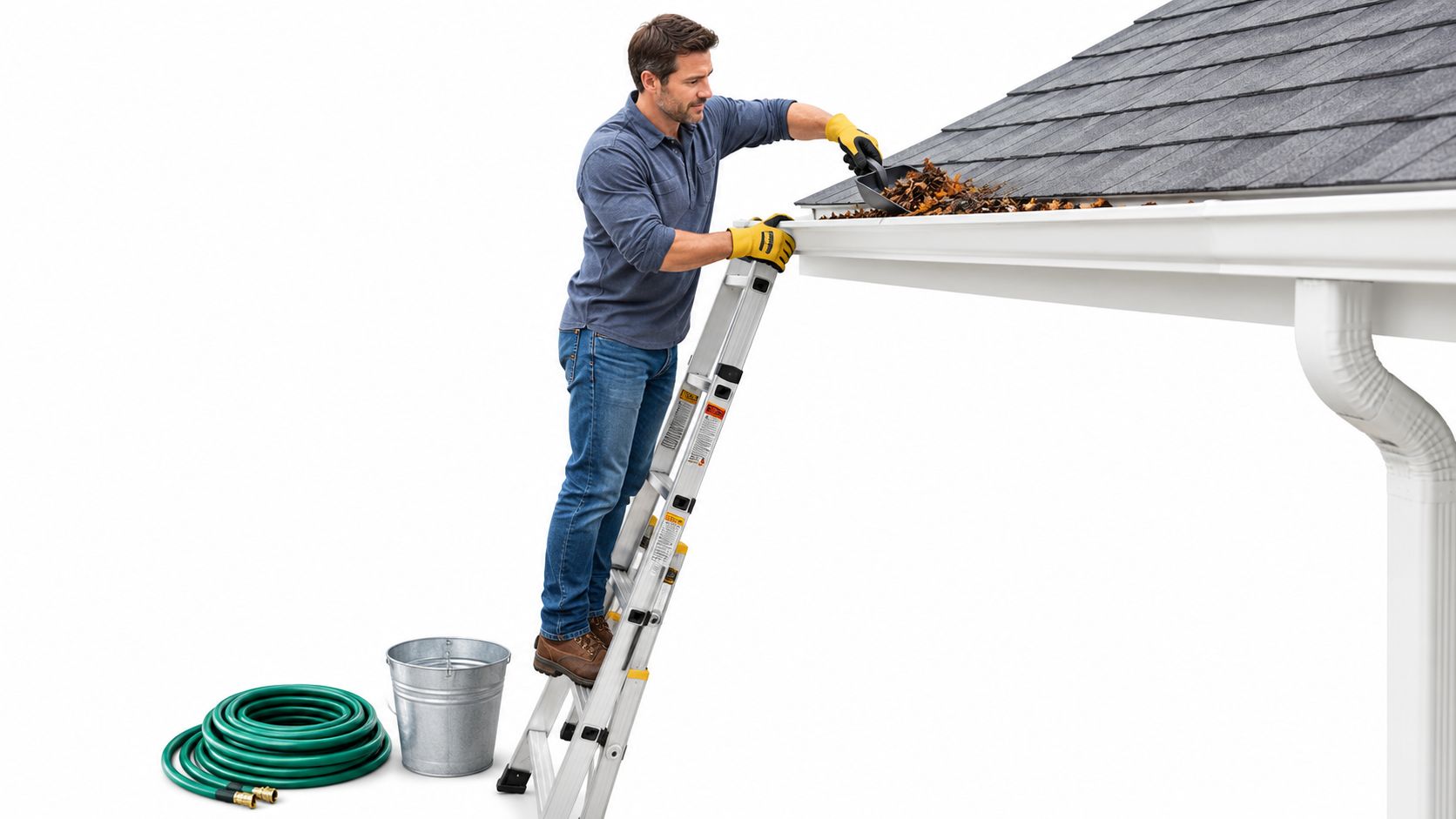
Don't use a ladder while operating a pressure washer if the position makes it difficult to control the wand. An unstable stance can cause the nozzle to swing toward glass, trim, landscaping, or the underside of a panel. Reaching from the ground with an extension wand, or hiring a technician with appropriate equipment, is safer than leaning into an awkward angle.
Colorado Springs adds another layer of concern. Repeated wetting can leave moisture in places that later experience freezing conditions, while strong UV exposure can worsen failed sealant and aged paint. A surface that dries cleanly in the afternoon can still have a problem inside the wall.
Warning signs during and after the wash
Stop and reassess if you notice:
- Panel movement: Siding flexes, lifts, or rattles under the spray.
- Water at the interior: Moisture appears around a window, door, outlet, or interior wall.
- Unexpected runoff: Water emerges from a lap joint rather than flowing down the exterior face.
- Finish changes: Paint dulls, fibers rise, or the surface shows lines from the nozzle.
- Persistent dampness: A section remains wet after surrounding siding has dried.
The objective isn't merely a clean wall. It's a clean wall with intact finishes, dry interior edges, and no evidence that the building envelope received water it wasn't designed to handle.
DIY Pressure Washing Versus Hiring a Pro in Colorado Springs
DIY siding cleaning can look inexpensive at first. You rent a machine, buy detergent, and set aside a weekend. The calculation changes when the home has multiple stories, fragile siding, hard-to-reach gables, or staining that requires chemistry rather than brute force.
Published national estimates place pressure washing a one-story home's siding at about $180 to $400, while a two-story home is estimated at about $300 to $650. The same pricing summary gives a range of roughly $0.15 to $0.50 per square foot for pressure washing, as reported by Hotsy of Memphis. Local pricing can vary with access, material, condition, preparation, and the scope of work.

What DIY gives you
A rental can make sense for a homeowner who has accessible, compatible vinyl siding, understands the machine, and can protect nearby surfaces. You control the schedule and avoid paying for labor, but you also carry responsibility for setup, chemical handling, equipment control, and cleanup.
The hidden cost is the mistake. A blown lap joint, etched window, damaged paint finish, bent aluminum panel, or bleach-stressed plant can require work that wasn't part of the original plan. Ladder time also increases the physical and control risks, particularly around upper-story siding.
What a professional service changes
A qualified local exterior cleaning company should identify the siding before selecting a method. The operator can choose between pressure washing and soft washing, use wide fan tips, adjust distance continuously, and keep detergent from drying in small sections.
Commercial equipment doesn't automatically make a job safer. It gives the technician more control when paired with training and a written process. The best choice depends less on owning a machine and more on whether you can confidently protect the material, wall openings, landscaping, and your own safety.
Cultivate House Detailing provides pressure washing for siding along with other exterior cleaning services in Colorado Springs and nearby communities. For a homeowner who'd rather avoid weekend equipment handling and uncertain results, requesting a scope-based estimate can make the decision easier.
Choosing a Local Siding Cleaning Company You Can Trust
The person holding the wand matters more than the machine sitting in the truck. Siding cleaning rewards judgment, especially when one home has several materials, aging paint, delicate windows, or landscaping close to the wall.
Ask a Colorado Springs exterior cleaning company to explain its process before you book. A useful conversation should cover:
- Material identification: The technician should ask what type of siding is installed or inspect it before quoting the work.
- Pressure and soft-wash options: A pressure-only promise is a warning sign. Some siding requires low-pressure chemical cleaning or should not be pressure-washed at all.
- Protection plan: The scope should mention windows, doors, plants, outlets, exterior lights, and other vulnerable areas.
- Insurance: Request proof of current insurance, particularly for multi-story or commercial work.
- Written scope: The estimate should state which surfaces will be cleaned, what preparation is included, and how access issues affect the service.
- Relevant experience: Ask for references involving siding similar to yours, not just driveways or concrete.
Vague pricing and guarantees of instant results deserve caution. Organic staining may need detergent dwell time, and heavily weathered siding may require a different solution than lightly dusty siding. A responsible technician won't promise that every surface can receive the same treatment.
Colorado Springs and nearby areas such as Black Forest, Monument, and Manitou Springs experience wind, strong sun, and seasonal weather shifts. Those conditions make routine exterior cleaning part of property care, not just a cosmetic exercise. Companies that communicate clearly online and offline often reflect that same attention to customer service. Businesses evaluating their broader digital presence can also review this resource on home services social strategy.
Before hiring, ask who will do the work, how the siding will be tested, what happens if damaged panels are found, and whether the team can combine siding with related services such as window washing, gutter cleaning, or walkway cleaning.
How Often to Pressure Wash Siding and When to Schedule It
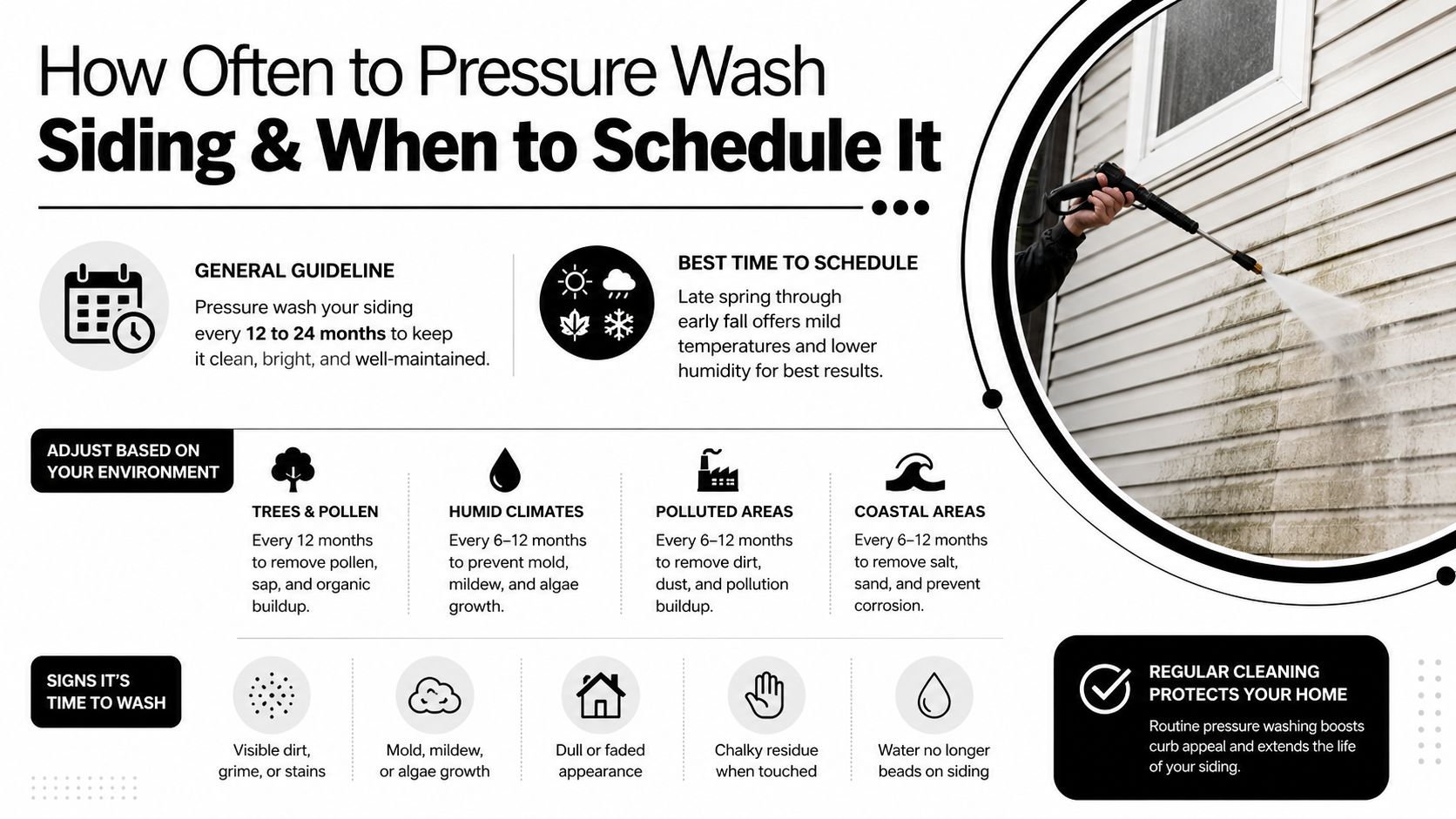
Most Colorado Springs siding benefits from a baseline cleaning rhythm of once per year, especially when dust, algae, and winter grime are visible. The exact timing should follow the home's exposure and condition rather than an inflexible calendar.
A post-winter wash can remove accumulated soil and residue before warm weather makes organic staining more noticeable. Late-summer algae growth may create another useful scheduling cue, particularly on shaded or damp-facing walls. After a major wind event or wildfire-debris event, inspect the exterior and consider an additional cleaning if ash, dust, or organic material has settled on the siding.
Build siding into a larger maintenance visit
Siding cleaning works best as part of an exterior checklist. While inspecting the walls, look at gutters that may be creating runoff marks, windows with hard-water buildup, screens holding dust, and walkways that collect tracked soil. Combining related work can reduce repeated setup and gives you a clearer view of the property's overall condition.
Property managers and business owners can use the same approach for commercial buildings. Exterior window cleaning, siding care, gutters, and entry walks all affect how a property looks to residents, customers, and visitors.
The three habits that protect siding over time are simple:
- Use a downward angle so water travels with the siding's drainage design.
- Choose a wide nozzle and safe distance instead of relying on high pressure.
- Hire a technician who respects the material and knows when pressure washing isn't appropriate.
Cultivate House Detailing offers siding-safe pressure washing and soft-wash-style exterior cleaning for homes and businesses in Colorado Springs, Black Forest, Monument, Manitou Springs, and surrounding communities. Visit Cultivate House Detailing to request a quote and schedule a careful siding cleaning service customized to your home's material, condition, and access.
Prefer to leave it to a professional? Cultivate House Detailing offers pressure washing in Colorado Springs. Get a free quote.