
Gutter cleaning is important because clogged channels concentrate roof runoff against siding and foundations, while dry debris creates a fuel load beside the roof edge; water damage and freezing accounted for 22.6% of U.S. homeowners insurance claims in 2023. In Colorado Springs, keeping that drainage path clear helps address foundation moisture, winter freeze-thaw exposure, and an identifiable wildfire ignition hazard.
You might already have the warning signs: water spilling past the gutter during an afternoon storm, needles visible along the roofline, or dirty streaks beneath an overflowing corner. Perhaps you're arranging window cleaning in Colorado Springs, CO and realizing the gutters above that glass need attention, too. Treat those concerns as connected exterior-maintenance tasks, not interchangeable cleaning jobs.
Why Colorado Springs Homeowners Cannot Afford to Ignore Their Gutters
A gutter overflowing beside your front door during a summer thunderstorm isn't just inconvenient. It's a visible sign that roof water isn't following its intended route away from the building. A channel packed with dry needles presents a different concern even when there's no rain in the forecast.
That's why gutter cleaning is important locally: homeowners need the same system to manage runoff and stay free of combustible buildup. Colorado's Division of Fire Prevention and Control specifically recommends removing leaves and needles from roofs and gutters in its wildfire preparedness guidance. Waiting until debris causes an obvious blockage overlooks that second purpose.
Look beyond the mess you can see
The practical starting point is a ground-level inspection. Look for vegetation in the channel, staining below joints, disconnected downspout extensions, and gutter sections that no longer follow a consistent line. You don't need to diagnose every defect yourself, but you should distinguish cleaning needs from repair needs.
- Debris needs removal: Leaves, needles, twigs, and sediment belong out of the drainage path.
- Loose components need attention: A separated joint or hanging extension won't become functional because someone clears the leaves.
- Persistent overflow needs investigation: Ask whether an outlet is blocked, a section is sagging, or the drainage arrangement needs professional evaluation.
For homeowners in Colorado Springs and nearby communities, my recommendation is straightforward: schedule maintenance around conditions, not appearances alone. Gutters hidden behind a roof edge still need attention, and attractive windows don't tell you whether downspouts work.
Practical rule: Book gutter care for drainage and debris control. Book window cleaning for glass, screens, and the visible finish of your property.
If seasonal window cleaning is already on your calendar, use that appointment as a reminder to assess the rest of the exterior. Combining the scheduling conversation can be convenient, but ask for a separate gutter scope so neither task gets treated as an afterthought.
The Real Risks of Clogged Gutters Around Your Home
Water spilling against siding is the obvious problem. Repeated exposure around fascia, windows, and the foundation is the more important reason to act. A small blockage can redirect runoff toward several building components instead of the intended discharge point.
The insurance figures provide context, not a prediction of your gutter repair bill. Insurance Information Institute data reported from ISO records show that water damage and freezing represented 22.6% of U.S. homeowners insurance claims in 2023, with an average claim severity of approximately $15,400 from 2019 through 2023, as summarized in this gutter maintenance and insurance statistics resource. Those figures cover the broader loss category, not gutter-caused claims alone.
The illustration below highlights the areas to inspect when overflow becomes visible.

Follow the water, not just the leaves
Start at the overflow location. Water beneath a joint calls for a different response from water spilling along an entire sagging run. Check the wall below, the condition of the fascia, and where runoff reaches the ground.
Consider a disconnected extension after yard work. The gutter may look clean from above, yet the downspout still releases water beside the house. Likewise, removing visible leaves without checking the outlet can leave the original obstruction in place.
| Visible sign | What to ask a professional to check |
|---|---|
| Streaks below a gutter corner | Joint condition and nearby outlet blockage |
| Water beside the foundation | Downspout connection and discharge location |
| A bowed or uneven channel | Gutter alignment, supports, and retained water |
| Recurring winter ice near an overflow point | Drainage condition and whether roof evaluation is needed |
Colorado's snow, spring runoff, summer thunderstorms, and freeze-thaw conditions make these observations worth recording. Photograph the problem from a safe location and tell your service provider when it happens.
Don't assume gutter cleaning alone resolves every winter roof issue, basement leak, or damaged board. Maintenance removes obstructions; diagnosis identifies the remaining problem. If overflow continues after a thorough cleaning, request an evaluation rather than paying for repeated cleanouts without an explanation.
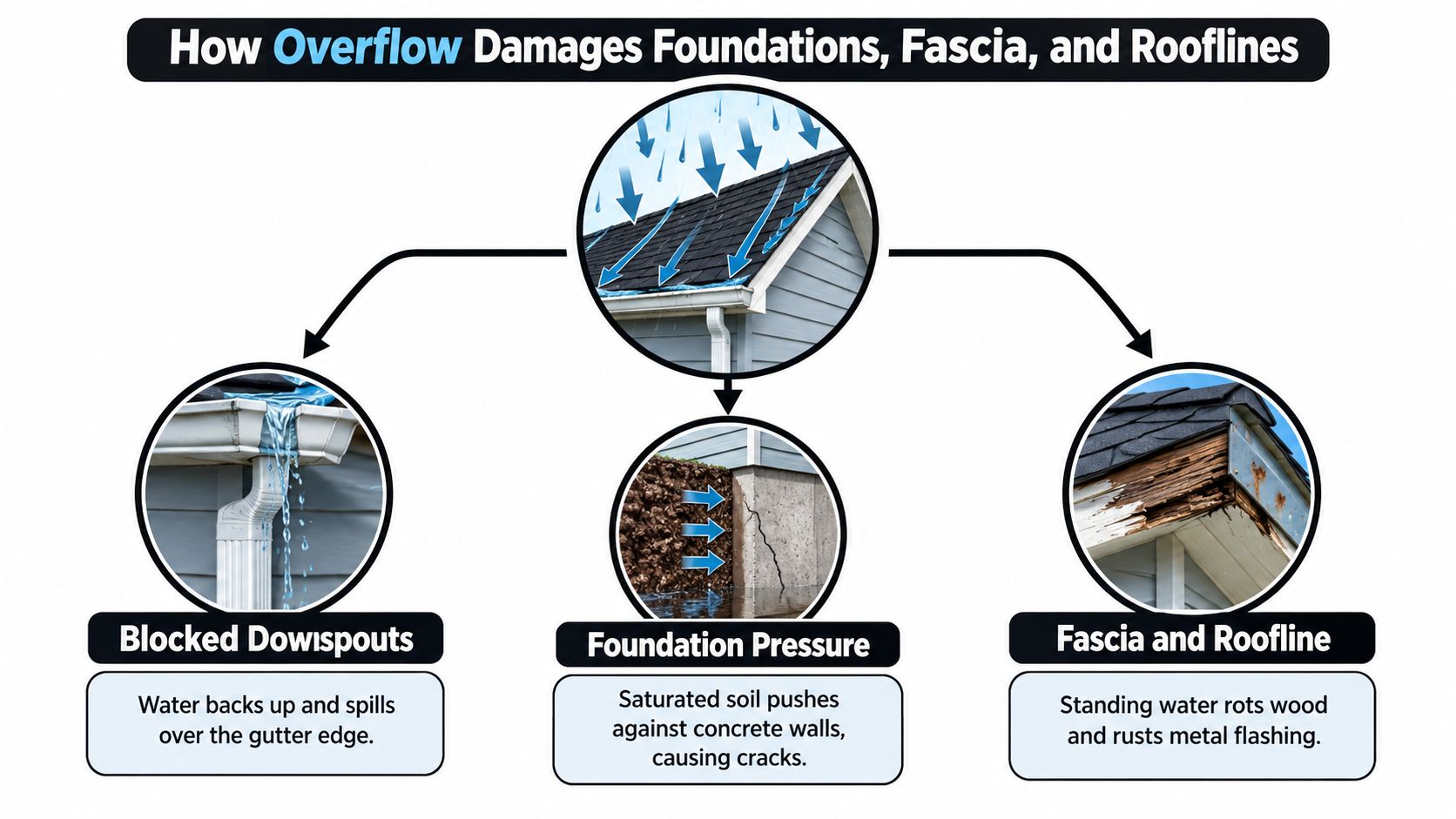
How Overflow Damages Foundations, Fascia, and Rooflines
A roof collects rainfall across a broad surface and concentrates it around the building perimeter. Gutters and downspouts should then carry that water to a suitable discharge point. If the final destination is wrong, a clean gutter still leaves you with a drainage problem.
When soil beside the foundation becomes saturated, moisture can move through concrete or masonry. Capillary action means moisture travels through small pores; hydrostatic pressure means accumulated water presses against the foundation. The U.S. Department of Energy's foundation drainage guidance recommends discharge to a sloping point at least 5 feet from the foundation, or to an underground catchment at least 10 feet away, and explains the importance of maintaining the drainage system.
The diagram below follows the route from roof runoff to vulnerable building areas.
Inspect the entire route to discharge
Don't judge performance by whether the top channel looks empty. A useful inspection follows water through the outlet, elbows, downspout, extension, and receiving area.
- Clear the full run: Remove sediment as well as loose leaves, especially around outlets.
- Verify flow through bends: Ask the cleaner to check elbows and downspout runs rather than assuming they're open.
- Confirm the destination: Extensions should remain attached and release water onto ground that slopes away.
- Flag standing water: Sagging sections retain water and place sustained load on fasteners and fascia.
The foundation relationship deserves particular attention if you've noticed dampness downstairs. This explanation of why clogged gutters can lead to foundation problems offers additional context for that maintenance decision.
A clear gutter isn't the finish line. Water needs a clear route away from the house.
Some properties also need a yard-drainage solution. If runoff remains trapped after the gutter system is functioning, Modern Yard Landscapes' resource on how to install yard drainage is a useful starting point for discussing site drainage with a qualified professional.
Keep those jobs distinct. Gutter cleaning addresses debris; damaged supports require repair, and unsuitable grading or discharge arrangements require drainage planning. Ask for each issue to be identified separately so you can prioritize the right work.
The Wildfire Connection Most Homeowners Overlook
A tidy yard doesn't tell you whether the roof edge is ready for ember exposure. Gutters can hold dry organic material immediately beside the building, away from the areas homeowners usually inspect while gardening or maintaining defensible space.
The Colorado State Forest Service recommends removing leaves, pine needles, and other debris from roofs, decks, and gutters. Its home and property wildfire guidance also recommends metal vent screening with openings no larger than 1/8 inch. These are separate tasks because debris accumulation and ember entry require different measures.
Wind-driven embers can lodge in a debris-filled gutter and ignite that material. The concern isn't that leaves are untidy. It's their position next to roof edges, fascia, eaves, and adjacent building components.
Remove fuel without overstating protection
Gutter cleaning removes one identifiable fuel source. It does not make a home fireproof. Colorado's Building for Wildfire guidance pairs debris removal with appropriate noncombustible gutter and guard materials.
The state's Property and Insurance Wildfire Preparedness Guide likewise recommends Class A fire-rated roofing, noncombustible gutters, ember- and flame-resistant vents, and a noncombustible 0-to-5-foot buffer around the structure. A cleaning appointment shouldn't be presented as a substitute for those construction and property measures.
What Gutter Cleaning Does and Does Not Address for Wildfire Risk
| Inside Scope of Gutter Cleaning | Requires Separate Measures |
|---|---|
| Removing accessible leaves, needles, and twigs from channels | Evaluating roof materials and roof condition |
| Clearing debris at gutter outlets | Installing appropriate ember-resistant vents |
| Checking accessible buildup around guards | Selecting noncombustible gutter or guard materials |
| Identifying visible roof-edge debris that needs attention | Clearing decks, roof valleys, and areas beside exterior walls |
| Reducing combustible contents within the gutter system | Developing and maintaining broader defensible space |
For homes near wooded areas or open space, ask whether your appointment includes accessible roof debris or only the gutter channel. The distinction matters because material can remain outside the cleaned area.
A resource on gutters and roof cleaning can help you frame that service conversation. Request a clear description of accessible areas, excluded work, and conditions that require a roofing or wildfire-mitigation professional.
The right recommendation is specific: remove the gutter fuel, then assess the other exposed parts of the property. Don't accept a blanket promise of wildfire prevention.
How Often Colorado Springs Gutters Really Need Cleaning
Use a recurring inspection schedule, not a universal annual rule. The right cleaning rhythm depends on how quickly your property collects debris and what happens between scheduled visits.
Start by checking whether leaves and needles have accumulated since the last cleanout.

Colorado municipal guidance treats this as ongoing maintenance. Local fire-safety guidance on keeping roofs, decks, and gutters clear advises regular cleaning and notes that wildfires can occur at any time of year. For Colorado Springs homeowners, that supports checking conditions between calendar appointments rather than assuming fall cleaning finishes the job.
Build a seasonal rhythm around your property
- Spring runoff preparation: Check for debris, separated connections, and drainage problems after winter. Arrange cleaning or repair before runoff exposes an unresolved blockage.
- Summer storm checks: Inspect safely after severe weather and look for fresh twigs, displaced extensions, or new overflow marks.
- Leaf-drop cleanup: Remove seasonal accumulation, then reassess if nearby trees continue shedding.
- Dry-period preparation: Check for combustible buildup before periods of raised wildfire risk, even if the gutter hasn't overflowed.
- Wind-event follow-up: Recheck exposed roof edges and channels when wind has deposited fresh material.
Homes beneath mature pines or close to tree cover warrant closer observation than properties with little overhead vegetation. That doesn't mean prescribing the same service interval to every wooded property. Watch how quickly your own channels refill and adjust the schedule accordingly.
This video can accompany your maintenance planning.
Don't wait for an appointment if you can already see a blockage or disconnected downspout. Contact your provider with photographs and explain whether the issue involves overflow, dry debris, or visible damage.
Scheduling tip: Keep a short record of cleaning dates and the weather events that prompted extra checks. Your property's history is more useful than a generic maintenance calendar.
Seasonal window washing can provide a convenient reminder to review gutter conditions. Ask about coordinating exterior window cleaning with gutter care, while keeping the inspection and cleaning requirements explicit.
DIY Cleaning Versus Hiring a Local Professional
DIY gutter cleaning is reasonable only when access is straightforward and you're comfortable completing the whole job safely. A low, easily reached gutter with light debris is different from a high roofline above sloping ground.
The cost comparison also needs honesty. DIY involves your time, equipment, debris handling, and access planning; professional service adds a fee but transfers the cleaning work to a service provider. Get a property-specific quote, not an assumed local price based on a generic graphic.
Use the comparison below to frame the decision, while confirming prices and safety arrangements directly with your provider.

Choose by access and completeness
Before attempting DIY, assess where the ladder would stand, whether the ground is stable, and whether you can reach the work without leaning beyond a safe position. Don't climb onto a roof or improvise access because an outlet is just out of reach.
| DIY may be reasonable | Hire a professional when |
|---|---|
| Low gutters and uncomplicated access | Height or sloping ground makes access difficult |
| Light debris you can reach safely | Heavy buildup or guards complicate removal |
| You can inspect the full drainage route | You can't verify outlets and downspout flow |
| You're comfortable using suitable equipment | You're uneasy on a ladder or unsure how to proceed |
A gutter scoop, collection bucket, and controlled rinse can support a cleanout, but equipment doesn't replace safe access or a complete inspection. Ask a professional how they handle outlets, elbows, guards, and visible defects.
FEMA advises regularly removing leaves, pine needles, and other roof and gutter debris because wind-blown embers can ignite accumulated fuel, and recommends noncombustible, corrosion-resistant gutter screens in its wildfire property-protection guidance. Screens are a material choice, not permission to stop checking for buildup.
My recommendation is to hire help whenever height, terrain, or incomplete access would turn maintenance into guesswork. Judge value by the work completed and documented, not just the amount of debris removed.
Scheduling Service and Getting a Clear Local Quote
A useful quote should tell you what the crew will clean, what they'll check, and what remains outside the appointment. “Gutter cleaning” alone isn't a detailed scope.
Provide photographs, describe access constraints, and mention guards, recurring overflow, or known downspout trouble. Ask whether the estimate includes debris removal, rinsing, accessible outlet checks, and observations of visible damage. Repairs and difficult-access work should be discussed separately.
Ask for observable results
- Drainage checks: Confirm how the provider will verify accessible downspout flow and discharge connections.
- Condition notes: Request notification of sagging sections, separated joints, damaged downspouts, or obvious fascia concerns.
- Ground-level observations: Ask the crew to flag splashback or discharge beside the foundation.
- Debris handling: Clarify where removed material goes and what cleanup is included.
- Follow-up guidance: Ask which findings need a repair specialist rather than another cleaning visit.
If you're also searching for window cleaning near me, request separate details for residential window cleaning or commercial window cleaning. Dirty glass, hard-to-reach panes, streaks, and seasonal buildup deserve their own service plan. Professional window cleaning addresses the visible finish; gutter care addresses the drainage and debris concerns discussed here.
Interior window cleaning, exterior window washing, screen cleaning, track cleaning, and hard water stain removal shouldn't be assumed to come in one package. Ask which options are available and included. For home sellers and business owners, clean glass supports a cared-for appearance and clearer Colorado views without confusing cosmetic work with structural maintenance.
Prioritize active overflow and difficult access, then coordinate appearance-focused services around the same property-maintenance plan. That gives a busy homeowner a clear sequence: address the drainage concern, document anything needing repair, and schedule the glass cleaning that finishes the exterior.
Cultivate House Detailing offers gutter cleaning, fire-mitigation clearing, and professional residential and commercial window cleaning in Colorado Springs and surrounding communities. Visit Cultivate House Detailing to request a quote, describe your gutter concerns, and ask about coordinating gutter care with your next window-cleaning appointment.