
You notice it after a hard Colorado Springs rain. Water spills over the gutter edge near the front entry, needles are packed tight in the valley above the garage, and one shady section of roof has started to show dark streaks. A lot of homeowners put that off for another weekend. Around here, that delay can get expensive fast.
Homes along the Pikes Peak region deal with a rough mix of ponderosa pine debris, summer monsoons, winter snow load, freeze-thaw cycles, and wildfire season. Gutters and roof cleaning isn't cosmetic maintenance in this climate. It's part of protecting siding, fascia, shingles, foundations, and the dry debris that can collect right where embers like to land.
Your Guide to Gutters and Roof Cleaning in Colorado Springs
A common local pattern goes like this. Spring winds drop needles and seed litter. Summer storms hit hard and fast. Fall fills gutters again, and then winter turns any trapped water into ice. If the system was already struggling, snowmelt has nowhere to go except over the edge or back under the roofline.
That risk is why routine service matters more than many homeowners expect. The average water damage claim from gutter neglect ranges from $11,605 to $14,000, while typical preventative maintenance runs $100 to $300 annually, and only 25% of homeowners clean their gutters the recommended twice a year, according to this gutter maintenance data. That gap between a manageable service cost and a major repair bill is exactly why this work belongs on the calendar, not on the someday list.
For homes near Black Forest, Monument, Rockrimmon, and the west side, the issue usually isn't whether debris will build up. It's how quickly. Pine needles pack densely, break down slowly, and hide problems underneath. By the time you see overflow from the ground, the downspout may already be restricted and the hanger line may already be under stress.
Local reality: In Colorado Springs, a gutter can look only partially dirty from the driveway and still be fully blocked where it matters most.
If you're comparing options and trying to understand how roofing and gutter decisions fit together, this expert roofing and gutter guide is a useful outside reference. For a more Colorado-specific look at maintenance timing, guard options, and local debris patterns, the Colorado homeowner's guide to local gutter cleaning and guard installation adds practical context.
Beyond Debris The Real Risks of Neglected Gutters
Neglected gutters don't just hold leaves. They change where water goes, how ice forms, and what sits on your roof during fire season. In Colorado Springs, those aren't separate problems. They feed into each other.
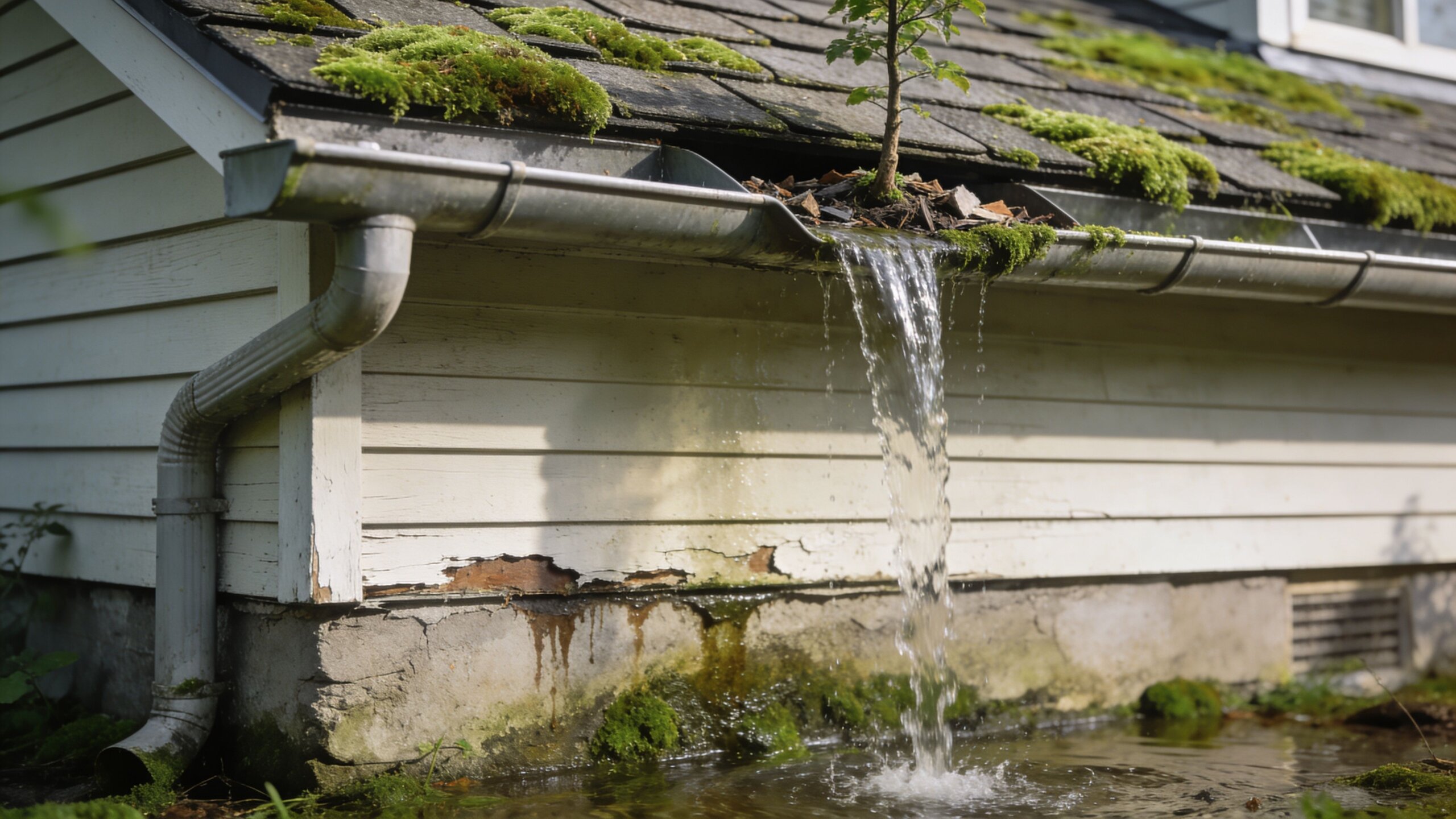
Water doesn't stay where you want it
When debris dams up a gutter run, rainwater starts looking for the next lowest path. That might be over the front edge onto flower beds and walkways. It might be behind the gutter onto fascia boards. It might be down the siding and toward the foundation.
Clogged gutters also push water back under the lower edge of roofing materials. That creates a different kind of problem than simple overflow. Once drainage slows down enough, moisture lingers where roofing systems are supposed to dry out.
A neglected roofline often leaves clues before obvious interior damage appears:
- Overflow marks: Dirty stripes on siding below the gutter line
- Soil washout: Mulch trenches or splashback near downspout exits
- Trim staining: Darkened fascia or soffit areas
- Basement warning signs: Musty smells or damp edges after storms
A lot of those signs get mistaken for isolated drainage issues when the underlying cause is overhead.
Colorado ice dams start with poor drainage
Ice dams don't begin with snow alone. They often begin with gutters that entered winter already packed with debris. Once meltwater reaches a blocked section, it stalls, refreezes, and builds up along the edge. That creates an icy ramp that can push water back toward the roof deck.
Homes around the Springs see enough freeze-thaw swings that this pattern repeats quickly. One mild afternoon followed by a cold night is enough to turn a clogged section into a hard freeze point. By the time icicles show up, the system has already lost control of drainage.
Keep gutters clear before first sustained snow, not after. Ice is much harder to manage than dry debris.
Fire season changes the stakes
This is the risk most generic articles skip. In our area, dry debris in gutters acts like stored tinder. Needles, leaves, roof grit, and windblown organic matter collect in a spot that embers can easily reach.
In fire-prone regions like Colorado Springs, integrating gutter cleaning with defensible space clearing can reduce home ignition risks by up to 50%, according to local fire-mitigation guidance. That matters in places like Black Forest and the edges of Monument, where homes back up to heavier tree cover and seasonal wind can move embers well beyond the main fire line.
If you want a broader look at how clean gutters protect the home beyond the roof edge, this article on how clean gutters protect more than just your roof is worth reading.
When to Call a Pro A Homeowner Inspection Checklist
You don't need to climb onto the roof to tell whether your gutter system is struggling. Most of the warning signs show up at ground level if you know what to watch for.

What to check from the ground
Walk the perimeter after a storm and again on a dry day with good light. Look at the full run, not just the front of the house.
- Watch for overflow: Water should exit through downspouts, not pour over the face of the gutter.
- Look for sagging: A gutter line that dips or bows usually signals debris weight, weak support, or both.
- Check for plant growth: If you can see sprouts, moss clumps, or compacted material, water has been sitting there too long.
- Scan the siding: Streaks, splash marks, and discoloration below the gutter line are common signs of repeated overflow.
- Notice pest activity: Birds, insects, and rodents treat clogged gutters like shelter.
Pay attention to the hardware
Loose brackets matter more than many homeowners realize. Loose gutter brackets can cause gutters to sag, leading to improper drainage and fascia rot at a 40% faster rate in high-debris zones like Colorado's ponderosa pine areas. Professionals check for this, as failure rates can double annually without inspection, according to this gutter hanger and cleaning guide.
That means a gutter can be "mostly working" and still be gradually pulling away from the fascia season after season. By the time the separation is obvious, the repair is rarely limited to the bracket.
This short video gives a helpful visual sense of what inspectors look for during service:
A simple local timing rule
For most homes in Colorado Springs, twice-yearly service is the practical baseline. One visit should happen after winter and spring debris. The second should happen before snow season.
A faster schedule makes sense if your property has heavy pine cover, roof valleys that trap needles, or uphill exposure to windblown debris. Homes in Black Forest and Monument often need more attention because the material load builds up faster and hides deeper in the gutter trough.
If you can see debris from the driveway, the problem is usually worse than it looks from below.
The DIY Dilemma vs Professional Gutter Service
A lot of homeowners think about doing this job themselves for one simple reason. It seems straightforward. Grab a ladder, a bucket, gloves, and clear out the mess. Sometimes that works. Sometimes it turns into a half-day project that still leaves blocked downspouts, hidden leaks, and a risky trip up and down the ladder.
The biggest issue isn't effort. It's exposure.
Gutter cleaning is a significant source of household injuries. Approximately 20,000 ladder-related injuries occur each year specifically during gutter cleaning, with over 500,000 people visiting emergency rooms annually for all ladder-related incidents, as noted in this ladder and gutter safety reference. For a chore that often feels routine, the risk is much higher than people assume.

Side by side trade-offs
| Option | What looks appealing | What often gets missed |
|---|---|---|
| DIY gutter cleaning | Lower out-of-pocket cost, immediate control over timing | Ladder risk, incomplete flushing, missed hanger issues, harder access on upper stories |
| Professional service | Safer access, faster workflow, full system check | Scheduling ahead, service cost, choosing a company that actually inspects rather than only scoops debris |
DIY also tends to focus on what you can see. Homeowners usually remove the obvious leaf mat and assume the system is clear. But the hard part is often hidden inside elbows, downspout drops, roof valleys, and the back edge where water has already been sneaking behind the gutter.
What professionals are really checking
A proper service isn't just debris removal. It should include:
- Flow confirmation: Water needs to move through the full system, not just disappear from the top opening.
- Attachment review: Brackets, seams, end caps, and pitch should be checked while the gutter is accessible.
- Roof edge observation: Moss, granule loss, and packed valley debris often show up during the same visit.
- Ground cleanup: A clean gutter line isn't finished if the landscaping is left covered in sludge.
For some single-story homes with easy access, confident homeowners may still choose to handle light maintenance themselves. But steep rooflines, second-story sections, and pine-heavy neighborhoods shift the equation quickly. At that point, the safer decision usually isn't about convenience. It's about avoiding injury and catching problems before they spread.
How We Deliver Spotless Gutters and a Safe Roof
A good gutters and roof cleaning service should feel methodical, not rushed. The work has to solve the immediate debris problem and also answer a bigger question. Is water going to move where it should after the crew leaves?

Step one is always inspection
Before cleaning starts, the roofline and gutter runs need a close visual review. That includes obvious debris load, but also bracket condition, visible sagging, signs of overflow, roof valley buildup, and sections where tree cover keeps materials damp longer.
On many homes, ground-based inspection tools and telescoping equipment make that first pass safer and more efficient. For multi-story sections, that matters. You want the crew deciding where the trouble spots are before anyone starts removing debris.
Dry removal first, then drainage checks
The first goal is to remove leaves, needles, twigs, and compacted roof grit without forcing that material deeper into the system. Dry removal keeps downspouts from getting packed tighter.
After that, the crew should verify water flow. A gutter isn't clean just because the top edge looks empty. Downspouts have to carry water freely, and the full run has to drain with the right pitch.
A thorough appointment usually includes these steps:
- Target the heavy buildup first: Valleys, behind chimneys, and shaded corners tend to hold the wettest debris.
- Clear the gutter body by hand or vacuum: This avoids turning solid debris into a clog slurry.
- Flush and test downspouts: Flow needs to be confirmed, not assumed.
- Check seams and attachments: Cleaning often exposes leaks or loose sections that weren't visible before.
- Clean the ground below: Mud, needles, and runoff residue shouldn't be left on walkways or planting beds.
Roof treatment matters when moss and algae show up
Roof cleaning has to be handled differently than gutter cleaning. Aggressive pressure is not the answer on asphalt shingles or delicate roof surfaces. Professionals use soft washing at low pressure (50–100 bar) after debris removal to eliminate algae and moss. This process is critical because untreated moss can retain moisture, lift shingles, and block gutters, increasing repair costs threefold, based on this roof soft washing walkthrough.
That sequence matters. Debris comes off first. Organic growth gets treated next. Then the roof can be rinsed in a way that protects the roofing material instead of scouring it.
A roof can look dirty and still be structurally fine. It can also look only lightly stained while moss roots are already holding moisture against the surface.
For homeowners in Colorado Springs who want ground-level access methods, debris removal, and exterior cleaning handled by one provider, Cultivate House Detailing offers gutter cleaning, roof-adjacent debris service, and related exterior maintenance.
Your Local Fire and Weather Prep Checklist
Colorado Springs doesn't need a generic maintenance calendar. The timing here should follow snowmelt, monsoon flow, pine drop, and fire season. A simple seasonal routine keeps the work manageable and helps you avoid the scramble that happens when gutters get ignored until they're already overflowing.
Spring after snow and wind
Start with a post-winter check. Snow movement, freeze-thaw cycling, and spring gusts can leave behind grit, twigs, and compacted debris that didn't exist in fall.
Use spring to:
- Inspect for winter movement: Look for loosened sections, corner separation, and staining below the eaves.
- Clear drainage paths: Early storms will test every low spot in the system.
- Check roof valleys: Wind-driven buildup often hides where two roof planes meet.
Summer before monsoons and during fire season
Summer in the Springs can shift quickly from dry and windy to heavy afternoon rain. This is also when neglected debris becomes more than a drainage issue.
For homes in Black Forest, Monument, and other treed areas, summer is the right time to combine gutter work with nearby debris clearing. Keep roof edges, gutters, and the immediate perimeter free of dry organic material so monsoon runoff can move cleanly and windblown embers have less to land in.
Fall before the first lasting freeze
Fall cleaning is the one appointment homeowners regret skipping. Needles and leaves can pile up fast, and once cold weather settles in, a minor clog can turn into an ice problem.
A useful fall checklist looks like this:
- Clear all upper runs: Debris left in second-story gutters becomes harder to reach once winter starts.
- Verify downspout discharge: Water needs to exit away from the house before freezing weather arrives.
- Trim back overhang where possible: Less fresh debris means slower buildup during storms.
- Schedule before snow, not after: It's easier and safer to correct drainage while the system is dry.
Winter watch and water-conscious methods
During winter, most homeowners should monitor rather than attempt active cleaning. Watch for abnormal icicle formation, overflow during melt periods, and spots where snowmelt consistently stalls.
For properties focused on conservation, cleaning methods matter too. In response to Colorado's drought conditions, modern eco-friendly approaches such as dry vacuuming or biodegradable enzyme treatments can reduce water usage by 70-90% compared to traditional hosing, according to this low-water cleaning reference. That's especially relevant for water-conscious communities like Manitou Springs.
Cost usually comes down to access, home size, roof complexity, and how much material has built up since the last service. A lightly loaded single-story ranch and a pine-covered multi-story home near the foothills don't take the same time or equipment.
Protect Your Investment with Colorado Springs' Trusted Experts
Gutters and roof cleaning protects the parts of your home you don't think about until they fail. In Colorado Springs, that means controlling storm runoff, reducing the chance of winter ice trouble, and removing the dry debris that raises fire risk around the roofline.
The homes around Pikes Peak deal with conditions that generic maintenance advice doesn't fully cover. Pine needles pack tight. Summer storms hit hard. Winter punishes weak drainage. A clean, properly draining system gives your roofline a better chance to handle all of it.
If you've noticed overflow, sagging, dark streaks, or visible buildup, it's time to get it looked at before the next season adds another layer to the problem. The right service should leave you with clear gutters, verified flow, a cleaner roof edge, and a better understanding of what your home needs next.
If your home in Colorado Springs, Black Forest, Monument, Manitou Springs, Woodland Park, or nearby areas needs professional gutters and roof cleaning, request a quote from Cultivate House Detailing. You'll get clear communication, practical recommendations, and service built for local weather, debris, and fire-season conditions.
Looking for a professional to take care of it? Cultivate House Detailing offers gutter cleaning in Colorado Springs. Get a free quote.