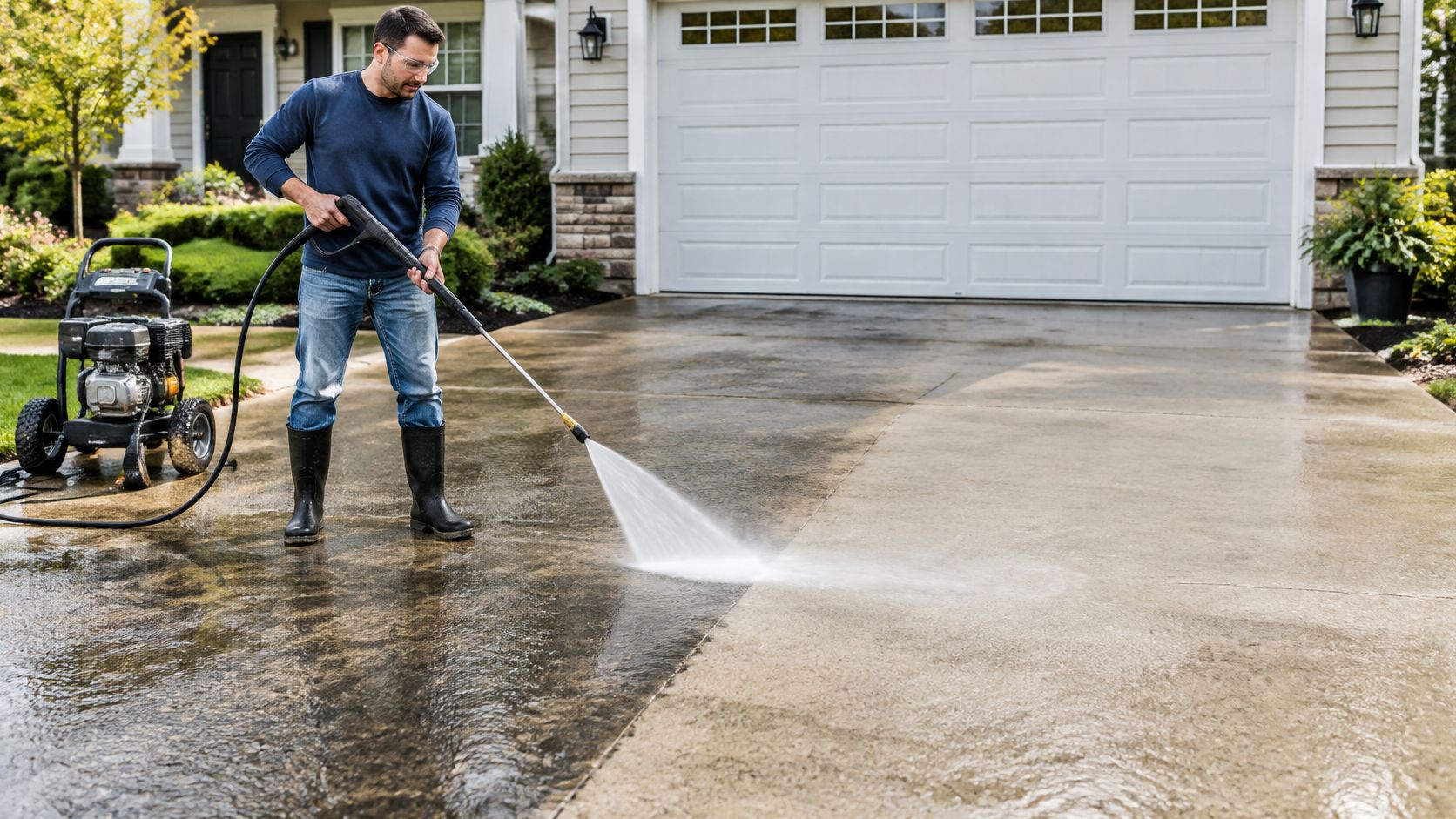
For a sound poured-concrete driveway, use 2,000 to 3,000 PSI, starting at the low end and testing a hidden strip first. But if the machine's pressure rating were the whole answer, why would the same washer leave one driveway clean and another permanently striped?
The difference is usually surface condition, nozzle choice, working distance, and preparation. Knowing how much PSI to pressure wash a driveway starts with identifying what you're cleaning, not buying the strongest machine.
For Colorado Springs homeowners, a clean driveway is often part of a larger exterior refresh, alongside dirty windows, dusty screens, and seasonal buildup. Cultivate House Detailing serves Colorado Springs and surrounding communities with a surface-conscious approach: choose the cleaning method that suits the property rather than treating every exterior material alike.
Recommended PSI for Each Driveway Material
Sound poured concrete generally belongs in the 2,000 to 3,000 PSI working band, with the bottom of that band the sensible starting point. The pressure-setting guidance from ForgeClaw places concrete driveways within a broader recommended range of 1,500 to 3,000 PSI.
Machine capacity affects how quickly you can work, but it doesn't establish a safe setting for every finish. According to Lowe's driveway-cleaning guide, a washer rated at least 1,500 PSI can clean concrete and asphalt, while a 3,000-PSI machine generally completes the work faster.
Match the starting point to the finish
Use these surface-specific settings as conservative test recommendations, not guaranteed damage-free limits. For coated materials, the coating manufacturer's cleaning requirements take priority.
| Driveway surface | Typical PSI range | Start at | Watch for |
|---|---|---|---|
| Sound poured concrete | 2,000 to 3,000 | 2,000 | Step up only if a test strip stays streaky after correcting technique |
| Broom-finished concrete | 1,500 to 2,500 | 1,500 | Grime sits in broom grooves; widen the angle before adding pressure |
| Aged, cracked or sealed concrete | 1,500 to 2,000 | 1,500 | Cracks widen and sealant lifts; test first |
| Decorative or stamped concrete | 1,200 to 1,800 | 1,200 | Surface coating strips easily |
| Asphalt | 1,500 to 2,500 | 1,500 | Soft in warm weather; keep the wand moving to avoid gouging |
| Brick or concrete pavers | Lowest effective setting permitted by the paver and joint-material manufacturers | Lowest permitted setting | High pressure washes out joint sand |
Broom-finished concrete needs attention to the grooves, not more force. On aged concrete, exposed grit or flaking paste changes the decision entirely: deterioration isn't dirt, and washing harder won't fix it.
Decorative concrete requires particular restraint because you may be cleaning a protective coating rather than bare concrete. With pavers, inspect the joints before deciding whether pressure washing is appropriate.
Account for Colorado Springs conditions
Winter freeze-thaw cycles can aggravate existing cracks and weakened concrete. An older Colorado Springs driveway with scaling or open cracks deserves a gentler approach than a sound slab, even when both look equally dirty.
For broad areas, the practical discussion of surface cleaner techniques for driveways from Ventura County Roof Cleaners helps explain why tool control matters alongside pressure selection.
Practical rule: The number on the machine describes its capability, not a universal safe force at the slab.
Choose the surface category that matches your driveway, begin at its lowest suitable setting, and let a hidden test strip determine whether to proceed.
Nozzle Choice and Distance That Protect Concrete
A narrow jet can damage concrete at a setting that works acceptably with a wide fan. Spray angle and working distance determine how concentrated the impact becomes, so changing tips isn't a minor accessory choice.
The common color system runs from a concentrated red tip to a wider white tip. Confirm the markings on your own equipment, especially if replacement tips have been mixed together.
Compare the tools before connecting one
| Nozzle or tool | Spray angle | Best use on a driveway | Verdict |
|---|---|---|---|
| Red tip | 0 degrees | Not suitable for driveways | Avoid; can etch concrete |
| Yellow tip | 15 degrees | Stubborn oil or gum spots at edges | Spot use only |
| Green tip | 25 degrees | Spot cleaning on sound concrete | Use with care |
| White tip | 40 degrees | Wide, gentle rinsing on broad areas | Safer default, not damage-proof |
| Surface cleaner | Rotating or fixed bar | Full driveway slabs | Best choice for even results |
A yellow tip isn't a substitute for degreaser. Use it only when the material can tolerate concentrated cleaning and the stain has already received appropriate treatment.
For the main slab, choose a surface cleaner matched to the washer's pressure and flow requirements. Its controlled jet height and cleaning pattern make consistent coverage easier than freehand wand work, although moving too quickly can still leave bands.
Keep the working distance consistent
The Somners driveway-cleaning guide identifies about 30 centimeters, roughly 12 inches, as a reasonable initial distance for sound concrete when the equipment manufacturer permits it. Move farther away when the finish appears fragile, and never move closer than the manufacturer allows.
Keep the wand moving through each pass rather than pivoting your wrist and bringing the tip closer at the center. That arc concentrates cleaning in the middle and weakens it at the edges.
A striped finish is a reason to check angle, distance, and movement before reaching for more pressure.
If stripes appear, widen the fan or step back. Don't chase each stripe with a concentrated jet, because you can turn uneven cleaning into permanent etching.
How to Set and Test Pressure Before You Clean
A hidden test strip is the best way to answer your pressure question. It shows how your particular surface responds to your machine, detergent, nozzle, and pace.
State Farm's pressure-washing guidance warns that excessive force can worsen crumbling concrete and brick, supporting a low starting pressure and an inconspicuous test before broad cleaning.
Run a controlled test
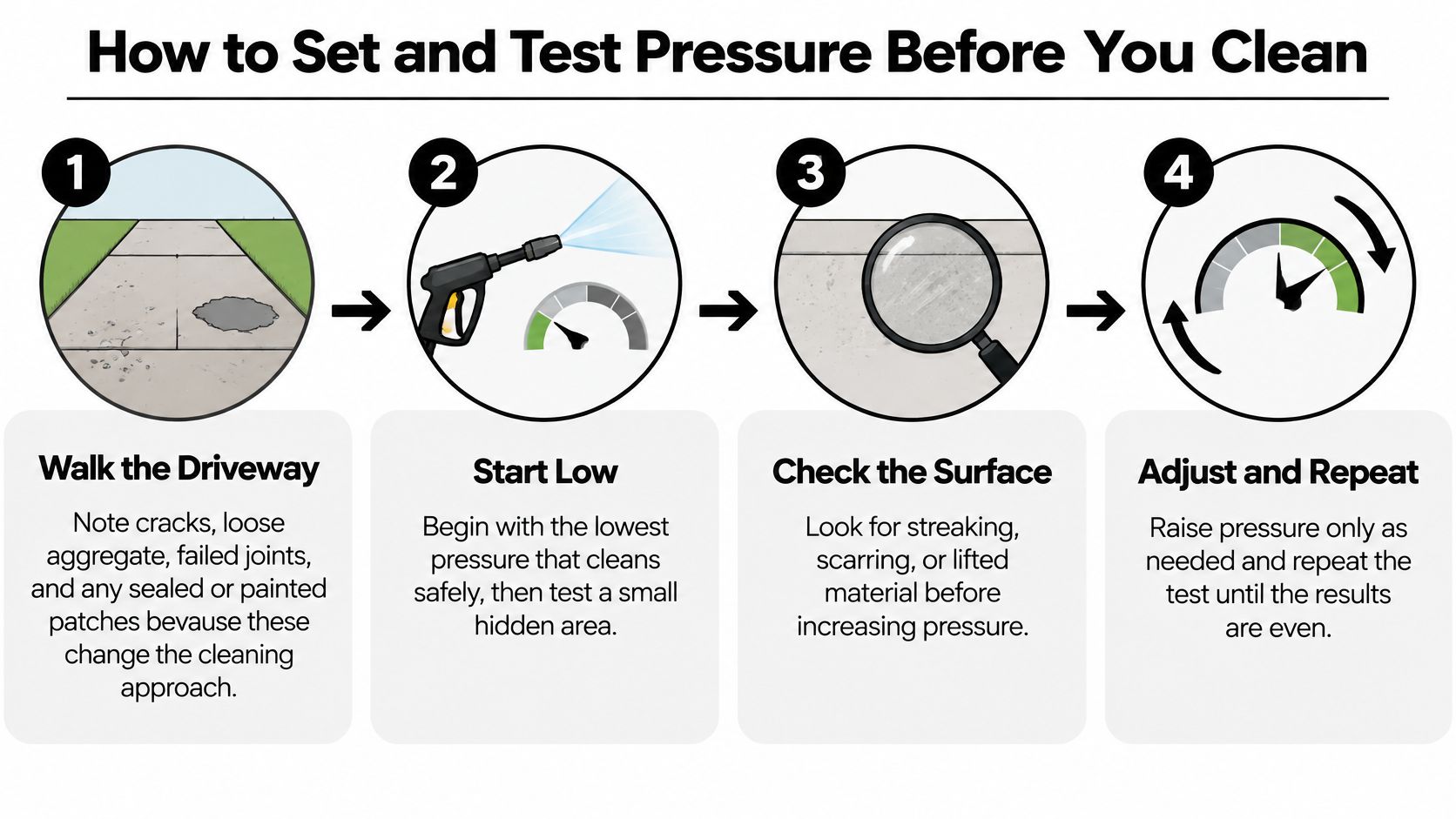
Walk the driveway before connecting the wand. Look for cracks, loose aggregate, failed joints, painted patches, and lifting sealant. Mark questionable areas so you won't accidentally treat them like sound concrete.
Choose the lowest suitable setting for the surface. Use the manufacturer-approved pressure adjustment, if your machine has one, rather than assuming full output is appropriate. A cautious start preserves room to adjust without immediately stripping weakened material.
Fit the widest suitable tip or a compatible surface cleaner. Begin with generous clearance and a stable stance. This gives you a controlled baseline instead of combining high pressure with an aggressive nozzle.
Select a small hidden strip. A discreet area beside the garage can work, provided it represents the driveway's general condition. Don't choose an already damaged patch as your only test of otherwise sound concrete.
Make a smooth pass and inspect it. Look for uniform cleaning without fresh pitting, displaced joint material, exposed aggregate, or coating loss. If grit appears in the wash water, pause and determine whether it's loose dirt or driveway material.
Change one variable at a time. If cleaning is weak, check detergent action and coverage before cautiously reducing distance or increasing pressure. If the surface etches, strips, or crumbles, stop rather than trying to finish the patch.
Let the strip dry before committing. Wet concrete can hide differences in texture and color. Continue only when the dry strip looks evenly cleaned and feels consistent with the surrounding finish.
The following visual summarizes the inspection-and-adjustment process.
Adjust the machine without guessing
Not every washer offers adjustable pressure. If yours doesn't, use approved tip selection and standoff distance to manage cleaning intensity, then repeat the test after each change.
Spray angle isn't a calibrated pressure setting. Don't assume a wider tip produces a specific PSI, and don't fit an incompatible nozzle to force a different output.
A common mistake is turning up pressure when the actual problem is uneven coverage. A wider fan may blend passes more evenly; a carefully reduced distance may improve weak cleaning on sound concrete, but neither adjustment should bypass another test.
How to Clean the Whole Driveway Without Streaks
Prepare the entire work area before cleaning the first strip. CRAFTSMAN's pressure-washer guidance supports sweeping debris, protecting nearby features, pretreating stains, and controlling runoff before tackling the main surface.
The cleaning pattern should remain controlled across the slab, rather than changing every time you reach a darker patch.
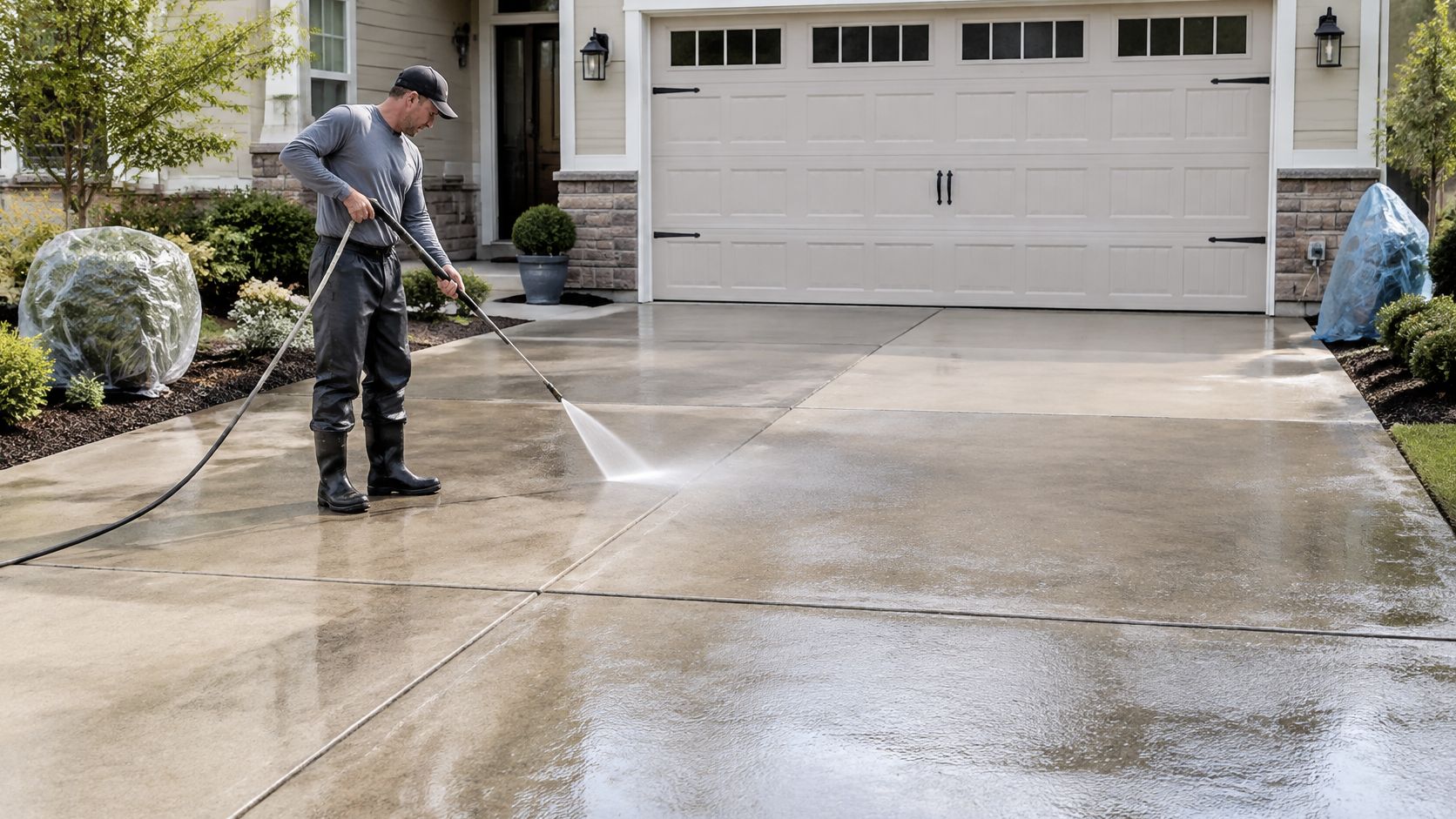
Prepare first, then clean in lanes
Sweep loose gravel and debris away so the spray won't scatter them. Move vehicles, protect doors and outdoor outlets, and shield nearby plants and mulch from dirty water and detergent.
Pretreat oil and grease with a concrete-compatible degreaser. Allow the product's specified dwell time, agitate where appropriate, and don't let it dry; skipping this step often leaves oil halos after the surrounding concrete brightens.
For a more detailed preparation sequence, use this driveway pretreatment guide. The Painters North Shore patio cleaning guide also offers useful context for treating concrete stains before relying on mechanical cleaning.
Work in manageable lanes, overlapping enough to avoid missed edges. Keep the same pace and tool position throughout; rushed passes followed by slow corrective passes commonly create tiger stripes.
- Follow the slope: Direct dirty water toward an approved collection or drainage arrangement, not back across finished concrete.
- Control edges separately: Finish borders and stubborn patches carefully, using concentrated spray only where the surface tolerates it.
- Rinse the whole slab: Remove loosened soil and detergent so residue doesn't dry into pale streaks.
This demonstration provides a visual reference for driveway-cleaning movement.
Judge the result when it dries
Inspect in daylight after the surface dries. Look for an even overall appearance without dark lane edges or shadows where passes overlapped.
Some discoloration comes from weathering, old repairs, or contamination that has soaked in. Don't keep removing surface material to chase a stain that no longer responds to appropriate treatment.
Safety Rules and the Mistakes That Damage Driveways
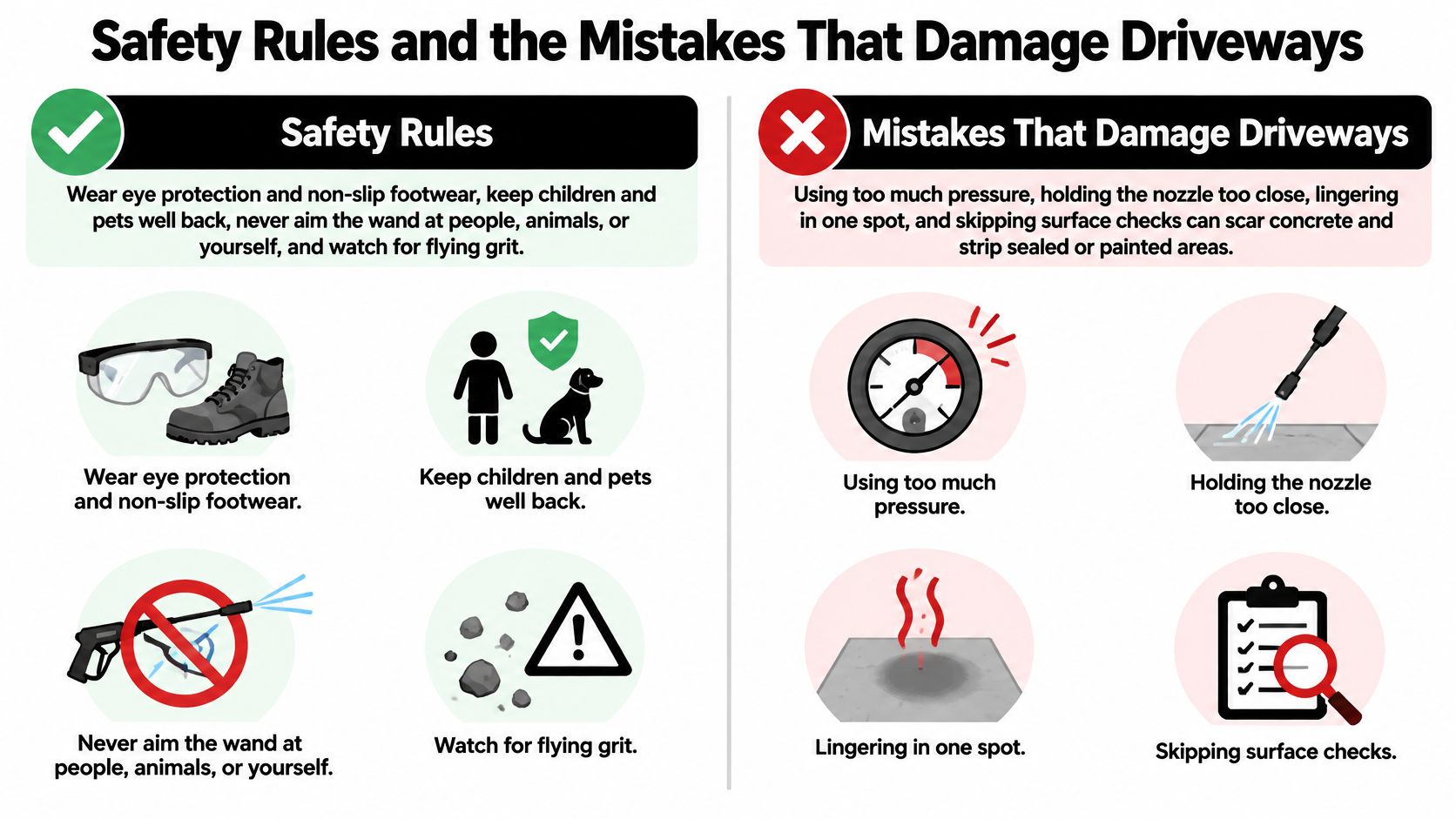
The PSI number is only the first safety decision. Technique and surface condition decide whether a driveway wash is safe. A lower setting reduces risk, but it does not make a pressure washer harmless. The pressure-washer operating manual covers protective equipment, surface suitability, and control of the spray around people and surrounding materials. Read it before you start.
Wear eye protection and non-slip footwear. Keep children and pets clear of the work area, and never aim the wand at yourself, another person, or an animal. Grit can travel farther than expected, including debris thrown out from under a surface-cleaner housing.
Protect more than the driveway
Inspect hoses, couplings, and electrical connections before starting. Set the machine on stable, level ground where vibration will not walk it toward an edge, and follow its electrical or engine safety instructions.
- Keep spray away from the house: A stray jet can force water behind trim or tear window screens. Leave a generous margin around glass, siding, seals, and door openings.
- Do not blast damaged coatings: A narrow tip can lift sealant and paint. Stop if the wash reveals peeling edges instead of removing dirt.
- Treat unexpected roughness as a warning: Fresh pitting or newly exposed aggregate means the process is removing material, not just contamination.
Check current water and runoff rules
Outdoor water-use restrictions can limit when and how you wash, and some distinguish cosmetic cleaning from maintenance or safety work. Confirm the current requirements with your local water provider, municipality, and HOA before scheduling. A lower PSI does not override a restriction, and hiring a professional does not create an exemption. Keep detergent and oil-contaminated runoff out of storm drains unless the responsible authority explicitly permits the discharge.
If damage begins, release the trigger and reassess. I would treat fresh pitting that continues under a gentler setup as a sign to call a professional. The same applies when you cannot tell contamination from failing concrete.
Deciding Between DIY and a Professional Driveway Wash
The decision rarely comes down to the maximum PSI on the machine. A sound, flat concrete driveway with light dirt, safe footing, and predictable drainage is a reasonable DIY candidate. So is a homeowner with enough time to prepare, test, clean, and inspect without rushing.
A professional becomes the better choice when uncertainty sits in the surface rather than the schedule. Renting a more powerful washer does not resolve failing sealant, decorative finishes, heavy oil staining, or steep access. The number on the machine matters less than what a hidden test strip reveals about the concrete, the nozzle, and your pace.
Choose based on the difficult part
| DIY is a reasonable fit | Professional assessment is the better fit |
|---|---|
| Sound, straightforward concrete | Stamped, decorative, coated, or deteriorating surfaces |
| Light dirt and manageable access | Heavy oil staining or embedded contamination |
| Safe footing and predictable drainage | Slopes, awkward access, or difficult runoff control |
| Time to work patiently | A large area that encourages rushed cleaning |
A capable crew brings maintained equipment, experience reading surface condition, and a deliberate testing process. Hard and soft surfaces require different pressure levels so the surface is cleaned without being damaged. That choice protects the property, not just its appearance.
The same tool-to-surface logic applies beyond concrete, as this tile care advice for Melbourne homeowners shows, though a driveway decision still turns on concrete condition, drainage, and access.
Hire for the condition you're unsure about, not just the square footage you don't want to clean.
Plan coordinated exterior care in Colorado Springs
Cultivate House Detailing is a locally owned exterior cleaning company serving Colorado Springs and nearby communities. The team matches the approach to each surface and property, with residential window cleaning, commercial window cleaning, gutter cleaning, pressure washing, holiday lights, and window screen repair available.
If you're searching for window cleaning near me, consider the whole property rather than glass alone. Professional window cleaning improves clear views and natural light, while coordinated exterior care keeps a clean entrance from sitting beside dusty glass.
When requesting a quote, identify the services you need, such as pressure washing, window cleaning, gutter cleaning, holiday lights, or window screen repair. Clear scope makes it easier to understand what's included and organize the work.
We recommend pressure washing the home and surrounding areas at least once a year between March and November, with timing suited to the property and area of town. Our driveway pressure-washing service information can help you decide what to include in a quote request.
Cultivate House Detailing offers driveway pressure washing and professional window cleaning in Colorado Springs, with gutter cleaning available for a coordinated exterior refresh. Note your driveway material, photograph any cracks or stains, and visit Cultivate House Detailing to request a quote and discuss which services fit your property.