A storefront in Colorado Springs can look ready for business until the morning light exposes fingerprints on the entry doors, hard-water spots along the lower panes, and dust worked into every frame. Then a commercial window cleaning quote arrives as one unexplained number, leaving the owner unsure whether it reflects the glass, the building height, or the equipment needed to reach it.
Learning how to price commercial window cleaning makes that quote easier to evaluate. For business owners, property managers, and new service providers in Colorado Springs, CO, the useful questions are practical: How many panes are included? Is the service interior, exterior, or both? Can a crew reach the glass from the ground, or does the job require a lift or rope-access plan? How often will the property be cleaned?
Commercial window cleaning is commonly quoted by the pane, window, square foot, or hour. Current market guides place commercial rates around $2 to $8 per pane, $5.50 to $15.00 per window, and $0.50 to $2.50 per square foot, while hourly pricing commonly sits around $50 to $100 per cleaner, depending on access and building complexity, as outlined in this commercial window cleaning pricing guide.
The reliable method is straightforward. Identify the cost drivers, choose a pricing model that fits the building, build the quote from measurable units, apply access and condition modifiers, then present the proposal clearly enough that both sides can negotiate with confidence.
Why Smart Pricing Starts Before the First Wipe
A quote should tell the story of the job
A transparent commercial window cleaning estimate starts with the property, not a convenient round number. A ground-level retail storefront in Colorado Springs may have repetitive panes, easy parking, and quick access. A nearby office building may have fewer windows but include second-story glass, interior partitions, restricted work areas, and a schedule that requires the crew to work around employees.
Those buildings shouldn't receive the same price because they have a similar number of windows. The estimate needs to show what the crew is being paid to handle, including glass volume, setup, travel within the site, access, detailing, and the risks associated with working above ground level.
Business owners can ask for a breakdown without knowing trade terminology. A useful quote should identify the number of panes or windows, the areas included, the cleaning frequency, the access method, and any separate charges for screens, tracks, mineral deposits, or post-construction debris.
Practical rule: If a quote doesn't explain what changes the price, it isn't transparent enough to compare.
Volume is only the starting point
Pane count matters because it gives the cleaner a measurable service unit. It doesn't describe the whole job. A narrow storefront pane, a tall entry door, and a large floor-to-ceiling panel may all be counted as glass, but they don't necessarily take the same time or require the same technique.
That distinction matters for local businesses from Monument to Manitou Springs. Wind-blown dust, seasonal buildup, busy entrances, and hard-water residue can increase the work even when the layout looks simple from the parking lot. Interior window cleaning may also require moving around desks, protecting merchandise, or coordinating with staff before opening.
Frequency changes the condition a crew encounters. A property maintained on a practical schedule generally needs routine cleaning, while a neglected facade may require extra scrubbing and stain treatment before it can return to maintenance condition. Owners can influence that variable through scheduling, while height and access usually remain fixed characteristics of the building.
A repeatable method protects both sides
A cleaner who prices only by intuition can underbid a difficult building and later rush the work, add surprise charges, or lose money. An owner who compares only the final total can choose a quote that leaves out screens, entry glass, upper elevations, or the setup required for safe access.
The stronger approach separates glass volume from access risk. Count the service units first. Select a baseline rate next. Then account for height, equipment, scope, condition, and frequency. That process produces a quote that can be explained before work begins and checked after the visit.
The Six Cost Drivers Behind Every Quote
Six variables usually determine why two commercial window cleaning estimates differ: labor time, equipment, building access, height, frequency, and glass condition. They overlap, but they shouldn't be collapsed into one vague “difficulty” fee.
Labor time
Labor includes more than squeegeeing. A crew may need to walk equipment across a large property, establish a safe work area, remove screens, detail frames, protect interior surfaces, and clean around customers or employees. A storefront with simple exterior panes may move quickly, while a medical office or busy restaurant can require careful staging and interior coordination.
Hourly commercial work commonly falls around $50 to $100 per cleaner, depending on access and building complexity, according to the commercial window cleaning rate guidance. That range isn't a universal price tag. It helps explain why a labor-heavy site shouldn't be judged against a simple pane-count quote without checking the scope.
Equipment
A ground-level job may need standard squeegees, scrubbers, extension poles, towels, and a water-fed pole system. Upper glass can require ladders, lifts, additional safety equipment, or a different crew plan. Equipment creates direct costs, but it also adds loading, setup, positioning, and breakdown time.
Building access
Parking restrictions, locked gates, landscaping, awnings, narrow courtyards, and occupied offices can slow a crew even when the glass itself is clean. A building manager who provides access details early helps the cleaner quote accurately and avoid a last-minute change.
Height
Height is one of the strongest pricing modifiers. One published commercial rate sheet assigns $1.00 per ground-level pane, $2.25 per second-story pane, and an additional $50 plus $2.75 per pane for third- and fourth-story work. Broader guides place high-access commercial work around $5 to $15 per pane, compared with $2 to $5 per pane for low-rise windows, as shown in this commercial glass pricing reference.
Frequency
Routine service can reduce the amount of restoration work required on each visit. Monthly, quarterly, or seasonal scheduling also lets the contractor plan route work and understand the property better. A one-time quote and a recurring proposal shouldn't be compared as though they carry identical conditions.
Glass condition
Hard-water staining, construction debris, adhesive, paint, and embedded dust can require more than a maintenance wash. A new office build in Colorado Springs may need post-construction detailing before recurring service makes sense. A Manitou Springs facade with mineral buildup may need specialized stain-removal work rather than a standard pass.
| Cost Driver | What It Means | Effect on Price |
|---|---|---|
| Labor time | Cleaning, detailing, setup, coordination, and breakdown | More time usually raises the labor portion |
| Equipment | Poles, ladders, lifts, water-fed systems, and safety gear | Specialized equipment adds preparation and operating cost |
| Building access | Parking, gates, courtyards, awnings, and occupied spaces | Difficult movement increases setup time |
| Height | Ground, second-story, upper-story, or specialty access | Higher elevations can move the job into a different rate class |
| Frequency | One-time, seasonal, or recurring maintenance | Regular service can reduce heavy buildup and surprises |
| Glass condition | Dust, mineral deposits, adhesive, paint, or construction residue | Restoration and post-construction work require more labor |
The important distinction is control. A property owner can't change the building's height, but can improve access coordination, clarify scope, and choose a schedule that prevents avoidable buildup.
Choosing the Right Pricing Model for the Building
No single pricing model works for every commercial property. The right choice depends on whether the glass is repetitive, oversized, difficult to reach, spread across multiple elevations, or part of an ongoing maintenance route.
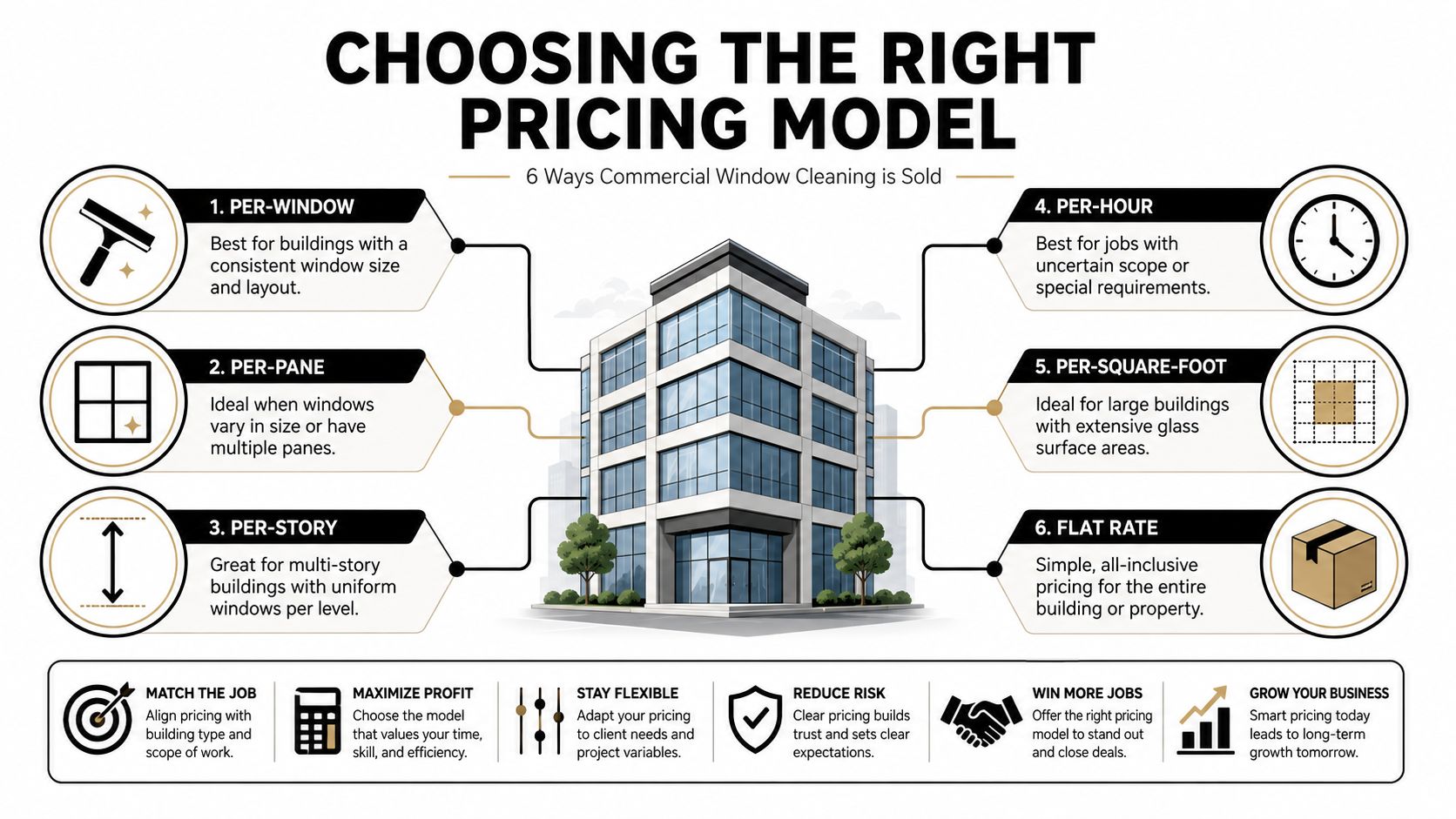
Six models and their natural fit
Per-window pricing works well for standard storefronts and small offices with similar windows. It gives the buyer a simple comparison, but it can become inaccurate when one “window” contains multiple panes or when entry doors and transoms require extra detailing.
Per-pane pricing is more precise for divided lights, grids, and layouts where each pane represents a distinct cleaning unit. It can fail when panes vary greatly in size or when upper glass requires lift work. A large pane shouldn't automatically receive the same treatment as a small repetitive pane.
Per-story pricing helps organize buildings with clear ground, second, and upper-story divisions. It makes height visible in the proposal, but it still needs a scope description because stories can contain very different glass types and access conditions.
Per-hour pricing fits irregular sites, heavily soiled glass, specialty detailing, and jobs where the final labor time is difficult to predict. Buyers get flexibility, but the final total may be less certain unless the cleaner provides an estimated range and explains what changes the time.
Per-square-foot pricing suits large facades, showrooms, and properties with predictable glass area. It avoids counting hundreds of panes one by one, though it can hide access and setup differences if the estimate doesn't itemize them.
Flat-rate or recurring package pricing works for ongoing maintenance when the scope and schedule are stable. It can simplify budgeting for a Colorado Springs office, restaurant, dealership, or retail route. It shouldn't be used to disguise changing conditions or include vague “all glass” language.
Compare scope before comparing totals
One- to two-story commercial work often runs around $3 to $6 per pane for outside-only service and $4 to $8 per pane for inside-and-out, while the broader commercial range can reach $4 to $12 or more per pane depending on access and building height, according to this commercial window cleaning price comparison.
The classic mistake is comparing a low per-pane bid with a higher custom proposal without checking whether the first quote excludes doors, screens, tracks, interior glass, or lift setup. Ask each bidder to describe the same service units and access assumptions. A fair comparison is based on equivalent scope, not merely matching arithmetic.
Building Your Pricing Formula Step by Step
A practical quote begins with measurable units and adds difficulty only where the property creates it. This keeps an easy storefront from subsidizing a complicated facade and prevents a fourth-story office from being priced like ground-level glass.
Count the service units
Start with a site walk or a detailed property review. Count panes when the layout is divided or inconsistent. Count windows when the units are standardized. Separate ground-level, second-story, and higher-access glass so the quote doesn't bury the most important risk variable.
Also record:
- Interior and exterior scope: Mark which elevations and interior areas are included.
- Doors and transoms: Identify entry glass separately when fingerprints and edge detailing add time.
- Screens and tracks: Confirm whether screens are removed, cleaned, and replaced.
- Condition: Note hard-water staining, adhesive, paint, construction debris, and neglected frames.
- Access: Record whether the crew can use a pole, ladder, lift, or another access method.
Select a baseline rate
Neutral pricing calculators describe a sequence that starts with service units, applies a baseline rate, and then adds modifiers. Those baseline rates can range roughly from $0.50 to $2.00 per pane, while access multipliers can rise from 1.0 at ground level to 3.5 or more for rope access, as explained in this commercial window cleaning calculator methodology.
Use the baseline only for comparable glass. Don't use a ground-level rate for a third-story elevation just because the pane count is convenient.
A basic formula looks like this:
Base quote = service units × baseline rate
Then expand it:
Final quote = base quote + access adjustment + scope adjustment + condition adjustment + service minimum, when applicable
The modifiers don't need to be hidden percentages. A clear proposal can show “second-story access,” “interior glass,” “screen handling,” or “post-construction detailing” as separate line items.
Work through a Colorado Springs example
Consider a hypothetical two-story office with a standardized layout. The cleaner first separates the ground-level panes from the second-story panes, confirms that both interior and exterior glass are included, and checks whether screens or hard-water stains require additional work.
The quote should then apply the chosen baseline to each group and use a higher access factor for the second-story panes. The exact total depends on the verified count, selected rates, condition, and scope. The value of the formula is that another contractor can inspect the same building and explain a different number using the same visible drivers.
For a small storefront, the pane calculation may produce a very low figure if the site has limited glass. Service minimums can then make the visit workable. One 2026 pricing guide lists small storefront minimums of $25 to $75, small office buildings at $100 to $250, and multi-story commercial properties at $500 or more per job, as detailed in the commercial window cleaning pricing guide.
Before sending the proposal, check whether the price covers travel, setup, labor, equipment, insurance, administrative time, and profit. A quote that covers only the wiping time may look competitive but won't remain sustainable after parking, loading, weather delays, or safety requirements enter the job.
For operators refining estimates, AI price optimization solutions can help organize quote inputs and identify inconsistent pricing patterns, but software shouldn't replace a site review. A local commercial window cleaning kit also needs the right tools and access planning, which property owners can review through this commercial window cleaning kit resource.
The calculation should support judgment, not pretend every property is identical.
A final review should ask one question: Would this price still make sense if the crew encountered exactly what the site inspection described? If the answer is no, the estimate needs a clearer modifier or a better-defined scope.
Adjusting for Colorado Springs and Winning the Proposal
Colorado Springs properties experience conditions that affect cleaning effort without fitting neatly into a national average. Strong sun can bake residue onto exposed glass, wind can move dust across storefronts and office elevations, and seasonal buildup can vary between Black Forest, Monument, Manitou Springs, and Woodland Park. Those conditions don't justify an unexplained surcharge. They justify documenting the condition and explaining the labor it creates.
Local conditions belong in the scope
A storefront near a busy road may collect dust on entry glass and frames. An office with exposed upper elevations may require more careful scheduling when wind affects pole work or lift positioning. A property that hasn't been cleaned since construction or a long period of neglect may need stain or debris removal before it can enter a maintenance program.
The proposal should state what the crew observed and how that observation changes the work. “Hard-water stain removal on lower exterior panes” is more useful than “difficult glass.” “Second-story exterior access by extension pole” gives the manager a basis for comparison.
Published commercial guides place small storefront minimums around $25 to $75, small office buildings around $100 to $250, and multi-story commercial properties at $500 or more per job, but the building-specific scope determines where a Colorado Springs estimate lands within those categories, as shown in the commercial window cleaning pricing information.
Make recurring service easy to approve
A recurring proposal should show what changes between visits. Monthly or quarterly scheduling may reduce heavy buildup and make labor more predictable, but the offer still needs defined areas, frequency, interior access, screen treatment, and cancellation terms. Avoid presenting a vague discount that makes the buyer wonder whether the one-time quote was inflated.
A strong proposal can include:
- Clear service map: List elevations, doors, transoms, interior glass, screens, and tracks.
- Access explanation: State whether the crew will use poles, ladders, lifts, or another method.
- Condition notes: Separate routine cleaning from mineral stain removal or construction cleanup.
- Schedule options: Offer a one-time visit and a recurring maintenance plan with the same scope language.
- Documentation: Identify insurance and safety records relevant to above-height work.
Answer the questions that block approval
Property managers usually need confidence before they approve a higher quote. Explain why access requires additional setup, how the crew will protect customers and staff, and what happens if the site isn't ready on the scheduled date.
For taller buildings, ask whether the contractor's insurance explicitly covers above-height or rope-descent work. OSHA's rope-descent system rule for window cleaning became effective in 2017, and industry guidance connects compliant high-rise work with annual rooftop anchor inspection, operator training, and documented recertification. Some insurance policies exclude rope-descent or above-height work unless the vendor's coverage specifically includes it, as described in this high-rise window cleaning safety guidance.
A proposal wins when it makes the work understandable. Price matters, but clarity lets the buyer see what they're purchasing and why the number is appropriate.
Frequently Asked Questions About Commercial Window Cleaning Prices
Why does third- and fourth-story work need a setup surcharge?
Upper-story work can require specialized access planning, equipment positioning, safety controls, and additional time before the first pane is cleaned. A surcharge reflects those job requirements rather than applying a generic markup to easy glass. Ask the cleaner to identify the access method and the affected elevations.
What safety and insurance documents should a business verify?
For higher glass, request proof of coverage for the actual work being proposed, especially if rope descent or other above-height methods are involved. Also ask about training, rooftop anchor inspection, and documented recertification. OSHA's rope-descent rule became effective in 2017, and some policies exclude this type of work unless coverage explicitly includes it, according to the earlier high-rise compliance guidance.
How does recurring pricing differ from a one-time quote?
A one-time visit may include heavier buildup, extra setup, or restoration-related work. A recurring plan is built around a defined schedule and maintenance scope, so it can make labor and budgeting more predictable. Compare the included glass and frequency before deciding whether a recurring arrangement offers enough value.
How can I compare bids using different models?
Translate each proposal into the same scope. Confirm pane or window count, interior and exterior areas, access method, screens, tracks, stains, minimum charges, and schedule. Then compare the final service delivered, not just the per-pane, hourly, or square-foot figure. Cultivate House Detailing can prepare a transparent commercial quote for businesses in Colorado Springs and nearby communities.
Cultivate House Detailing provides commercial window cleaning for storefronts, offices, restaurants, dealerships, and other Colorado Springs-area businesses, with pricing built around the property's glass count, size, location, access, and condition. Visit Cultivate House Detailing to request a clear quote for interior window cleaning, exterior window cleaning, screen cleaning, hard-water stain removal, or recurring maintenance service.
Rather not do it yourself? Cultivate House Detailing offers residential window cleaning in Colorado Springs. Get a free quote.