Your driveway usually tells the story of the season before anyone reaches the front door. In Colorado Springs, that often means winter grime, dusty runoff, dark tire marks, and the chalky residue left behind after snow and ice treatments. The house can look sharp, the landscaping can be tidy, and the concrete still drags down the whole exterior.
That's why pressure washing a concrete driveway matters. Done right, it restores brightness, improves traction, and helps you see what shape the slab is in. Done poorly, it can leave stripes, expose weak surface paste, and make an older driveway look worse instead of better.
Colorado adds its own complications. High-altitude sun dries cleaners fast. Freeze-thaw cycles exploit every weak spot. Road treatment residue and seasonal grime settle into the surface and tend to hang on. A solid cleaning plan has to account for all of that, not just raw pressure.
Bringing Your Colorado Springs Curb Appeal Back to Life
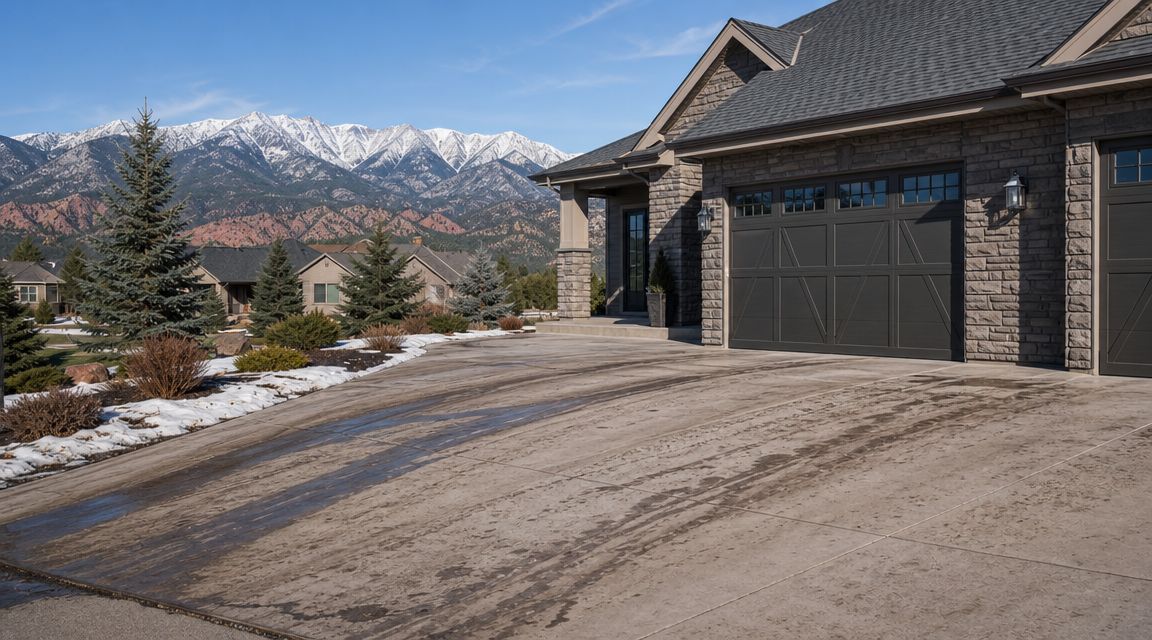
A common Colorado Springs scene goes like this. Snow melts off the Front Range backdrop, the light comes back, and suddenly the driveway looks rougher than it did all winter. What looked like a little dirt in January turns into broad gray traffic lanes, rust-colored spots near sprinklers, and dark patches where vehicles sit every day.
For homeowners, that can be frustrating because concrete stains change the feel of the whole property. The driveway is one of the largest visible surfaces on the front of the house. When it looks neglected, the home does too.
What Colorado does to concrete
Colorado concrete takes a beating from several directions at once:
- Winter residue sticks around because dirty meltwater settles into the pores of the slab.
- Freeze-thaw movement stresses weak areas and makes existing flaws more noticeable after cleaning.
- Strong sun at altitude speeds drying so detergents and rinse water can flash off before the job is finished evenly.
- Mag-chloride and similar road treatments leave behind grime that often needs more than a quick hose rinse.
A driveway can still be structurally sound and look tired. That's usually the sweet spot for professional cleaning. The goal isn't to blast the surface until it turns bright. The goal is to remove contamination while keeping the concrete intact.
A clean driveway should look evenly restored, not freshly scarred.
Cleaning for appearance and preservation
Pressure washing works best when it's treated as surface care, not brute-force demolition. That means using the right setup, cleaning in sections, and paying attention to the condition of the slab. Older standard concrete usually responds well when handled correctly. Decorative concrete, newer pours, and soft or weathered areas need more restraint.
Homeowners who are comparing materials may also find it useful to read Booms Up Civil Group on driveways, which gives broader context on how concrete functions as a long-term exterior surface. That matters because cleaning decisions should support the life of the driveway, not just this weekend's curb appeal.
Choosing the Right Tools for the Job
The biggest DIY mistake isn't buying a weak machine. It's using the wrong combination of pressure, flow, nozzle, and technique. Concrete can handle meaningful cleaning power, but it still punishes sloppy tool choices.
For most concrete driveways, Consumer Reports says any pressure washer producing at least 1,500 psi can work, but the job goes much faster at 2,500 to 3,000 psi, and concrete can readily withstand that power without etching when the right nozzle and technique are used, according to Consumer Reports guidance on pressure-washer-safe surfaces.
PSI and GPM in plain English
PSI is the force hitting the surface. GPM is the amount of water moving through the job. Homeowners tend to focus on PSI because it sounds like power, but driveway cleaning also depends on flow. Good flow helps carry dirt away instead of just cutting a narrow clean line through it.
For embedded dirt, algae, and oil-stained traffic areas, a machine in the roughly 2,000 to 3,000 PSI range is generally the practical lane for residential driveway work. If you're using an underpowered electric unit, it can still work, but it's slower and more labor-intensive on a full driveway.
Pressure Washer Nozzle Guide for Concrete Driveways
| Nozzle (Color) | Spray Angle | Best Use Case for Driveways | Warning |
|---|---|---|---|
| White | 40-degree | Broad rinsing, light surface cleaning, final wash-down | Safer, but slower on heavy buildup |
| Green | 25-degree | General concrete cleaning, balanced fan pattern for most driveway work | Still needs steady movement and correct distance |
| Yellow | 15-degree | Tight, focused cleaning on stubborn areas with caution | Can leave lines or marks if you linger |
| Red | 0-degree | Not recommended for broad driveway cleaning | High risk of visible damage and etching |
| Black | Soap | Applying detergent or pre-treatment | Not for actual soil removal by pressure alone |
Gas vs electric and what actually matters
Gas machines usually make more sense for full-size driveways because they move faster and pair better with surface cleaners. Electric units are quieter and easier to store, but they often turn a straightforward cleaning job into a long one.
A surface cleaner is often the difference between “clean” and “professionally uniform.” It spreads pressure more evenly and reduces striping compared with hand-wanding the whole slab. If you want a deeper look at how setup affects results, this piece on optimizing detailing with proper tools is useful because the same logic applies here. Tool choice changes both finish quality and risk.
If you're also cleaning outdoor living areas, the process for a driveway overlaps with patio work in several ways. This guide on how to pressure wash concrete patio surfaces is a helpful companion for comparing approaches.
The Professional Technique for a Streak-Free Finish
You finish a driveway, step back, and the slab looks worse in the afternoon sun than it did when it was dirty. The zebra lines show up, the rinse water dries in patches, and every missed pass stands out. In Colorado Springs, that happens fast because our dry air, wind, and high-altitude sun pull moisture off the surface quicker than many homeowners expect.
A clean, even finish comes from control. The operator has to hold a steady distance, keep a consistent walking pace, and overlap each pass enough that one lane blends into the next. The goal is uniform cleaning across the whole slab, not a collection of brighter stripes.
The sequence that works
Start with the setup. Move vehicles, sweep off loose grit, and clear the edges where dirt collects against the garage slab, curb line, and expansion joints. Pre-treat spots that need separate chemistry, then wash the main field in sections small enough to stay wet while you work.
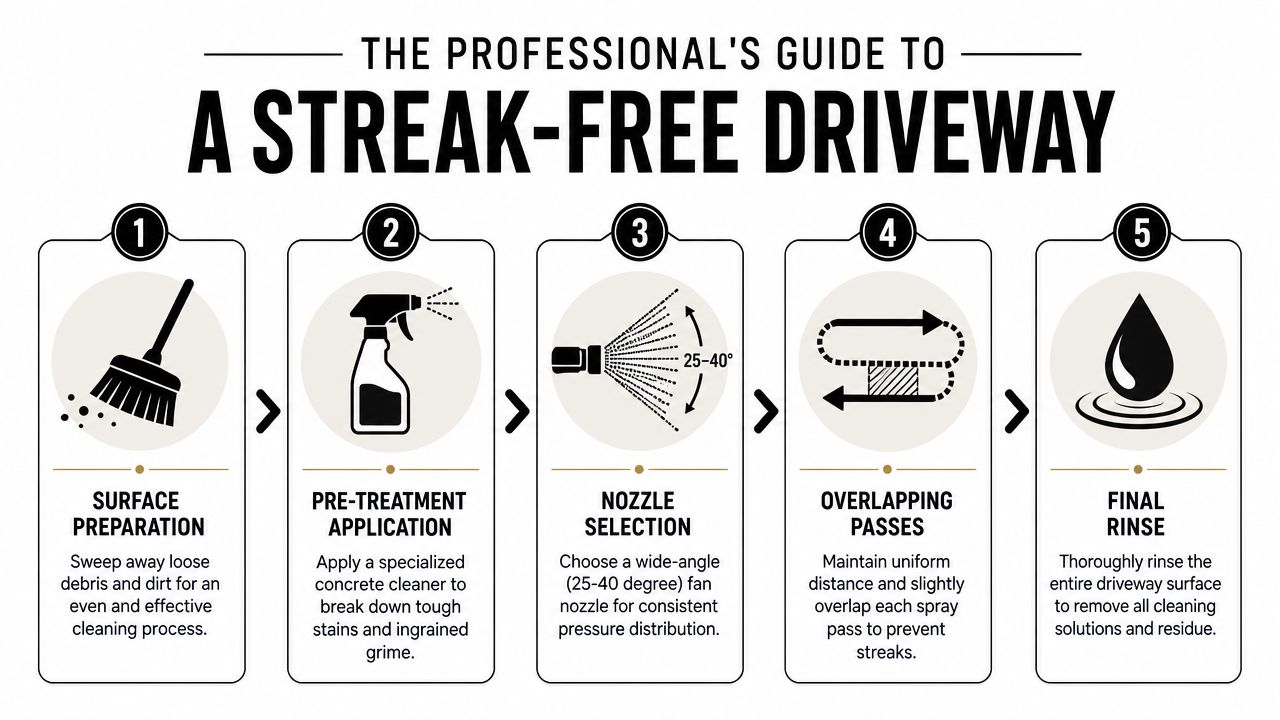
On most Colorado Springs driveways, I want runoff moving away from the finished area instead of back across it. That usually means starting at the high side and working downhill with a surface cleaner, then following with a controlled rinse. If the slab has low spots, adjust the pattern so dirty water does not settle and dry back onto clean concrete.
How pros avoid zebra striping
Striping usually comes from two mistakes. The first is uneven overlap. The second is changing speed every time the wand hits a darker patch.
Keep the pattern boring. Straight passes. Consistent overlap. No random arcs at the end of each sweep.
For homeowners who want to see that movement in action, this driveway cleaning video demonstration shows the kind of controlled path that produces a more uniform finish.
A quick visual helps if you've never seen the pattern in motion:
A practical workflow for Colorado Springs driveways
Colorado changes the technique. Bright sun can dry detergent before it has time to work. Freeze-thaw wear leaves some slabs more porous, so they clean unevenly if you rush them. Mag-chloride residue from winter roads can also leave a film that smears if it is not rinsed thoroughly.
Use a workflow that accounts for those conditions:
- Sweep first so loose sand and grit do not turn into slurry.
- Pre-treat visible problem areas before the main wash begins.
- Test a small inconspicuous spot to confirm the surface is reacting well.
- Clean in manageable sections that stay wet from start to rinse.
- Watch the runoff path so dirty water does not dry on the finished surface.
- Do a final rinse with intention around joints, edges, and low areas where residue likes to collect.
Practical rule: If the section starts drying before you finish cleaning it, shorten the section.
That one adjustment prevents a lot of streaking in Colorado Springs. It also protects older concrete from the common DIY mistake of increasing pressure when the actual problem is heat, wind, or poor rinse management. On driveways with winter wear, scaling, or surface damage, professional cleaning usually makes more sense because the technique has to be matched to the condition of the slab, not just the machine.
How to Tackle Stubborn Oil Rust and Mildew Stains
A driveway can look cleaner overall and still feel unfinished because three stains are still staring back at you. In Colorado Springs, those trouble spots often get worse after winter. Mag-chloride tracks, strong sun, and repeated freeze-thaw cycles can drive contamination deeper into older or more porous concrete.
General washing will not solve that. Stain removal works best when each stain is treated for what it is.
Oil and grease need time and the right chemistry
Oil sinks into concrete instead of sitting neatly on top. On a driveway that has seen a few Colorado winters, surface wear often opens the slab enough for oil to hang on below the top layer. If you blast it with pressure first, you can strip off surface dirt, leave the oil behind, and create a bright etched spot that looks worse from the street.
Start with a concrete degreaser on a dry or slightly damp stain. Give it full dwell time based on the label, scrub if the product calls for it, then rinse and clean the area with controlled pressure. Older spots usually take more than one round.
That is normal.
Hot, dry weather matters here too. In Colorado Springs, cleaners can flash off fast in direct sun, so treat smaller sections and keep an eye on dwell time. If the product dries on the slab, it stops helping and can leave residue behind.
Rust needs a different approach
Rust is its own category. Fertilizer, metal furniture, old snow shovels, and irrigation overspray all leave marks that do not respond well to degreasers. Pressure alone usually spreads the stain or pushes it deeper into the surface.
Use a rust remover labeled for concrete, apply it carefully to the stained area, and rinse with control so you are not dragging orange runoff across clean concrete. On decorative or older driveways, I always advise caution because some rust removers are aggressive enough to change the appearance of the surrounding slab if they are overapplied.
Fix the source too. If sprinklers are hitting metal hardware or hard water is feeding the stain, the rust usually returns.
Mildew, algae, and dark organic staining respond better to treatment than force
Organic growth shows up along fence lines, shaded edges, north-facing sections, and areas with sprinkler overspray. Those stains usually release with the right pre-treatment and a moderate wash. High pressure is rarely the smartest first move, especially on concrete that already has small pits or winter wear.
Look for the pattern before treating:
- Shaded corners stay damp longer and keep feeding mildew growth.
- Edges adjacent to the ground collect soil, mulch, and runoff that stain the border of the slab.
- Sprinkler zones create repeat marks that come back until the watering pattern is corrected.
Dark stains can look similar from a distance, but they do not clean the same way. Black mildew, orange rust, brown leaf tannins, and petroleum stains each need a different product and a different rinse strategy.
On mixed-stain driveways, the order matters. Treat oil first so you are not smearing it during the main wash. Handle rust in a controlled area. Pre-treat organic growth where moisture tends to linger. That sequence gives a cleaner result and lowers the chance of blotchy concrete.
This is also the point where DIY jobs start getting expensive. The wrong chemical, too much pressure, or poor timing in Colorado sun can leave permanent contrast in the slab. Professional driveway cleaning is often less about stronger equipment and more about knowing what the stain is, how porous the concrete has become, and how to clean it without shortening the life of the surface.
Pressure Washing Safety and Common Mistakes to Avoid
Pressure washing a concrete driveway looks simple from the sidewalk. In reality, the line between effective cleaning and surface damage is thin. Most expensive mistakes happen because the operator gets impatient and starts chasing “instant white” results.
Improper pressure washing can permanently etch or remove the top layer of cement paste, especially on newer or softer concrete, and professionals recommend testing in an inconspicuous area first and waiting at least 90 days before washing new concrete, according to Home Depot's driveway pressure washing guidance.
The mistakes that cause the most trouble
Some errors show up immediately. Others show up after the next freeze.
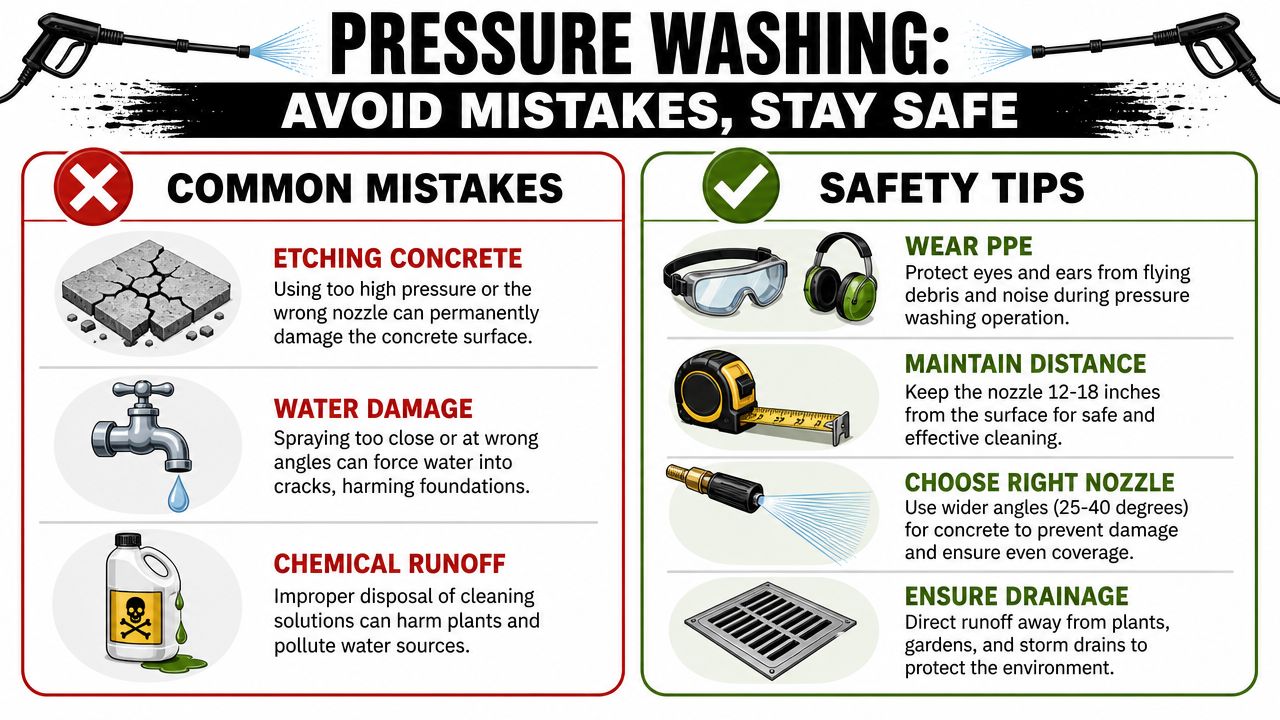
- Too much nozzle concentration leaves wand marks, lines, and etched spots.
- Working too close to the slab can cut into weaker surface areas.
- Forcing water into cracks or joints can worsen existing problems.
- Ignoring runoff can push dirty water into landscaping, garage edges, or areas you've already cleaned.
Newer concrete deserves extra caution. Even if it looks hard, the surface may still be vulnerable. Decorative finishes and previously weakened areas also react differently than plain, older standard concrete.
Personal safety matters too
A pressure washer can injure people and damage property quickly. Wear eye and hearing protection. Keep footing steady, especially where driveway slopes and rinse water meet. Watch nearby garage doors, light fixtures, outlets, trim, and plants before you start spraying.
If you're using detergent, control where that runoff goes. Concrete cleaning shouldn't mean dead grass or chemical residue collecting where it shouldn't.
Why DIY risk climbs fast
The hard part isn't pulling the trigger. It's recognizing when the slab is telling you to back off. That usually shows up as fuzzing, visible paste loss, inconsistent color change, or a surface that suddenly looks rougher instead of cleaner.
If one area brightens much faster than the rest, stop and reassess. Uneven response often means uneven concrete strength.
That judgment call is where experience pays for itself. A homeowner can absolutely clean a driveway. The question is whether the risk to the surface is worth the learning curve.
Protect Your Investment with Proper Drying and Sealing
A driveway isn't finished when the dirt is gone. Washing exposes the actual condition of the surface, and in Colorado that clean concrete immediately goes back to work against sun, moisture, deicers, and temperature swings.
Best practices for concrete maintenance include annual pressure washing and applying a sealant every 2 to 3 years, and after washing the surface should be allowed to dry for a full day before sealing and driving on it, according to this concrete driveway maintenance guidance.
Why sealing matters in Colorado
Colorado Springs driveways face a rough cycle. Moisture gets in, temperatures swing, and the slab expands and contracts. UV exposure also wears on unprotected surfaces over time. Sealing doesn't make concrete indestructible, but it does help reduce how quickly the surface absorbs what it shouldn't.
That matters even more if your driveway sees winter road residue, irrigation overspray, or repeated vehicle parking in the same locations.
Drying is not a throwaway step
Sealing damp concrete is a common shortcut, and it usually backfires. The slab needs time to dry out after cleaning so the sealer can bond properly. If the driveway still holds moisture, the finish may look uneven or fail early.
A simple post-wash checklist helps:
- Let the slab dry fully before applying any sealer.
- Keep vehicles off it during the drying and curing window.
- Check forecast conditions so rain or runoff doesn't interfere.
- Treat sealing as protection, not just shine.
For long-term care, pressure washing and sealing work as a pair. Cleaning removes the contamination. Sealing helps slow down how fast the next round sets in.
When to Call a Professional Driveway Cleaner in Colorado Springs
Some driveway jobs are good DIY projects. Some are not. If the slab is in decent shape, lightly soiled, and you already have the right machine, you may be able to handle it yourself with patience and care.
But many Colorado Springs driveways aren't simple. They have slope, mixed staining, weathered sections, decorative borders, or years of winter buildup. That's when “weekend project” starts turning into equipment rental, test patches, inconsistent color, and a lot more time than expected.
DIY versus professional help
Here's the practical comparison.
- DIY can make sense if the driveway is lightly dirty, you understand nozzle control, and you're willing to move slowly.
- Professional cleaning makes more sense when the slab has oil staining, uneven discoloration, visible weak spots, or a high chance of striping.
- DIY often costs less upfront, but the trade-off is time, setup, cleanup, and the risk of visible damage.
- Professional work usually reduces uncertainty because the workflow is built around surface condition, not guesswork.
What homeowners usually want
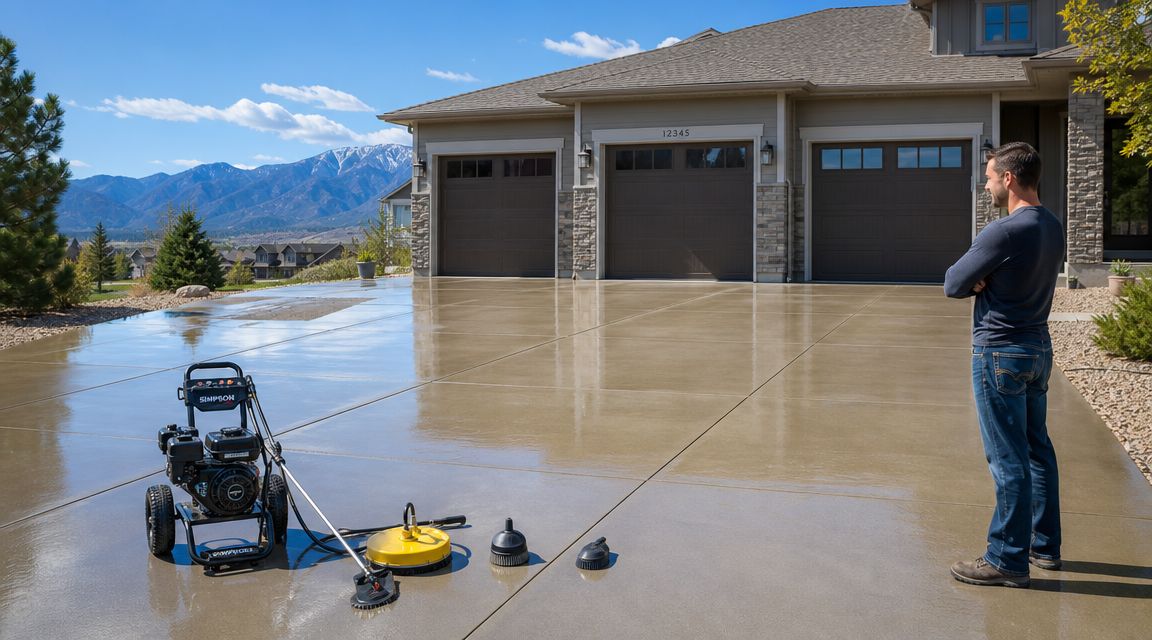
People don't just want a cleaner driveway. They want a driveway that looks evenly cleaned, doesn't get damaged, and doesn't take over the weekend. They also want clear communication around scheduling, arrival, and what to expect if stains don't fully release.
That communication piece matters more than most home service companies realize. If you're curious how service businesses are improving responsiveness, it's interesting to explore Rosie for home services communication and see how faster follow-up supports a smoother customer experience.
For homeowners who'd rather skip the trial-and-error side of pressure washing concrete driveway surfaces, Cultivate House Detailing's driveway cleaning service is one local option in Colorado Springs and nearby communities. The company provides exterior cleaning services that include concrete driveway pressure washing along with other residential exterior care.
Good reasons to make the call
Consider professional help if any of these sound familiar:
- You've got multiple stain types and don't want to guess at treatment order.
- The driveway has age or surface wear and you're worried about etching it.
- The slab is large or steep and streak control will be difficult.
- You want sealing done after cleaning and prefer one coordinated process.
- You don't want the hassle of setup, cleanup, and testing.
In Colorado Springs, that decision often comes down to risk versus payoff. If the driveway is a major part of the home's curb appeal, protecting the concrete is just as important as making it look better.
If your driveway has picked up winter residue, oil spots, mildew, or uneven discoloration, Cultivate House Detailing can help you get it cleaned with the right process for Colorado conditions. Reach out for a quote if you want a driveway that looks refreshed without the trial-and-error that often comes with DIY pressure washing.
Want it handled by a local crew? Cultivate House Detailing offers pressure washing in Colorado Springs. Get a free quote.