You notice it when the sun drops and the parking lot starts doing your property no favors. The front walk feels dim. The building sign disappears from the street. A few fixtures are still on, but they don't aim where people walk, park, or pause. Customers feel it, tenants notice it, and staff leaving after hours definitely notice it.
That's where commercial outdoor lighting installation stops being a cosmetic add-on and becomes part of how a property works. In Colorado Springs, that matters even more. Businesses here deal with visibility, safety, curb appeal, code requirements, and a climate that can punish cheap fixtures and sloppy planning.
A restaurant patio in Old Colorado City needs guests to feel comfortable walking back to their cars. A retail center in the north end needs a storefront and pedestrian paths that stay inviting after dark. An office or mixed-use property near major corridors needs light that supports security without blasting glare into every window and neighboring lot.
Done well, outdoor lighting helps a business look open, cared for, and professionally managed. Done poorly, it creates harsh hot spots, dark gaps, complaints, wasted power, and maintenance headaches. The difference is usually not the fixture catalog. It's the plan behind it.
Enhancing Your Colorado Springs Business After Dark
A common scenario plays out the same way. A property manager does a walkthrough at dusk, and the site looks acceptable for about five minutes. Then the weak points show up. The sidewalk between the lot and the entrance fades out. A wall pack throws hard light straight out instead of down. The side service area is bright in one corner and shadowy everywhere else.
That kind of uneven lighting doesn't just look dated. It changes how people use the property. Customers move faster instead of lingering. Employees pay more attention to where they step than to where they're going. Tenants start raising concerns that are hard to dismiss because they're seeing the same thing every night.
What business owners usually want
Most commercial clients aren't asking for “more light.” They're asking for a property that works better after sunset.
- Safer access: Walkways, curbs, stairs, and entries need consistent visibility.
- Stronger first impression: A lit storefront or facade tells people the business is active and cared for.
- Better after-hours confidence: Parking areas and side approaches need fewer shadows and fewer blind spots.
- A cleaner brand image: Lighting should support the building, not overpower it.
For some owners, the trigger is appearance. For others, it's security. If you're also reviewing broader after-hours site protection, this guide on how properties deter crime with night security is a useful companion because it puts lighting in the larger context of visibility, access control, and active site management.
Good exterior lighting doesn't shout. It guides people, supports visibility, and removes uncertainty.
Why the investment usually pays off in practice
Commercial outdoor lighting installation earns its keep in a few ways at once. It supports safety, helps a property show better at night, and reduces the operational frustration that comes from unreliable or mismatched fixtures. The right system also makes routine maintenance simpler because the layout, controls, and equipment were selected for the site instead of pieced together over time.
In Colorado Springs, that local lens matters. A generic lighting layout might look fine on paper but still miss what the property needs after dark. A professional approach starts with how people move through the site, what the business wants the property to communicate, and what local conditions will do to the equipment over time.
The Professional Lighting Plan Demystified
Most failed lighting jobs have the same root problem. Someone chose fixtures before they studied the site.
Professional commercial outdoor lighting installation starts with a property assessment that maps how the space is used. That includes buildings, sidewalks, drive lanes, parking stalls, planted areas, service areas, signs, existing electrical access, and any place where people gather, walk, queue, or unload. You're not just identifying where lights can go. You're defining where light needs to perform.
The photometric plan is the real starting point
A proper commercial lighting installation begins with a site-specific photometric plan. This process uses specialized software to simulate fixture placement, beam angles, and light spread so underlit or overlit zones can be corrected before installation, which improves safety and performance, as described in this guidance on creating an outdoor commercial lighting layout plan.
Think of that plan as a blueprint for light. Before anyone orders hardware or pulls wire, the design shows how fixtures will interact across the site. That lets an installer catch the problems that usually lead to expensive rework, such as glare at entrances, dead space between poles, light spilling across property lines, or fixtures mounted where conduit routing later forces a compromise.
What a serious planning process includes
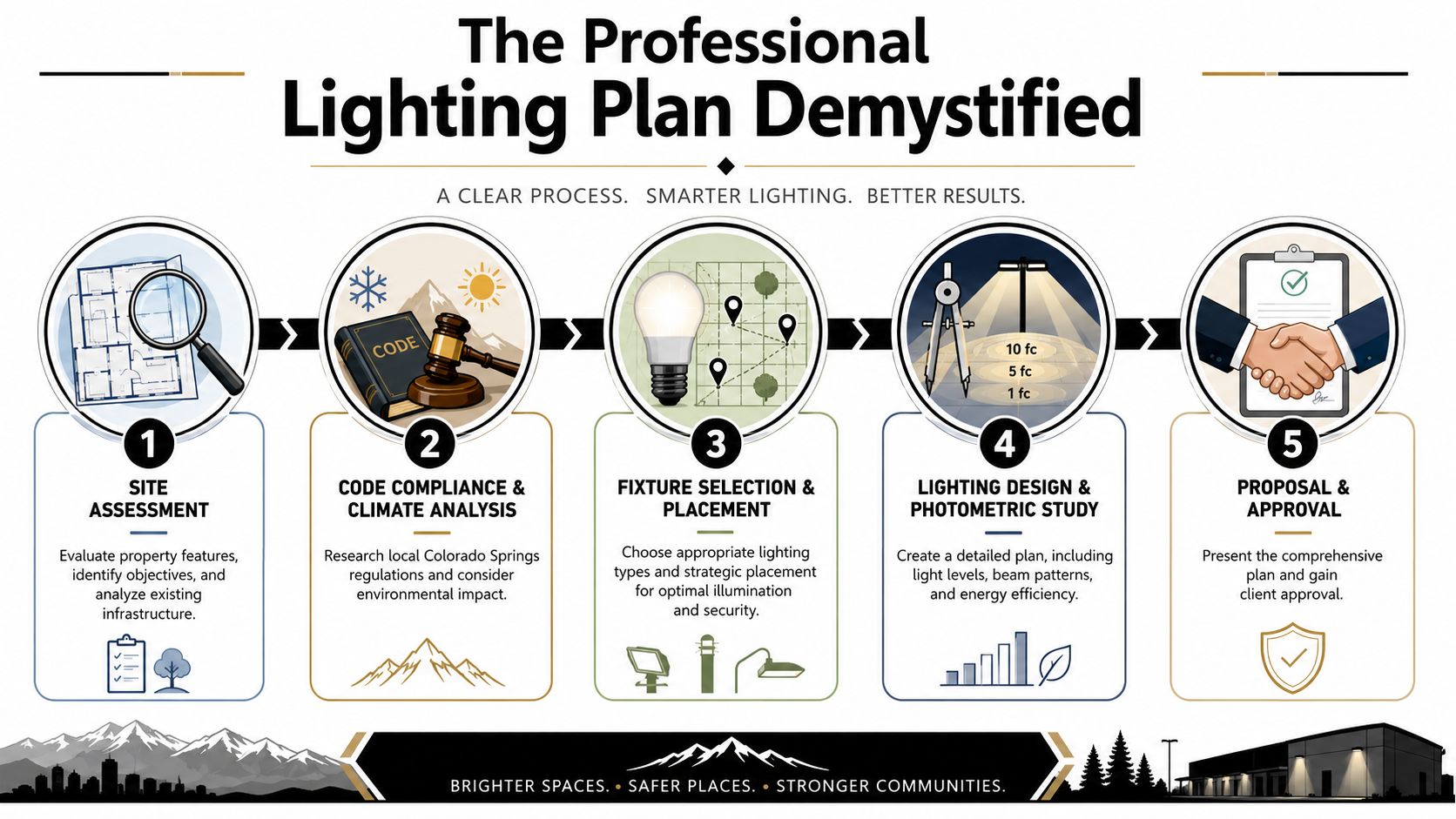
A practical lighting plan usually moves through five parts.
Property assessment
The installer walks the site in daylight and, ideally, reviews how it behaves after dark. Entrances, crosswalks, loading areas, patios, and signs all get treated differently because they serve different tasks.Electrical review
Existing circuits, panel capacity, conduit routes, junction boxes, and mounting conditions matter early. If you ignore electrical routing until later, the optical design often gets watered down to fit the wiring instead of the other way around.Fixture and mounting decisions
Beam spread, mounting height, shielding, and finish selection get matched to the site. A wall-mounted fixture might work perfectly at a rear service door and fail completely along a broad pedestrian frontage.Photometric simulation
The design gets tested before the field crew arrives. That's where dark corners, hot spots, and glare are easiest to fix.Client review and revision
A good installer doesn't hand you a vague sketch. They show you how the lighting is intended to function.
Practical rule: If an installer can't explain where the light lands before installation, they're asking you to gamble on labor, equipment, and code compliance.
What this prevents
Without a design process, the same mistakes repeat:
- Dark transitions: The lot may be bright while the walkway to the door is not.
- Driver glare: A fixture aimed for output instead of comfort can make the space feel less safe, not more.
- Light trespass: Neighbors and adjacent tenants don't appreciate stray light crossing into areas that don't need it.
- Costly revisions: Moving fixtures, re-aiming mounts, or adding controls after the fact is always harder than solving it on paper.
A lighting plan doesn't slow the project down. It protects the budget from predictable mistakes.
Choosing the Right Fixtures and Technology
The fixture conversation gets easier once the layout is clear. At that point, you're not shopping by appearance or wattage label. You're matching fixture type to task, mounting condition, operating schedule, and maintenance reality.
LED has become the default for most commercial projects for good reason. The commercial segment of the global outdoor lighting market was valued at USD 32.3 billion in 2024, and LEDs are a dominant technology because they support long-term cost-effectiveness and reduced maintenance for businesses, according to this outdoor lighting market analysis.
Why LED usually wins
On commercial properties, older lighting systems often create two problems at once. They draw more power than owners want, and they demand more attention than maintenance teams have time to give. LED fixtures address both by reducing relamping frequency and improving long-run operating economics.
That doesn't mean every LED fixture is a smart buy. Cheap housings, poor optics, weak drivers, and bad glare control can ruin a project fast. What matters is not just that a fixture uses LED technology, but that the fixture is built for the actual application.
Common Commercial Outdoor Fixtures and Their Uses
| Fixture Type | Primary Use | Best For |
|---|---|---|
| Wall pack | Building perimeter lighting | Rear doors, service corridors, side elevations |
| Bollard | Low-level pedestrian guidance | Walkways, plazas, path edges |
| Floodlight | Targeted wide-area illumination | Yards, facades, signage, focused security areas |
| Canopy light | Downward light under cover | Drive-throughs, covered entries, fueling or loading canopies |
| Area light | Broad site coverage from poles or mounts | Parking lots, circulation lanes, open common areas |
Matching fixture type to the property
Wall packs work well when you need dependable perimeter coverage close to the building. Bollards make more sense where pedestrian comfort and low mounting height matter. Floodlights can solve specific visibility problems, but they're also one of the easiest ways to create glare if they're overused or aimed poorly.
For many properties, the smartest system is layered. Area lights handle broad circulation. Bollards or architectural fixtures guide pedestrian movement. Accent lighting supports signs or facade details. The site feels better because each fixture is doing a narrower job.
Controls matter as much as fixtures
A strong fixture without a smart control strategy is incomplete. Outdoor lighting often runs for long hours, so scheduling and dimming have a direct effect on operating cost and compliance.
Useful control options include:
- Photocells: Turn lights on at dusk and off at daylight.
- Timers: Fit predictable schedules for sites with fixed business hours.
- Motion or occupancy response: Raise light only when activity occurs in lower-use zones.
- Zone controls: Let parking, entrances, service areas, and decorative lighting operate differently.
Cultivate House Detailing also offers permanent lighting in Colorado Springs for properties that want a custom-fitted exterior lighting solution with installation and setup handled as part of one system.
The best equipment choices usually look unremarkable on a quote sheet. That's because the win isn't the fixture itself. The win is that each fixture fits its job, its location, and its operating pattern.
Colorado Springs Lighting Codes and Climate Considerations
A Colorado Springs property can look sharp at 6 p.m. and create problems by 10 p.m. if the light is too bright, too exposed, or aimed into the wrong place. That usually shows up in three ways. Complaints from nearby tenants or neighbors, premature fixture wear, and a system that costs more to run and maintain than the original proposal suggested.
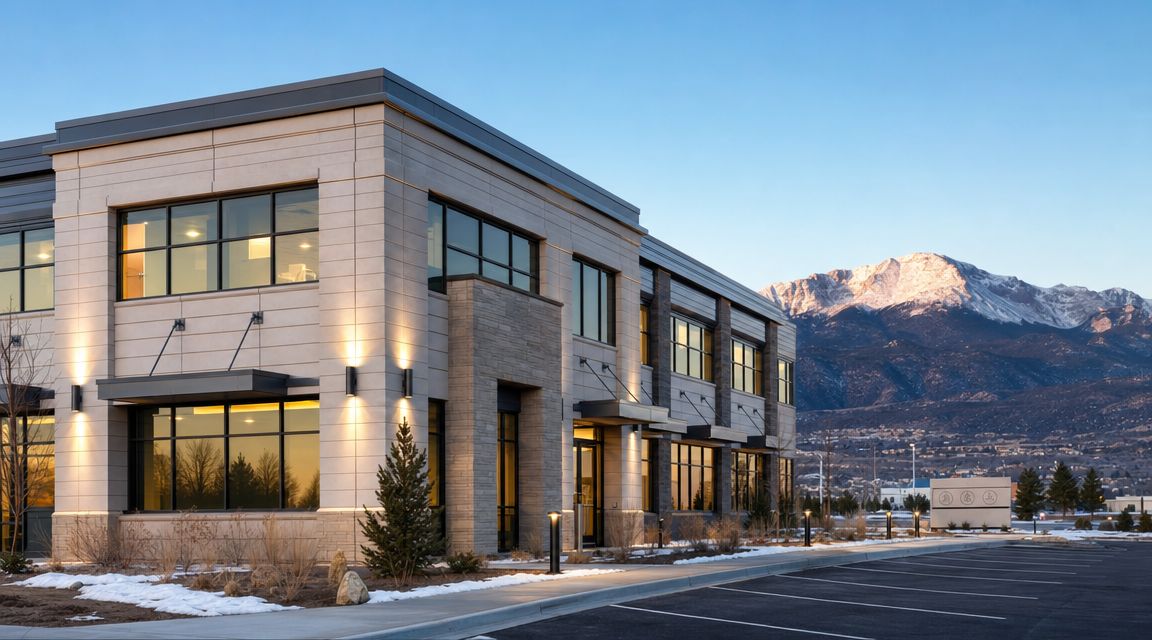
Colorado Springs is not a forgiving market for generic outdoor lighting plans. Higher UV exposure at altitude breaks down cheap lenses, coatings, and gaskets faster than many owners expect. Winter adds freeze-thaw stress, snow storage changes how low fixtures perform, and wind can expose weak mounting details that looked fine on paper.
Local code pressure starts with glare and control
The code conversation here usually centers on light trespass, shielding, and after-hours operation. A fixture can be technically bright enough for the task and still be the wrong choice if it throws glare across parking aisles, into adjacent properties, or up into the night sky. That is why fixture cutoff, aiming, and mounting height matter as much as output.
Current code guidance also puts more weight on control strategy. Exterior lighting is often expected to operate independently from indoor systems, with daylight shutoff and occupancy-based reduction where appropriate, as outlined in this lighting code guidance.
For property managers, the practical takeaway is straightforward. Approval risk and operating cost are shaped by how the system behaves after hours, not just by what fixture is listed on the submittal.
Good outdoor lighting protects visibility without advertising itself from a block away.
Colorado Springs climate changes fixture selection
Materials matter more here than they do in milder regions. Powder coat quality, corrosion resistance, gasket design, lens stability, and hardware grade all affect service life. On exposed facades and pole lights, weak finishes fade early and cheap seals fail early.
Placement also changes in winter. Decorative path lights that look balanced in July may disappear behind plowed snow in January. Wall packs and area fixtures can create harsh reflected glare on snow-covered pavement if they were selected for raw output instead of beam control.
The best local plans account for:
- Shielding and cutoff: Helps control glare, trespass, and dark-sky concerns.
- UV-resistant materials: Reduces premature yellowing, cracking, and finish breakdown.
- Snow-aware placement: Keeps pedestrian guidance and site visibility usable in winter.
- Wind-ready mounting: Protects poles, brackets, and facade fixtures from long-term movement and failure.
- Serviceability: Cuts labor hours when lamps, drivers, or controls need attention.
For owners reviewing commercial outdoor lighting services in Colorado Springs, the difference is usually visible in the details. The plan should reflect local code expectations, weather exposure, and how the site operates after dark.
Local incentives can improve the payback
Colorado Springs projects also have an advantage that many generic guides skip. Utility rebates and efficiency programs can improve the return on a lighting upgrade, especially when controls are part of the scope from the start. Program rules change, so they need to be verified at quoting, but that is one more reason to build the design around local requirements instead of copying a national template.
Done right, code alignment and climate durability support the same goal. Lower operating cost, fewer callbacks, better nighttime appearance, and a property that feels safer without looking overlit.
Understanding Project Costs Permits and Safety
Commercial outdoor lighting installation costs are never just “the price of the fixtures.” Owners get into trouble when they budget only for visible hardware and ignore everything that makes the system legal, durable, and serviceable.
What drives the budget
Most project proposals are built around a few core categories:
- Fixtures and controls: The equipment itself, including sensors, photocells, timers, and any networked components.
- Electrical materials: Conduit, wire, boxes, fittings, disconnects, and mounting hardware.
- Labor: Installation time changes based on access, trenching, height, retrofitting complexity, and commissioning.
- Equipment access: Lifts, specialty ladders, traffic control measures, or other site logistics for safe installation.
A small property with straightforward mounting points can be much simpler than a site with aging infrastructure, long wire runs, difficult roof access, or active business hours that limit when crews can work. That's why two projects that look similar at a glance can price out very differently.
ROI is about lifecycle, not just bid price
The U.S. Department of Energy notes that outdoor LED lighting projects have shown estimated paybacks ranging from 3 years to more than 20 years, depending on site conditions, energy prices, operating hours, and controls, according to its outdoor area lighting fact sheet.
That wide range is exactly why experienced installers don't promise a one-size-fits-all return. A property with long nightly run times and poor existing lighting can justify an upgrade much faster than a lightly used site with limited operating hours. The right question isn't “What's the cheapest install?” It's “What system gives us the best total outcome over time?”
A low bid can get expensive fast if it leaves you with bad aiming, weak controls, permit issues, or hard-to-service fixtures.
Permits are part of the project, not a nuisance
Permitting matters because exterior commercial lighting touches electrical safety, code compliance, and sometimes zoning or site-use considerations. The exact requirements depend on the scope and jurisdiction, but the core principle doesn't change. If a project needs a permit, that isn't optional paperwork. It's a safety checkpoint.
A professional installer should be able to explain what permits apply, who is responsible for them, and how inspection affects the project timeline. If that conversation feels vague, that's a warning sign.
Safety is where shortcuts show up
Outdoor commercial work combines electricity, weather, and access to heights. That means the risks are real even on seemingly simple jobs. Improper terminations, poor grounding, weak mounting, rushed ladder work, and neglected lockout procedures don't always fail on day one. They fail later, when the property is occupied and the potential for harm is greater.
The safest projects usually feel unremarkable to the client. The crew plans the access, protects the site, handles the electrical work correctly, and leaves a system that doesn't create lingering questions.
Your Hiring Checklist for Lighting Installers
If you're comparing bids, price alone won't tell you much. The better test is whether the contractor asks smart questions, documents the design clearly, and treats controls and compliance as part of the job instead of afterthoughts.
Many guides stay stuck on fixture type and spacing, but one of the most useful things a property manager can ask is how the installer plans for code-compliant lighting controls, because controls are a core efficiency measure with long-term operational impact, as noted in this article on outdoor lighting placement and control strategy.
Questions that separate professionals from guesswork
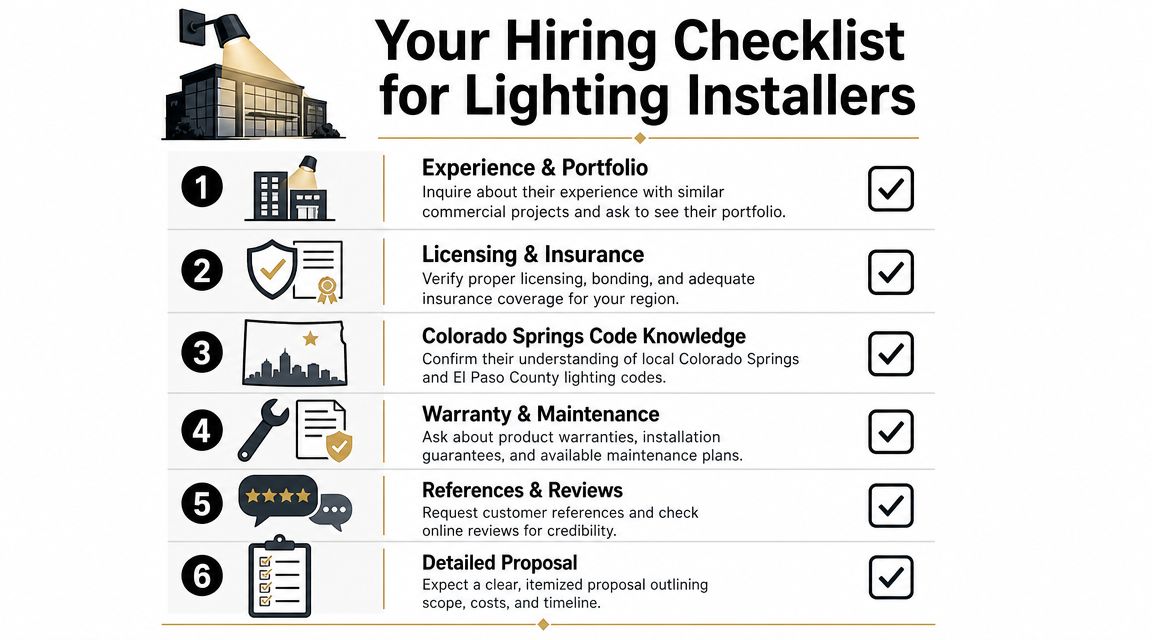
Use this checklist when you interview any company for commercial outdoor lighting installation.
- Ask about similar commercial work: A contractor who mostly installs small residential accent lighting may not be the right fit for parking areas, tenant-facing entries, or multi-zone properties.
- Verify licensing and insurance: Commercial electrical scope requires the right credentials and coverage. Don't settle for verbal reassurance.
- Request a photometric plan or equivalent layout: If the proposal skips the design step, the field crew will be solving expensive problems on your property.
- Press on local code knowledge: Colorado Springs and surrounding jurisdictions can create design constraints that out-of-area installers may overlook.
- Review warranty terms carefully: Product coverage and workmanship coverage are not the same thing.
- Expect an itemized proposal: You should be able to see what's included in fixtures, materials, controls, labor, and any access equipment.
Look for operational thinking, not just installation skill
A strong installer thinks past day one. They ask how the property is used, who needs visibility after hours, which areas should dim, and what maintenance will look like later.
For owners who want more background before that conversation, this guide to understanding commercial electrical solutions helps frame the bigger questions around contractor scope, planning, and electrical responsibility on business properties.
One more question worth asking
If your property also uses seasonal exterior lighting, ask whether the company can coordinate that work without creating conflicts in mounting, power access, or aesthetics. For some Colorado Springs businesses, commercial holiday light installation is part of the same year-round exterior presentation plan, so it helps when the installer understands both permanent and seasonal needs.
The right contractor makes the project feel predictable before work begins, not confusing until the invoice arrives.
Partner with Cultivate for a Brighter Safer Business
A commercial property should feel clear, safe, and well managed after dark. That takes more than swapping old fixtures for new ones. It takes a design that fits how people move through the site, equipment that can handle Colorado Springs conditions, and controls that support both code compliance and operating efficiency.
The strongest commercial outdoor lighting installation projects usually have the same traits. They solve actual visibility problems. They avoid glare and spill. They account for maintenance before equipment goes up. They respect the local environment instead of forcing a generic layout onto a specific property.
That's the standard Colorado Springs businesses should expect from any installer they consider. It's also why site assessment, photometric planning, fixture selection, code awareness, and safe execution all need to work together. If one piece is missing, the project may still turn on at night, but it won't perform the way it should.
Cultivate understands the value of an exterior that looks intentional and works reliably. For business owners and property managers, that means a process grounded in practical design, clean execution, and local awareness, from the first walkthrough to the final nighttime review.
If your commercial property in Colorado Springs needs safer walkways, sharper curb appeal, or a smarter after-dark lighting plan, contact Cultivate House Detailing for a no-obligation consultation and quote.
Need it done properly the first time? Cultivate House Detailing offers holiday lighting installation in Colorado Springs. Get a free quote.