The first glass windows appeared in the Roman Empire around the 1st century CE, especially in Alexandria and Roman bathhouses. The first glass doors developed from the same idea, using framed panes to separate spaces while still admitting light.
A small Roman pane would look cloudy and uneven beside modern glass, but it solved an important problem. Instead of leaving an opening exposed or covering it with cloth, horn, or mica, builders could place a solid glass sheet into a wall or frame. That change improved light control, reduced drafts, and added security. It also began the long story behind the clear windows and glazed doors homeowners now maintain with professional window cleaning in Colorado Springs, CO.
When the First Glass Window and Door Appeared
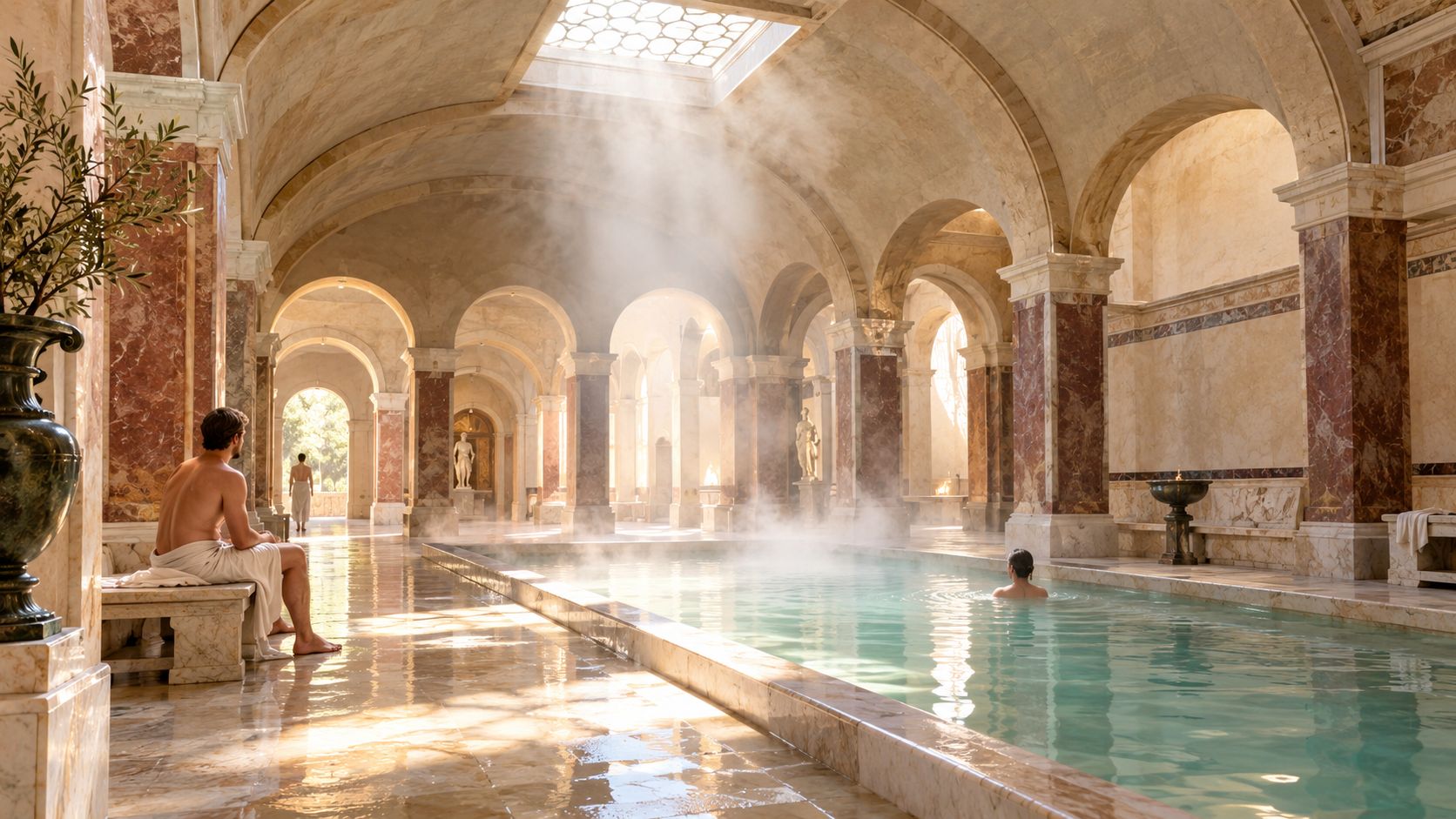
Steam drifted through a Roman bathhouse as sunlight entered through a small opening high above the pool. The light wasn't sharp or perfectly clear. It filtered through a thick, slightly cloudy pane, creating a soft glow while helping keep wind and rain outside.
Historical summaries credit the Romans as the first known users of glass windows around 100 CE in Alexandria. By the first century CE, wealthy Romans were fitting homes and bathhouses with panes of cast glass, and archaeological evidence from Pompeii and other Roman sites shows that these early sheets were installed in actual openings rather than used only as ornaments. The history of glass windows helps place this development in the larger story of architectural glazing.
Before glass panes, builders used materials such as oiled linen, animal horn, and mica to soften an opening. These materials could admit some light, but they didn't create a true glazed surface. Cast glass marked the shift from a light filter to a fixed pane that offered both illumination and a physical barrier.
Windows and early glass doors
The surviving evidence is strongest for windows, including Roman bathhouses and buildings in Roman Egypt, Pompeii, and Herculaneum. The House of the Stags at Herculaneum and the Villa of the Mysteries at Pompeii are often discussed in connection with early Roman glazing, although the exact arrangement and preservation of individual panes vary by site.
The same practical idea naturally extended to doors. Wealthy villas could use framed glass panels in interior doors, allowing light to travel between rooms while preserving a visual and physical division. These weren't modern exterior sliding doors. They were small, valuable panels set into sturdy wood or metal frames.
Historical takeaway: The first glass window wasn't designed for a perfect view. It was designed to make an opening more useful.
How Roman Artisans Made the Earliest Glass Panes
Roman glassmakers had to turn a hot, workable mass into a sheet thin enough for a building opening. Two techniques mattered most, and each had limits that explain the appearance of early windows.
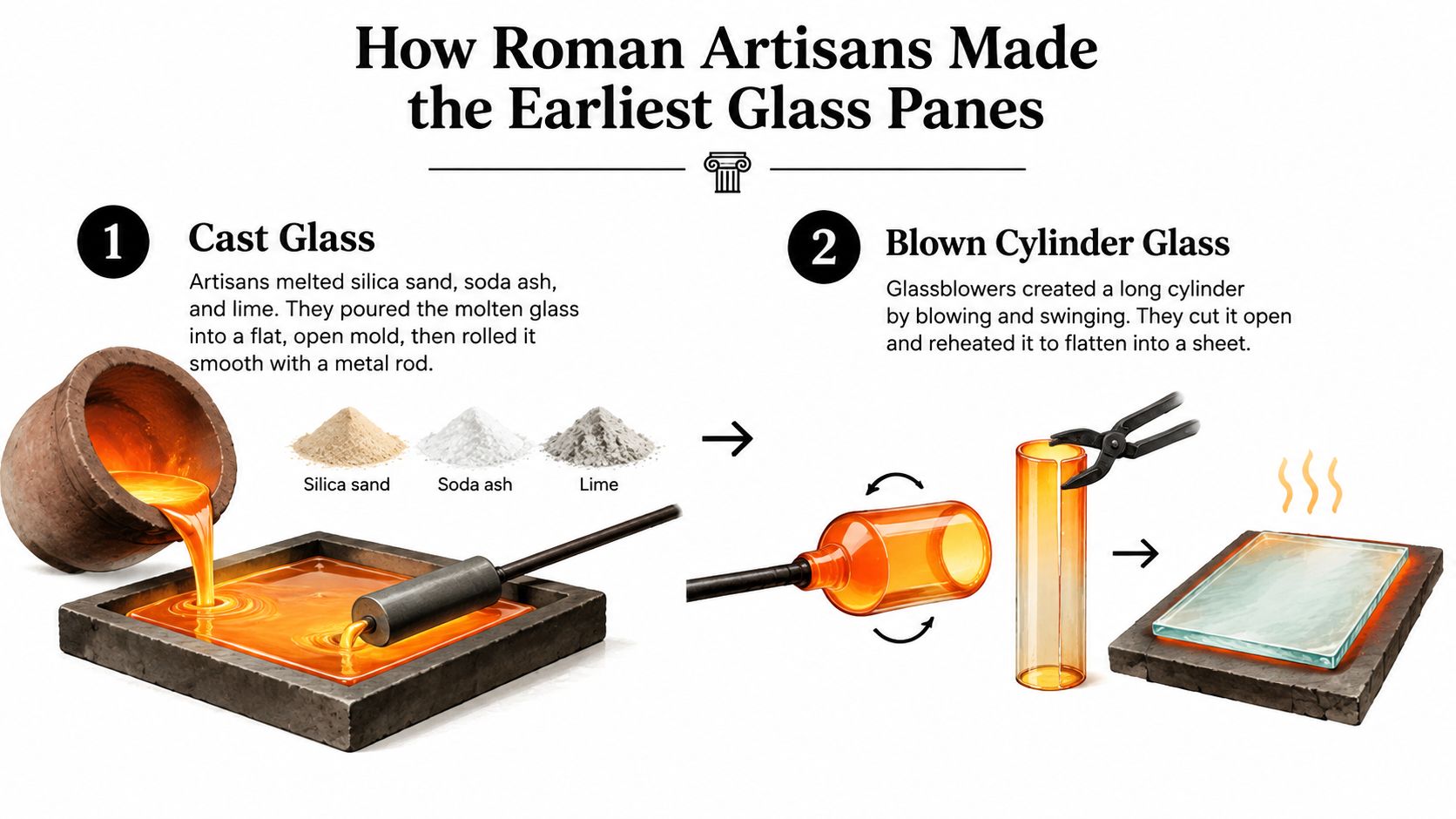
Cast glass used a flat surface
With cast glass, an artisan first heated a mixture containing silica sand, soda ash, and lime in a clay crucible. Once the material became molten, the glassmaker poured it onto a flat surface and spread it into a rough sheet.
The process was similar to rolling dough, but the material was far hotter, heavier, and more fragile. A roller or rod helped distribute the glass, but the sheet cooled unevenly. Artisans could then smooth portions of the surface with abrasive materials such as pumice, though polishing couldn't remove every ripple or variation in thickness.
That uneven cooling created panes that admitted light without offering a crisp view. The sheet could still perform its essential job, especially in a bathhouse or villa where weather protection mattered more than optical perfection.
Blown cylinders improved the shape
A second approach began with a gather of molten glass on a blowpipe. The artisan blew into it to form a long bubble, then used movement and gravity to elongate the shape. The warm cylinder could be opened, reheated, and flattened into a sheet.
A later mouth-blown cylinder technique developed in Germany in the 11th century, but the basic idea of making a hollow form and flattening it belongs to the broader history of early glassmaking. Both cast and blown methods produced relatively small panes, which meant builders had to join many sections inside a supporting frame.
See the process visually before continuing with this short demonstration:
The frame wasn't merely decorative. It compensated for the limitations of the material by holding multiple small panes together, much like a tiled surface supports pieces that would be difficult to use as one large sheet.
What Early Glass Windows Actually Looked Like
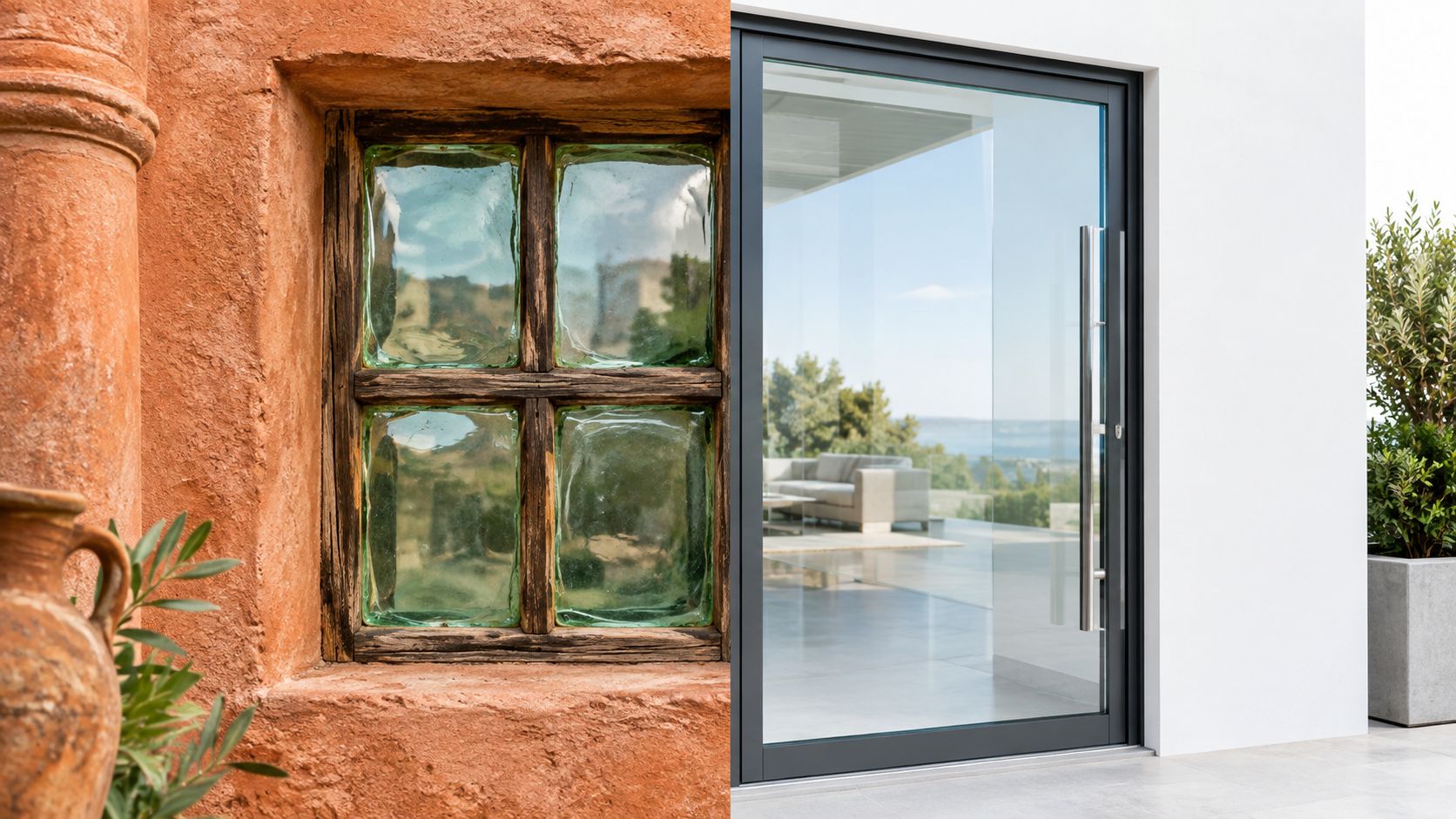
Early Roman window glass didn't look like the clear pane in a contemporary home. Manufacturing produced uneven thickness, waviness, bubbles, and limited optical clarity, so a person looking through it might see softened shapes rather than a sharp view.
Many early panes also had a faint greenish cast. Trace iron in the raw materials could influence the color, especially toward thicker edges. That tint wasn't a design choice. It was a visible reminder that ancient glassmakers were working with natural ingredients and less controlled furnaces.
Translucent rather than fully transparent
Roman glass was often better described as translucent than transparent. It brought daylight into a room while blurring details, a quality that worked well in baths and private residences. Modern frosted bathroom glass provides a useful comparison, although early Roman panes weren't manufactured with today's uniform frosting process.
The irregular surface also affected how light entered. Instead of a perfectly even beam, sunlight could scatter across the interior, making the room brighter without creating a direct line of sight.
Why frames had many divisions
Small sheets needed support. Builders placed them in wooden or bronze frames, with narrow structural members separating one pane from the next. The result was a muntin-heavy pattern that later became familiar in historic architecture across Europe and North America.
| Property | Early Roman Glass | Modern Float Glass |
|---|---|---|
| Surface | Uneven and visibly wavy | Consistently flat |
| Clarity | Often translucent with poor optical quality | Designed for clear views |
| Thickness | Irregular from casting or flattening | Uniformly controlled |
| Color | May show a greenish tint | Available in clear and specialized low-iron options |
| Typical use | Light, weather protection, insulation, and security | Views, daylight, insulation, safety, and design |
These differences explain why old glass can be charming but demanding. Historic panes may preserve character that new glass can't reproduce, while modern glass gives homeowners the consistent clarity expected from interior window cleaning and exterior window washing.
Breakthroughs That Made Glass Windows Practical
The next advances came as practical responses to earlier limitations. Roman cast glass could close an opening, but its size and clarity were restricted. Glassmakers in later centuries focused on making sheets larger, flatter, and easier to install.
In Germany during the 11th century, glassmakers refined the mouth-blown cylinder technique. They blew a long bubble, extended it into a tube, cut it open while warm, and flattened it into a pane. This approach made larger sheets possible than simple casting, which helped churches and other substantial buildings fill broader openings.
The process still left marks. Flattening a blown cylinder could create ripples and variations, but the method addressed the immediate problem of scale. A larger pane meant fewer joints, fewer frame members, and more uninterrupted light.
Plate glass pursued flatness
In 17th-century France, Louis Lucas de Nehou and Abraham Thevart developed an early successful plate-glass process. Molten glass was cast onto a metal table, then ground and polished into a large, flat sheet. The work was laborious, but grinding removed surface irregularities that blowing and rolling left behind.
This was a different kind of breakthrough. Cylinder glass focused on making a usable sheet larger, while plate glass focused on making it flatter and more visually consistent.
Several methods solved different problems
The broader history also includes crown glass, which produced thin disks from a blown bulb. Each method had a particular advantage, whether size, flatness, brightness, or production cost.
The material became increasingly practical for homes, public buildings, workshops, and greenhouses as craftsmen improved these separate qualities. Modern windows didn't appear because one invention solved everything. They developed through a chain of fixes, each addressing a weakness in the previous method.
Why It Took Thousands of Years to Get Clear Glass
Glass itself is far older than glass windows. Man-made glass is documented as early as about 3500 BCE in Eastern Mesopotamia and Egypt, while some historical summaries place early origins around 2500 BCE in Mesopotamia. Those early materials could serve beads, vessels, and decorative objects, but a window demanded a very different kind of control.
The gap between early glassmaking and architectural glazing came from several connected obstacles:
- Raw materials: Impurities in sand could add color, bubbles, and inconsistency.
- Furnace control: Large quantities of glass had to remain hot and workable without collapsing or cracking.
- Shaping: Artisans needed ways to spread, blow, cut, and flatten molten glass.
- Cooling: Glass had to cool gradually enough to avoid breaking.
- Cost: Early panes required skilled labor and expensive fuel, so wealthy patrons and public buildings could justify them before ordinary households could.
The blowpipe was invented around 100 BCE on the Syrian coast, improving the ability to form thinner, more usable glass. That tool didn't instantly create modern windows, but it gave glassmakers a better way to control a hot bubble and shape it into forms that could later become sheets. The brief history of window glass and glazing traces these milestones as connected steps rather than a single invention.
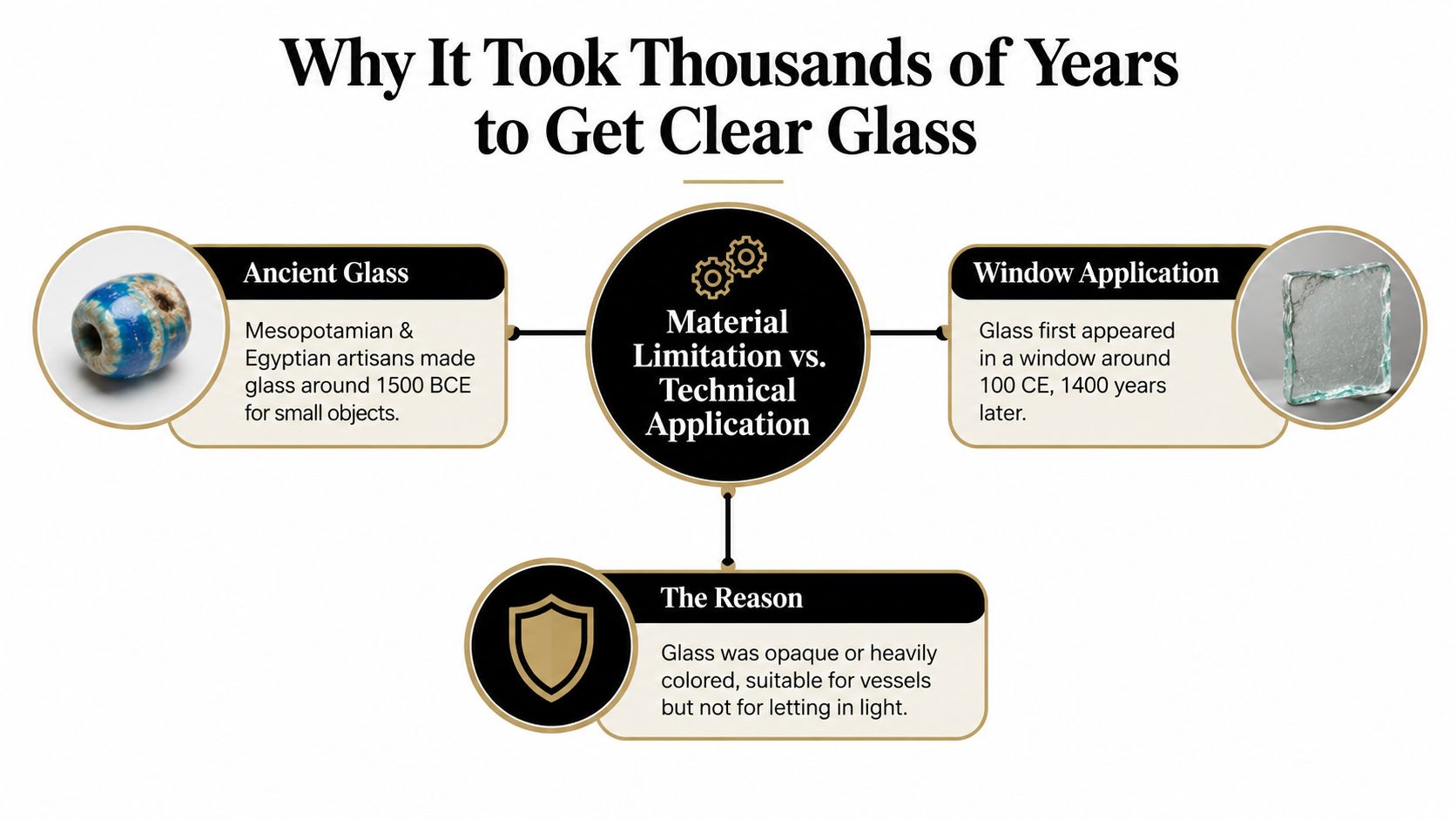
Glass was available long before glass windows were practical. The difficult part was making a flat sheet that could survive handling and perform reliably in a building.
The timeline stretched across roughly 4,000 years, from early man-made glass to Roman glazing and later European production. Britain illustrates the delay clearly. Evidence of a glass industry there dates to 680 CE, while window glass was first manufactured there in the early 17th century.
From Ancient Panes to Modern Windows and Doors
A modern window quote reflects problems ancient craftsmen first encountered. Consistent thickness addresses the visual distortion caused by early casting and flattening. Streak-free clarity depends on removing surface contamination, while accurate frames, tracks, and screens keep the complete window system working as intended. The practical connection is clear in this guide to cleaner windows and proper frames, tracks, and screens.
Modern float glass uses a different manufacturing principle. Molten glass travels across a bath of molten tin, which produces a broad, uniform surface. The result is far more consistent than the small, wavy panes available to Roman builders.
Historical solutions and present-day expectations
| Historical Breakthrough | Modern Equivalent |
|---|---|
| Cast glass created a solid pane for an opening | Glazing that provides light, separation, and weather protection |
| Blown cylinders made larger sheets possible | Broad window and door panels |
| Grinding and polishing improved flatness | Uniform glass designed for clear views |
| Better framing supported small panes | Engineered frames, tracks, seals, and screens |
| Improved glass production expanded architectural use | Double-pane, triple-pane, coated, and tempered products |
The same progression applies to doors. A framed glass door has to balance visibility, daylight, structure, and safe operation. For readers comparing installation approaches, this commercial glass door installation guide offers useful context about the practical considerations surrounding modern glazed doors.
For Colorado Springs homeowners and businesses, historical quality still has a maintenance lesson. Dust, pollen, hard-water deposits, screen debris, and dirty tracks can hide the clarity that modern glass was designed to provide. Interior window cleaning, exterior window cleaning, screen cleaning, and track cleaning address different parts of the same system.
A professional window cleaning service can also help with hard-to-reach glass in homes, storefronts, offices, restaurants, and other properties. Cultivate House Detailing provides residential and commercial window cleaning in Colorado Springs, CO, including interior and exterior cleaning for windows up to the fourth story, with service areas that include Black Forest, Monument, Manitou Springs, and Woodland Park.
Cultivate House Detailing helps Colorado Springs homeowners and businesses maintain clear glass with interior window cleaning, exterior window washing, screen cleaning, and related exterior maintenance services. Visit Cultivate House Detailing to request a quote and schedule professional window cleaning for your property.