You move the car and find a dark patch right where you hoped there wouldn't be one. Maybe it's a fresh drip from a visitor's vehicle, or maybe you've just noticed an old stain that rain and snow haven't shifted. Either way, grabbing the hose feels like the obvious next move.
For a Colorado Springs homeowner figuring out how to get rid of oil stains on driveway concrete, the better starting point is dry containment. Removing oil takes a different approach from ordinary exterior cleaning or window washing: capture what's loose, draw out what's embedded, and plan where every bit of waste will go.
Why Oil Stains Stick to Colorado Driveways
A drip beneath a parked car can look harmless until you move the vehicle and see how far the dark patch extends. After a sunny afternoon, a windy evening, or an overnight freeze, you might not know whether you're looking at fresh oil or an old stain.
That distinction matters more than the size of the brush you buy. Concrete is a porous mineral surface, not a sealed countertop. Oil can enter those pores, leaving discoloration that remains after the surface liquid is gone. Driveway-cleaning guidance from Allstate distinguishes fresh-spill absorption from treatment for embedded staining and cautions that restoring the original color isn't guaranteed.
Read the stain before choosing a cleaner
Look at the driveway without rubbing the mark or pouring water over it. You're trying to identify which situation you have:
- Wet and glossy: Free oil is still present. Start with absorbent material, not detergent.
- Dark but dry: The surface liquid is gone, but residue remains. An extraction treatment may be appropriate.
- An old shadow: The mark has survived weather or previous cleaning. Assess the surface before escalating the treatment.
For example, a glossy patch beneath a leaking oil pan needs a different response from a dry outline left by a vehicle that hasn't parked there for months. Treating both with the same quick scrub skips the most useful decision.
Weather doesn't tell you whether the oil is gone
After rain or melting snow, the spot may look different. Don't assume that a lighter appearance means the petroleum has been captured and disposed of safely.
In Colorado Springs, also pay attention to the slab itself. Weathered areas, worn patches, and previously sealed concrete deserve a cautious approach. If the driveway is wet or frozen, postpone chemical cleaning rather than trying to judge results through moisture or ice.
Practical rule: If the concrete still looks oily and wet, stay with absorption. If only a dry shadow remains, consider extraction rather than scrubbing harder.
The goal is no free oil, substantially lighter discoloration, and no contaminated runoff entering the gutter. An invisible repair isn't something anyone should promise before assessing the stain.
That gives you a sensible sequence: dry containment, an appropriate extraction treatment, surface-specific cleaning, and controlled waste handling. Professional pressure washing belongs at the handoff point when deeper staining or wastewater collection makes DIY cleanup impractical.
Absorb Fresh Oil Before It Soaks In
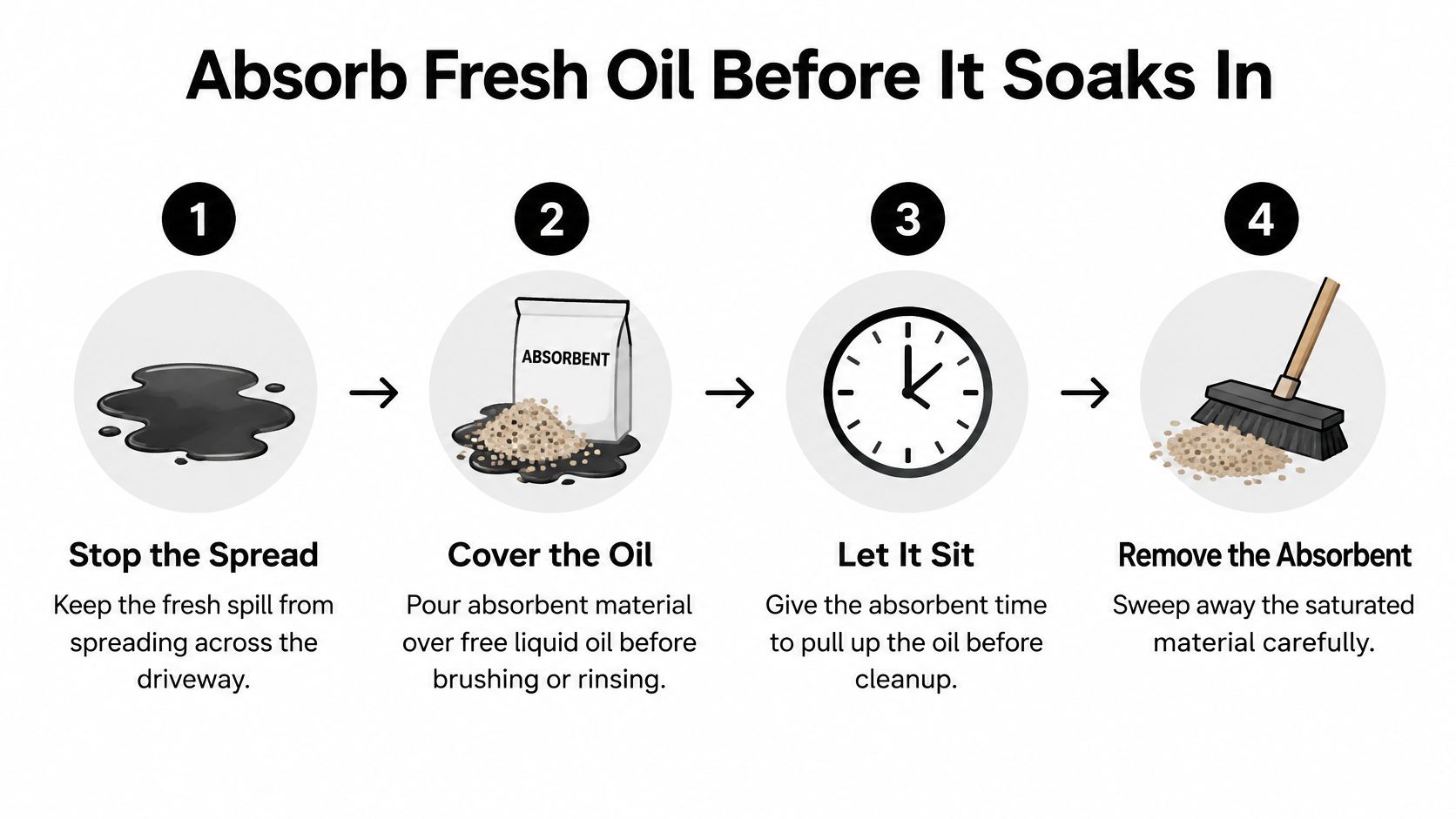
Keep the brush and hose out of the job while liquid oil remains. Your first task is to capture it without spreading it across clean concrete.
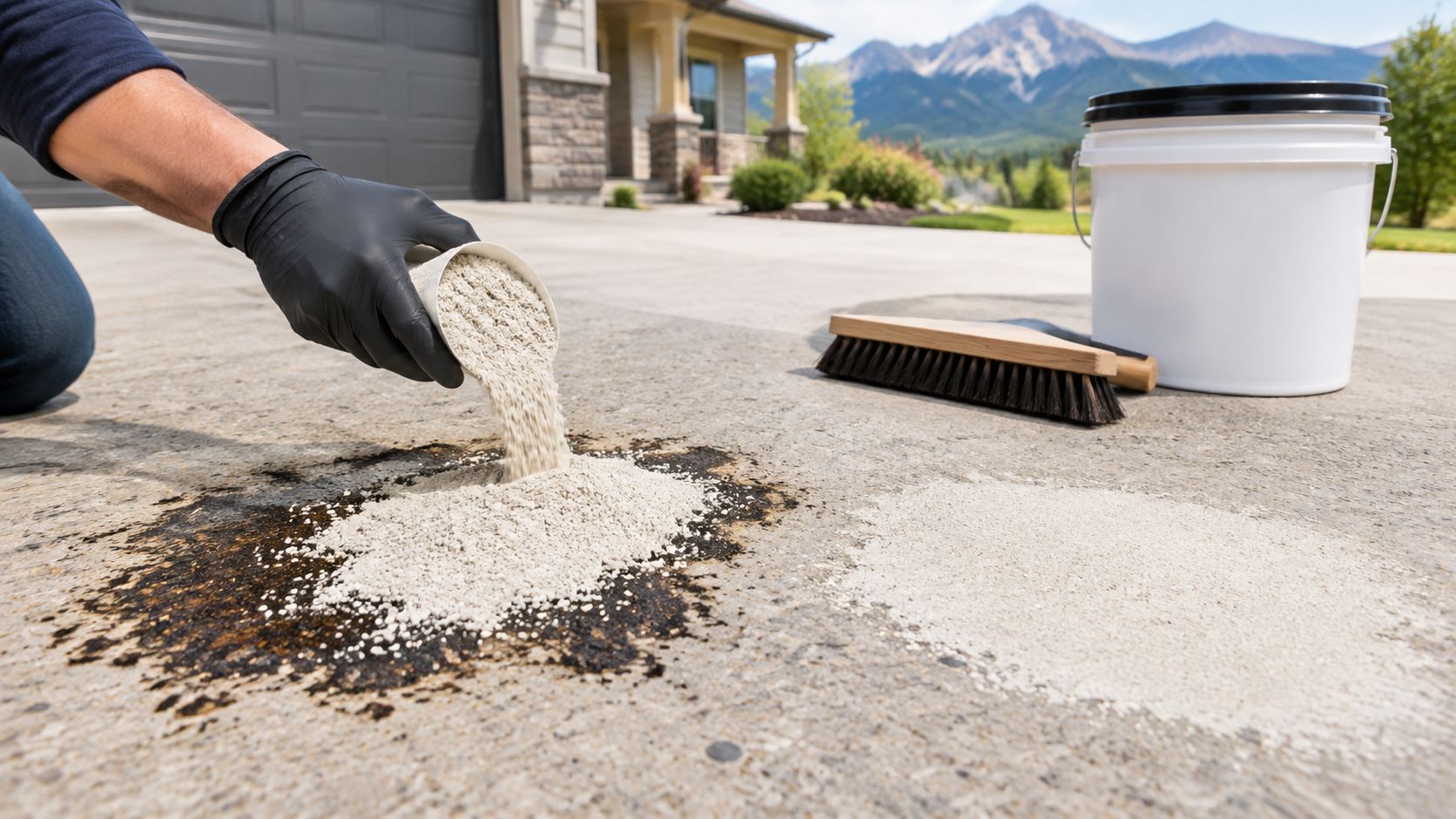
Cover the entire wet area generously with an oil-compatible absorbent. Clay-based commercial oil absorbent, suitable clay litter, or another dry material intended for oil cleanup can help contain a small driveway spill. Pour it gently rather than grinding it into the surface.
Keep the sequence simple:
Choose capacity, not just convenience
Absorbents don't all hold the same amount of oil. Natural materials such as clay, sand, peat moss, sawdust, and corncobs typically absorb 4 to 20 times their own weight, while synthetic materials such as polypropylene, polyethylene, or polyurethane can absorb as much as 70 times their weight; some synthetic products can also be cleaned and reused, according to EPA guidance on oil-spill absorbents.
That doesn't mean you need a specialized synthetic pad for every drip. It means you should use enough suitable material to capture the liquid, rather than sprinkling a thin dusting over a shiny puddle.
- Cover beyond the wet patch: Make sure the absorbent reaches the full spill, including small trails beneath the vehicle.
- Leave it undisturbed: Give the material time to take up oil according to its instructions.
- Sweep and inspect: Collect the saturated material in a suitable container. Add fresh absorbent if the concrete still looks wet.
Wiping can spread oil, and immediately hosing the spill can move it toward soil or drainage. Neither action substitutes for collecting it.
Let the absorbent finish its job
For ordinary granular treatment, allow several hours or overnight before sweeping. If you choose the dry-cement method, University of Georgia Extension's oil-stain guidance specifies at least 24 hours, with repeat applications until the powder no longer draws out oil.
Don't start wet cleaning on a frozen or water-covered driveway. Contain an active spill where it's safe to do so, but wait for suitable surface conditions before applying cleaners.
A substantial pool is a different job from a few vehicle drips. Arrange controlled liquid removal rather than burying a large volume under household supplies or attempting to rinse it away.
Once free oil is captured, you can evaluate cleaners. Evo Dyne Products offers a resource to compare degreaser types for tough jobs, but the cleaner's own label must establish whether it suits your driveway.
Used absorbent is contaminated waste. Hold it for proper disposal instead of washing the remaining granules down the driveway apron.
Pull Older Stains Out with a Poultice
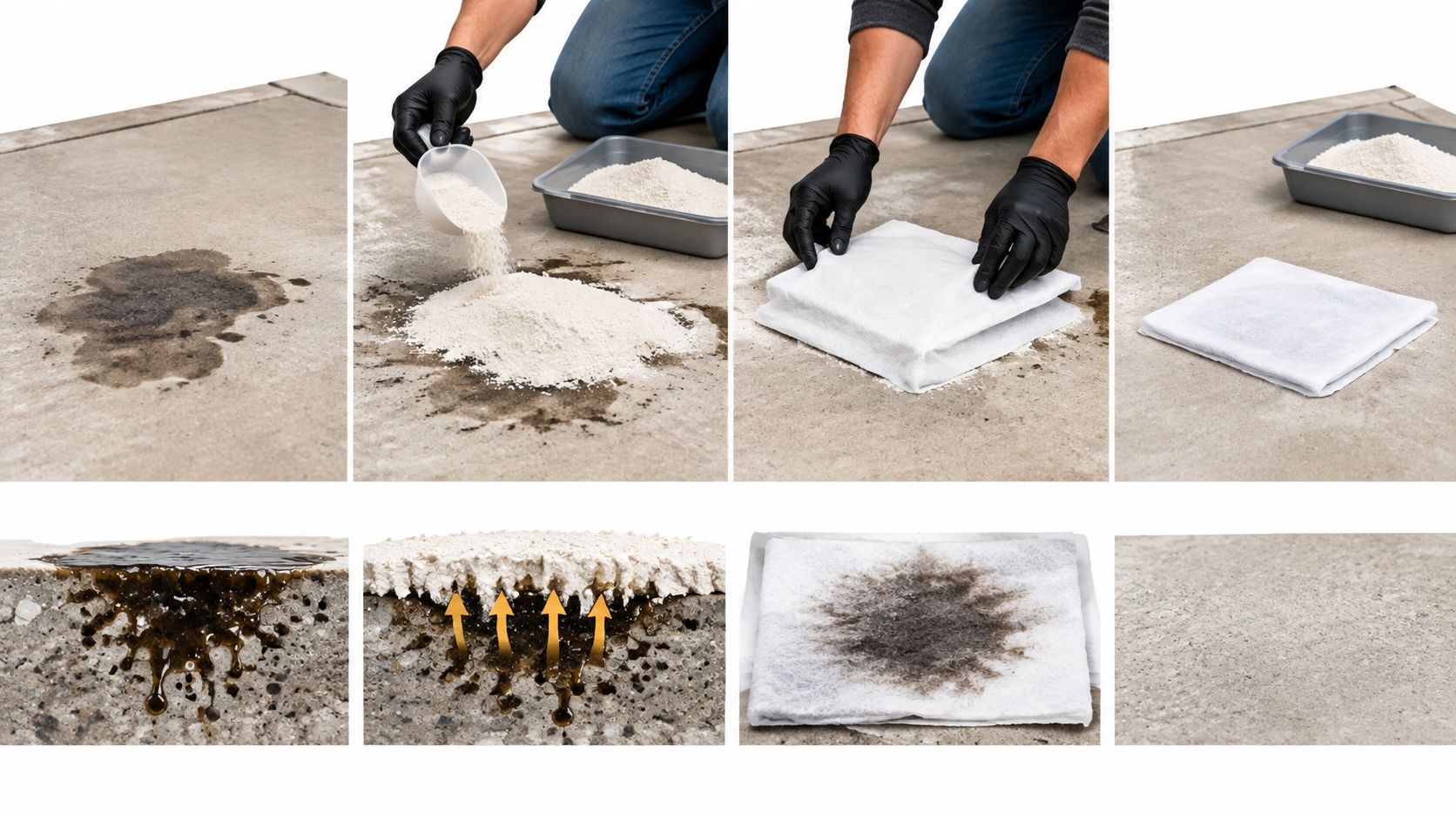
An old, dry stain calls for patience, not more elbow grease. A poultice combines an absorbent with an appropriate treatment to draw embedded residue toward the surface, where you can collect it.
This illustration shows the basic absorbent-treatment sequence:
Build an extraction treatment, not a chemical experiment
Where the surface and product directions permit solvent treatment, University of Georgia Extension's guidance drawn from the Portland Cement Association describes using mineral spirits or paint thinner, followed by dry cement, talcum powder, cornstarch, or kitty litter, then sweeping the material up the following day and repeating if necessary.
Keep the absorbent layer beyond the visible mark rather than matching its outline exactly. That margin helps you treat the affected area without working only on its darkest center.
Solvent treatment isn't a casual recommendation for every homeowner. Read the label, confirm surface compatibility, wear the specified gloves and eye protection, and maintain ventilation. If you can't control ignition sources, exposure, or waste, skip this method and request an assessment.
A poultice is a slow extraction treatment. It isn't a promise that tomorrow's concrete will match the untouched driveway.
For another visual reference, the following video accompanies the cleaning process. Product labels and surface compatibility still govern your own treatment.
Use an alkaline stage only when appropriate
The same Extension guidance describes a paste of 1 part trisodium phosphate, or TSP, to 6 parts water, allowed to dry for a full day before scrubbing and rinsing with clear water. Treat that as a surface-specific method, not permission to apply TSP to every driveway material.
After extraction, a stiff brush and an approved detergent or concrete-rated degreaser can address remaining surface residue. Follow the cleaner's dwell time and work from the outside edge inward.
Keep these boundaries clear:
- Spot-test first: Confirm that the treatment doesn't change the finish in an inconspicuous area.
- Never mix chemicals: Don't combine solvents, degreasers, or alkaline cleaners to make a stronger homemade formula.
- Prepare for tomorrow's collection: Have containers and runoff controls ready before starting, not after the treatment dries.
Mineral spirits, acetone, xylene, lacquer thinner, MEK, caustic soda, and strong alkaline products require serious caution. They aren't interchangeable household stain removers, and their fire, inhalation, skin, vegetation, and runoff hazards deserve more attention than a quick online recipe provides.
If the surface tolerates treatment and the stain is improving, another controlled cycle may make more sense than immediately increasing pressure. Judge progress by captured residue and a lighter mark, not by a same-hour color match.
Match the Method to Your Driveway Surface
The stain isn't the only thing you're treating. You're also treating plain concrete, a coating, decorative color, asphalt, or individual pavers, and those surfaces shouldn't automatically receive the same chemistry.
Before applying another product, identify the material and any sealer. If you don't know what a previous owner used, that uncertainty is a reason to test or seek advice, not to assume the strongest cleaner will be safe.
Which Driveway Oil Treatment Fits the Stain
| Situation | Better first move | Stop if |
|---|---|---|
| Fresh liquid on plain concrete | Dry absorption | The spill exceeds what you can safely contain |
| Dry surface residue | Labeled detergent or concrete-safe degreaser | A hidden test changes the appearance |
| Embedded stain on sound, uncoated concrete | Compatible poultice | Extraction no longer improves the mark |
| Sealed, colored, or decorative concrete | Finish-compatible spot test | The coating clouds or color changes |
| Asphalt or pavers | Material-specific cleaner and guidance | The surface softens, changes unexpectedly, or sheds material |
| Old staining with difficult drainage | Professional assessment | Wastewater can't be controlled |
The dry-cement and alkaline approaches described earlier concern concrete. Don't transfer those recipes automatically to asphalt, pavers, or a coated surface. Choose products explicitly labeled for the material you have.
More detergent doesn't necessarily mean more extraction
A study of oil-contaminated concrete reported approximately 5 to 7% effectiveness for powdered detergents and 5 to 10% for gel detergents, compared with 95 to 97% purification using thionic bacteria and oxalic acid under its experimental conditions.
Those results aren't a household product comparison or a recommendation to make a biological treatment at home. They illustrate a narrower point: you shouldn't assume that adding more soap will extract embedded oil.
A surface wash and an extraction treatment do different jobs. If detergent has removed loose residue but left a dry shadow, repeated aggressive brushing may be the wrong next move.
A useful stopping point: When further treatment threatens the finish more than it improves the stain, reassess the job.
For weathered Colorado concrete, particularly a slab already showing freeze-thaw wear, ask whether another treatment is worth the surface risk. High pressure isn't an automatic upgrade.
Technical guidance on removing embedded oil from concrete describes extending a poultice roughly 6 inches beyond the visible stain, allowing approximately 24 hours before removal, and treating pressure washing as a final removal step rather than the opener.
A driveway and walkway pressure-washing assessment is an alternative to another DIY cycle when the oil is embedded or the finish needs careful handling. Ask for a decision based on stain age, apparent depth, surface condition, and drainage, rather than a blanket promise of complete removal.
Keep Oil and Rinse Water Out of Drains
“Rinse thoroughly” isn't a complete cleanup plan. If dirty water leaves your driveway and enters the street, you may have moved the contamination rather than collected it.
On a sloped Colorado Springs driveway, plan containment before any wet treatment. Check the low edge, the gutter, nearby soil, and any storm inlet. If you can't keep wastewater on the work area for collection, don't begin rinsing.
Catch the waste before it travels
Use absorbent socks or suitable barriers at the low edge to interrupt flow. Old towels may help with a small amount of moisture, but don't mistake them for a complete containment system.
Minimize rinse volume while still following the cleaner's directions. Collect solids first, then use additional absorbent for remaining oily slicks rather than flooding them toward the curb. Erie Insurance's driveway-cleaning guidance specifically recommends collecting dislodged oil instead of washing it into the street.
Use this checklist before opening the hose:
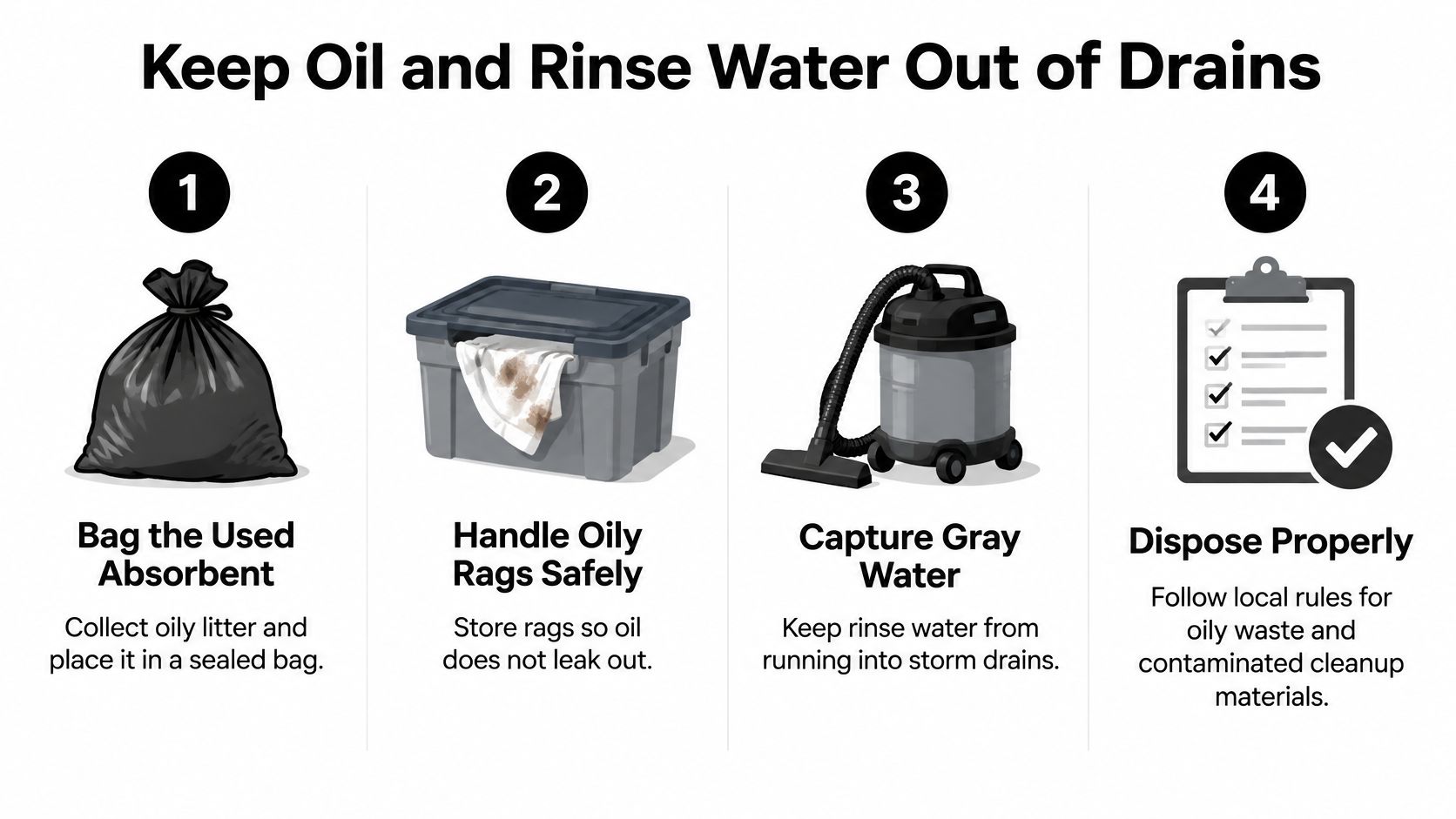
Keep different waste streams separate
The practical task is to hold the waste safely until you know how it must be handled locally.
- Used granules and powders: Sweep them into compatible sacks or containers without scattering dust or leaving a trail.
- Oily rags and pads: Store them separately using precautions appropriate to the substance and product labels.
- Liquid runoff: Collect it separately from dry solids. Don't assume diluted degreaser makes oily water suitable for a drain.
- Gasoline-contaminated materials: Don't mix them with ordinary household trash or treat them as routine motor-oil cleanup.
Spill-containment guidance hosted by Ireland's EPA calls for diverting contamination away from drains, placing used absorbents in sacks or containers, and holding larger quantities in an impervious contained area such as a plastic-lined bund. It also identifies waste-contractor removal using a tanker or intermediate bulk container as an option for substantial liquid on concrete.
For a homeowner, the lesson is simple: a large pool may require specialist collection, not a bigger garden hose.
Before transporting waste, verify current El Paso County or City of Colorado Springs household hazardous-waste acceptance rules. Describe the actual contents, including oil, cleaner, solvent, or gasoline contamination, rather than calling everything driveway waste.
Property managers and HOAs should make wastewater handling part of the scope of work. Ask who supplies containment, who removes collected liquid, and who handles disposal. A visibly cleaner apron isn't a finished cleanup if petroleum has entered the storm drain.
When Driveway Pressure Washing Is the Safer Call
A pressure washer is a removal tool, not a substitute for containment or chemical judgment. Once extraction and surface assessment are complete, professional washing may be the sensible finishing step.
The concern isn't just damaging concrete. OSHA's oil-spill response guidance warns that high-pressure washing can aerosolize oil into respirable droplets and that concentrated detergents, degreasers, solvents, and heated water can volatilize hydrocarbons. It also advises avoiding unprotected skin and eye contact.
When washing produces oil mist, that guidance identifies respiratory protection at least equivalent to a disposable P100 filtering facepiece respirator as a recommended control. That's an occupational exposure precaution, not a suggestion that buying a mask makes an uncontrolled driveway job safe.
Recognize when the job has changed
Consider handing the driveway to a trained crew when the difficulty is no longer ordinary surface dirt:
- The stain remains embedded: A properly completed extraction treatment hasn't produced useful improvement.
- Drainage is difficult: The driveway slopes toward a storm inlet, or you can't collect the wastewater.
- Chemicals create exposure concerns: Treatment would put solvents near plants, ignition sources, or an open garage.
- The finish is vulnerable: Sealer, decorative color, or existing surface wear makes further experimentation risky.
- The contaminated area is extensive: You don't have the equipment or containers to manage the resulting waste.
These are reasons to seek an assessment, not proof that every stain requires professional washing. A small, fresh, contained drip may remain a manageable DIY job.
Know what a useful estimate should explain
Cultivate House Detailing offers driveway pressure washing alongside patio, walkway, siding, and professional window cleaning services in Colorado Springs and nearby communities, including Black Forest, Monument, Manitou Springs, and Woodland Park. For an oil-stain job, ask the crew to separate its proposed treatment from any general exterior-cleaning package.
The estimate should address stain pretreatment, the lowest effective pressure, protection for adjacent surfaces and plants, and wastewater handling. It should also explain whether repeated treatment may be necessary and whether a residual shadow is likely.
Don't assume every exterior surface should receive the same washing method. The distinction between soft washing and pressure washing matters when concrete sits beside siding, trim, and other finishes.
If you're also arranging residential window cleaning or commercial window cleaning, identify that work separately. Exterior window washing, interior glass, screens, and tracks need their own scope, rather than being treated like extensions of an oily driveway cleanup.
Clear communication should continue from the estimate through follow-up. Before anyone turns on the water, you should understand what the crew expects to remove, what may remain, and how it will keep contaminated water out of the street.
For driveway pressure washing and professional window cleaning in Colorado Springs and surrounding communities, visit Cultivate House Detailing to request a quote. Describe whether your oil stain is fresh or embedded, mention any sealer or surface wear, and ask how the crew will contain and collect runoff before scheduling the cleanup.